
Market Report · July 29, 2026

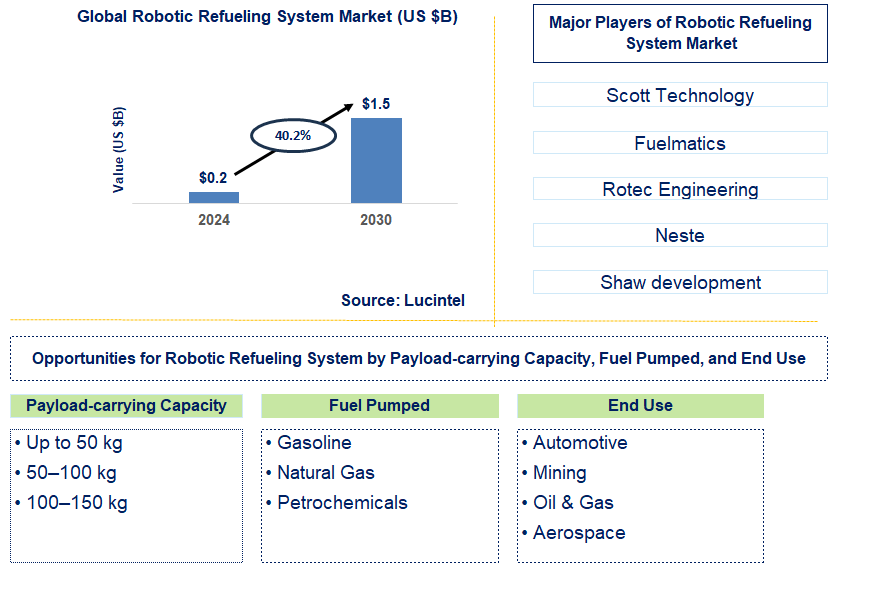
Key data points: The market size in 2030 = $1.5 billion, growth forecast = 40.2% annually for the next 6 years. Scroll below to get more insights. This market report covers trends, opportunities, and forecasts in the global robotic refueling system market to 2030 by payload-carrying capacity (up to 50 kg, 50–100 kg, and 100–150 kg), fuel pumped (gasoline, natural gas, and petrochemicals), end use (automotive, mining, oil & gas, and aerospace), and region (North America, Europe, Asia Pacific, and the Rest of the World)
We'll send your sample report shortly.
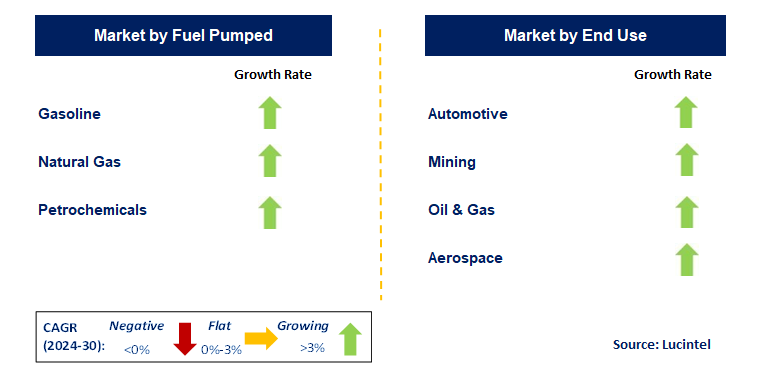
• Lucintel forecasts that, within the payload-carrying capacity category, 100–150 kg is expected to witness the highest growth over the forecast period due to growing demand for automation and electric/hybrid vehicles across the globe.
• Within the fuel pumped category, gasoline will remain the largest segment due to growing adoption of autonomous haulage trucks.
• In terms of region, APAC is expected to witness the highest growth over the forecast period due to high adoption of automation in the automotive industry of the region. A more than 150-page report is developed to help in your business decisions.
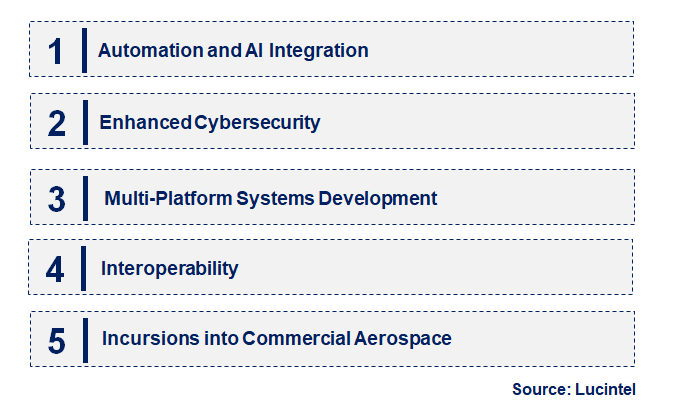
• Automation and AI Integration: Advanced AI algorithms and automation technologies will continue to enhance precision and efficiency. These technologies enable robots to perform complex refueling tasks with minimal human intervention, resulting in reduced errors and lower operational costs.
• Enhanced Cybersecurity: As automation becomes more widespread, cybersecurity has become a critical concern to protect refueling systems from intrusion. Strong encryption and robust security protocols must be in place to safeguard sensitive military operations.
• Multi-Platform Systems Development: There is a growing trend for refueling systems that can support multiple types of aircraft. This development will help reduce complexity and the need for specialized equipment for different platforms.
• Interoperability: The development of RFS technology is focused on ensuring compatibility with legacy military infrastructure. Interoperability ensures that new systems can work effectively alongside older equipment and across various branches of the military.
• Incursions into Commercial Aerospace: Technologies developed for military RFS are finding applications in commercial aviation. The demand for autonomous and efficient refueling solutions is expected to drive growth in both the military and commercial sectors. These trends are setting the pace for the RFS market, improving efficiency, security, and versatility, and driving the development of more advanced and integrated refueling solutions.
• Autonomous aerial refueling systems: New innovations have led to the creation of fully autonomous aerial refueling systems. These systems are designed for inflight refueling of aircraft with minimal human oversight, enhancing mission efficiency by reducing risk.
• Improved precision technologies: New precision technologies in RFS ensure refueling with a high degree of accuracy and reliability. These technologies minimize the chances of errors and maximize overall performance during refueling missions.
• Integration with UAVs: The adoption of robotic refueling systems is increasing within unmanned aerial vehicles. The latest developments in this area include the refueling of UAVs in mid-air, increasing their range of operation and time on mission.
• Advanced sensor systems: Advanced sensors deployed in RFS are improving situational awareness and ensuring operational safety. These sensors help detect potential issues that could arise and ensure precise refueling under most conditions.
• Collaborative development projects: The rise in collaboration between defense contractors and research institutions is accelerating innovation related to RFS. Joint ventures now focus on developing cutting-edge technologies and solutions to meet the needs of the modern military. These developments are pushing the frontiers of robotic refueling toward higher levels of efficiency, reliability, and adaptability.
• Military Aircraft Refueling: The RFS technology has numerous applications in the military. There is significant potential in developing refueling systems that are efficient and adaptable for a wide range of military aircraft.
• Commercial Aerospace: New opportunities exist for adapting RFS technologies to commercial aviation applications. Improvements in efficiency and cost reductions for commercial aircraft refueling present exciting growth prospects.
• UAS: As the use of UAS (Unmanned Aircraft Systems) increases, the demand for refueling solutions tailored to these systems also rises. Investments in UAS-capable RFS will yield significant returns in this emerging part of the market.
• Space Missions: The growing space exploration industry also holds promise for robotic refueling technologies. Developing systems capable of supporting spacecraft and satellites positions companies at the forefront of innovations in the space industry.
• Automation and AI Solutions: Increasing automation and the use of AI in RFS will significantly promote growth. These technologies enhance operational efficiency and accuracy, creating opportunities for leading companies to deliver advanced solutions. These growth opportunities represent the future of the RFS market, which is advancing technologically and expanding its range of applications.
• Technological Development: Advancements in robotics and AI are driving innovative ideas for more sophisticated refueling systems. Key factors contributing to market growth include enhanced capabilities and efficiency.
• Growing Defense Expenditure: Increasing defense expenditure across the globe is encouraging investment in next-generation refueling technologies. Higher military spending is driving the advancement and proliferation of state-of-the-art RFS.
• Efficiency Requirements: The growing need for efficiency in refueling operations is another enabler. Robotic systems can refuel faster and more accurately, which has become essential for today's military and commercial aviation.
• Operational Cost Reduction: Robotic systems reduce labor costs and minimize human error. As a result, economic viability becomes a strong factor for the acceptance and growth of RFS technologies in various industries.
• Growth in Aerospace Sector: The expansion of military and commercial aerospace is driving the demand for advanced refueling solutions. This growth is fostering innovation and investment in RFS technologies. Challenges in the robotic refueling system market include:
• Cybersecurity Risks: Advanced RFS features a higher degree of automation, which increases the risk of cyber-related incidents. Robust cybersecurity mechanisms must be implemented to safeguard sensitive refueling activities.
• Regulatory Compliance: Complex and constantly evolving regulatory environments have made it difficult to operate effectively. This has created a need for compliance with international and national standards if the technology is to gain market acceptance and operational success.
• High Development Costs: The initial investment required for advanced RFS can be very high. Such high costs are a deterrent to many organizations. These drivers and challenges will influence the future trends of the RFS market, ultimately shaping its growth and development in the coming years.
• Scott Technology
• Fuelmatics
• Rotec Engineering
• Neste
• Shaw development
• Up to 50 kg
• 50–100 kg
• 100–150 kg
• Gasoline
• Natural Gas
• Petrochemicals
• Automotive
• Mining
• Oil & Gas
• Aerospace
• North America
• Europe
• Asia Pacific
• The Rest of the World
• United States: The U.S. is ahead in integrating advanced AI and machine learning into its RFS. The Air Force is testing autonomous aerial refueling systems with the objective of increasing precision and reducing crew workload. Additionally, many defense contracts currently call for the development of robust, flexible refueling systems for both manned and unmanned aircraft.
• China: Advances in robotic refueling are part of China's broader effort to modernize its military. Recent state-backed projects aim at upgrading systems for both ground and aerial refueling to achieve higher levels of automation and efficiency. This reflects broader trends in China, which has been investing in indigenous research and development to provide self-reliant technologies that support its growing ambitions in aerospace.
• Germany: Germany is also planning robotic refueling systems, leveraging its engineering expertise, particularly for the Eurofighter Typhoon and the A400M aircraft. This demonstrates Germany's ambition to ensure high performance of systems under variable conditions, which is a keen expression of its doctrine of precision and high-tech solutions within its strategic defense sector.
• India: India continues to develop its RFS capabilities through collaboration with international defense contractors, as well as innovation on the domestic front. The main focus is on cost-effective, reliable systems that can support the growing fleet of advanced fighter jets and transport aircraft as part of India's overall defense modernization strategy.
• Japan: Japan is developing robotic refueling systems within its defense structure, in line with its commitment to advanced technologies and efficiency. Partnerships with U.S. defense firms and investments in local R&D will drive development tailored to Japan's specific operational needs.


• Scott Technology
• Fuelmatics
• Rotec Engineering
• Neste
• Shaw development Q6. Which robotic refueling system market segment will be the largest in future? Answer: Lucintel forecasts that 100–150 kg is expected to witness highest growth over the forecast period due to growing demand for automation and electric/hybrid vehicles across the globe. Q7. In robotic refueling system market, which region is expected to be the largest in next 6 years? Answer: APAC is expected to witness highest growth over the forecast period due to high adoption of automation in the automotive industry of the region. Q.8 Do we receive customization in this report? Answer: Yes, Lucintel provides 10% customization without any additional cost.


Choose a license that fits your team. Instant PDF delivery.
Prices exclude taxes. Instant delivery. Custom licensing available on request.
Market Report · July 29, 2026
Market Report · July 20, 2026
Market Report · July 20, 2026
Trusted partner for strategic intelligence and business growth


Receive a complimentary market analysis tailored to your industry. Our analysts will identify key growth opportunities and competitive dynamics specific to your business.

Market size, growth rate, and key trend analysis for your specific sector.

Top competitor positioning and market share analysis.

Strategic recommendations backed by data-driven insights.
Get curated market intelligence and competitive moves straight to your inbox.
By subscribing, you agree to receive our monthly insights. Unsubscribe anytime.
Receive a complimentary market analysis tailored to your industry. Our analysts will identify key growth opportunities and competitive dynamics specific to your business.
Market size, growth rate, and key trend analysis for your specific sector.
Top competitor positioning and market share analysis.
Strategic recommendations backed by data-driven insights.
Get curated market intelligence, emerging trends, and competitive moves straight to your inbox each month.
By subscribing, you agree to receive our monthly insights. Unsubscribe anytime.
We'll send your sample report shortly.