
Market Report · July 31, 2026

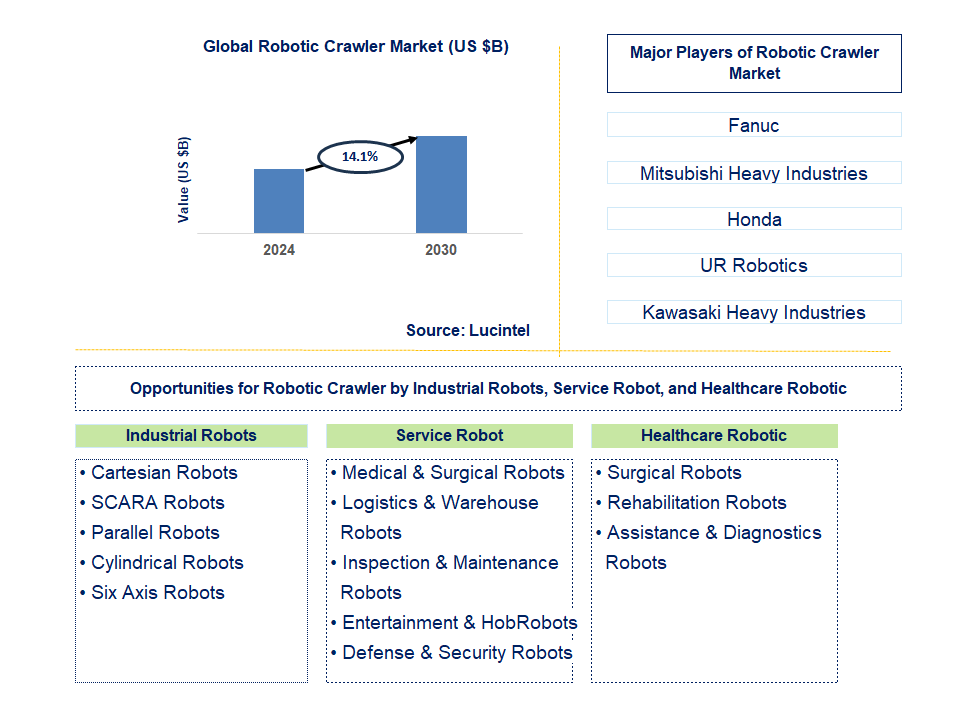
Key data points: The growth forecast = 14.1% annually for the next 6 years. Scroll below to get more insights. This market report covers trends, opportunities, and forecasts in the global robotic crawler market to 2030 by industrial robots (cartesian robots, scara robots, parallel robots, cylindrical robots, and six axis robots), service robot (medical & surgical robots, logistics & warehouse robots, inspection & maintenance robots, entertainment & hobrobots, and defense & security robots), healthcare robotic (surgical robots, rehabilitation robots, and assistance & diagnostics robots), and region (North America, Europe, Asia Pacific, and the Rest of the World)
We'll send your sample report shortly.
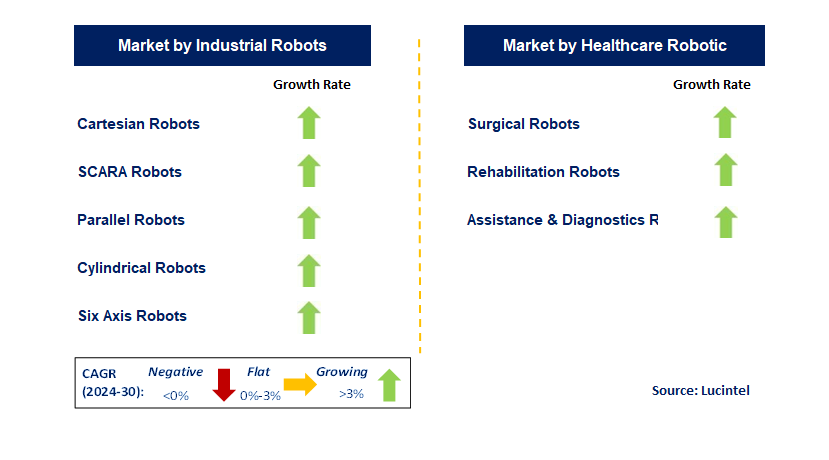
• Lucintel forecasts that, within the industrial robots category, cartesian robot is expected to witness the highest growth over the forecast period.
• Within the service robot category, surgical robot is expected to witness the highest growth.
• In terms of region, APAC is expected to witness the highest growth over the forecast period. A more than 150-page report is developed to help in your business decisions.
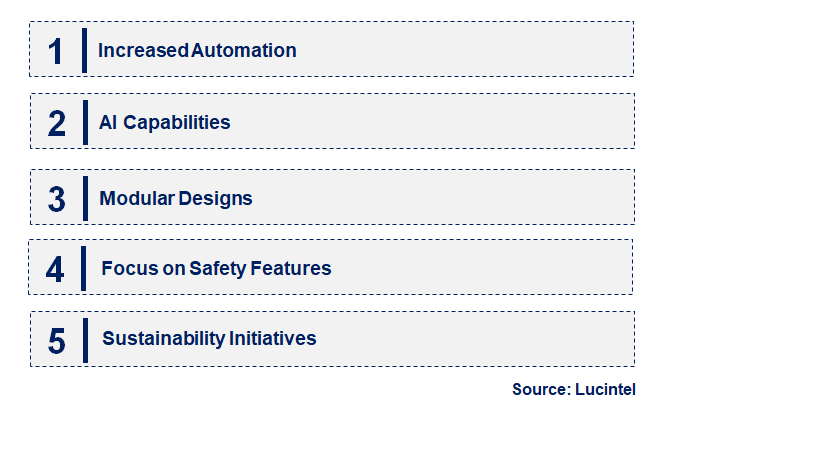
• Increased Automation: One of the key trends is automation, where robots are integrated into existing systems to increase efficiency with less human intervention and fewer errors, especially in hazardous environments. This makes operations safer and more reliable.
• AI Capabilities: Improvements in AI allow robotic crawlers to learn from their environment and enhance their actions. AI integration enables proper navigation and decision-making in real-time, offering effectiveness in complex tasks under varying conditions.
• Modular Designs: Through modular designs, manufacturers enable clients to add or upgrade components as needed. This adaptability makes robotic crawlers suitable for use in virtually any environment.
• Focus on Safety Features: The use of robotic crawlers is increasing in sensitive environments, making the development of advanced safety features critical. This includes integrating sensors and automated emergency protocols to avoid accidents and ensure worker safety. These robots are becoming ideal industrial companions.
• Sustainability Initiatives: The robotic crawlers market is incorporating significant improvements in sustainability. Energy-efficient designs, combined with environmentally friendly materials, not only align with global sustainability goals but also attract eco-conscious consumers. Such trends are transforming the robotic crawlers market, driving innovation and expanding applications across industries.
• Navigation Technologies: Recent advancements in navigation technologies such as GPS and LiDAR have improved the robots’ autonomous capabilities. These technologies enable robots to navigate complex environments, significantly increasing their utility in construction and inspection tasks.
• Integration of Multi-Sensor Systems: The integration of multi-sensor systems enables robotic crawlers to record detailed data during operations. This enhances decision-making, empowering sectors such as agriculture and environmental monitoring to take more informed, strategic actions.
• Collaborative Robotics: Collaborative robotic systems are now available, allowing crawler robots to work alongside human operators. This increases productivity and safety, as humans can focus on more complex tasks while robots handle repetitive or hazardous work.
• Remote Operating Capabilities: Remote operating capabilities are revolutionizing the use of robotic crawlers. Operators do not need to be on-site to control the robots; they can operate them from a distance, expanding the robots’ range of applications, especially in dangerous or inaccessible areas.
• Research and Development Investment: Investments in research and development are increasing to enhance the performance and functionality of robotic crawlers. These innovations ensure that robotic crawlers meet industry demands and keep up with technological advancements. These developments propel the robotic crawler market toward high growth, improving performance, user experience, and expanding the range of applications.
• Construction Industry: The construction industry presents significant opportunities for robotic crawlers, which are useful for site inspections and material handling. Crawlers can traverse rough terrains, repeat tasks multiple times, boosting productivity and safety.
• Agricultural Uses: Ground-based robots are becoming essential in agriculture for tasks like soil surveying and crop monitoring. These robots increase farm productivity, resulting in higher crop yields and better resource utilization.
• Environmental Monitoring: Robotic crawlers are widely used in environmental monitoring, such as pollution checks and habitat surveys. Their ability to operate in challenging terrain makes them highly effective for collecting data that aids in conservation efforts.
• Energy Industry: The energy industry uses robotic crawlers to inspect infrastructure, especially in areas that are inaccessible to humans. These machines can access hard-to-reach areas, enabling periodic checks that enhance safety.
• Disaster Relief: Robotic crawlers are increasingly applied in disaster relief efforts. These machines can navigate through debris and hazardous sites, using sensitive sensors to locate trapped individuals during search and rescue operations. These growth opportunities reflect the promising future of the robotic crawlers market, which is being fostered by diverse applications and a growing focus on automation and efficiency across industries.
• Advancements in Technology: Growth in robotics, AI, and sensor technologies has led to enhanced functionality in robotic crawlers. They are now more versatile and effective in applications, pushing their adoption.
• Emphasis on Safety: Robotic crawlers are vital in performing risky tasks that pose a danger to human workers. Anything that operates in hazardous environments is highly sought after, making safety a top priority for demand.
• Infrastructure Development: Increasing investments in infrastructure, especially in growing economies, have created a huge demand for robotic crawlers, which streamline the construction process and improve site inspections.
• Environmental Regulations: Growing environmental regulations compel industries to install technologies that help them achieve sustainability. Robotic crawlers assist in monitoring and managing environmental impacts. Challenges in the robotic crawler market include:
• High Installation Costs: The high cost of installation is a significant barrier to entry. It is an expensive technological advance for smaller companies. While the payback period may be long, the upfront cost deters mass adoption.
• Operational Complexity: The complexity of operating and maintaining robotic crawlers can be challenging for some organizations. Training staff and ensuring proper integration into existing workflows are essential for success.
• Market Competition: The market is becoming highly competitive, with numerous companies offering similar products. This intense competition can drive prices down, affecting profitability and making it challenging for some companies to sustain operations. These drivers and challenges strongly affect the robotic crawler market, influencing strategic decisions and shaping the future of automation technologies.
• Fanuc
• Mitsubishi Heavy Industries
• Honda
• UR Robotics
• Kawasaki Heavy Industries
• Yaskawa Electric Corporation
• Haaga
• Cartesian Robots
• SCARA Robots
• Parallel Robots
• Cylindrical Robots
• Six Axis Robots
• Medical & Surgical Robots
• Logistics & Warehouse Robots
• Inspection & Maintenance Robots
• Entertainment & HobRobots
• Defense & Security Robots
• Surgical Robots
• Rehabilitation Robots
• Assistance & Diagnostics Robots
• North America
• Europe
• Asia Pacific
• The Rest of the World
• United States: The U.S. robotic crawlers market is rapidly innovating. Companies continue to develop more versatile and robust models for various industries. These crawlers increasingly feature high-tech sensors and AI to collect and analyze real-time data. The construction and energy industries rely heavily on these robots to inspect sites and areas, improving safety and efficiency.
• China: China's robotic crawler market is driven by significant investments in automation across multiple sectors. Local manufacturers are developing low-cost models with high-performance solutions tailored to different applications, including infrastructure inspection and agriculture. Government initiatives like smart cities and industrial automation are accelerating the adoption of robotic crawlers in urban planning and environmental monitoring.
• Germany: Germany leads in crawler robotic technology, with a focus on precision and reliability. Advanced technologies such as IoT connectivity and machine learning are integrated to enhance operational capacity in crawler robots. The automotive and manufacturing sectors are significant consumers, using crawlers in manufacturing lines for checks and logistics automation to improve productivity and reduce operational risks.
• India: The Indian market for robotic crawlers is gaining importance, particularly in construction and agriculture. Companies are offering affordable and efficient solutions that meet local needs. The government's focus on infrastructure development and smart farming practices is expected to drive demand for robotic crawlers, improving operational efficiency.
• Japan: Japan’s market, characterized by high-tech integration and a focus on safety, is seeing companies develop autonomous crawlers for use in hazardous environments like nuclear facilities and disaster-hit zones. With an aging workforce, robotics is gaining fast-paced growth, as certain tasks are difficult for humans to perform.


• Fanuc
• Mitsubishi Heavy Industries
• Honda
• UR Robotics
• Kawasaki Heavy Industries
• Yaskawa Electric Corporation
• Haaga Q5. Which robotic crawler market segment will be the largest in future? Answer: Lucintel forecasts that cartesian robot is expected to witness the highest growth over the forecast period. Q6. In robotic crawler market, which region is expected to be the largest in next 5 years? Answer: APAC is expected to witness highest growth over the forecast period. Q.7 Do we receive customization in this report? Answer: Yes, Lucintel provides 10% customization without any additional cost.


Choose a license that fits your team. Instant PDF delivery.
Prices exclude taxes. Instant delivery. Custom licensing available on request.
Market Report · July 31, 2026
Market Report · July 31, 2026
Market Report · July 31, 2026
Trusted partner for strategic intelligence and business growth


Receive a complimentary market analysis tailored to your industry. Our analysts will identify key growth opportunities and competitive dynamics specific to your business.

Market size, growth rate, and key trend analysis for your specific sector.

Top competitor positioning and market share analysis.

Strategic recommendations backed by data-driven insights.
Get curated market intelligence and competitive moves straight to your inbox.
By subscribing, you agree to receive our monthly insights. Unsubscribe anytime.
Receive a complimentary market analysis tailored to your industry. Our analysts will identify key growth opportunities and competitive dynamics specific to your business.
Market size, growth rate, and key trend analysis for your specific sector.
Top competitor positioning and market share analysis.
Strategic recommendations backed by data-driven insights.
Get curated market intelligence, emerging trends, and competitive moves straight to your inbox each month.
By subscribing, you agree to receive our monthly insights. Unsubscribe anytime.
We'll send your sample report shortly.