
Market Report · July 31, 2026

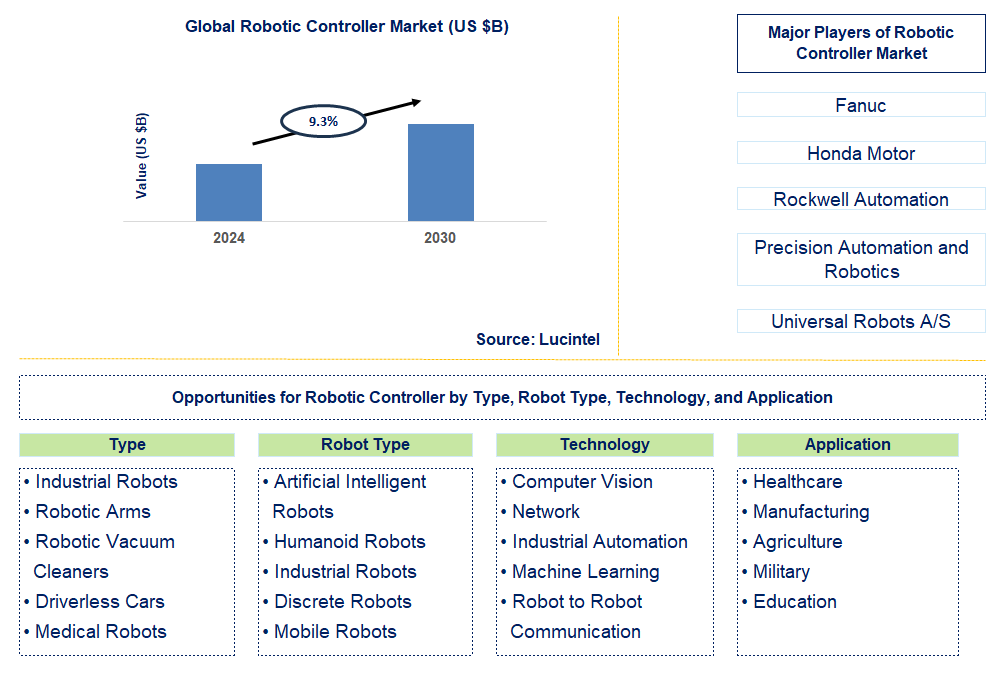
Key data points: The growth forecast = 9.3% annually next 6 years. Scroll below to get more insights. This market report covers trends, opportunities, and forecast in the global robotic controller market to 2030 by type (industrial robots, robotic arms, robotic vacuum cleaners, driverless cars, and medical robots), robot type (artificial intelligent robots, humanoid robots, industrial robots, discrete robots, and mobile robots), technology (computer vision, network, industrial automation, machine learning, and robot to robot communication), application (healthcare, manufacturing, agriculture, military, and education), and region (North America, Europe, Asia Pacific, and the Rest of the World)
We'll send your sample report shortly.
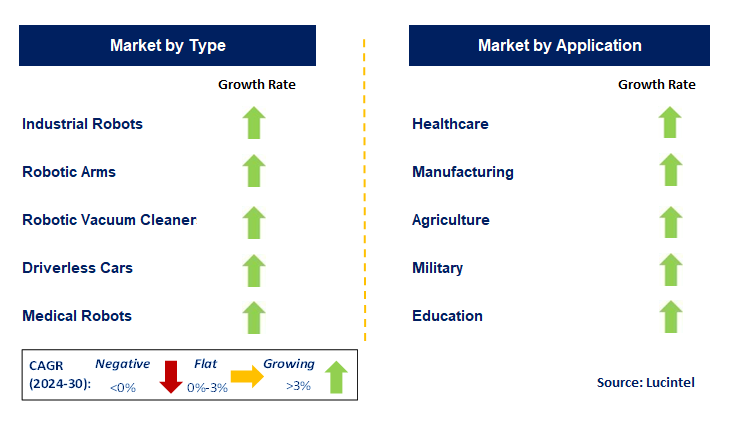
• Lucintel forecasts that industrial robot is expected to witness the highest growth over the forecast period.
• Within this market, healthcare will remain the largest segment.
• APAC is expected to witness highest growth over the forecast period. A more than 150-page report is developed to help in your business decisions.
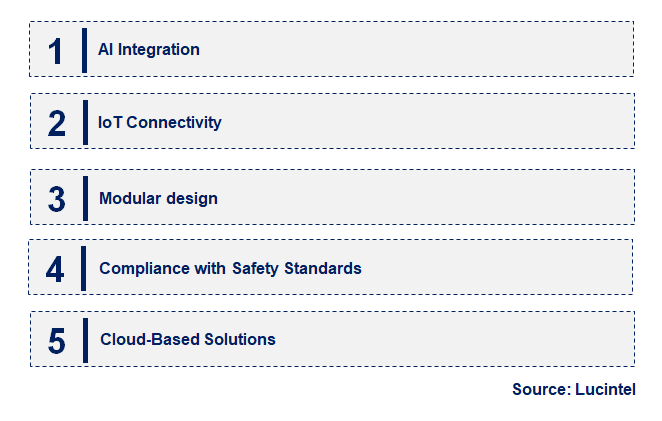
• AI Integration: Artificial intelligence in robotic controllers enables better learning abilities. It is through artificial intelligence that robots learn to adapt to new situations and environments, thereby making them significantly efficient in diverse applications.
• IoT Connectivity: Integration of Internet of Things (IoT) technologies is further making it possible for robotic controllers to share real-time data with each other. IoT connectivity, in this regard, enhances the operational visibility that allows decisions to be taken and resources to be allocated better in industrial settings.
• Modular design: The trend toward modularity in the robotic controllers makes it easy to customize and scale up. Companies can upgrade their systems without redesigning when they need to, hence guaranteeing flexibility and cost-effectiveness while using automation.
• Compliance with Safety Standards: There is a continued effort to achieve compliance with safety standards while developing robotic controllers. The quality of safety features on the controller will be measured by the efficiency of the emergency stop mechanisms, collision detection, and others to ensure safe human-robot collaboration in workplaces.
• Cloud-Based Solutions: Increase adoption of the cloud-based technology to the robotic controller is making remote monitoring and control possible. This is turning out to be a door in businesses to efficiently manage numerous robotic systems and enhance operation effectiveness by way of resulting savings in maintenance expenditures. Trends such as these are shaping the nature of the robotic controller market. It will lead to an innovational and an acquisition spree across other industries.
• Sophisticated AI Algorithms: Companies are even in the use of several sophisticated algorithms of AI in the robotic controllers, advancing their decision-making capabilities. This development allows robots to perform complicated tasks with higher accuracy and the efficiency and thereby decreases the need for constant human oversight.
• Release of IoT-enabled controllers: these new robotic controllers include IoT integration, giving the possibility of free data communication that enhances real-time monitoring and diagnostics capabilities, thus giving the opportunity to achieve better overall performance in operational effectiveness and minimizing downtime in the manufacturing environment.
• Enhanced Safety Capabilities: Latest updates in new versions of robotic controllers have additionally armed them with advanced safety features. This will assist manufacturers in adhering to global safety standards while improving a healthier interaction of robotics at workplace.
• Modular Controllers Design: Firms are designing modular robotic controllers that can be configured for use in different applications. Businesses can accordingly change their robotic systems to meet specific needs without having to make significant changes.
• Cloud-Based Monitoring Solutions: Cloud-based robotic controller solutions are changing how businesses manage their fleets of robots. It provides real-time insights as well as analytics, and the performance scheduling and maintenance of the robots are more optimized. These recent developments in the robotic controller market are driving innovation, enhancing security, and promoting collaboration. As technology continues to evolve, these advancements will play a crucial role in shaping the future of robotics across various industries.
• Manufacturing Automation: The adoption of robotic controllers in manufacturing automation increases with respect to increase more companies pursue productivity. Collaborative robots support the controllers make production processes easy because by reducing labor costs, they enhance efficiency.
• Applications in Health Care: The use of robotic controllers is on the rise in health care, especially where assistive robots are used. These controllers improve patient care through monitoring and assistance, since a larger percentage of the population is aging.
• Argo Application: Through agricultural application, there is tremendous potential for using robotic controllers. Through developed controllers for agricultural robots, planting and harvesting can be automated, hence increasing efficiency and crop yield.
• Logistics and Warehousing: With the expansion of e-commerce, there has been increased demand for controllers in logistics. For example, controllers that make autonomous vehicles and sorting robots can make warehouse operations more efficient and ensure that orders are delivered within a shorter time frame.
• Service Robotics: The acceptance of service robots in various industries has created a growing number of niche markets for industrial robotic controllers. These can be useful for very specific applications like hospitality, retail, or customer service, where an industrial robotic controller could improve the user experience and enhance the efficiency with which it is operated. These growth opportunities redefine the emerging robotic controller market, allowing businesses to grow and innovate.The robotic controller market has several drivers and challenges produced by changing technological, economic, and regulatory factors.
• Fanuc
• Honda Motor
• Rockwell Automation
• Precision Automation and Robotics
• Universal Robots A/S
• Kuka
• Yaskawa Elecric Corporation
• Industrial Robots
• Robotic Arms
• Robotic Vacuum Cleaners
• Driverless Cars
• Medical Robots
• Artificial Intelligent Robots
• Humanoid Robots
• Industrial Robots
• Discrete Robots
• Mobile Robots
• Computer Vision
• Network
• Industrial Automation
• Machine Learning
• Robot to Robot Communication
• Healthcare
• Manufacturing
• Agriculture
• Military
• Education
• North America
• Europe
• Asia Pacific
• The Rest of the World
• United States: US is in the lead for innovative ideas concerning robotic controllers, especially with the integration of Industrial automation. Companies in the near future would develop advanced AI-based controllers with more adaptability and learning capabilities, which would help more effortlessly integrate robots into manufacturing processes and increase operational efficiency and reduce time down.
• China: With the push from the Chinese government on automation, it is sweeping through the development of robot controllers at whirlwind speed. Increasingly, domestic firms, which are investing in R&D, are rolling out controllers for various applications-from manufacturing to logistics. This focus has helped improve China's overall leadership position in robotics technology worldwide.
• Germany: Robotic controllers in Germany still remain robustly strong for precision engineering. Given the major trend, the IoT capabilities are linked to real-time data processing and remote monitoring. These added functionalities have upgraded the efficiency of robotic systems in manufacturing as well as the automotive sectors.
• India: The market for robotic controllers in India is picking up steam since start-ups and traditional vendors are turning towards cheap automation solutions. One of the lead drivers is a focus on developing dedicated application-specific controllers, especially agriculture and small manufacturing applications. Such innovation makes automation possible for different sectors within India.
• Japan: Japan still leads the sector with major innovations in the robotic controllers being designed for health and elder care. Emphasis on developing intuitive user interfaces has improved the usability of such systems thereby enabling their widespread usage within personal and professional markets, which has mitigated the problems due to a rapidly aging population.


• Fanuc
• Honda Motor
• Rockwell Automation
• Precision Automation and Robotics
• Universal Robots A/S
• Kuka
• Yaskawa Elecric Corporation Q5. Which robotic controller market segment will be the largest in future? Answer: Lucintel forecasts that industrial robot is expected to witness the highest growth over the forecast period. Q6. In robotic controller market, which region is expected to be the largest in next 5 years? Answer: APAC is expected to witness highest growth over the forecast period. Q7. Do we receive customization in this report? Answer: Yes, Lucintel provides 10% customization without any additional cost.


Choose a license that fits your team. Instant PDF delivery.
Prices exclude taxes. Instant delivery. Custom licensing available on request.
Market Report · July 31, 2026
Market Report · July 31, 2026
Market Report · July 31, 2026
Trusted partner for strategic intelligence and business growth


Receive a complimentary market analysis tailored to your industry. Our analysts will identify key growth opportunities and competitive dynamics specific to your business.

Market size, growth rate, and key trend analysis for your specific sector.

Top competitor positioning and market share analysis.

Strategic recommendations backed by data-driven insights.
Get curated market intelligence and competitive moves straight to your inbox.
By subscribing, you agree to receive our monthly insights. Unsubscribe anytime.
Receive a complimentary market analysis tailored to your industry. Our analysts will identify key growth opportunities and competitive dynamics specific to your business.
Market size, growth rate, and key trend analysis for your specific sector.
Top competitor positioning and market share analysis.
Strategic recommendations backed by data-driven insights.
Get curated market intelligence, emerging trends, and competitive moves straight to your inbox each month.
By subscribing, you agree to receive our monthly insights. Unsubscribe anytime.
We'll send your sample report shortly.