
Report Feature
Robot Guide Dog Market Trends and Forecast
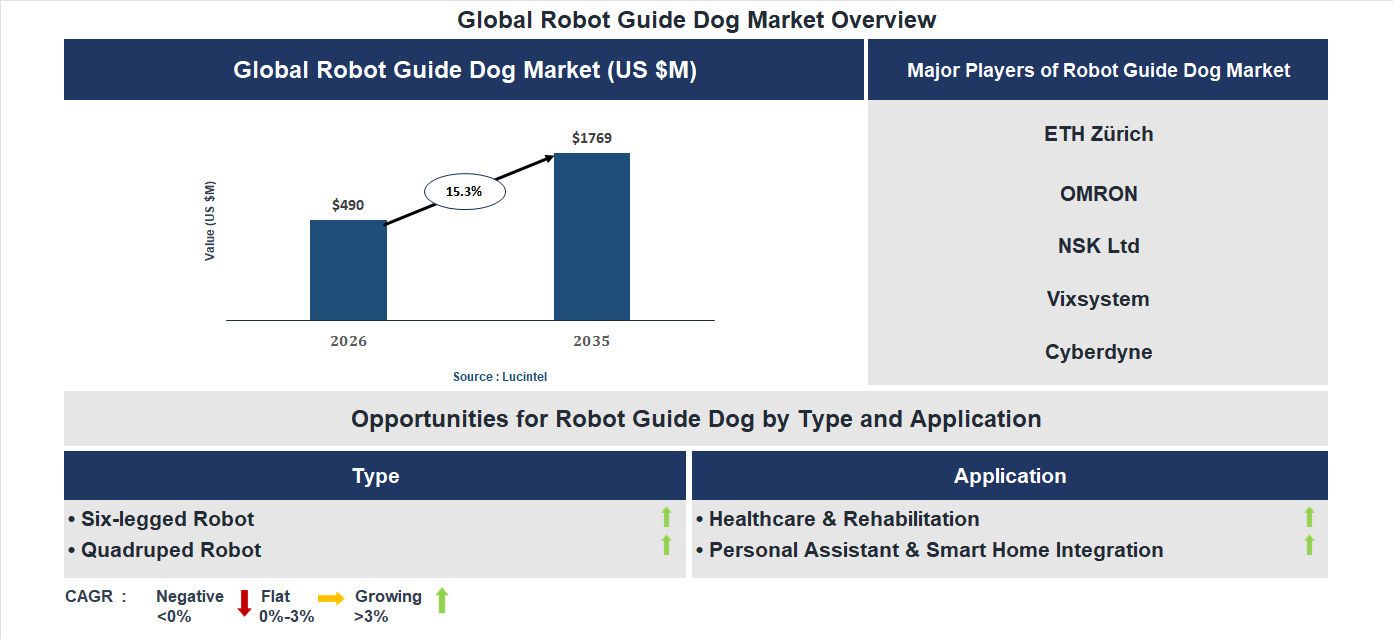
The future of the global robot guide dog market looks promising with opportunities in the healthcare & rehabilitation and personal assistant & smart home integration markets. The global robot guide dog market is expected to reach an estimated $1769 million by 2035 with a CAGR of 15.3% from 2026 to 2035. The major drivers for this market are the increasing focus on assistive robotics, the rising demand for mobility support, and the growing integration of AI navigation systems.• Lucintel forecasts that, within the type category, quadruped robot is expected to witness higher growth over the forecast period.
• Within the application category, healthcare & rehabilitation is expected to witness the highest growth.
• In terms of region, APAC is expected to witness the highest growth over the forecast period. Gain valuable insights for your business decisions with our comprehensive 150+ page report. Sample figures with some insights are shown below.
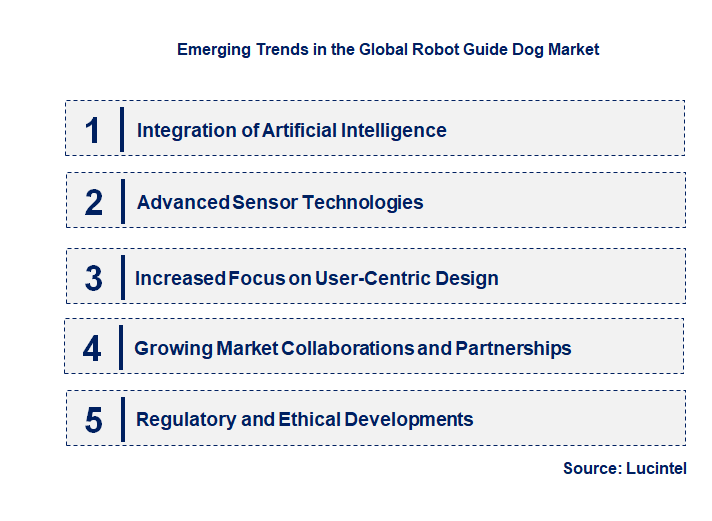
Emerging Trends in the Robot Guide Dog Market
The robot guide dog market is experiencing rapid growth driven by technological advancements and increasing demand for assistive devices. As societies become more inclusive and technology becomes more sophisticated, innovative solutions are emerging to support individuals with visual impairments. These developments are transforming traditional mobility aids, making navigation safer and more efficient. The integration of artificial intelligence, robotics, and sensor technology is creating smarter, more responsive guide systems. This evolution not only enhances independence for users but also opens new opportunities for market expansion and technological innovation. The following key trends highlight the major developments shaping this dynamic market.• Integration of Artificial Intelligence : AI-powered robot guide dogs are becoming more intuitive and adaptive, capable of learning user preferences and environmental changes. This enhances navigation accuracy and safety, providing a more personalized experience. AI algorithms enable real-time obstacle detection and route optimization, making the guide more reliable in complex environments. As AI continues to evolve, these robots will become increasingly autonomous, reducing the need for human intervention and improving user confidence and independence.
• Advanced Sensor Technologies : The incorporation of sophisticated sensors such as LiDAR, ultrasonic, and infrared sensors allows robot guide dogs to detect obstacles with high precision. These sensors enable real-time environmental mapping and obstacle avoidance, even in crowded or unfamiliar settings. The improved sensory capabilities significantly enhance safety and navigation efficiency, especially in dynamic environments. As sensor technology advances, robot guide dogs will become more capable of handling complex terrains and unpredictable obstacles, broadening their usability.
• Increased Focus on User-Centric Design : Developers are prioritizing ergonomic and user-friendly designs to ensure comfort and ease of use. This includes adjustable harnesses, intuitive controls, and customizable features tailored to individual needs. User feedback is increasingly shaping product development, leading to more accessible and appealing devices. Such focus on user-centric design improves adoption rates and satisfaction, making robot guide dogs a more practical and preferred mobility aid for visually impaired users.
• Growing Market Collaborations and Partnerships : Companies are forming strategic alliances with technology providers, healthcare organizations, and assistive device manufacturers to accelerate innovation. These collaborations facilitate the integration of cutting-edge technologies and expand distribution channels. Partnerships also enable shared research and development efforts, reducing costs and increasing market reach. Such collaborations are vital for rapid product development and for establishing standards within the industry, ultimately driving market growth and technological advancement.
• Regulatory and Ethical Developments : Governments and industry bodies are working on establishing standards and regulations for robotic mobility aids. These frameworks aim to ensure safety, reliability, and ethical use of robot guide dogs. Regulatory clarity encourages investment and innovation while addressing concerns related to privacy, safety, and liability. As regulations evolve, they will shape product development, market entry strategies, and consumer trust, fostering a more secure and standardized market environment. In summary, these trends are collectively reshaping the robot guide dog market by making assistive technology more intelligent, safe, user-friendly, and widely accessible. The integration of AI and sensors, focus on user needs, strategic collaborations, and regulatory developments are driving innovation and market expansion. These changes are not only improving the quality of life for visually impaired individuals but also positioning the market for sustained growth and technological leadership.
Recent Development in the Robot Guide Dog Market
The Robot Guide Dog Market is experiencing rapid innovation driven by advancements in robotics, artificial intelligence, and assistive technologies. These developments aim to enhance mobility and independence for visually impaired individuals worldwide. As technology becomes more accessible and affordable, the market is poised for significant growth, attracting investments from both public and private sectors. The integration of smart features and improved durability is expanding the scope of robot guide dogs, making them a vital part of assistive solutions. These trends are transforming the landscape of mobility aids and creating new opportunities for stakeholders.• Enhanced Navigation Capabilities: Advancements in AI and sensor technology are enabling robot guide dogs to navigate complex environments more accurately. These improvements allow for better obstacle detection, real-time path planning, and adaptive responses to dynamic surroundings. As a result, users experience increased safety and confidence, expanding the usability of robot guide dogs in urban and rural settings. This development is expected to significantly boost adoption rates and market penetration, especially in areas with limited access to traditional guide dog services.
• Increased Durability and Battery Life: Recent innovations focus on making robot guide dogs more durable and energy-efficient. Enhanced battery technology and rugged design enable longer operational hours and resilience against harsh weather conditions. These improvements reduce maintenance costs and downtime, making robot guide dogs more reliable for daily use. The increased durability broadens their application scope, including outdoor activities and emergency situations, thereby attracting a wider customer base and fostering market growth.
• Integration of Smart Features: Incorporating IoT connectivity, voice recognition, and user-friendly interfaces has made robot guide dogs more interactive and intuitive. These smart features facilitate seamless communication between the user and the device, providing real-time updates and personalized assistance. Such integration enhances user experience, promotes independence, and encourages adoption among diverse user groups. The technological sophistication of these robots positions them as essential tools in assistive technology markets, driving innovation and competitive advantage.
• Cost Reduction and Accessibility: Efforts to lower manufacturing costs and improve affordability are making robot guide dogs accessible to a broader population. Economies of scale, improved supply chains, and technological advancements contribute to reduced prices. Increased affordability is expected to accelerate adoption among individuals and institutions, including healthcare providers and government agencies. This trend democratizes access to assistive mobility solutions, fostering market expansion and encouraging further innovation in the sector.
• Regulatory and Ethical Developments: Governments and industry bodies are establishing standards and guidelines for robot guide dog safety, privacy, and ethical use. These regulations aim to ensure user safety, data security, and ethical deployment of robotic assistance. Clear regulatory frameworks build consumer trust and facilitate market entry for new products. As these standards evolve, they will shape product development, influence market dynamics, and promote responsible innovation within the robot guide dog industry. The recent developments in navigation, durability, smart features, affordability, and regulation are collectively transforming the Robot Guide Dog Market. These innovations are enhancing user safety, expanding accessibility, and fostering technological integration, which are driving market growth. As these trends continue, the industry is poised for increased adoption, broader application, and sustained innovation, ultimately improving mobility solutions for visually impaired individuals worldwide.
Strategic Growth Opportunities in the Robot Guide Dog Market
The robot guide dog market is experiencing rapid growth driven by advancements in robotics, AI, and assistive technologies. Increasing demand for mobility solutions for visually impaired individuals, coupled with technological innovations, is expanding market opportunities. Strategic investments and collaborations are further accelerating development. This evolving landscape offers significant potential for companies to enhance independence and safety for users, while also opening new revenue streams. Understanding key growth opportunities is essential for stakeholders aiming to capitalize on this transformative industry.• Integration of AI for Enhanced Navigation and Obstacle Avoidance: Incorporating advanced AI algorithms enables robot guide dogs to better interpret environments, recognize obstacles, and adapt to dynamic settings. This improves safety and reliability for users, making the devices more intuitive and effective. Continuous AI development allows for personalized assistance, real-time decision-making, and seamless integration with other smart devices, thereby expanding usability and market adoption.
• Development of Lightweight, Durable, and Cost-Effective Designs: Creating affordable, lightweight, and durable robot guide dogs increases accessibility for a broader user base. Innovations in materials and manufacturing reduce costs while maintaining high performance standards. These design improvements facilitate easier handling, longer operational life, and wider distribution, especially in emerging markets, ultimately driving sales and market penetration.
• Expansion into Emerging Markets with Growing Disability Populations: Rising awareness and government initiatives in developing regions are creating new opportunities. Tailoring robot guide dog solutions to meet local needs and economic conditions can significantly expand market reach. Strategic partnerships with local organizations and healthcare providers can facilitate adoption, improve mobility for visually impaired populations, and foster market growth in these regions.
• Integration with Smart City Infrastructure for Enhanced Mobility: Connecting robot guide dogs with urban infrastructure, such as traffic signals and public transportation systems, can improve navigation and safety in complex environments. This integration supports seamless movement across cityscapes, reduces accidents, and enhances user confidence. Collaborations with city planners and technology providers are essential to develop compatible systems, opening avenues for widespread deployment in smart city initiatives.
• Adoption of Advanced Sensors and Connectivity Technologies: Incorporating cutting-edge sensors and IoT connectivity enhances environmental perception and real-time data sharing. This enables robot guide dogs to operate more effectively in diverse conditions and communicate with other assistive devices or emergency services. Such technological advancements improve user safety, situational awareness, and overall performance, thereby increasing market appeal and encouraging further innovation. The overall impact of these growth opportunities is poised to significantly expand the robot guide dog market, making mobility assistance more accessible, reliable, and integrated into daily life. As technological innovations and strategic initiatives progress, the industry is set to transform mobility solutions for visually impaired individuals worldwide, fostering greater independence and inclusion.
Robot Guide Dog Market Driver and Challenges
The robot guide dog market is influenced by a variety of technological, economic, and regulatory factors that shape its growth and development. Advances in robotics and artificial intelligence are enabling more sophisticated and reliable guide systems, while economic considerations such as cost reduction and accessibility are driving adoption. Regulatory frameworks around safety standards and ethical considerations also impact market expansion. Additionally, societal needs for assistive technologies for visually impaired individuals are fueling innovation and demand. Navigating these drivers and challenges is crucial for stakeholders aiming to capitalize on the markets potential and address barriers to widespread implementation. The factors responsible for driving the robot guide dog market include:-• Technological Innovation: The rapid development of robotics, sensors, and AI algorithms enhances the capabilities of robot guide dogs, making them more autonomous, reliable, and user-friendly. These technological advancements improve navigation, obstacle detection, and user interaction, which are critical for safety and effectiveness. As technology continues to evolve, costs are decreasing, making these devices more accessible to a broader audience. The integration of machine learning allows for personalized assistance, further increasing user confidence and satisfaction. This ongoing innovation sustains market growth by meeting the increasing demand for advanced assistive devices.
• Rising Demand for Assistive Technologies: The increasing prevalence of visual impairments globally has created a significant demand for innovative mobility solutions. Robot guide dogs offer a safe, reliable, and cost-effective alternative to traditional guide dogs, especially in regions where trained animals are scarce or expensive. Governments and healthcare providers are investing in assistive technologies to improve the quality of life for visually impaired individuals. The growing awareness and acceptance of robotic solutions as viable mobility aids are expanding market opportunities. This demand is further driven by aging populations and the need for independent mobility options, fueling market expansion.
• Economic Factors and Cost Efficiency: The high costs associated with training and maintaining live guide dogs limit accessibility for many users. Robot guide dogs, once mass-produced, promise lower long-term costs and easier maintenance, making them a more economical option. As manufacturing processes improve and economies of scale are achieved, prices are expected to decrease, broadening market reach. Additionally, insurance coverage and government subsidies for assistive devices are encouraging adoption. The economic benefits of reduced training time and increased availability position robot guide dogs as a cost-effective solution, thereby accelerating market growth.
• Regulatory and Safety Standards: The development and deployment of robot guide dogs are heavily influenced by regulatory frameworks that ensure safety, reliability, and ethical use. Governments and industry bodies are establishing standards for robotic mobility aids, which impact design, testing, and certification processes. Compliance with these standards is essential for market acceptance and widespread adoption. Regulatory support can facilitate faster approval processes and foster consumer confidence. Conversely, stringent regulations may pose challenges by increasing development costs and timeframes. Navigating these regulatory landscapes is vital for market players aiming to expand their offerings globally.
• Technological Integration and User Experience: The integration of user-centric design principles with advanced robotics enhances the usability and acceptance of robot guide dogs. Features such as intuitive controls, real-time obstacle avoidance, and seamless communication improve user experience. Customization options allow for tailored assistance based on individual needs, increasing adoption among diverse user groups. Moreover, integration with smartphones and wearable devices provides additional control and feedback, making the technology more accessible. Improving user experience through innovative design and integration is a key driver that ensures higher satisfaction and broader market penetration. The challenges facing this robot guide dog market include:-
• Technological Limitations and Reliability: Despite rapid advancements, current robot guide dogs face challenges related to battery life, environmental adaptability, and obstacle detection accuracy. These limitations can compromise safety and reliability, especially in complex or unpredictable environments. Ensuring consistent performance across diverse conditions remains a significant hurdle. Additionally, hardware durability and maintenance requirements can affect user confidence and operational costs. Overcoming these technological barriers is essential for gaining widespread acceptance and ensuring the devices meet the high safety standards required for assistive mobility aids.
• High Development and Production Costs: Developing sophisticated robotic systems involves substantial investment in research, development, and manufacturing. These costs can translate into higher retail prices, limiting accessibility for many users. Achieving economies of scale is necessary to reduce costs, but initial investments remain high. Furthermore, ongoing maintenance and software updates add to the total cost of ownership. These financial barriers can slow market adoption, especially in low-income regions or among users with limited financial resources, posing a significant challenge to market expansion.
• Regulatory and Ethical Concerns: The deployment of robotic guide dogs raises regulatory and ethical questions related to safety, privacy, and liability. Establishing comprehensive standards and obtaining approvals can be time-consuming and costly. Concerns about data security, user privacy, and the potential for malfunction pose risks that need addressing through strict regulations. Ethical considerations regarding replacing live guide dogs with robots also influence public perception and acceptance. Navigating these complex regulatory and ethical landscapes is crucial for market players to avoid legal issues and foster consumer trust. In summary, the robot guide dog market is driven by technological innovation, increasing demand for assistive devices, economic benefits, regulatory support, and user-centric design. However, technological limitations, high costs, and regulatory challenges pose significant barriers. The overall impact of these drivers and challenges will determine the pace and extent of market growth. Successful navigation of these factors can lead to widespread adoption, improved quality of life for visually impaired users, and a sustainable market trajectory.
List of Robot Guide Dog Companies
Companies in the market compete on the basis of product quality offered. Major players in this market focus on expanding their manufacturing facilities, R&D investments, infrastructural development, and leverage integration opportunities across the value chain. With these strategies robot guide dog companies cater increasing demand, ensure competitive effectiveness, develop innovative products & technologies, reduce production costs, and expand their customer base. Some of the robot guide dog companies profiled in this report include-• ETH Zürich
• OMRON
• NSK Ltd
• Vixsystem
• Cyberdyne
Robot Guide Dog Market by Segment
The study includes a forecast for the global robot guide dog market by type, application, and region.Robot Guide Dog Market by Type [Value from 2019 to 2035]:
• Six-legged Robot
• Quadruped Robot
Robot Guide Dog Market by Application [Value from 2019 to 2035]:
• Healthcare & Rehabilitation
• Personal Assistant & Smart Home Integration
Robot Guide Dog Market by Region [Value from 2019 to 2035]:
• North America
• Europe
• Asia Pacific
• The Rest of the World
Country Wise Outlook for the Robot Guide Dog Market
The robot guide dog market is experiencing rapid growth driven by technological advancements, increasing demand for assistive devices, and a focus on enhancing independence for individuals with visual impairments. As countries invest in innovative solutions, the market is evolving with new products, improved functionalities, and expanded applications. Governments, research institutions, and private companies are collaborating to develop more sophisticated and affordable robot guide dogs, aiming to improve quality of life and safety for users worldwide. This global trend reflects a broader push toward automation and robotics in healthcare and assistive technology sectors, shaping the future landscape of mobility aids for the visually impaired.• United States: The US market is leading with significant investments in AI-powered robot guide dogs, integrating advanced sensors and machine learning for better obstacle detection and navigation. Major tech firms and startups are collaborating to develop more realistic and affordable options, with increased government funding for assistive technology research. The adoption rate is rising among healthcare providers and visually impaired communities, driven by regulatory support and consumer awareness.
• China: China is rapidly expanding its robot guide dog market through government initiatives and substantial R&D investments. Local companies are focusing on cost-effective solutions tailored for large-scale deployment, especially in urban areas. Innovations include enhanced sensory systems and integration with smart city infrastructure. The market benefits from Chinas strong manufacturing base and growing domestic demand for assistive devices, aiming to improve accessibility and independence.
• Germany: Germany emphasizes high-quality, reliable robot guide dogs with a focus on safety and user comfort. The market is characterized by collaborations between robotics firms and healthcare institutions to develop sophisticated models with improved navigation and user interface. Regulatory standards are strict, ensuring product safety and efficacy. The country also invests in research to enhance the integration of robot guide dogs with existing mobility aids and smart home systems.
• India: Indias market is witnessing increased adoption driven by government initiatives promoting accessible technology and affordability. Local startups are developing low-cost robot guide dogs suitable for diverse terrains and urban environments. The focus is on creating scalable solutions to address the needs of a large visually impaired population. Partnerships with NGOs and government agencies are facilitating wider distribution and awareness.
• Japan: Japan is at the forefront of robotics innovation, with advanced robot guide dogs featuring sophisticated AI, sensory perception, and seamless human interaction. The market benefits from Japans expertise in robotics and aging population, emphasizing assistive technology for elderly and disabled individuals. Ongoing research aims to improve emotional interaction and adaptability, making robot guide dogs more intuitive and user-friendly.

Features of the Global Robot Guide Dog Market
Market Size Estimates: Robot guide dog market size estimation in terms of value ($M). Trend and Forecast Analysis: Market trends (2019 to 2025) and forecast (2026 to 2035) by various segments and regions. Segmentation Analysis: Robot guide dog market size by type, application, and region in terms of value ($M). Regional Analysis: Robot guide dog market breakdown by North America, Europe, Asia Pacific, and Rest of the World. Growth Opportunities: Analysis of growth opportunities in different types, applications, and regions for the robot guide dog market. Strategic Analysis: This includes M&A, new product development, and competitive landscape of the robot guide dog market. Analysis of competitive intensity of the industry based on Porter’s Five Forces model.
FAQ
Q1. What is the market size and growth forecast for robot guide dog market? Answer: The global robot guide dog market is expected to reach an estimated $1769 million by 2035 and grow with a CAGR of 15.3% from 2026 to 2035. Q2. What are the major drivers influencing the growth of the robot guide dog market? Answer: The major drivers for this market are the increasing focus on assistive robotics, the rising demand for mobility support, and the growing integration of AI navigation systems. Q3. What are the major segments for robot guide dog market? Answer: The future of the robot guide dog market looks promising with opportunities in the healthcare & rehabilitation and personal assistant & smart home integration markets. Q4. Who are the key robot guide dog market companies? Answer: Some of the key robot guide dog companies are as follows:• ETH Zürich
• OMRON
• NSK Ltd
• Vixsystem
• Cyberdyne Q5. Which robot guide dog market segment will be the largest in future? Answer: Lucintel forecasts that, within the type category, quadruped robot is expected to witness higher growth over the forecast period. Q6. In robot guide dog market, which region is expected to be the largest in next 5 years? Answer: In terms of region, APAC is expected to witness the highest growth over the forecast period. Q7. Do we receive customization in this report? Answer: Yes, Lucintel provides 10% customization without any additional cost.
Table of Contents
List of Figures
List of Tables
Methodology
- In-depth interviews of the major players in this market
- Detailed secondary research from competitors’ financial statements and published data
- Extensive searches of published works, market, and database information pertaining to industry news, company press releases, and customer intentions
- A compilation of the experiences, judgments, and insights of Lucintel’s professionals, who have analyzed and tracked this market over the years.


Buy Now
Choose a license that fits your team. Instant PDF delivery.
Prices exclude taxes. Instant delivery. Custom licensing available on request.
Key Questions
- • What are some of the most promising, high-growth opportunities for the robot guide dog market by type (six-legged robot and quadruped robot), application (healthcare & rehabilitation and personal assistant & smart home integration), and region (North America, Europe, Asia Pacific, and the Rest of the World)?
- • Which segments will grow at a faster pace and why?
- • Which region will grow at a faster pace and why?
- • What are the key factors affecting market dynamics? What are the key challenges and business risks in this market?
- • What are the business risks and competitive threats in this market?
- • What are the emerging trends in this market and the reasons behind them?
- • What are some of the changing demands of customers in the market?
- • What are the new developments in the market? Which companies are leading these developments?
- • Who are the major players in this market? What strategic initiatives are key players pursuing for business growth?
- • What are some of the competing products in this market and how big of a threat do they pose for loss of market share by material or product substitution?
- • What M&A activity has occurred in the last 7 years and what has its impact been on the industry? For any questions related to Robot Guide Dog Market, Robot Guide Dog Market Size, Robot Guide Dog Market Growth, Robot Guide Dog Market Analysis, Robot Guide Dog Market Report, Robot Guide Dog Market Share, Robot Guide Dog Market Trends, Robot Guide Dog Market Forecast, Robot Guide Dog Companies, write Lucintel analyst at email: helpdesk@lucintel.com. We will be glad to get back to you soon.


