
Report Feature
Road Transport Refrigeration Equipment Market Trends and Forecast
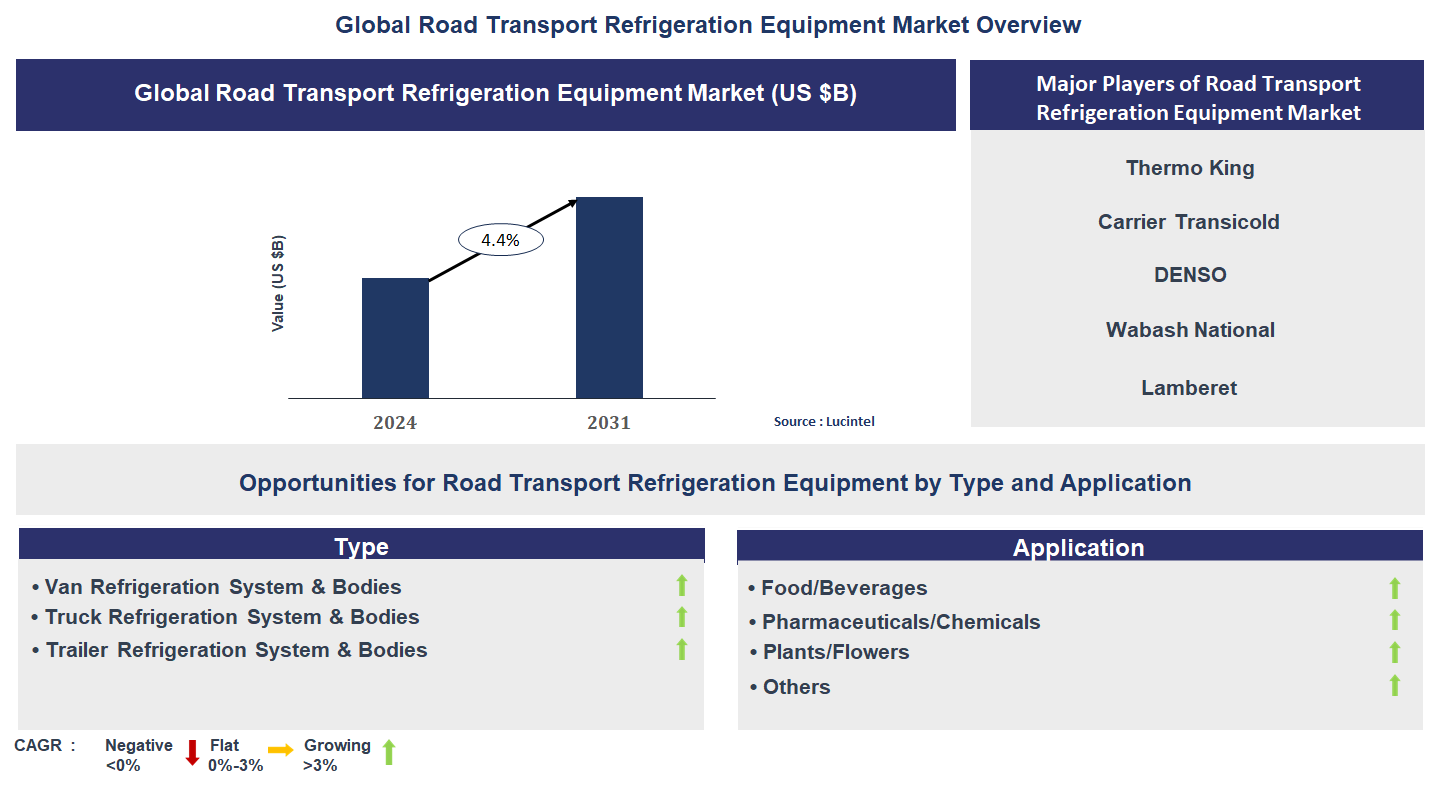
The future of the global road transport refrigeration equipment market looks promising with opportunities in the food/beverage, pharmaceutical/chemical, and plant/flower markets. The global road transport refrigeration equipment market is expected to grow with a CAGR of 4.4% from 2025 to 2031. The major drivers for this market are the increasing demand for refrigerated transportation, the rising adoption of cold chain logistics, and the growing need for fresh food transportation.• Lucintel forecasts that, within the type category, truck refrigeration system & body is expected to witness the highest growth over the forecast period.
• Within the application category, food/beverage is expected to witness the highest growth.
• In terms of region, APAC is expected to witness the highest growth over the forecast period. Gain valuable insights for your business decisions with our comprehensive 150+ page report. Sample figures with some insights are shown below.
Emerging Trends in the Road Transport Refrigeration Equipment Market
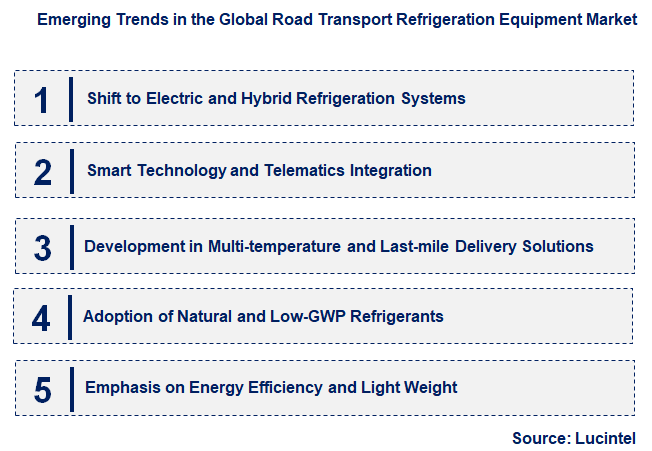
The road transport refrigeration equipment market is experiencing a revolutionary phase, propelled by both technological innovations, changing consumer needs, as well as mounting environmental pressures. These new trends are not only reshaping the production and application of refrigeration equipment, but are also affecting supply chains, marketing strategies, and the global competitive landscape. Therefore, players in the market are shifting their attention to innovation, product diversification, and sustainability in order to remain competitive and strong in a rapidly evolving world.• Shift to Electric and Hybrid Refrigeration Systems: One of the main trends is the growing shift towards electric and hybrid refrigeration systems. This is being led by a worldwide trend towards sustainability and increasing regulation on the emissions from diesel engines. Electric systems provide a cleaner, quieter alternative, with hybrids offering an intermediary solution. This trend is influencing the market by stimulating innovation in battery technology and power management systems. Manufacturers currently have available a variety of electric choices, from vehicle-driven units for light trucks to self-driven battery units for trailers.
• Smart Technology and Telematics Integration: The smart technology and telematics integration is one of the most significant upcoming trends. The systems enable fleet managers to track temperature, humidity, and location in real time. They also have the capability to send predictive maintenance notices and optimize routes for delivery. This is influencing the market by enhancing operating efficiency, lowering fuel expenses, and raising food safety. The capability to offer an auditable record of temperature control is emerging as a critical differentiator for logistics players.
• Development in Multi-temperature and Last-mile Delivery Solutions: There exists a strong upcoming trend of multi-temperature and last-mile delivery solutions. With increasing consumer demand for more products, both fresh and frozen, transported at various temperatures in one vehicle, there is a demand for multi-temperature transport. With the rise of e-commerce, there is also a requirement for small, efficient refrigeration units for small delivery vehicles. It is influencing the market by creating new, high-value segments of demand and stimulating the creation of specialized equipment specifically for these uses.
• Adoption of Natural and Low-GWP Refrigerants: A new trend is the increased adoption of natural and low-global warming potential (GWP) refrigerants such as CO2 and R-290. This trend is prompted by global initiatives such as the Kigali Amendment, which seeks to phase out high-GWP hydrofluorocarbons (HFCs). This trend is affecting the market by requiring manufacturers to reform their systems to safely operate with these new refrigerants. Companies that can offer compliant and efficient solutions will have a significant market advantage.
• Emphasis on Energy Efficiency and Light Weight: The industry is witnessing a strong drift towards energy efficiency and light weight. With increasing fuel prices and carriers trying to achieve maximum payload, companies are coming up with refrigeration units featuring more efficient compressors, better insulation materials, and lightweight materials. This trend is affecting the industry by lowering operating expenditure for fleet operators and enhancing overall cold chain logistics sustainability. These patterns are collectively transforming the road transport refrigeration equipment market by propelling it towards a more specialized, technologically driven, and environmentally friendly future. The focus on electrification, digitalization, and green refrigerants is changing the industry from a conventional manufacturing industry to one of innovation and product differentiation.
Recent Development in the Road Transport Refrigeration Equipment Market
The road transport refrigeration equipment market is experiencing dynamic change, influenced by the interplay of global economic forces, technological advances, and changing regulatory environments. These recent trends are impacting production, supply chains, and end-user applications. The market is being driven towards electrification and smart technology uptake to respond to increasing demand for efficiency and sustainability. The sector is reacting with diversification of products and strategic realignment towards high-value end uses.• Introduction of All-electric and Hybrid Refrigeration Units: One key development is the mass introduction of all-electric and hybrid refrigeration units by leading companies. Carriers such as Carrier Transicold and Thermon King have launched new product lines that run on battery power or a mix of electric and diesel power. This is affecting the market by offering a good substitute for conventional diesel units, complying with tighter emission standards, and lowering operating costs for fleet owners. These units are less noisy and present a greener option for urban and last-mile deliveries.
• Integration of IoT and Telematics for Real-time Monitoring: One major development is the sophisticated integration of IoT (Internet of Things) and telematics for real-time monitoring and control. These systems enable fleet managers to remotely monitor cargo temperature, track fuel consumption, and get real-time alerts. This is making a difference in the market by delivering unprecedented visibility in the cold chain. It aids to maintain product integrity, prevent spoilage, and enhance the overall efficiency of logistics, which is a prime area of concern for food and pharmaceutical industries.
• Evolution of Lightweight and Aerodynamic Trailer Designs: Latest advancements witness a significant emphasis laid on lightweight and aerodynamic trailer designs, which complement refrigeration units. Producers are employing composite technologies and high-level engineering to lower the total weight of refrigerated trailers, which enhances fuel economy and raises payload capacity. This is affecting the marketplace by enabling fleet operators to decrease costs and meet their sustainability objectives because less energy is needed to preserve the cold chain.
• Strategic Alliances to Speed Up Technology Adoption: Recent trends involve a shift towards strategic alliances between cold equipment makers and electric vehicle firms or logistics providers. For instance, certain firms are forming partnerships with electric truck manufacturers to design integrated, all-electric cold chain solutions. This is influencing the market by speeding up technology adoption and resulting in more end-to-end, integrated solutions for a more efficient and sustainable logistics system.
• Growth into the Pharmaceutical and Medical Logistics Industry: The market is experiencing a dramatic growth in the development of its interest in the pharmaceutical and medical logistics industry. Distribution of temperature-sensitive vaccines, biologics, and other medical products requires highly accurate and reliable temperature control. This is influencing the market by establishing a high-value niche market that requires specialized equipment and sophisticated monitoring capabilities and driving manufacturers to develop and adhere to stringent regulatory standards. These transformative developments cumulatively are affecting the road transport refrigeration equipment market by catalyzing a shift toward a more diversified, competitive, and sustainable market. The momentum toward electrification and the growth in smart technologies are opening up new avenues for growth, and the emphasis on high-value industries such as pharmaceuticals is redefining the market at its core.
Strategic Growth Opportunities in the Road Transport Refrigeration Equipment Market
The road transport refrigeration equipment market holds great strategic opportunities for growth fueled by changing consumer behavior, innovation, and a worldwide sustainability push. The opportunities lie beyond conventional applications and reside in high-value niche markets across most industries. To realize these opportunities, players in the market have to concentrate on product differentiation, innovation, and strategic collaborations. By focusing on these specific areas of growth, businesses can achieve a competitive advantage and be profitable in the long term.• Growing in Last-mile E-commerce Delivery: Last-mile e-commerce delivery is a big strategic growth opportunity. The fast development of grocery shopping and food delivery online has driven a strong demand for refrigerated solutions for light commercial and small vans. The units must be very compact, efficient, and simple to install. This has an influence on the market by developing a new, high-volume application that is less vulnerable to the conventional economic cycles and more in sync with the dynamic growth of the e-commerce market.
• Targeting the Life Sciences and Pharmaceutical Industry: The life sciences and pharmaceutical industry is a prime opportunity for growth. The shipping of temperature-sensitive medical products, like vaccines, biologics, and clinical trial materials, involves very strict temperature control and a trackable cold chain. Global demand for new drug development and demand for dependable shipping of these products are driving this opportunity. This influences the marketplace by offering a steady supply of demand from an important and constantly developing industry that demands high-purity products.
• Taking Advantage of the Food Service and Quick Service Restaurant (QSR) Industry: The food service and quick service restaurant industry is a huge growth opportunity. With the global demand for fresh, prepared, and ready-to-eat food growing, so does demand for a comprehensive refrigerated transportation system to provide restaurants and fast-food chains. This affects the market by offering a new, high-volume use that is critical in upholding the quality and safety of food products.
• Solutions Development for Multi-temperature Logistics: The multi-temperature logistics industry presents a strategic opportunity. With the desire of logistics firms to achieve maximum efficiency and save costs, they are more often carrying products with various temperature needs in one vehicle. Creation of multi-temperature units, wherein there are distinct climate-controlled compartments in a single truck or trailer, is one of the areas to grow. This affects the market by giving a new source of revenue, which is vital for many logistics businesses.
• Where to Target: In the light of the above, there exists a strategic opportunity in targeting aftermarket services and maintenance. With an increasing installed base of road transport refrigeration units, there is a growing demand for specialized maintenance, repair, and replacement of parts. Those companies able to provide end-to-end service packages, remote diagnostics, and predictive maintenance capabilities will possess a strong competitive advantage. This effects the market by building a high-margin revenue stream that is less risky than that of new equipment sales. These growth strategy opportunities are restructuring the road transport refrigeration equipment market by calling for a transition away from a bulk commodity business to one centered on specialized, high-value products. By focusing on high-growth industries and adopting the trend toward sustainability, firms can generate new revenue streams, position themselves differently from the competition, and capture a more solid future market position.
Road Transport Refrigeration Equipment Market Driver and Challenges
The market for road transport refrigeration equipment is influenced by a rich interplay of principal drivers and obstacles, including several technical, economic, and regulatory influences. Demand by significant sectors increases the growth in the market, and a trend towards greener practices encourages innovation. Nonetheless, this growth is cushioned by important challenges in the fuel cost volatility, stiff competition, and the intricacy of the value chain. Perceiving the interaction among these forces is vital towards grasping the current state of the market and predicting its future trend. The factors responsible for driving the road transport refrigeration equipment market include: 1. Growing Demand for Perishable Commodities: The key driver for the market is the steady growth in demand for perishable commodities. Due to globalization, urbanization, and the growth of e-commerce, customers have better access to fresh produce, frozen foods, and flowers. The increasing consumer demand for a variety of products necessitates a strong cold chain logistics system, and this translates to increasing demand for refrigerated shipping equipment. 2. Development of the E-commerce and Online Grocery Market: The fast development of the e-commerce and online grocery market is a key driver. This trend has generated a demand for safe and efficient last-mile refrigerated delivery options. With more customers buying groceries and other temperature-controlled items online, there’s high demand for small and medium-sized refrigerated vans. This has presented new market opportunities and segments for manufacturers. 3. Stringent Food Safety and Pharmacy Rules: The rising number of stringent food safety and pharmacy rules is a significant growth driver. Governments and regulatory institutions are mandating stricter regulations for the transportation of perishable items and temperature-sensitive pharmaceutical products. This necessitates the use of sophisticated refrigeration equipment with accurate temperature control and high-level temperature logging. This fuels the use of high-tech and dependable equipment. 4. Technological Developments in Refrigeration Systems: Technological developments in refrigeration systems are a prime mover. Advances in more energy-efficient compressors, better insulation materials, and natural refrigerants are making refrigeration units cost-effective and environmentally friendly. These technologies enable manufacturers to provide products that lower operating expenses for fleet operators and enable them to achieve their environmental objectives. 5. Cold Chain Infrastructure Expansion: Expansion of cold chain infrastructure, more so in emerging economies, is a major propellant. With investment in upgrading logistics and transport infrastructure, the need for refrigerated trucks to link production hubs to consumption centers is in tandem. The trend is driven by government policy and private investment in cold storage and transport. Challenges in the road transport refrigeration equipment market are: 1. High Initial Capital and Operating Expenses: The industry has a great challenge posed by the high initial capital and operating expenses of refrigerated transport equipment. The units and insulated trailers are costly to acquire, and fuel and maintenance form a significant operating cost. This may act as a barrier to entry for small logistics players and affect the profitability of those in operation. 2. Volatility of Fuel Prices: The industry is greatly challenged by the volatility of fuel prices. A refrigeration unit installed on a truck or trailer is usually driven by a diesel engine, and this can cause high fuel prices to drastically raise costs of operation. This could be hard for transporters to plan their budgets and could be a big challenge under a volatile economy. 3. Availability of Skilled Labor: One major challenge is the availability of skilled labor. Operating and maintaining sophisticated refrigeration units needs specific expertise and experience. There are limited qualified technicians to do the proper maintenance and repair of these units, and this can result in equipment downtime and rising operational costs. In summary, the road transport refrigeration equipment industry is at a crossroads, with strong drivers pushing it while immense challenges require strategic adjustment. The increasing demand from conventional as well as emerging industries and the increasing emphasis on sustainability and technological advancement is giving way to new growth and profitability opportunities. Yet the market has to deal with high equipment and operating costs, the ever-present menace of fuel price instability, and the lack of skilled workers.List of Road Transport Refrigeration Equipment Companies
Companies in the market compete on the basis of product quality offered. Major players in this market focus on expanding their manufacturing facilities, R&D investments, infrastructural development, and leverage integration opportunities across the value chain. With these strategies road transport refrigeration equipment companies cater increasing demand, ensure competitive effectiveness, develop innovative products & technologies, reduce production costs, and expand their customer base. Some of the road transport refrigeration equipment companies profiled in this report include-• Thermo King
• Carrier Transicold
• DENSO
• Wabash National
• Lamberet
• MHI
• Chereau
• Great Dane
• Zanotti
• Kingtec
Road Transport Refrigeration Equipment Market by Segment
The study includes a forecast for the global road transport refrigeration equipment market by type, application, and region.Road Transport Refrigeration Equipment Market by Type [Value from 2019 to 2031]:
• Van Refrigeration System & Bodies
• Truck Refrigeration System & Bodies
• Trailer Refrigeration System & Bodies
Road Transport Refrigeration Equipment Market by Application [Value from 2019 to 2031]:
• Food/Beverages
• Pharmaceuticals/Chemicals
• Plants/Flowers
• Others
Road Transport Refrigeration Equipment Market by Region [Value from 2019 to 2031]:
• North America
• Europe
• Asia Pacific
• The Rest of the World
Country Wise Outlook for the Road Transport Refrigeration Equipment Market
The road transport refrigeration equipment market is undergoing a tremendous transformation, which is influenced by an overall rise in demand for perishable products globally and strict food safety standards. This has resulted in an enhanced requirement for efficient and dependable cold chain logistics. The market is transforming due to technological developments, such as the creation of more energy-efficient and environment-friendly systems, as well as smart technologies being incorporated for monitoring in real time.• United States: The U.S. market is considerably advanced and is witnessing a robust thrust towards electrification and zero-emission solutions. With the incentive of federal and state regulations, combined with corporate sustainability objectives, businesses are investing in all-electric and hybrid refrigeration systems. There is also a big trend towards telematics and live monitoring systems for enhanced efficiency, fuel economy, and strict adherence to rigorous food safety regulations.
• China: China is the fastest-growing and largest market for road transport refrigeration equipment. Current trends revolve around large-scale infrastructure and cold chain logistics growth. The booming food service and e-commerce industries in the country are spurring a high demand for refrigerated trucks and trailers. Although conventional diesel-powered units continue to lead, electric and hybrid refrigeration systems are gaining traction, motivated by government support and a national effort to decrease pollution. The market is competitive with a combination of local and foreign manufacturers.
• Germany: Germany’s market forms a significant portion of Europe’s advanced logistics industry. One of the core developments is a concentration on sustainable and high-performance refrigeration solutions that meet stringent EU environmental laws. The market is in the vanguard in terms of using cryogenic and nitrogen-based refrigeration systems to become zero-emission. German businesses are also leaders in combining smart technologies for route optimization and predictive maintenance.
• India: The Indian market is at a crucial growth stage, with rapid urbanization and food supply chain formalization driving growth. One of the developments here is the growing use of refrigerated transportation for fresh produce and pharmaceutical products. Drives include the government’s emphasis on enhancing cold chain infrastructure and increased consumer preference for frozen and packaged foods. Recent developments involve the launch of low-cost, small-sized refrigerating units for light commercial vehicles, which are important in terms of last-mile delivery in high-density urban locations.
• Japan: The market in Japan is developed and deeply embedded in its highly advanced logistics system. One of the most important developments is on compact and extremely efficient refrigeration units for small and medium duty trucks used frequently for city delivery. The market is also witnessing a strong focus on advanced hybrid and electric refrigeration systems aimed at noise and emission reductions in congested urban areas.

Features of the Global Road Transport Refrigeration Equipment Market
Market Size Estimates: Road transport refrigeration equipment market size estimation in terms of value ($B). Trend and Forecast Analysis: Market trends (2019 to 2024) and forecast (2025 to 2031) by various segments and regions. Segmentation Analysis: Road transport refrigeration equipment market size by type, application, and region in terms of value ($B). Regional Analysis: Road transport refrigeration equipment market breakdown by North America, Europe, Asia Pacific, and Rest of the World. Growth Opportunities: Analysis of growth opportunities in different type, application, and regions for the road transport refrigeration equipment market. Strategic Analysis: This includes M&A, new product development, and competitive landscape of the road transport refrigeration equipment market. Analysis of competitive intensity of the industry based on Porter’s Five Forces model.
FAQ
Q1. What is the growth forecast for road transport refrigeration equipment market? Answer: The global road transport refrigeration equipment market is expected to grow with a CAGR of 4.4% from 2025 to 2031. Q2. What are the major drivers influencing the growth of the road transport refrigeration equipment market? Answer: The major drivers for this market are the increasing demand for refrigerated transportation, the rising adoption of cold chain logistics, and the growing need for fresh food transportation. Q3. What are the major segments for road transport refrigeration equipment market? Answer: The future of the road transport refrigeration equipment market looks promising with opportunities in the food/beverage, pharmaceutical/chemical, and plant/flower markets. Q4. Who are the key road transport refrigeration equipment market companies? Answer: Some of the key road transport refrigeration equipment companies are as follows:• Thermo King
• Carrier Transicold
• DENSO
• Wabash National
• Lamberet
• MHI
• Chereau
• Great Dane
• Zanotti
• Kingtec Q5. Which road transport refrigeration equipment market segment will be the largest in future? Answer: Lucintel forecasts that, within the type category, truck refrigeration system & body is expected to witness the highest growth over the forecast period. Q6. In road transport refrigeration equipment market, which region is expected to be the largest in next 5 years? Answer: In terms of region, APAC is expected to witness the highest growth over the forecast period. Q7. Do we receive customization in this report? Answer: Yes, Lucintel provides 10% customization without any additional cost.
Table of Contents
List of Figures
List of Tables
Methodology
- In-depth interviews of the major players in this market
- Detailed secondary research from competitors’ financial statements and published data
- Extensive searches of published works, market, and database information pertaining to industry news, company press releases, and customer intentions
- A compilation of the experiences, judgments, and insights of Lucintel’s professionals, who have analyzed and tracked this market over the years.


Buy Now
Choose a license that fits your team. Instant PDF delivery.
Prices exclude taxes. Instant delivery. Custom licensing available on request.
Key Questions
- • What are some of the most promising, high-growth opportunities for the road transport refrigeration equipment market by type (van refrigeration system & bodies, truck refrigeration system & bodies, and trailer refrigeration system & bodies), application (food/beverages, pharmaceuticals/chemicals, plants/flowers, and others), and region (North America, Europe, Asia Pacific, and the Rest of the World)?
- • Which segments will grow at a faster pace and why?
- • Which region will grow at a faster pace and why?
- • What are the key factors affecting market dynamics? What are the key challenges and business risks in this market?
- • What are the business risks and competitive threats in this market?
- • What are the emerging trends in this market and the reasons behind them?
- • What are some of the changing demands of customers in the market?
- • What are the new developments in the market? Which companies are leading these developments?
- • Who are the major players in this market? What strategic initiatives are key players pursuing for business growth?
- • What are some of the competing products in this market and how big of a threat do they pose for loss of market share by material or product substitution?
- • What M&A activity has occurred in the last 5 years and what has its impact been on the industry? For any questions related to Road Transport Refrigeration Equipment Market, Road Transport Refrigeration Equipment Market Size, Road Transport Refrigeration Equipment Market Growth, Road Transport Refrigeration Equipment Market Analysis, Road Transport Refrigeration Equipment Market Report, Road Transport Refrigeration Equipment Market Share, Road Transport Refrigeration Equipment Market Trends, Road Transport Refrigeration Equipment Market Forecast, Road Transport Refrigeration Equipment Companies, write Lucintel analyst at email: helpdesk@lucintel.com. We will be glad to get back to you soon.


