
Market Report · July 31, 2026

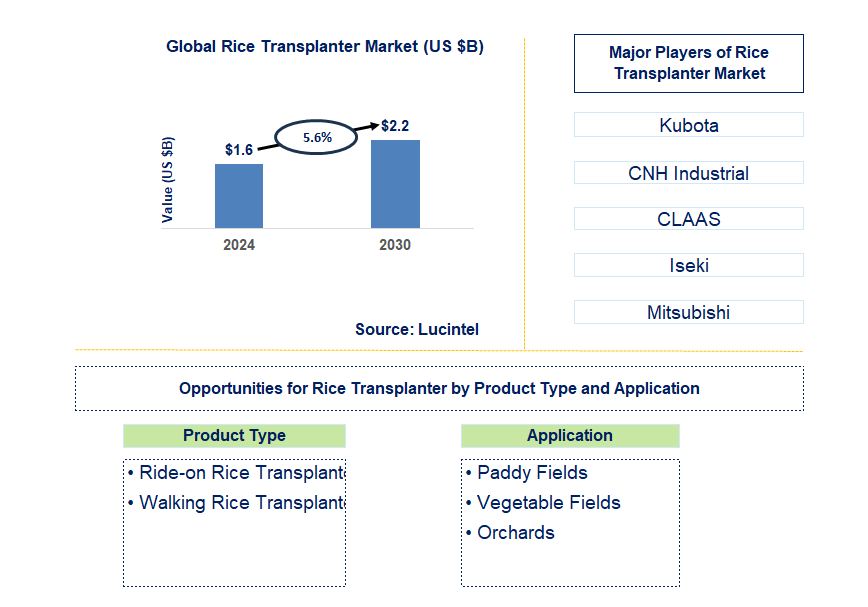
Key data points: The market size in 2030 = $2.2 billion, growth forecast = 5.6% annually for the next 6 years. Scroll below to get more insights. This market report covers trends, opportunities, and forecasts in the global rice transplanter market to 2030 by product type (ride-on rice transplanter and walking rice transplanter), application (paddy fields, vegetable fields, and orchards), and region (North America, Europe, Asia Pacific, and the Rest of the World)
We'll send your sample report shortly.
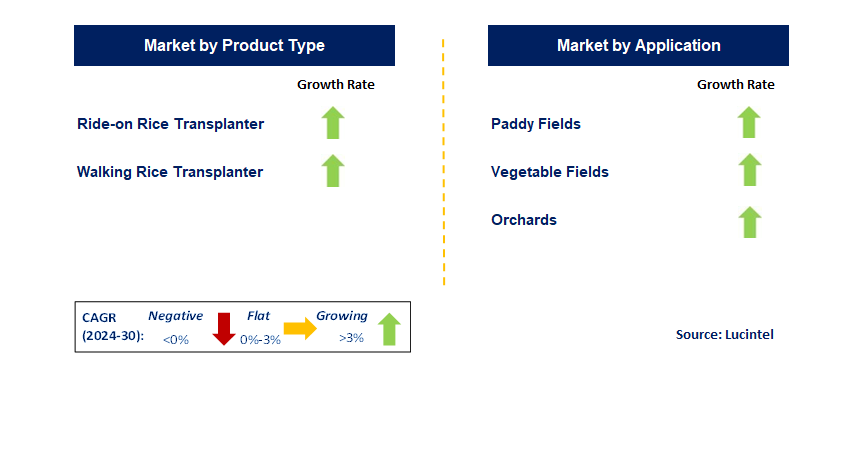
• Lucintel forecasts that, within the product type category, ride on rice transplanter is expected to witness the highest growth over the forecast period due to high-speed and multi-row capabilities, growing demand for rice globally, and it provides superior operational performance compared to that of manual transplanting.
• In terms of regions, APAC will remain the largest region over the forecast period due to growing rice production in countries such as India, Indonesia, and Thailand, rising demand for transplanting equipment owing to the increasing mechanization of field operations, as well as, increasing adoption of precision farming techniques across various agricultural fields including rice cultivation. Gain valuable insights for your business decisions with our comprehensive 150+ page report.
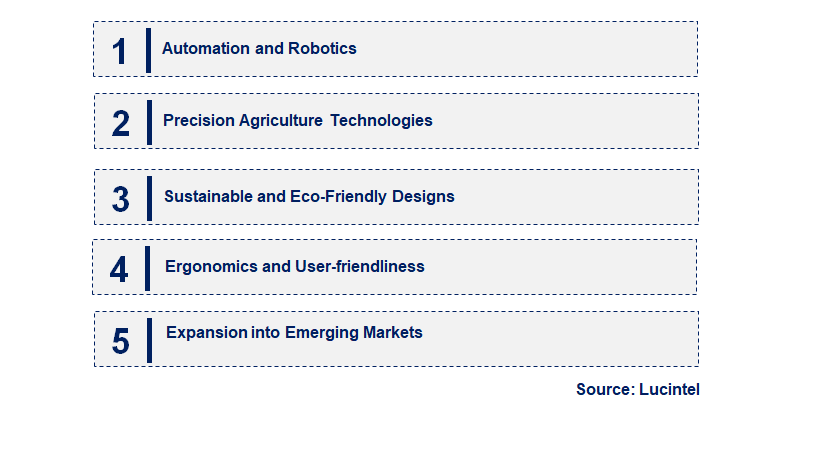
• Automation and Robotics: Rice transplanters are increasingly being automated and robotized to make the planting process more efficient and exact. Robotic and automated systems decrease human effort in planting while improving placement orientation. These technologies help address labor shortages, improve productivity, and ensure consistent planting across large fields. It will become cheaper as automation technology progresses and is adopted by different farming settings.
• Precision Agriculture Technologies: The use of precision agriculture technologies like GPS and GIS is revolutionizing rice transplanting activities. Use of precise agro-technology facilitates more accurate planting as well as field management practices hence optimizing resource utilization with minimal wastage. Such developments assist farmers in achieving better crop yields thus enhancing general efficiency. This shift towards precision agriculture comes from a need for higher output levels due to the increasing population densities that strive to sustain modern farming practices.
• Sustainable and Eco-Friendly Designs: Rice transplanters are becoming more sustainable and environmentally friendly. There is a need to develop sustainable designs that will reduce environmental impact through the use of energy efficient technologies and environmentally friendly materials. This trend supports global sustainability goals as well as consumer preferences for green technology. Manufacturers are developing rice planters which consume fewer resources, lower emissions and contribute towards a more sustainable agriculture.
• Ergonomics and User-friendliness: Rice transplanters design is now centered on ergonomics and user friendliness. Ergonomic designs enable users to work longer without fatigue since comfort is improved. Machines are made more accessible and efficient through user-friendly interfaces and controls. This trend is essential in improving working conditions and facilitating adoption of mechanized transplanting methods.
• Expansion into Emerging Markets: Penetration of emerging regions with rice transplanter market has begun. Increased demand for rice transplanters resulting from mechanized farming and improved agricultural practices in the emerging economies. Manufacturers have adapted their products to suit these markets by providing cost-effective but durable solutions. Results show that this expansion opens up new growth avenues in this industry, leading to innovations. The industry is being reshaped by emerging trends in the rice transplanter market such as automation and robotics, precision agriculture technologies, sustainable designs, ergonomic features, and market expansion. Such changes are brought about by technological advancements, increasing demand for efficiency and a sustainability focus which has led to more innovative and effective rice transplanting solutions.
• Advanced Robotic Transplanters: Advanced robotic rice transplanters have emerged with more sophisticated sensors and AI that enhances planting accuracy and efficiency. These machines can navigate fields with ease, choose seedlings for transplantation precisely and perform multiple tasks at once. This innovation addresses labor shortages as well as increase productivity hence making robotic transplanters a significant advancement in modern agriculture.
• Integration of GPS and GIS Technology: The use of global positioning systems (GPS) as well as geographic information systems (GIS) into the transplanting equipment for rice is increasing accuracy in planting and controlling fields. The GPS and GIS help to provide accurate control on seeding rate, seed placement which enable optimum resources utilization with minimum wastage. This move improves the efficiency of rice transplants thereby supporting the uptake of precision agriculture.
• Sustainable and Eco-Friendly Designs: Manufacturers have been concentrating their efforts on sustainable and eco-friendly designs that utilize energy efficient technologies and eco-friendly materials for rice transplanters. These designs are meant to minimize environmental impacts alongside addressing worldwide sustainability objectives. This change is in line with technological shift towards greener methods that support safer environment agricultural practices.
• Ergonomic and User-Friendly Features: Modern developments in transplanted rice cultivation technology have resulted in changes aimed at enhancing usability such as user friendly designs. Some of the new models come with adjustable handles, easy grips, intuitive controls among others thus enhancing user comfort while reducing fatigue. These are vital considerations when it comes to improving labor conditions as well as increasing mechanized transplanting solutions adoption rates.
• Expansion of Market: Offerings The market for rice transplanters is expanding with new market offerings designed for various agricultural settings as well as diverse needs of farmers. Low-cost and durable models have been introduced by manufacturers targeting the small and medium farms while advanced machines are made for large scale operations. This assists in serving wide-ranging demands of global rice cultivation sector and propels market growth. Changes in the rice transplanter industry are attributed to recent advancements that include robotization, GPS and GIS integration, sustainability designs, ergonomic designs, law enforcement oriented features and increased options to the markets. These changes will improve processes in the needle seeder technology leading to having more accurate planting methods therefore changing how it is currently done.
• Expansion of automated transplanters: This opportunity lies in the expansion of robotic rice transplanters. Machines for other farm duties will be developed with advancement in robotic technology allowing them to vary their functions for example as per field requirements. Investing in robotic transplanters can address labor shortages and increase efficiency, making it a key growth area in modern agriculture.
• Development of Precision Agriculture Solutions: The development of precision agriculture solutions like GPS and GIS based rice transplanters presents an opportunity for growth. Planting accuracy is improved using such and reduces wastage hence resource optimization and improved yields. Manufacturers can tap into this trend by providing modernized, innovative precision farming solutions.
• Focus on Sustainable and Eco-Friendly Products: Developing sustainable and eco-friendly rice transplanters is a growing opportunity. For that reason, consumers as well as companies are buying those products with less environmental impact while at the same time raising awareness over the importance of greening their businesses. This market can be tapped by developing energy efficient trans-planters made from eco-concerned materials that meet global sustainability objectives.
• Innovation in Ergonomic and User-Friendly Designs: Developing ergonomic as well as user friendly designs is a chance for growth by improving operators’ comfort and reducing weariness. These include adjustable handles and intuitive controls that make the rice transplanters more available, efficient among other additional features. It is an important development that increases adoption and improves overall users’ experience.
• Market Penetration in Emerging Regions: The strategic growth opportunity is to expand into emerging regions with growing agricultural activities. There is a need for cheap and durable rice transplanters due to the fact that mechanized farming becomes popular in these places. Manufacturers should be able to serve these markets by giving tailor-made solutions that respond to local requirements and situations, hence promoting expansion of business through increased market presence. Strategic growth opportunities in the rice transplanter market include expanding robotic systems, developing precision agriculture solutions, focusing on sustainability, innovating ergonomics designs, and penetrating emerging markets. These opportunities demonstrate progress made by the industry through technological breakthroughs, evolving customer tastes plus farming trends resulting into sustainable development in the future of rice transplanting sector.
• Kubota
• CNH Industrial
• CLAAS
• Iseki
• Mitsubishi
• Yanmar
• Mahindra & Mahindra
• TYM
• Jiangsu World Agriculture Machinery
• Ride-on Rice Transplanter
• Walking Rice Transplanter
• Paddy Fields
• Vegetable Fields
• Orchards
• North America
• Europe
• Asia Pacific
• The Rest of the World
• United States: The United States market of rice transplanter is moving towards precision agriculture and automation. The introduction of advanced rice transplanters with GPS or GIS technology will improve planting accuracy and optimize field operations. These machines are built to work more effectively on large farms while reducing labor costs incurred through traditional methods of transplanting. The US market focuses on high-efficiency and precision farming thus there is ongoing emphasis on development of equipment which can handle varying soil types under diverse field conditions.
• China: China is one of the largest producers of rice, and is witnessing great strides in rice transplanters, with the adoption of technology as well as automation. Among recent developments are fully automated rice transplanters that can execute multiple tasks such as planting, fertilizing and weeding in one stroke. These innovations are aimed at addressing labor shortages while increasing yield productivity. Furthermore, there is much attention given to the development of models that suit different terrains and small-scale farms common in China thereby improving their flexibility as well as efficiency in transplanting rice.
• Germany: Precision and environmental sustainability are key considerations in Germany rice transplanter market. German manufacturers are developing high-tech transplanters which use advanced sensors and data analytics to optimize seed placement and planting density. Resource consumption is thus reduced by these machines while their impact on the environment is minimized thereby meeting broader goals for sustainable development within Germany. Moreover, more of these companies have adopted electric or hybrid versions that emit less pollutants and decrease operational costs in line with green agricultural technology orientation towards energy efficiency
• India: The rice transplanter industry in India is growing very fast due to mechanization of farming methods. Latest innovations include affordable and long-lasting rice transplanters that can be used by small and medium scale farmers. These machines are designed with a focus on making them user-friendly and efficient, which will enable many Indian farmers to acquire them. Consequently, it is essential for developing transplanters that can effectively perform even on difficult soils or terrains thus serving the different agricultural needs of India’s diverse agriculture.
• Japan: Automation and precision engineering have been the hallmarks of the rice planter markets in Japan. The Japanese manufacturers are coming up with highly automated rice planting machines that employ advanced robotic systems and AI for accurate planting and field management purposes. They are efficient enough to be used on farmlands covering less than an acre. Furthermore, ergonomic design has become a main concern as well as user interfaces in order to improve labor conditions and operational efficiency in agriculture as practiced in Japan.


• Kubota
• CNH Industrial
• CLAAS
• Iseki
• Mitsubishi
• Yanmar
• Mahindra & Mahindra
• TYM
• Jiangsu World Agriculture Machinery Q6. Which rice transplanter market segment will be the largest in future? Answer: Lucintel forecasts that ride on rice transplanter is expected to witness the highest growth over the forecast period due to high-speed and multi-row capabilities, growing demand for rice globally, and it provides superior operational performance compared to that of manual transplanting. Q7. In rice transplanter market, which region is expected to be the largest in next 5 years? Answer: APAC will remain the largest region over the forecast period due to growing rice production in countries such as India, Indonesia, and Thailand, rising demand for transplanting equipment owing to the increasing mechanization of field operations, as well as, increasing adoption of precision farming techniques across various agricultural fields including rice cultivation. Q.8 Do we receive customization in this report? Answer: Yes, Lucintel provides 10% customization without any additional cost.


Choose a license that fits your team. Instant PDF delivery.
Prices exclude taxes. Instant delivery. Custom licensing available on request.
Market Report · July 31, 2026
Market Report · July 31, 2026
Market Report · July 31, 2026
Trusted partner for strategic intelligence and business growth


Receive a complimentary market analysis tailored to your industry. Our analysts will identify key growth opportunities and competitive dynamics specific to your business.

Market size, growth rate, and key trend analysis for your specific sector.

Top competitor positioning and market share analysis.

Strategic recommendations backed by data-driven insights.
Get curated market intelligence and competitive moves straight to your inbox.
By subscribing, you agree to receive our monthly insights. Unsubscribe anytime.
Receive a complimentary market analysis tailored to your industry. Our analysts will identify key growth opportunities and competitive dynamics specific to your business.
Market size, growth rate, and key trend analysis for your specific sector.
Top competitor positioning and market share analysis.
Strategic recommendations backed by data-driven insights.
Get curated market intelligence, emerging trends, and competitive moves straight to your inbox each month.
By subscribing, you agree to receive our monthly insights. Unsubscribe anytime.
We'll send your sample report shortly.