
Market Report · May 18, 2026

This market report covers trends, opportunities, and forecasts in the global resonators market to 2031 by technology (piezoelectric, mems, surface acoustic wave, bulk acoustic waves, and others), application (telecommunication, alarms and detection, military and space, automotive, and others), and region (North America, Europe, Asia Pacific, and the Rest of the World)
We'll send your sample report shortly.
![Resonator Market Trend and Forecast by Application [Value from 2019 to 2031]:](https://lucintel.com/images/Resonator-Technology-Market-Segment.png "Resonator Market Trend and Forecast by Application [Value from 2019 to 2031]:")
• Adoption of MEMS Resonators: The shift from quartz-based to MEMS resonators is gaining momentum due to their compact size, low power consumption, and high reliability. MEMS technology allows for seamless integration into modern electronic devices, catering to the demands of IoT applications and 5G networks.
• Integration with 5G and IoT Devices: The deployment of 5G technology and IoT devices requires resonators that have high-frequency stability and low-phase noise. The resonators are being optimized for these needs, which has been driving innovation in signal processing and communication technologies.
• Temperature Compensated Resonators: Temperature-compensated resonators are gaining importance as they ensure performance under different environmental conditions. These resonators are particularly valuable in automotive and industrial applications where temperature fluctuations are common.
• Miniaturization and Low-Cost Manufacturing: The requirement for compact and low-cost resonators is driving innovation in manufacturing techniques, including wafer-level packaging. Such innovations improve production efficiency and meet the requirements of consumer electronics and wearable technologies.
• Advances in Wideband Resonator Technology: Wideband resonators are being developed to meet the need for higher bandwidth in telecommunications and radar systems. Their ability to support multiple frequency bands is expanding their application scope in the defense and commercial sectors. These emerging trends in the field of resonator technology are driving tremendous development of communication, sensing, and processing capabilities. From MEMS integration to wideband support, resonators continue evolving to meet the rapidly changing needs of various sectors in the industry, ultimately providing better performance, reliability, and versatility in modern electronic systems.

• Potential in Technology: These devices exploit resonance phenomena to filter signals with high precision, enable ultra-stable frequency generation, and detect minute changes in physical or environmental conditions. Their compact size, low power consumption, and integration capability with CMOS circuits make them ideal for next-gen applications in 5G, IoT, and wearable devices.
• Degree of Disruption: The degree of disruption is high, especially in sectors like RF communications and precision sensing, where resonators can replace bulkier, less efficient legacy components. In quantum technologies, optical resonators are critical in controlling and reading quantum states, promising breakthroughs in secure communication and advanced computing.
• Current Technology Maturity Level: In terms of technology maturity, MEMS resonators are relatively mature and commercially deployed, while photonic and quantum resonators are at experimental to early commercial stages, requiring further refinement.
• Regulatory Compliance: Regulatory compliance varies by application. For telecommunications and medical devices, strict standards apply regarding signal interference, electromagnetic compatibility, and biocompatibility. Resonator technology generally aligns well with existing frameworks but must be validated on a case-by-case basis depending on the end use.
• Abracon: Abracon has introduced ultra-miniature MEMS-based resonators, which are ideal for IoT and wearable applications. They are characterized by improved stability, low power, and form factors, offering compact, energy-efficient designs for portable electronics.
• IQD Frequency Products: IQD has introduced a series of high-frequency crystal oscillators that incorporate advanced temperature-compensated resonators. They are suitable for telecommunications and 5G applications, ensuring improved frequency stability under varying environmental conditions, thus ensuring reliable network performance.
• Microchip Technology: Microchip Technology has developed resonators with an extended frequency range and low jitter characteristics for precision timing applications. These innovations are crucial in aerospace and defense where reliability and accuracy are at their best.
• Murata Manufacturing: Murata has launched wideband resonators that have been optimized for high-speed data transmission in automotive and industrial applications. These products will allow for better communication in connected vehicles and smart factories.
• SHOULDER Electronics: SHOULDER Electronics has concentrated on packaging resonators into multifunctional modules for IoT applications and, therefore, reduced the number of discrete components and improved the design process.
• SiTime: SiTime led the MEMS resonator revolution with programmable features that support customizing the resonators to specific application requirements for consumer electronics and data centers. This flexibility supports faster development cycles and broader adoption.
• Token Electronics Industry: Token Electronics has also offered high-temperature resonators that are designed for particularly adverse environments, such as the oil and gas exploration segment; these operate reliably under any extreme conditions.
• TXC: TXC company also launched ultra-low-phase noise resonators, which improve clarity for high-frequency communication systems. These products are critical in next-generation wireless networks as well as satellite communications. These innovations are driving major transformations in the resonator market to enable higher performance, broader functionality, and increased reliability in various industries.
• Advances in MEMS Technology: The market is gaining due to the transition from conventional quartz resonators to MEMS resonators. This innovation provides MEMS devices with improved size, power efficiency, and integration capabilities that add more functionality to portable electronics, IoT devices, and wearables. This further broadens the scope of application in consumer and industrial segments.
• Increased Demand Due to 5G Connectivity: The rollouts of 5G networks have rapidly increased the demand for resonators that operate at high frequency and low phase noise. Their primary application is to enable signal clarity and stability during faster data transmission. This development therefore is promoting the production of resonators that can support communication within faster speeds and better network performance.
• Integration in Automotive and Aerospace Applications: Resonators are becoming critical to the automotive and aerospace industries with applications in GPS, ADAS, and satellite communications. Their reliability and precision are enhancing safety and operational efficiency in those industries.
• Miniaturization and Energy Efficiency Trends: Demand for smaller, energy-efficient components is driving innovation in resonator designs. Modern resonators are being developed to meet the compactness requirements of IoT devices, wearable tech, and other portable solutions, thus contributing to energy savings and longer device lifespans. Challenges
• Supply Chain and Material Costs: The main challenges for the resonator industry include sourcing materials and manufacturing capabilities that affect timelines and costs of manufacturing. Investment in more robust supply chain strategies and innovative materials to ensure production stability is necessary to overcome such challenges. Opportunities and challenges influence the resonators technology market. Opportunities, such as MEMS technology, 5G connectivity, and miniaturized, energy-efficient components, are driving growth and innovation in the industry. However, challenges like supply chain constraints and regulatory requirements need to be managed to ensure sustained growth.
• Abracon
• IQD Frequency Products
• Microchip Technology
• Murata Manufacturing
• Shoulder Electronics
• Sitime
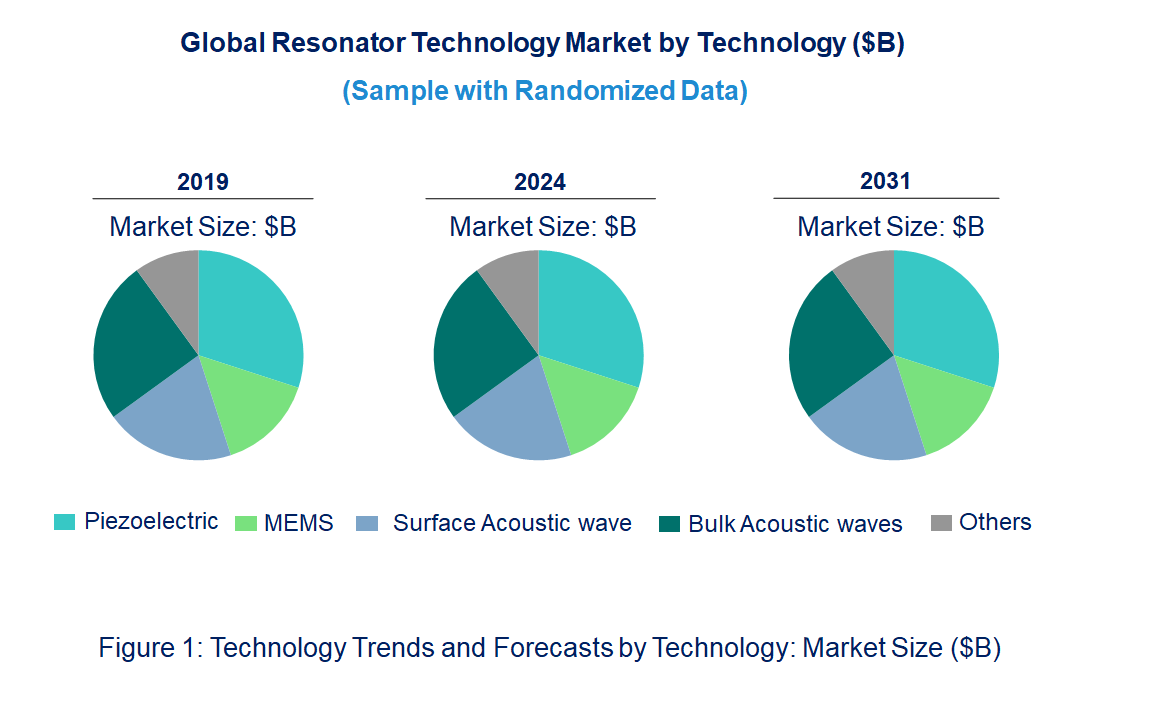
• Technology Readiness by Technology Type: Piezoelectric resonator are mature and are utilized in applications like sensors, actuators, and basic frequency controls. MEMS is more ready to be mass-deployed and supports the development of high-performance wearable electronics, IoT devices, and high-speed communication devices. SAW resonators find readiness in RF filtering of mobile devices and GPS systems. BAW resonator are prepared for high-frequency telecom applications and, in particular, 5G networks, where such applications require a high level of stability and precision. Other technologies, such as dielectric and optical resonator, are emerging and show promise for applications needing ultra-high frequency responses and reduced power consumption. Each technology’s readiness goes a long way in impacting its adoption, with MEMS and BAW leading into advanced consumer electronics and the telecom sectors.
• Disruption Potential by Technology Type: The disruption potential of resonator technologies varies highly. Piezoelectric resonator are simple and reliable, but less competitive with other advanced options. MEMS resonator have revolutionized the market, allowing for systems that are smaller, more integrated, and consume less power. Surface Acoustic Wave (SAW) resonators are highly effective in high-frequency applications, such as RF filters, but not as effective when miniaturized compared to MEMS. High-frequency stability bulk acoustic wave resonator are necessary for the future of 5G and telecommunications applications, albeit requiring more sophisticated fabrication, as are other novel technologies optomechanical and dielectric resonator. Each technology will disrupt the niche differently in which they are used, but MEMS and BAW will spur innovation in small, power-efficient designs of next-gen electronics.
• Competitive Intensity and Regulatory Compliance: The market of resonator is highly competitive as the product requirement is highly precise and miniaturized parts across industries. Piezoelectric and SAW face pressure from MEMS mainly due to efficiency and capabilities of integration. The stringent regulation compliance, especially for the telecommunications industry for safety and performance standards for MEMS and BAW resonator. Furthermore, the use and manufacture of piezoelectric materials must adhere to environmental as well as safety regulations, impacting the cost and availability.
• Piezoelectric
• MEMS
• Surface Acoustic wave
• Bulk Acoustic waves
• Others
• Telecommunication
• Alarms and Detection
• Military and Space
• Automotive
• Others
• North America
• Europe
• Asia Pacific
• The Rest of the World
• Latest Developments and Innovations in the Resonator Technologies
• Companies / Ecosystems
• Strategic Opportunities by Technology Type


Choose a license that fits your team. Instant PDF delivery.
Prices exclude taxes. Instant delivery. Custom licensing available on request.
Market Report · May 18, 2026
Market Report · May 18, 2026
Market Report · May 18, 2026
Trusted partner for strategic intelligence and business growth


Receive a complimentary market analysis tailored to your industry. Our analysts will identify key growth opportunities and competitive dynamics specific to your business.

Market size, growth rate, and key trend analysis for your specific sector.

Top competitor positioning and market share analysis.

Strategic recommendations backed by data-driven insights.
Get curated market intelligence and competitive moves straight to your inbox.
By subscribing, you agree to receive our monthly insights. Unsubscribe anytime.
Receive a complimentary market analysis tailored to your industry. Our analysts will identify key growth opportunities and competitive dynamics specific to your business.
Market size, growth rate, and key trend analysis for your specific sector.
Top competitor positioning and market share analysis.
Strategic recommendations backed by data-driven insights.
Get curated market intelligence, emerging trends, and competitive moves straight to your inbox each month.
By subscribing, you agree to receive our monthly insights. Unsubscribe anytime.
We'll send your sample report shortly.