
Market Report · July 31, 2026

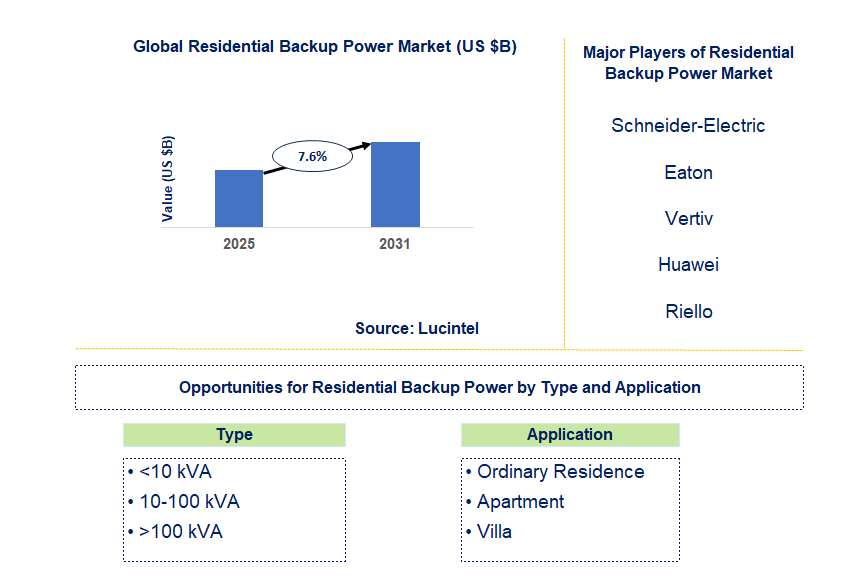
Key data points: The growth forecast = 7.6% annually for the next 7 years. Scroll below to get more insights. This market report covers Trends, opportunities and forecasts in residential backup power market to 2031 by type (<10 kva, 10-100 kva, and >100 kva), application (ordinary residence, apartment, and villa), and region (North America, Europe, Asia Pacific, and the Rest of the World)
We'll send your sample report shortly.
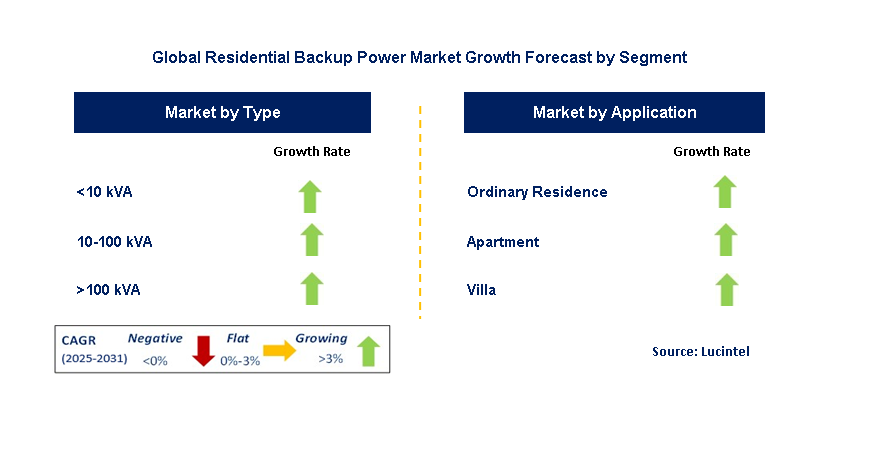
• Lucintel forecasts that, within the type category, >100 kva is expected to witness the highest growth over the forecast period due to the increasing reliance on backup power for larger residential or commercial applications.
• Within the application category, villa is expected to witness the highest growth due to the growing space requirement.
• In terms of region, North America is expected to witness the highest growth over the forecast period due to the growing adoption of backup power solutions.
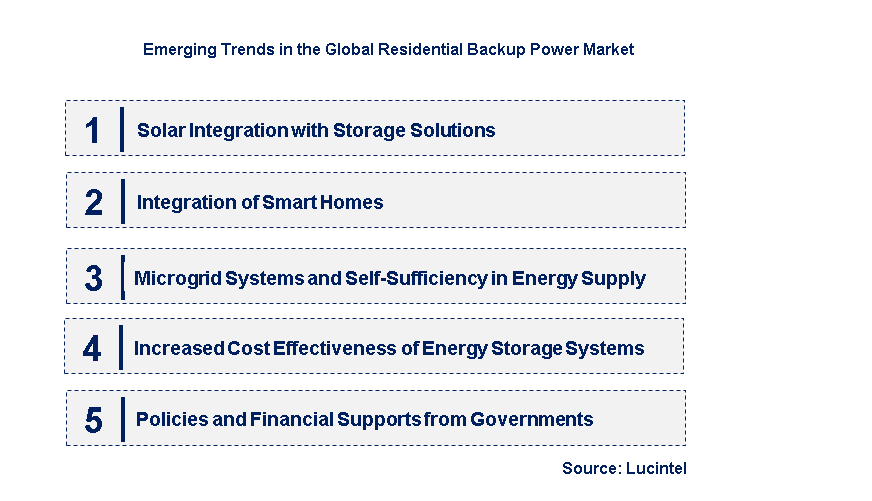
• Solar Integration with Storage Solutions: The innovative combination of solar energy systems and energy storage technologies enables self-sufficient energy systems. This greatly reduces the reliance on the grid while also providing definitive backup during power interruptions. This trend is further fueled by the increasing affordability of solar panels and batteries, alongside energy self-sufficiency's heightened popularity. Self-sustaining systems can clearly be seen as solar plus storage solutions will continue to lead the residential backup power market.
• Integration of Smart Homes: Residential backup power systems have become significantly enhanced with the development of smart home technologies. The integration of smart systems with backup power systems allows for better control over energy consumption and effective remote access. Smart home systems enable the prioritized provision of critical energy-guzzling services, for instance, lights and fridges, during outages while ensuring lower energy use. This trend ensures efficient usage of reserve power and cuts the risk of critical functions being non-operational in times of power shutdowns during the day.
• Microgrid Systems and Self-Sufficiency in Energy Supply: In recent years, microgrids have become more popular for use in residential backup power systems. When paired with solar panels and batteries, microgrids allow homes to function independently of the central power grid, powering and storing energy. This approach can be supplemented with other renewable sources like wind power to improve reliability. This trend is especially important in the context of natural disasters or for rural areas with an unstable grid. Microgrids offer homeowners greater energy security and resiliency as these systems are more flexible and robust than conventional systems.
• Increased Cost Effectiveness of Energy Storage Systems on Batteries: In particular, the price of energy storage systems with lithium-ion batteries has drastically declined, now making backup power systems affordable for many households. The combination of developing technologies along with lower manufacturing costs is consistently lowering the price of backup energy storage systems, and as a result, more consumers are willing to incorporate them in their homes. With advanced developments in energy storage and these systems remaining economically viable, backup energy solutions will be easily attainable for homeowners looking to increase the reliability of their electricity supply.
• Policies and Financial Supports from Governments: Policies and financial supports from the government are important factors that affect the growth of the residential backup power market. Several nations have initiated tax reductions and subsidies as a means to incentivize homeowners to install renewable energy systems with backup power features. These systems are too costly for many consumers, and these incentives help break those financial barriers. As governments keep focusing on sustainability and energy self-sufficiency, this is likely to boost market growth, especially in areas with high energy costs or regular power interruptions. These emerging trends point out the construction of the residential backup power market. The integration of solar power with storage systems, smart home devices, shrinking costs of energy storage, and supportive government policies add up and make the market more open, competitive, and robust. These trends combined will lead to more consumers wanting residential backup power systems due to the need for reliable and clean energy solutions.
• Better Battery Storage Technology: Advanced battery technologies such as lithium-ion batteries have greatly improved in efficiency, economy, and scaling storage capabilities. Because of these developments, battery power systems are becoming more and more reliable and less costly for homeowners. The declining price of battery storage is leading to greater consumer uptake, and wide adoption of these systems is improving backup power solutions to a greater segment of homeowners.
• Adoption of Solar-Plus-Storage Systems: Solar-plus-storage systems have become popular among homeowners who require supplementary power, as these systems are capable of generating and storing power independently without depending on the grid, which makes them more available during outages. As technology costs continue to decline, and as governments encourage their use, the combination of solar and storage systems is increasingly viewed as an economical and viable energy solution.
• Rise of Microgrids: In the residential backup power industry, the concept of microgrids, which enables homes to function autonomously from the primary grid, is becoming popular. Microgrids serve to enhance energy self-sufficiency by letting homeowners produce, store, and manage their power. This is particularly useful for residing in regions with weak grid connectivity or experiencing frequent outages, as it increases resilience against disruptions and ensures smooth access to power when needed.
• Smart Backup Systems: The adoption of modern technology in the backup power systems is changing the way homeowners utilize energy during outages. The intelligent systems enable users to track and manage their backup power systems remotely, for example, via mobile phones, which increases user engagement with energy consumption. These systems can further be configured to automatically give priority to essential energies while limiting non-critical ones, resulting in enhanced efficiency and ease of use.
• Enhanced Aid and Support from the Governments: The governments are keen to promote the adoption of backup power systems across the globe by providing tax credits, rebates, and subsidies. These incentives lower the cost of installation for homeowners, encouraging more people to invest in these systems. Moreover, governments are also implementing policies to promote renewable energy and strengthen the grid, which in turn will expand the residential backup power market. The developments in backup power systems are seen as the result of a growing and multi-faceted demand for residential solutions that is being driven by the need for reliability, sustainability, and energy self-sufficiency. Advances in technologies in battery storage, the deployment of solar-plus-storage systems, and greater government support are all factors that are transforming the residential backup power market by making these solutions more effective and economical for homeowners.
• Solar-Plus-Storage Systems: With the lowering of prices for solar panels with energy storage systems, it has become easier for homeowners to ensure energy independence. Additionally, government incentives are paving the way for us to spend less time on the grid. As a result, solar-plus-storage systems will increasingly become prominent in residential backup power markets. This will further strengthen the residential power market.
• Energy Storage Systems for Grid Resilience: More areas that suffer from natural disasters and frequent outages are relying on energy storage systems to guarantee a continuous power supply during grid disruptions. This shift provides a huge opportunity for companies that seek to enhance energy storage reliability for households.
• Smart Home Energy Management: Advanced smart home energy management systems are giving new life to the residential backup power market by providing the ability for homeowners to control and monitor their energy use. This makes it easier for businesses to develop efficient backup energy systems, user-friendly, cater to the demand, and most importantly, eliminate issues with smart technology integration.
• Grid Solutions for Areas that Are Slums: Off-grid technologies are increasing in popularity in hard to reach areas where electricity is not consistently available. Backup residential power systems, such as solar and storage systems, along with microgrids, ensure that energy is available to the house. The increasing movement toward off grid energy sources enables these untapped regions to be targeted by additional companies and new products chosen for sale.
• Recycling Batteries and Achieving Sustainability: Alongside the increasing popularity and expansion of residential backup power systems, there is also a growing need for sustainable methods of recycling used batteries. This trend can be taken advantage of by providing advanced and green methods for recycling technology. This opportunity also strategically resonates with the international adoption of sustainable and circular economy approaches. Thus, a green investment will be delivered while achieving financial proceeds. The sector of residential backup power, particularly in slums, has many distinct opportunities for growth that can be capitalized on. Additional areas include but are not limited to an expansion of solar energy captured in storage systems, increased power usage controls, off grid approaches, along with more novel methods of saving and utilizing energy. All these should naturally result in more economical, environmentally friendly, and efficient solutions to energy use.
• Schneider-Electric
• Eaton
• Vertiv
• Huawei
• Riello
• KSTAR
• CyberPower
• Socomec
• Toshiba
• EAST
• <10 Kva
• 10-100 Kva
• >100 Kva
• Ordinary Residence
• Apartment
• Villa
• North America
• Europe
• Asia Pacific
• The Rest of the World
• United States: In the US, concern over grid reliability, coupled with extreme weather incidents like hurricanes and wildfires, has led to the residential backup power market expanding significantly. The use of batteries like the Tesla Powerwall has greatly increased as homeowners can now save energy from their solar panels. These systems are more affordable due to federal and state subsidies like tax credits and rebates for solar and backup systems. Microgrid technologies are also increasing in popularity, giving homeowners more control over their power supply, especially in remote or disaster-prone areas.
• China: Upon focusing on energy resilience while trying to reduce its carbon footprint, the Chinese residential backup power market is growing well. Homeowners are increasingly adopting solar-plus-storage solutions due to government subsidies that encourage the installation of home energy storage systems. China is also lowering costs and improving efficiency due to its position as a global leader in battery storage systems production. These advancements are making residential backup power solutions more reachable, especially in rural areas where grid reliability is a concern. The Chinese government’s unwavering commitment to renewable energy further aids in strengthening the market’s growth.
• Germany: Germany has made great strides in the market for residential backup power, primarily as a result of the country’s commitment to renewable energy and energy self-sufficiency. The integration of solar power and energy storage systems is helping homeowners to store excess energy that can be used during outages. Government policies, such as the Renewable Energy Sources Act (EEG), have facilitated the adoption of solar and battery systems through grant schemes. In addition, the growing use of smart home technologies enables homeowners to manage power consumption and use of backup energy, which improves the efficiency of residential backup systems.
• India: the Indian market for residential backup power is growing at an unprecedented rate, especially in cities where outages are common due to power supply problems. The high cost of electricity and the need for a responsible energy policy have encouraged many homeowners to invest in solar power systems with battery storage for backup energy. The Indian government is providing various inducements to promote the use of solar energy, such as subsidies and tax credits. These measures are capturing the installation of backup power systems at a lower initial investment. In addition, the growing concern about the environment and the need for cleaner energy make a strong case for the rapid expansion of this market.
• Japan: The Japanese residential backup power market is evolving as the country moves towards energy security and resilience after the 2011 Fukushima disaster. There is a growing adoption of home energy storage systems by homeowners, especially in conjunction with solar power. The government has done a lot in incentivizing the shift to solar and storage solutions. In addition, the country is also advancing in the smart grid technologies that make better management of distributed energy resources possible. Moreover, Japan’s population is very high, and its natural disasters like earthquakes and typhoons are very common. This has further increased the need for backup power solutions in the country to ensure uninterrupted energy supply.


• Schneider-Electric
• Eaton
• Vertiv
• Huawei
• Riello
• KSTAR
• CyberPower
• Socomec
• Toshiba
• EAST Q5. Which residential backup power market segment will be the largest in future? Answer: Lucintel forecasts that, within the type category, >100 kva is expected to witness the highest growth over the forecast period due to the increasing reliance on backup power for larger residential or commercial applications. Q6. In residential backup power market, which region is expected to be the largest in next 5 years? Answer: In terms of region, North America is expected to witness the highest growth over the forecast period due to the growing adoption of backup power solutions. Q7. Do we receive customization in this report? Answer: Yes, Lucintel provides 10% customization without any additional cost.


Choose a license that fits your team. Instant PDF delivery.
Prices exclude taxes. Instant delivery. Custom licensing available on request.
Market Report · July 31, 2026
Market Report · July 22, 2026
Market Report · July 20, 2026
Trusted partner for strategic intelligence and business growth


Receive a complimentary market analysis tailored to your industry. Our analysts will identify key growth opportunities and competitive dynamics specific to your business.

Market size, growth rate, and key trend analysis for your specific sector.

Top competitor positioning and market share analysis.

Strategic recommendations backed by data-driven insights.
Get curated market intelligence and competitive moves straight to your inbox.
By subscribing, you agree to receive our monthly insights. Unsubscribe anytime.
Receive a complimentary market analysis tailored to your industry. Our analysts will identify key growth opportunities and competitive dynamics specific to your business.
Market size, growth rate, and key trend analysis for your specific sector.
Top competitor positioning and market share analysis.
Strategic recommendations backed by data-driven insights.
Get curated market intelligence, emerging trends, and competitive moves straight to your inbox each month.
By subscribing, you agree to receive our monthly insights. Unsubscribe anytime.
We'll send your sample report shortly.