
Report Feature
Reseller Hosting Software Market Trends and Forecast
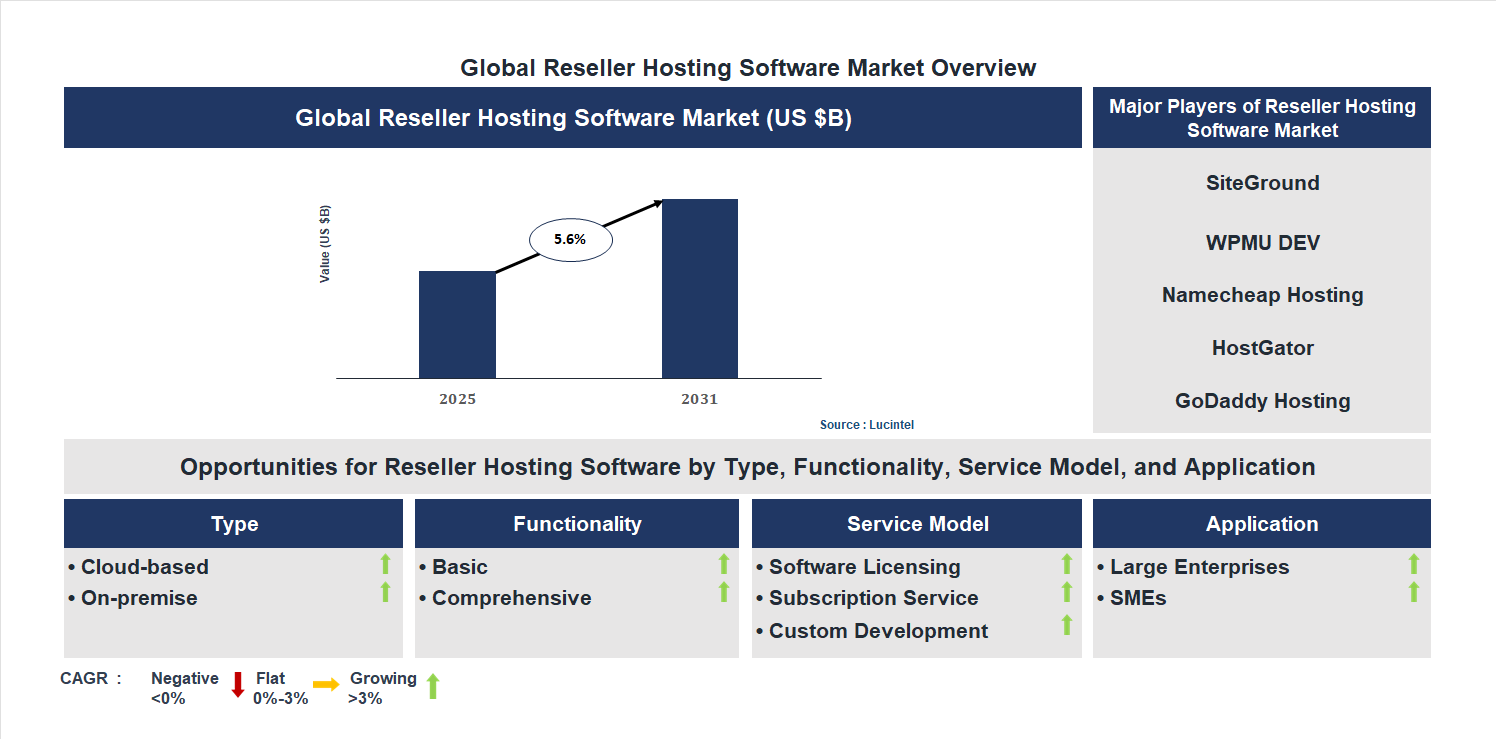
The future of the global reseller hosting software market looks promising with opportunities in the large enterprise and SME markets. The global reseller hosting software market is expected to grow with a CAGR of 5.6% from 2025 to 2031. The major drivers for this market are the increasing demand for web hosting services, the rising adoption of cloud based solutions, and the growing need for managed hosting platforms.• Lucintel forecasts that, within the type category, cloud-based is expected to witness higher growth over the forecast period.
• Within the application category, SME is expected to witness higher growth.
• In terms of region, APAC is expected to witness the highest growth over the forecast period. Gain valuable insights for your business decisions with our comprehensive 150+ page report. Sample figures with some insights are shown below.
Emerging Trends in the Reseller Hosting Software Market
The reseller hosting software market is experiencing rapid evolution driven by technological advancements, changing customer demands, and increased competition. As businesses seek more flexible, scalable, and cost-effective hosting solutions, providers are innovating to meet these needs. Emerging trends are shaping the landscape, influencing how services are delivered, managed, and consumed. These developments are not only enhancing operational efficiencies but also expanding market opportunities. Understanding these key trends is essential for stakeholders aiming to stay competitive and capitalize on new growth avenues in this dynamic industry.• Cloud Integration: Cloud integration is transforming reseller hosting by enabling seamless scalability and flexibility. Resellers can now offer cloud-based solutions that allow clients to easily expand or reduce resources without significant infrastructure changes. This trend reduces costs, improves reliability, and enhances user experience. Cloud integration also facilitates better data management and disaster recovery options, making hosting services more resilient. As cloud adoption grows, reseller platforms are increasingly incorporating cloud features, allowing providers to meet diverse client needs and stay competitive in a rapidly evolving market.
• Automation and AI Technologies: Automation and artificial intelligence are streamlining operations within the reseller hosting market. Automated provisioning, billing, and customer support reduce manual effort and minimize errors. AI-driven analytics help resellers understand customer behavior, optimize resource allocation, and personalize services. These technologies improve efficiency, reduce operational costs, and enhance customer satisfaction. As AI tools become more sophisticated, they enable resellers to offer smarter, more responsive hosting solutions, giving them a competitive edge and enabling rapid scaling in a competitive environment.
• Focus on Security and Compliance: Security remains a top priority as cyber threats increase and regulatory requirements tighten. Reseller hosting providers are investing in advanced security features such as DDoS protection, SSL certificates, and malware scanning. Compliance with standards like GDPR and HIPAA is becoming essential, especially for clients in regulated industries. Enhanced security measures build trust and protect both providers and clients from data breaches and legal penalties. This trend underscores the importance of robust security frameworks, influencing product development and customer retention strategies in the reseller hosting market.
• Green Hosting Initiatives: Sustainability is gaining prominence, with providers adopting green hosting practices to reduce environmental impact. This includes using energy-efficient data centers, renewable energy sources, and eco-friendly hardware. Green initiatives appeal to environmentally conscious clients and can serve as a differentiator in a competitive market. They also help companies meet corporate social responsibility goals and comply with environmental regulations. As awareness of climate change grows, green hosting is becoming a key factor influencing purchasing decisions, prompting providers to innovate in sustainable infrastructure and operations.
• Customization and White-Label Solutions: Customization and white-label services are increasingly in demand as resellers seek to differentiate their offerings. White-label solutions allow resellers to rebrand hosting services and tailor features to specific customer segments. This flexibility enables resellers to create unique value propositions, improve customer loyalty, and expand their market reach. Customization options include control panel branding, tailored support, and specialized hosting packages. The trend empowers resellers to build their brand identity while leveraging robust backend infrastructure, fostering growth and innovation in the reseller hosting software market. In summary, these trends are fundamentally reshaping the reseller hosting software market by enhancing flexibility, security, sustainability, and customer-centricity. They enable providers to deliver more scalable, secure, and environmentally responsible solutions, fostering innovation and competitive advantage. As these developments continue, the market is poised for significant growth, driven by technological advancements and evolving customer expectations.

Recent Development in the Reseller Hosting Software Market
The reseller hosting software market is experiencing rapid growth driven by increasing demand for affordable web hosting solutions and the expansion of small to medium-sized businesses online. Technological advancements and the rise of cloud-based services are further fueling this development. As businesses seek scalable and customizable hosting options, providers are innovating to meet these needs. This evolving landscape presents significant opportunities for market players to expand their offerings, improve customer experience, and capture new customer segments.• Growing Demand for Affordable Hosting Solutions: Reseller hosting software enables entrepreneurs and small businesses to start web hosting services with minimal investment, fostering market entry and competition. This affordability attracts new entrants, increasing market size and diversity. As more businesses seek cost-effective hosting options, reseller software providers benefit from higher adoption rates. The trend also encourages innovation in pricing models and service packages, making hosting more accessible. Overall, this growth enhances market competitiveness and broadens customer reach.
• Cloud Integration Enhances Scalability: Integration of cloud technology into reseller hosting software allows for seamless scalability and flexibility. This development enables resellers to easily adjust resources based on customer demand, improving service reliability and customer satisfaction. Cloud integration reduces infrastructure costs and simplifies management, attracting more resellers to adopt these solutions. As cloud technology becomes more mainstream, the market benefits from increased efficiency, faster deployment, and expanded service offerings, driving overall growth and innovation.
• Advanced Management Tools Improve Efficiency: New management features such as automation, analytics, and user-friendly dashboards streamline reseller operations. These tools reduce manual effort, minimize errors, and enhance service customization. Improved efficiency allows resellers to focus on customer acquisition and retention, boosting profitability. The availability of sophisticated management software also attracts larger resellers seeking comprehensive control over their offerings. This development fosters a more competitive environment, encouraging continuous innovation and better service quality across the market.
• Increased Focus on Security and Compliance: As cyber threats grow, reseller hosting software providers are prioritizing security features like SSL certificates, DDoS protection, and data encryption. Compliance with regulations such as GDPR enhances customer trust and reduces legal risks. These security enhancements are critical for attracting security-conscious clients and maintaining a reputation. The market benefits from increased confidence in hosting services, leading to higher adoption rates. Continuous improvements in security protocols are expected to further strengthen market stability and customer loyalty.
• Customization and White-Label Solutions Drive Differentiation: Providers are offering highly customizable and white-label reseller hosting software to enable brands to create unique hosting experiences. This flexibility allows resellers to tailor services to specific niches or customer needs, fostering differentiation in a competitive market. White-label solutions also reduce development costs and time-to-market for resellers. As demand for personalized hosting services grows, this trend encourages innovation and diversification, expanding market opportunities for providers and resellers alike. The overall impact of these developments is a more dynamic, scalable, and secure reseller hosting software market. Increased innovation, affordability, and customization options are attracting a broader customer base, fostering competition, and driving growth. As technology continues to evolve, the market is poised for sustained expansion, benefiting providers, resellers, and end-users through improved services and new opportunities.
Strategic Growth Opportunities in the Reseller Hosting Software Market
The reseller hosting software market is experiencing rapid growth driven by the increasing demand for affordable web hosting solutions and the expansion of small to medium-sized businesses online. As digital presence becomes essential, providers seek scalable, user-friendly, and cost-effective software to manage reseller operations efficiently. Innovations in automation, security, and integration are further fueling market opportunities. Companies that capitalize on these trends can gain competitive advantages, expand their customer base, and enhance profitability in this dynamic industry landscape.• Expansion Into Emerging Markets: Reseller hosting software providers can tap into emerging economies where internet adoption is accelerating. These regions present significant growth potential due to rising small business activity and digital transformation initiatives. Offering localized solutions, affordable pricing, and tailored support can help penetrate these markets effectively, driving revenue growth and establishing a strong foothold early in these developing digital ecosystems.
• Integration of Advanced Automation Tools: Incorporating automation features such as billing, provisioning, and customer management streamlines reseller operations. This reduces manual effort, minimizes errors, and enhances customer experience. Advanced automation also enables resellers to scale their services rapidly, handle larger client bases efficiently, and reduce operational costs. As automation technology evolves, providers that integrate these tools will attract more resellers seeking efficiency and reliability.
• Focus on Enhanced Security and Compliance: Security remains a top concern for web hosting clients. Reseller software that offers robust security features, including SSL management, malware scanning, and data encryption, appeals to security-conscious customers. Additionally, compliance with data protection regulations like GDPR can be integrated into the software, providing resellers with a competitive edge. Strengthening security features will foster trust and reduce the risk of breaches, encouraging more businesses to choose reseller hosting solutions.
• Development of White-Label Solutions for Branding Flexibility: White-label reseller hosting software allows providers to customize branding, logos, and interfaces, enabling resellers to present a unified brand experience. This flexibility attracts entrepreneurs and agencies looking to establish their own hosting brands without developing software from scratch. Offering customizable white-label solutions can increase reseller adoption, foster brand loyalty, and open new revenue streams for software providers.
• Adoption of Cloud-Based and Scalable Infrastructure: Cloud technology offers resellers scalable, reliable, and cost-efficient hosting environments. Cloud-based reseller software facilitates easy resource management, rapid deployment, and high availability. As businesses seek flexible solutions that grow with their needs, providers offering cloud integration will gain a competitive advantage. This shift also supports remote management and automation, making reseller hosting more accessible and appealing to a broader customer base. The overall market outlook is positively influenced by these growth opportunities, enabling providers to innovate, expand geographically, and meet evolving customer demands. Embracing automation, security, customization, and cloud solutions will drive sustainable growth, increase market share, and foster long-term success in the reseller hosting software industry.
Reseller Hosting Software Market Driver and Challenges
The reseller hosting software market is influenced by a variety of technological, economic, and regulatory factors that shape its growth and development. Rapid advancements in cloud computing, increasing demand for affordable web hosting solutions, and the proliferation of small and medium-sized enterprises (SMEs) seeking online presence are key drivers. Additionally, evolving regulatory standards around data security and privacy impact market operations. Competitive pressures from established providers and emerging startups also influence innovation and pricing strategies. Understanding these drivers and challenges is essential for stakeholders aiming to capitalize on market opportunities while navigating potential obstacles. The factors responsible for driving the reseller hosting software market include:-• Technological Advancements: Rapid innovations in cloud infrastructure and automation tools enable resellers to offer scalable, reliable, and feature-rich hosting solutions. These advancements reduce operational costs and improve service quality, attracting more resellers to adopt sophisticated software platforms. As technology continues to evolve, resellers can differentiate their offerings, meet customer expectations, and expand their market reach, fueling overall growth.
• Growing Demand for Cost-Effective Hosting Solutions: Small and medium-sized businesses increasingly seek affordable hosting options to establish their online presence without significant upfront investments. Reseller hosting software provides a lucrative opportunity for entrepreneurs to start hosting businesses with minimal capital. This rising demand drives software providers to develop user-friendly, flexible, and affordable platforms, further expanding the market.
• Expansion of E-commerce and Digital Presence: The surge in e-commerce activities and digital marketing initiatives has heightened the need for reliable web hosting services. Reseller hosting software enables entrepreneurs to tap into this trend by offering tailored hosting solutions to online stores and service providers. As digital adoption accelerates globally, the market benefits from increased reseller activity and software adoption.
• Regulatory and Security Standards: Increasing regulatory requirements around data privacy, security, and compliance compel hosting providers to adopt advanced security features. Reseller hosting software that integrates robust security protocols, SSL certificates, and compliance tools becomes more attractive. This drives demand for sophisticated software solutions capable of meeting stringent standards, ensuring trust and reliability in the market. The challenges facing this reseller hosting software market include:-
• Intense Competition and Price Wars: The reseller hosting industry is highly competitive, with numerous providers vying for market share. This leads to aggressive pricing strategies, squeezing profit margins for resellers and software providers alike. Staying ahead requires continuous innovation and differentiation, which can be resource-intensive and challenging for smaller players.
• Rapid Technological Changes: The fast-paced evolution of hosting technologies demands constant updates and upgrades to reseller software. Keeping pace with new features, security protocols, and infrastructure improvements requires significant investment and technical expertise. Failure to adapt can result in obsolescence and loss of competitive edge.
• Regulatory and Data Security Challenges: Navigating complex regulatory landscapes and ensuring compliance with data protection laws pose ongoing challenges. Data breaches or non-compliance can lead to legal penalties, reputational damage, and loss of customer trust. Reseller hosting providers must invest heavily in security measures and compliance frameworks, increasing operational costs. In summary, the reseller hosting software market is driven by technological innovations, increasing demand for affordable hosting, and the expansion of digital businesses. However, it faces challenges from intense competition, rapid technological changes, and stringent regulatory requirements. These factors collectively influence market dynamics, requiring stakeholders to innovate continuously and adapt swiftly. The overall impact is a vibrant yet competitive landscape that offers significant growth opportunities alongside notable risks, emphasizing the importance of strategic planning and technological agility.
List of Reseller Hosting Software Companies
Companies in the market compete on the basis of product quality offered. Major players in this market focus on expanding their manufacturing facilities, R&D investments, infrastructural development, and leverage integration opportunities across the value chain. With these strategies reseller hosting software companies cater increasing demand, ensure competitive effectiveness, develop innovative products & technologies, reduce production costs, and expand their customer base. Some of the reseller hosting software companies profiled in this report include-• SiteGround
• WPMU DEV
• Namecheap Hosting
• HostGator
• GoDaddy Hosting
• InMotion Hosting
• A2 Hosting
• HostPapa
• HostArmada
• InterServer
Reseller Hosting Software Market by Segment
The study includes a forecast for the global reseller hosting software market by type, functionality, service model, application, and region.Reseller Hosting Software Market by Type [Value from 2019 to 2031]:
• Cloud-based
• On-premise
Reseller Hosting Software Market by Functionality [Value from 2019 to 2031]:
• Basic
• Comprehensive
Reseller Hosting Software Market by Service Model [Value from 2019 to 2031]:
• Software Licensing
• Subscription Service
• Custom Development
Reseller Hosting Software Market by Application [Value from 2019 to 2031]:
• Large Enterprises
• SMEs
Reseller Hosting Software Market by Region [Value from 2019 to 2031]:
• North America
• Europe
• Asia Pacific
• The Rest of the World
Country Wise Outlook for the Reseller Hosting Software Market
The reseller hosting software market has experienced significant growth driven by increasing demand for web hosting services worldwide. As businesses and individuals expand their online presence, the need for scalable, reliable, and cost-effective hosting solutions has surged. Technological advancements, such as automation and cloud integration, have further propelled market development. Different countries are adopting innovative strategies to enhance their offerings, reflecting diverse market dynamics and consumer preferences. This evolving landscape presents opportunities for providers to innovate and capture new customer segments, while also facing challenges related to competition, security, and regulatory compliance.• United States: The US market has seen rapid adoption of advanced reseller hosting platforms with integrated automation tools, improving efficiency and customer experience. Major providers are investing in cloud-based solutions to offer scalable services, and there is a growing trend toward white-label hosting to enable branding flexibility. The market is also witnessing increased focus on security features and compliance with data protection regulations, such as GDPR and CCPA. Additionally, the rise of small and medium-sized enterprises (SMEs) adopting reseller hosting has expanded the customer base, fostering innovation in service customization and support.
• China: China's reseller hosting software market is expanding due to the rapid growth of e-commerce and digital businesses. Local providers are focusing on affordable, easy-to-use platforms tailored to small businesses and startups. The government’s push for digital infrastructure development has facilitated market growth, with an emphasis on integrating AI and automation to improve service delivery. There is also a rising trend of partnerships between local hosting companies and international software vendors to enhance technological capabilities. Regulatory policies are evolving, requiring providers to ensure compliance with data sovereignty and cybersecurity standards.
• Germany: The German market emphasizes high security, data privacy, and compliance with strict EU regulations, such as GDPR. Providers are adopting robust security protocols and offering eco-friendly hosting options to appeal to environmentally conscious clients. The market is characterized by a focus on enterprise-grade solutions with advanced management features and seamless integration with other cloud services. Local providers are also investing in customer support and multilingual interfaces to cater to diverse client needs. Innovation in automation and billing systems is helping providers streamline operations and improve customer satisfaction.
• India: The Indian reseller hosting software market is experiencing rapid growth driven by increasing internet penetration and digital adoption among small businesses and entrepreneurs. Providers are offering cost-effective, feature-rich platforms to cater to a price-sensitive market. There is a significant focus on localized solutions, including multilingual interfaces and regional payment integrations. The market is also witnessing a surge in cloud-based hosting services, with providers leveraging automation to reduce operational costs. Government initiatives promoting digital literacy and startup ecosystems are further fueling market expansion, with many local players entering the space to capture emerging opportunities.
• Japan: Japan’s reseller hosting market is characterized by a focus on high reliability, security, and customer support. Providers are integrating advanced security features and offering tailored solutions for industries such as finance and healthcare. The market is also seeing increased adoption of cloud and hybrid hosting models to meet diverse client needs. Automation tools are being used to improve operational efficiency, while local providers emphasize compliance with strict data privacy laws. The trend toward eco-friendly hosting solutions and energy-efficient data centers is gaining momentum, aligning with Japan’s sustainability goals. Innovation in user interface design and multilingual support enhances customer experience in this mature market.

Features of the Global Reseller Hosting Software Market
Market Size Estimates: Reseller hosting software market size estimation in terms of value ($B). Trend and Forecast Analysis: Market trends (2019 to 2024) and forecast (2025 to 2031) by various segments and regions. Segmentation Analysis: Reseller hosting software market size by various segments, such as by type, functionality, service model, application, and region in terms of value ($B). Regional Analysis: Reseller hosting software market breakdown by North America, Europe, Asia Pacific, and Rest of the World. Growth Opportunities: Analysis of growth opportunities in different types, functionalities, service models, applications, and regions for the reseller hosting software market. Strategic Analysis: This includes M&A, new product development, and competitive landscape of the reseller hosting software market. Analysis of competitive intensity of the industry based on Porter’s Five Forces model.
FAQ
Q1. What is the growth forecast for reseller hosting software market? Answer: The global reseller hosting software market is expected to grow with a CAGR of 5.6% from 2025 to 2031. Q2. What are the major drivers influencing the growth of the reseller hosting software market? Answer: The major drivers for this market are the increasing demand for web hosting services, the rising adoption of cloud based solutions, and the growing need for managed hosting platforms. Q3. What are the major segments for reseller hosting software market? Answer: The future of the reseller hosting software market looks promising with opportunities in the large enterprise and SME markets. Q4. Who are the key reseller hosting software market companies? Answer: Some of the key reseller hosting software companies are as follows:• SiteGround
• WPMU DEV
• Namecheap Hosting
• HostGator
• GoDaddy Hosting
• InMotion Hosting
• A2 Hosting
• HostPapa
• HostArmada
• InterServer Q5. Which reseller hosting software market segment will be the largest in future? Answer: Lucintel forecasts that, within the type category, cloud-based is expected to witness higher growth over the forecast period. Q6. In reseller hosting software market, which region is expected to be the largest in next 5 years? Answer: In terms of region, APAC is expected to witness the highest growth over the forecast period. Q7. Do we receive customization in this report? Answer: Yes, Lucintel provides 10% customization without any additional cost.
Table of Contents
List of Figures
List of Tables
Methodology
- In-depth interviews of the major players in this market
- Detailed secondary research from competitors’ financial statements and published data
- Extensive searches of published works, market, and database information pertaining to industry news, company press releases, and customer intentions
- A compilation of the experiences, judgments, and insights of Lucintel’s professionals, who have analyzed and tracked this market over the years.


Buy Now
Choose a license that fits your team. Instant PDF delivery.
Prices exclude taxes. Instant delivery. Custom licensing available on request.
Key Questions
- • What are some of the most promising, high-growth opportunities for the reseller hosting software market by type (cloud-based and on-premise), functionality (basic and comprehensive), service model (software licensing, subscription service, and custom development), application (large enterprises and SMEs), and region (North America, Europe, Asia Pacific, and the Rest of the World)?
- • Which segments will grow at a faster pace and why?
- • Which region will grow at a faster pace and why?
- • What are the key factors affecting market dynamics? What are the key challenges and business risks in this market?
- • What are the business risks and competitive threats in this market?
- • What are the emerging trends in this market and the reasons behind them?
- • What are some of the changing demands of customers in the market?
- • What are the new developments in the market? Which companies are leading these developments?
- • Who are the major players in this market? What strategic initiatives are key players pursuing for business growth?
- • What are some of the competing products in this market and how big of a threat do they pose for loss of market share by material or product substitution?
- • What M&A activity has occurred in the last 6 years and what has its impact been on the industry? For any questions related to Reseller Hosting Software Market, Reseller Hosting Software Market Size, Reseller Hosting Software Market Growth, Reseller Hosting Software Market Analysis, Reseller Hosting Software Market Report, Reseller Hosting Software Market Share, Reseller Hosting Software Market Trends, Reseller Hosting Software Market Forecast, Reseller Hosting Software Companies, write Lucintel analyst at email: helpdesk@lucintel.com. We will be glad to get back to you soon.


