
Market Report · July 31, 2026

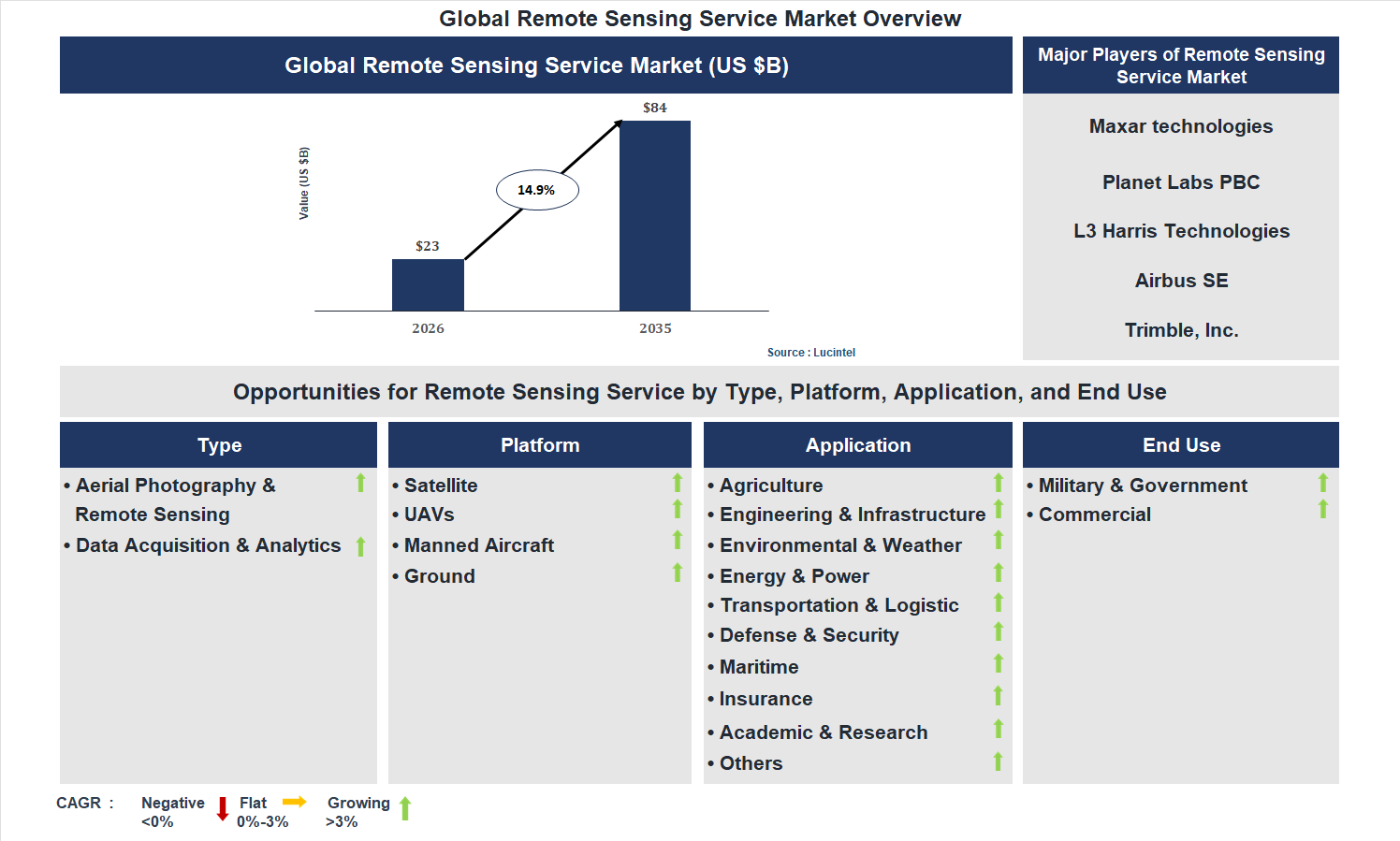
Key data points: The market size in 2035 = $84 billion, growth forecast = 14.9% annually for the next 8 years. Scroll below to get more insights. This market report covers trends, opportunities and forecasts in remote sensing service market to 2035 by type (aerial photography & remote sensing and data acquisition & analytics), platform (satellite, UAVs, manned aircraft, and ground), application (agriculture, engineering & infrastructure, environmental & weather, energy & power, transportation & logistic, defense & security, maritime, insurance, academic & research, and others), end use (military & government and commercial), and region (North America, Europe, Asia Pacific, and the Rest of the World)
We'll send your sample report shortly.
• Lucintel forecasts that, within the type category, data acquisition & analytic is expected to witness higher growth over the forecast period.
• Within the end use category, commercial is expected to witness higher growth.
• In terms of region, APAC is expected to witness the highest growth over the forecast period. Gain valuable insights for your business decisions with our comprehensive 150+ page report. Sample figures with some insights are shown below.
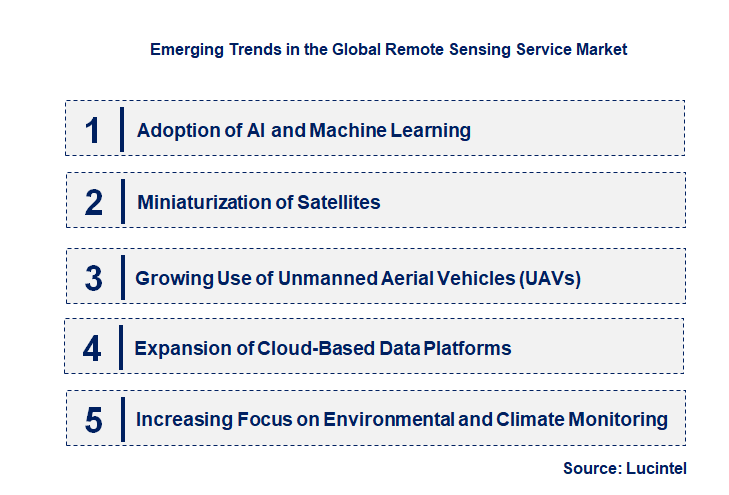
• Adoption of AI and Machine Learning: Integration of AI and machine learning algorithms is revolutionizing data analysis in remote sensing. These technologies enable faster, more accurate interpretation of large datasets, facilitating real-time decision-making. AI-driven analytics improve object detection, classification, and change detection, making remote sensing more efficient and reliable. This trend enhances applications in disaster management, agriculture, and urban planning by providing actionable insights quickly. As AI becomes more sophisticated, the market will see increased automation, reducing manual effort and operational costs, and expanding the scope of remote sensing applications.
• Miniaturization of Satellites: The development of small, lightweight satellites, such as CubeSats, is transforming satellite deployment and data collection. These miniaturized satellites are cost-effective, easier to launch, and can be deployed in constellations for frequent data updates. Their proliferation allows for higher revisit rates and more localized data collection, benefiting sectors like agriculture, environmental monitoring, and defense. This trend democratizes access to satellite imagery, enabling smaller organizations and countries to participate in remote sensing activities, thereby broadening the market and fostering innovation.
• Growing Use of Unmanned Aerial Vehicles (UAVs): UAVs or drones are increasingly used for high-resolution, flexible remote sensing. They offer rapid deployment, cost efficiency, and the ability to access hard-to-reach areas. UAVs are particularly valuable in agriculture for crop monitoring, in disaster zones for damage assessment, and in infrastructure inspection. Advances in drone technology, including longer flight times and better sensors, are expanding their capabilities. This trend enhances data granularity and timeliness, making remote sensing more versatile and accessible for localized applications, thus significantly impacting the market’s growth.
• Expansion of Cloud-Based Data Platforms: Cloud computing is playing a crucial role in managing and analyzing remote sensing data. Cloud platforms enable scalable storage, processing, and sharing of large datasets, facilitating collaboration among stakeholders. They also support advanced analytics and machine learning integration, providing users with user-friendly interfaces and real-time insights. This trend reduces infrastructure costs and improves data accessibility, especially for small and medium-sized enterprises. As cloud adoption increases, the remote sensing market will see enhanced data democratization, fostering innovation and expanding its user base across various industries.
• Increasing Focus on Environmental and Climate Monitoring: There is a rising demand for remote sensing services dedicated to environmental conservation and climate change monitoring. These services provide critical data on deforestation, pollution, sea-level rise, and natural disasters. Governments, NGOs, and private companies are investing heavily in these applications to support sustainable development goals. Improved sensor technology and data accuracy are enabling more detailed and timely environmental insights. This trend not only expands the market’s scope but also emphasizes the importance of remote sensing in addressing global environmental challenges, positioning it as a vital tool for sustainable management. These emerging trends are collectively transforming the remote sensing service market by enhancing data accuracy, accessibility, and application scope. The integration of advanced technologies like AI, miniaturized satellites, UAVs, cloud platforms, and environmental monitoring is making remote sensing more efficient, affordable, and versatile. These developments are broadening market participation, fostering innovation, and enabling more informed decision-making across multiple sectors, ultimately reshaping the future landscape of geospatial data services worldwide.
• Technological Advancements in Satellite Capabilities: The development of high-resolution satellites and miniaturized sensors has enhanced data quality and frequency. These improvements enable more precise environmental monitoring, urban planning, and resource management. As satellite technology becomes more affordable and accessible, a broader range of industries can leverage remote sensing data, leading to increased market adoption. This growth fosters innovation, improves data-driven decision-making, and opens new revenue streams for service providers.
• Growing Demand for Environmental Monitoring: Increasing concerns over climate change, deforestation, and pollution are driving demand for real-time environmental data. Remote sensing services provide critical insights into land use, water quality, and atmospheric conditions. Governments and organizations are investing in these services to support policy-making, conservation efforts, and disaster preparedness. This trend boosts market growth by expanding the scope of applications and encouraging the development of specialized monitoring solutions.
• Expansion in Agriculture and Precision Farming: Remote sensing is transforming agriculture through precision farming techniques that optimize crop yields and resource use. Satellite imagery and drone data enable farmers to monitor soil health, crop growth, and pest infestations accurately. This leads to increased productivity, reduced costs, and sustainable practices. The market benefits from rising adoption of these technologies, driven by the need for food security and sustainable agriculture, creating new business opportunities for service providers.
• Integration of AI and Big Data Analytics: The incorporation of artificial intelligence and big data analytics enhances the processing and interpretation of remote sensing data. These technologies enable faster, more accurate insights, supporting real-time decision-making across sectors like disaster management, urban planning, and defense. The ability to analyze vast datasets efficiently is transforming the market landscape, attracting investments and fostering innovation. This integration is crucial for developing advanced, automated remote sensing solutions that meet diverse industry needs.
• Increasing Use of IoT and Cloud Computing: The adoption of IoT devices and cloud platforms is revolutionizing remote sensing data management and dissemination. IoT sensors provide complementary data, while cloud computing offers scalable storage and processing power. This synergy improves data accessibility, collaboration, and real-time analysis. As a result, service providers can deliver more comprehensive solutions, expanding market reach. The trend supports the development of integrated remote sensing ecosystems, facilitating smarter decision-making and operational efficiency across industries. These developments are significantly transforming the remote sensing service market by enhancing data quality, expanding application areas, and enabling innovative solutions. The integration of advanced technologies like AI, IoT, and cloud computing is driving market growth and diversification. As demand for environmental, agricultural, and urban data increases, the market is poised for sustained expansion, offering new opportunities for stakeholders and shaping the future landscape of remote sensing services globally.
• Expansion into Precision Agriculture: Remote sensing services enable farmers to monitor crop health, soil conditions, and water usage with high accuracy, leading to optimized resource management and increased yields. The adoption of satellite and drone-based sensors supports sustainable farming practices and reduces costs. As global food demand rises, the integration of remote sensing in agriculture offers significant growth potential, especially in emerging markets seeking to modernize their farming techniques and improve productivity.
• Enhancing Defense and Security Capabilities: Governments and defense agencies increasingly rely on remote sensing for surveillance, border security, and intelligence gathering. The ability to detect threats, monitor military activities, and conduct reconnaissance from space or aerial platforms provides strategic advantages. Advances in resolution, data analytics, and real-time processing further enhance operational efficiency. Growing geopolitical tensions and the need for national security bolster demand, making this a critical growth avenue for remote sensing service providers.
• Advancing Environmental Monitoring and Climate Change Research: Remote sensing plays a vital role in tracking environmental changes, deforestation, pollution, and natural disasters. The technology supports climate change studies by providing data on sea level rise, greenhouse gas emissions, and land degradation. Governments, NGOs, and research institutions are investing heavily in remote sensing solutions to inform policy decisions and conservation efforts. The increasing focus on sustainability and environmental resilience drives continuous innovation and market expansion in this sector.
• Supporting Urban Planning and Smart City Development: Remote sensing data assists urban planners in infrastructure development, land use mapping, and traffic management. It enables efficient planning for sustainable growth, disaster preparedness, and resource allocation. As cities expand rapidly, the demand for high-resolution imagery and geospatial analytics grows. Integration with IoT and GIS platforms enhances decision-making processes, making remote sensing an essential component of smart city initiatives worldwide.
• Facilitating Disaster Management and Emergency Response: Remote sensing provides critical data for early warning systems, damage assessment, and recovery planning during natural calamities such as floods, hurricanes, and earthquakes. Rapid data acquisition from satellites and drones accelerates response times and improves resource deployment. The increasing frequency and severity of disasters globally amplify the importance of remote sensing services in saving lives and minimizing economic losses, creating substantial growth opportunities in this domain. These growth opportunities are poised to significantly influence the remote sensing service market by fostering innovation, expanding application scopes, and addressing critical societal needs. Companies that strategically invest in these areas can enhance their market position, contribute to sustainable development, and meet the evolving demands of various industries. The overall market outlook remains highly promising, driven by technological progress and increasing global reliance on remote sensing data.
• Technological Advancements: The rapid development of satellite and drone technologies has significantly enhanced data collection capabilities. High-resolution imaging, real-time data transmission, and improved sensor accuracy enable more precise and timely insights. These innovations facilitate applications in disaster management, agriculture, and urban planning, thereby expanding market potential. As technology continues to evolve, costs decrease, and accessibility increases, further fueling market growth and encouraging new service offerings.
• Growing Environmental and Climate Monitoring Needs: Increasing concerns over climate change, deforestation, and pollution have heightened the demand for accurate environmental data. Remote sensing provides critical insights into land use, water resources, and atmospheric conditions, supporting sustainable development initiatives. Governments and organizations are investing heavily in monitoring systems to comply with environmental regulations and to develop mitigation strategies, which significantly drives market expansion.
• Expansion in Agriculture and Precision Farming: The adoption of remote sensing in agriculture has revolutionized crop management and resource optimization. Precision farming techniques rely on satellite imagery and drone data to monitor crop health, soil conditions, and irrigation needs. This leads to increased yields, reduced resource wastage, and improved sustainability. As farmers and agribusinesses recognize these benefits, the market for remote sensing services in agriculture continues to grow rapidly.
• Increasing Government and Private Sector Investments: Governments worldwide are investing in space programs and remote sensing infrastructure to enhance national security, disaster response, and resource management. Simultaneously, private companies are entering the market, offering innovative solutions and expanding service portfolios. These investments boost technological development, infrastructure, and market reach, accelerating overall market growth.
• Rising Adoption of IoT and Big Data Analytics: The integration of remote sensing data with IoT devices and big data analytics enables comprehensive environmental and infrastructural monitoring. This synergy enhances predictive capabilities and decision-making processes across sectors such as urban development, transportation, and energy. The increasing adoption of these technologies amplifies the value of remote sensing services, fostering market expansion. The challenges facing the remote sensing service market include:-
• Regulatory and Data Privacy Concerns: The deployment of remote sensing technologies often faces regulatory hurdles related to data collection, satellite licensing, and national security. Privacy concerns over high-resolution imagery and sensitive data can lead to restrictions and delays in service deployment. Navigating complex legal frameworks and ensuring compliance pose significant challenges for market players seeking to expand their offerings.
• High Capital and Operational Costs: Developing and maintaining advanced remote sensing infrastructure, including satellites, drones, and ground stations, requires substantial investment. Operational costs such as data processing, storage, and analysis further add to financial burdens. These high costs can limit entry for smaller firms and slow down market growth, especially in emerging economies.
• Data Management and Integration Challenges: The vast volume of data generated by remote sensing devices necessitates sophisticated storage, processing, and analysis systems. Integrating remote sensing data with other sources and ensuring data accuracy and consistency remains complex. These technical challenges can hinder timely insights and reduce the overall efficiency of remote sensing services. The remote sensing service market is driven by technological innovations, environmental monitoring needs, agricultural advancements, strategic investments, and digital integration. However, regulatory issues, high costs, and data management challenges pose significant hurdles. The interplay of these factors will shape the market’s trajectory, requiring stakeholders to innovate and adapt to sustain growth and overcome obstacles. Overall, the market holds substantial potential for expansion, provided these challenges are effectively managed.
• Maxar technologies
• Planet Labs PBC
• L3 Harris Technologies
• Airbus SE
• Trimble, Inc.
• Aerial Photography & Remote Sensing
• Data Acquisition & Analytics
• Satellite
• UAVs
• Manned Aircraft
• Ground
• Agriculture
• Engineering & Infrastructure
• Environmental & Weather
• Energy & Power
• Transportation & Logistic
• Defense & Security
• Maritime
• Insurance
• Academic & Research
• Others
• Military & Government
• Commercial
• North America
• Europe
• Asia Pacific
• The Rest of the World
• United States: The US market has seen substantial growth with advancements in satellite technology and data analytics. Major players like NASA and private companies such as SpaceX are expanding their remote sensing capabilities. The focus is on improving resolution, real-time data processing, and integrating AI for better analysis. The government is investing in national security, environmental monitoring, and disaster response initiatives, boosting market demand. Additionally, increased collaboration between public and private sectors is fostering innovation and expanding service offerings.
• China: China has rapidly advanced its remote sensing infrastructure, launching numerous high-resolution satellites to support urban planning, agriculture, and military applications. The government prioritizes space technology development, with significant investments in domestic satellite programs. China is also leveraging AI and big data analytics to enhance data interpretation and operational efficiency. The country aims to become a global leader in remote sensing services, emphasizing self-reliance and technological innovation to meet domestic and international needs.
• Germany: Germanys remote sensing market is characterized by strong research and development activities, with a focus on environmental monitoring, climate change, and sustainable urban development. The country benefits from a robust aerospace industry and collaborations within the European Space Agency. German companies are adopting advanced sensor technologies and data processing techniques to improve accuracy and usability. The market is also driven by increasing demand for precision agriculture and smart city initiatives, supported by government policies promoting digital transformation.
• India: India is rapidly expanding its remote sensing capabilities through the launch of new satellites under programs like ISROs Carto sat series. The focus is on agriculture, forestry, disaster management, and urban planning. The government encourages private sector participation and international collaborations to enhance technological capabilities. India is also investing in developing indigenous satellite technology and data analytics platforms. The increasing use of remote sensing data for smart city projects and climate resilience initiatives highlights the countrys commitment to leveraging space technology for socio-economic development.
• Japan: Japans remote sensing market is driven by advancements in satellite technology, with a focus on disaster management, environmental monitoring, and resource management. The country has developed sophisticated sensors and data processing systems, often integrating AI and machine learning. Japan emphasizes resilience against natural disasters like earthquakes and tsunamis, utilizing remote sensing data for early warning systems. The government and private sector are collaborating to improve data accessibility and develop innovative applications, ensuring Japan remains a key player in the global remote sensing landscape.


• Maxar technologies
• Planet Labs PBC
• L3 Harris Technologies
• Airbus SE
• Trimble, Inc. Q6. Which remote sensing service market segment will be the largest in future? Answer: Lucintel forecasts that, within the type category, data acquisition & analytic is expected to witness higher growth over the forecast period. Q7. In remote sensing service market, which region is expected to be the largest in next 8 years? Answer: In terms of region, APAC is expected to witness the highest growth over the forecast period. Q8. Do we receive customization in this report? Answer: Yes, Lucintel provides 10% customization without any additional cost.


Choose a license that fits your team. Instant PDF delivery.
Prices exclude taxes. Instant delivery. Custom licensing available on request.
Market Report · July 31, 2026
Market Report · July 31, 2026
Market Report · July 31, 2026
Trusted partner for strategic intelligence and business growth


Receive a complimentary market analysis tailored to your industry. Our analysts will identify key growth opportunities and competitive dynamics specific to your business.

Market size, growth rate, and key trend analysis for your specific sector.

Top competitor positioning and market share analysis.

Strategic recommendations backed by data-driven insights.
Get curated market intelligence and competitive moves straight to your inbox.
By subscribing, you agree to receive our monthly insights. Unsubscribe anytime.
Receive a complimentary market analysis tailored to your industry. Our analysts will identify key growth opportunities and competitive dynamics specific to your business.
Market size, growth rate, and key trend analysis for your specific sector.
Top competitor positioning and market share analysis.
Strategic recommendations backed by data-driven insights.
Get curated market intelligence, emerging trends, and competitive moves straight to your inbox each month.
By subscribing, you agree to receive our monthly insights. Unsubscribe anytime.
We'll send your sample report shortly.