
Close Lucintel Chat
Didn't Find What You're Looking for?
Call us at +1972 636 5056 or write at helpdesk@Lucintel.com
Ask an Expert Provide Custom Requirements Download Sample Report Search Available Reports
  • helpdesk@Lucintel.com
  • |
  • Call Lucintel +1 972 636 5056
  • |
  • Login
  • |
  • Register
  • |
  • Search
  • |
'
...

The Impact of COVID-19 is included in Recloser Market Report. Buy it today to get an advantage.

Request the impact of COVID-19 on your product or industry


Recloser Market Trends and Forecast

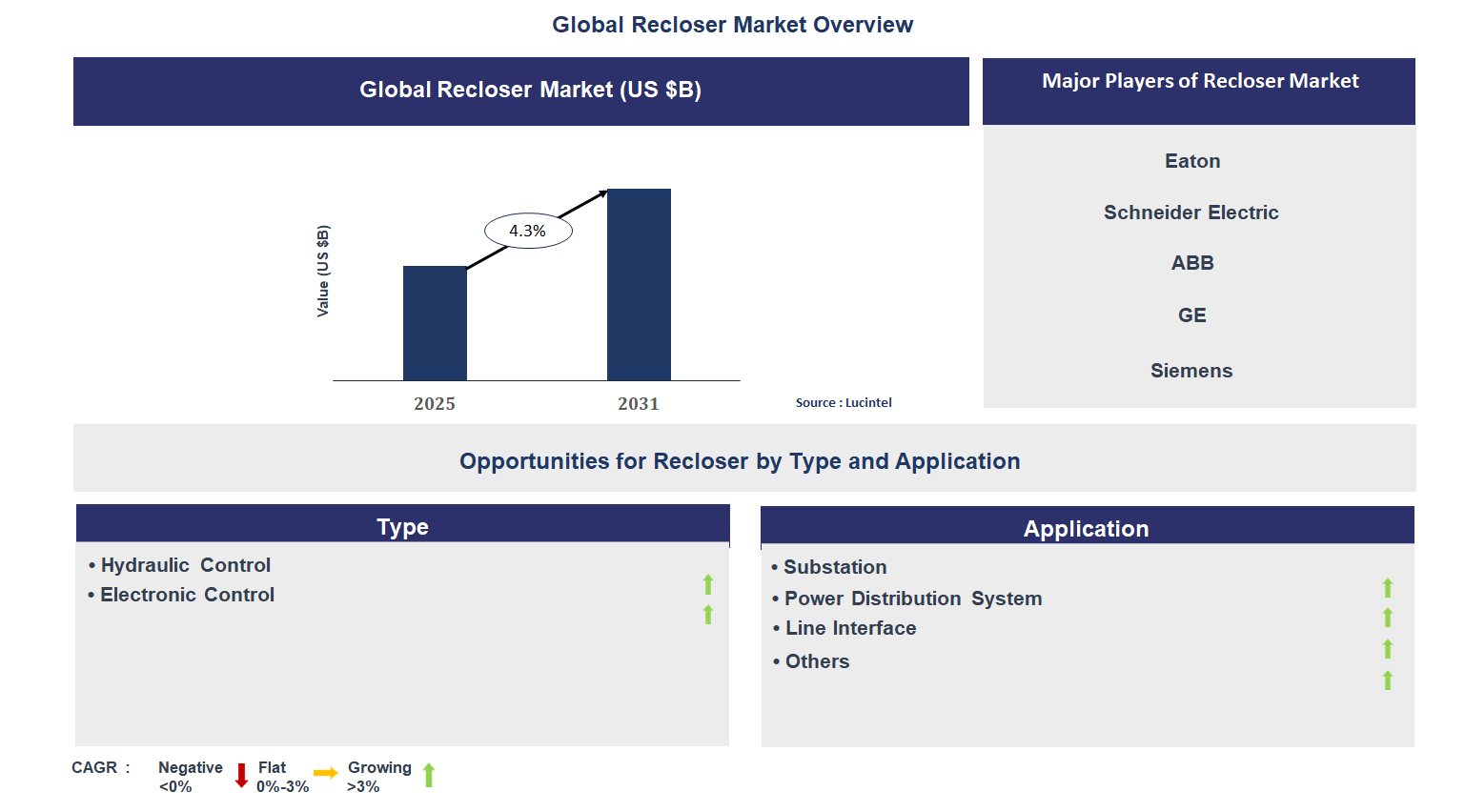
The future of the global recloser market looks promising with opportunities in the substation, power distribution system, and line interface markets. The global recloser market is expected to grow with a CAGR of 4.3% from 2025 to 2031. The major drivers for this market are the increasing demand for reliable electricity distribution, the rising adoption of smart grid technologies, and the growing focus on reducing power outages.

• Lucintel forecasts that, within the type category, electronic control is expected to witness higher growth over the forecast period.
• Within the application category, power distribution system is expected to witness the highest growth.
• In terms of region, APAC is expected to witness the highest growth over the forecast period.
Gain valuable insights for your business decisions with our comprehensive 150+ page report. Sample figures with some insights are shown below.
Recloser Market Trends and Forecast

Emerging Trends in the Recloser Market

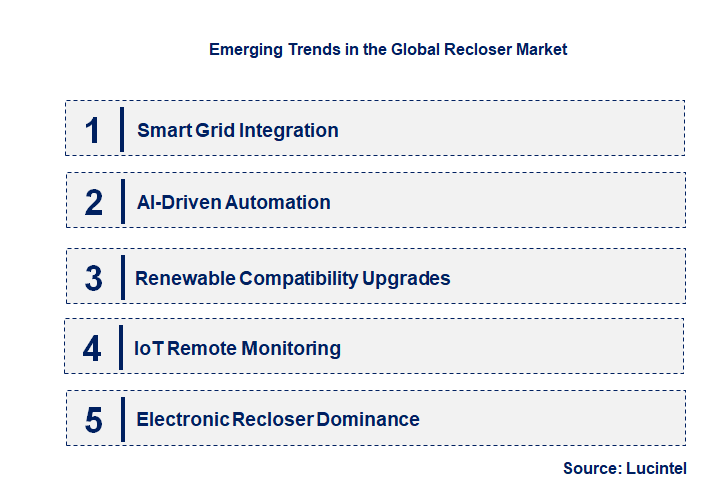
Emerging trends in the recloser market highlight a pivot to intelligent, resilient systems amid digital transformation and clean energy shifts. These evolutions optimize fault handling, integrate renewables, and leverage data analytics, propelling market growth toward automated, sustainable operations in evolving power landscapes.
• Smart Grid Integration: Reclosers now embed with SCADA systems for seamless communication, enabling dynamic load balancing. This trend cuts outage durations by 40%, bolsters grid stability, and facilitates distributed energy management, significantly impacting utilities by reducing operational costs and enhancing service continuity in volatile networks.
• AI-Driven Automation: Artificial intelligence optimizes reclose sequences and predicts faults via machine learning algorithms. It minimizes manual interventions by 50%, improves accuracy in complex scenarios, and drives preventive strategies, revolutionizing market dynamics with scalable, efficient solutions for high-reliability applications.
• Renewable Compatibility Upgrades: Designs adapt to variable solar and wind inputs with advanced voltage regulation. This accelerates clean energy adoption, stabilizes intermittent flows, and reduces integration losses by 25%, profoundly influencing growth in green-focused regions through robust, future-proof infrastructure.
• IoT Remote Monitoring: Sensor-equipped units enable cloud-based diagnostics and over-the-air updates. It extends asset life by 30%, enables proactive maintenance, and supports remote troubleshooting, reshaping services with data-driven insights that lower costs and boost uptime across global deployments.
• Electronic Recloser Dominance: Shift from hydraulic to electronic models offers precise control and compactness. This trend enhances fault selectivity by 35%, aligns with miniaturization needs, and cuts energy use, transforming the market toward versatile, eco-efficient options in urban and industrial settings.
These trends are reshaping the recloser market by infusing intelligence and adaptability, yielding efficiency surges and new paradigms in grid management. They collectively forecast a 5.9% CAGR, evolving traditional devices into pivotal enablers of resilient, sustainable energy ecosystems worldwide.
Emerging Trends in the Recloser Market

Recent Development in the Recloser Market

Recent global developments in the recloser market spotlight technological leaps and strategic deployments to counter rising outages and support electrification. These innovations fortify distribution reliability, integrate emerging tech, and align with sustainability mandates, steering the industry toward expansive, interconnected frameworks.
• Electronic Model Proliferation: Widespread adoption of electronic reclosers replaces legacy hydraulics with programmable logic for finer control. This slashes response times by 30%, optimizes energy distribution, and eases upgrades, markedly boosting market penetration in smart grid rollouts globally.
• IoT-Enabled Self-Healing Grids: Integration of IoT fosters autonomous fault rerouting and real-time analytics. It reduces downtime by 45%, enhances predictive capabilities, and supports microgrid autonomy, profoundly impacting resilience in renewable-heavy systems.
• Solid Insulated Innovations: New solid-dielectric designs offer compact, maintenance-free alternatives with superior insulation. They cut installation costs by 20%, improve safety in harsh environments, and drive adoption in urban expansions, reshaping durable solutions for dense networks.
• AI Fault Prediction Tools: Advanced algorithms analyze patterns for preemptive actions in reclose operations. This minimizes cascading failures by 35%, refines operational efficiency, and attracts tech investments, significantly elevating service standards in industrial applications.
• Asia-Pacific Market Surge: Rapid infrastructure builds in China and India spur localized manufacturing and deployments. It amplifies regional growth by 6.4%, diversifies supply chains, and tailors solutions for high-density loads, fundamentally expanding global access and innovation pipelines.
These developments are impacting the recloser market by accelerating digitization and regional expansions, delivering cost efficiencies and outage reductions. Together, they cultivate a robust sector, poised for doubled valuations through adaptive, high-performance technologies in electrified futures.

Strategic Growth Opportunities in the Recloser Market

Strategic growth in the recloser market targets key applications like renewables and urban distribution, harnessing tech synergies for reliability amid infrastructure booms. These opportunities unlock revenues via customized solutions, supporting global shifts to sustainable, intelligent power systems.
• Renewable Energy Grids: Reclosers with harmonic filters ensure stable integration of solar and wind farms. This avenue grows market share by 25% in clean projects, mitigates variability, and secures long-term utility contracts, driving decarbonization with uninterrupted green power flows.
• EV Charging Networks: Overload-protected units safeguard fast-charging stations from surges. It expands service ecosystems by 20%, enables scalable urban deployments, and partners with automakers, profoundly advancing mobility by preventing grid strains in high-adoption zones.
• Industrial Power Systems: Customizable reclosers handle heavy loads in manufacturing hubs with rapid reclose features. Opportunities yield 15% efficiency uplifts, comply with Industry 4.0, and minimize production halts, reshaping productivity through resilient, automated energy backbones.
• Smart City Distributions: Sensor-integrated models optimize microgrids for traffic and residential demands. This fosters municipal tenders, cuts urban blackouts by 40%, and integrates with IoT cities, positioning reclosers as vital for equitable, connected urban energy landscapes.
• Rural Electrification Projects: Affordable single-phase units extend coverage in remote areas with fault tolerance. It boosts access by 30%, aligns with development goals, and reduces isolation costs, significantly impacting inclusive growth in emerging economies through dependable supply chains.
These opportunities are impacting the recloser market by diversifying applications and fueling tech alignments with electrification megatrends. They synergize to mature the sector, generating sustained expansions and innovative ecosystems for resilient power delivery.

Recloser Market Driver and Challenges

The recloser market navigates a landscape shaped by technological innovations, economic expansions, and regulatory pushes. Drivers such as grid upgrades and clean energy mandates propel advancements, while challenges like costs and logistics demand adaptive strategies for balanced progression.
The factors responsible for driving the recloser market include:
1. Surging Electricity Demand: Escalating consumption from urbanization and EVs strains networks, necessitating advanced reclosers for reliability. This propels deployments by 7%, incentivizes capacity builds, and stimulates investments, ensuring steady revenue amid global power surges.
2. Smart Grid Modernization: Utilities invest in automated systems for efficient fault management and integration. It accelerates market growth by 6%, enables data-centric operations, and aligns with digital transitions, profoundly enhancing grid performance worldwide.
3. Renewable Energy Boom: Intermittency requires reclosers for voltage stability in solar-wind setups. This drives 8% regional CAGRs, lowers integration barriers, and supports net-zero policies, creating vast opportunities in green infrastructure.
4. Infrastructure Investments: Government funds target resilient distribution amid climate risks. It catalyzes projects, streamlines adoptions, and fosters partnerships, significantly expanding market reach in developing and mature economies alike.
5. Technological Advancements: AI and IoT innovations refine predictive controls and remote ops. This cuts costs by 25%, boosts accuracy, and attracts innovators, revolutionizing reclosers into intelligent assets for dynamic grids.
Challenges in the recloser market are:
1. Supply Chain Volatility: Material shortages and geopolitics delay components, hiking prices. It erodes margins by 15%, disrupts timelines, and pressures diversification, compelling resilient sourcing to sustain global service flows.
2. Elevated Deployment Costs: High-tech units demand substantial capital and skilled labor. This deters small utilities, slows penetrations by 20%, and widens adoption gaps, urging subsidies to democratize access in cost-sensitive markets.
3. Evolving Regulations: Varied standards across regions complicate compliance and certifications. It inflates expenses by 10%, delays launches, and risks fines, necessitating unified frameworks for seamless international expansions.
Drivers and challenges interplay to forge a vibrant recloser market, with innovations tipping scales toward expansion despite hurdles. Net outcomes feature tempered yet robust growth, equipping the sector for equitable, tech-forward roles in sustainable energy paradigms.

List of Recloser Companies

Companies in the market compete on the basis of product quality offered. Major players in this market focus on expanding their manufacturing facilities, R&D investments, infrastructural development, and leverage integration opportunities across the value chain. With these strategies recloser companies cater increasing demand, ensure competitive effectiveness, develop innovative products & technologies, reduce production costs, and expand their customer base. Some of the recloser companies profiled in this report include-
• Eaton
• Schneider Electric
• ABB
• GE
• Siemens
• Schweitzer Engineering Laboratories
• Noja Power
• Entec
• Tavrida Electric
• G&W

Recloser Market by Segment

The study includes a forecast for the global recloser market by type, application, and region.

Recloser Market by Type [Value from 2019 to 2031]:


• Hydraulic Control
• Electronic Control

Recloser Market by Application [Value from 2019 to 2031]:


• Substation
• Power Distribution System
• Line Interface
• Others

Recloser Market by Region [Value from 2019 to 2031]:


• North America
• Europe
• Asia Pacific
• The Rest of the World

Country Wise Outlook for the Recloser Market

The recloser market is surging globally, fueled by smart grid expansions, renewable energy surges, and the need for reliable distribution amid rising power demands. In the United States, China, Germany, India, and Japan, key advancements emphasize automation, fault management, and integration with distributed energy resources to minimize outages and enhance grid resilience.
• United States: U.S. recloser deployments are accelerating through federal grid modernization programs, with electronic models gaining traction for faster fault isolation. Recent initiatives include utility pilots for AI-enhanced controls, supporting wildfire-prone areas and EV growth, driving a 5.9% CAGR through enhanced reliability and reduced downtime in distribution networks.
• China: Chinas market is booming with massive smart grid investments, focusing on single-phase reclosers for rural and urban upgrades. Developments feature nationwide IoT integrations for real-time monitoring, aligning with renewable targets, boosting efficiency by 20% and expanding coverage in high-demand provinces.
• Germany: Germany advances recloser tech via Energiewende policies, prioritizing three-phase units for wind farm connections and urban resilience. Key changes involve modular designs with advanced sensors, complying with EU standards, improving fault response times and supporting net-zero goals in industrial hubs.
• India: Indias recloser sector transforms with infrastructure revamps under Saubhagya scheme, emphasizing cost-effective pole-mounted units for electrification. Advancements include hydraulic models for overload protection, addressing rural outages and industrial needs, fostering a 6.03% growth rate through reliable supply expansions.
• Japan: Japan focuses on seismic-resistant electronic reclosers amid disaster recovery efforts, integrating self-healing features for urban grids. Recent shifts feature remote automation pilots, enhancing uptime in tech corridors and renewables, aligning with energy security amid aging infrastructure upgrades.

Lucintel Analytics Dashboard

Features of the Global Recloser Market

Market Size Estimates: Recloser market size estimation in terms of value ($B).
Trend and Forecast Analysis: Market trends (2019 to 2024) and forecast (2025 to 2031) by various segments and regions.
Segmentation Analysis: Recloser market size by type, application, and region in terms of value ($B).
Regional Analysis: Recloser market breakdown by North America, Europe, Asia Pacific, and Rest of the World.
Growth Opportunities: Analysis of growth opportunities in different types, applications, and regions for the recloser market.
Strategic Analysis: This includes M&A, new product development, and competitive landscape of the recloser market.
Analysis of competitive intensity of the industry based on Porter’s Five Forces model.

Lucintel Consulting Services

FAQ

Q1. What is the growth forecast for recloser market?
Answer: The global recloser market is expected to grow with a CAGR of 4.3% from 2025 to 2031.
Q2. What are the major drivers influencing the growth of the recloser market?
Answer: The major drivers for this market are the increasing demand for reliable electricity distribution, the rising adoption of smart grid technologies, and the growing focus on reducing power outages.
Q3. What are the major segments for recloser market?
Answer: The future of the recloser market looks promising with opportunities in the substation, power distribution system, and line interface markets.
Q4. Who are the key recloser market companies?
Answer: Some of the key recloser companies are as follows:
• Eaton
• Schneider Electric
• ABB
• GE
• Siemens
• Schweitzer Engineering Laboratories
• Noja Power
• Entec
• Tavrida Electric
• G&W
Q5. Which recloser market segment will be the largest in future?
Answer: Lucintel forecasts that, within the type category, electronic control is expected to witness higher growth over the forecast period.
Q6. In recloser market, which region is expected to be the largest in next 5 years?
Answer: In terms of region, APAC is expected to witness the highest growth over the forecast period.
Q7. Do we receive customization in this report?
Answer: Yes, Lucintel provides 10% customization without any additional cost.

This report answers following 11 key questions:

Q.1. What are some of the most promising, high-growth opportunities for the recloser market by type (hydraulic control and electronic control), application (substation, power distribution system, line interface, and others), and region (North America, Europe, Asia Pacific, and the Rest of the World)?
Q.2. Which segments will grow at a faster pace and why?
Q.3. Which region will grow at a faster pace and why?
Q.4. What are the key factors affecting market dynamics? What are the key challenges and business risks in this market?
Q.5. What are the business risks and competitive threats in this market?
Q.6. What are the emerging trends in this market and the reasons behind them?
Q.7. What are some of the changing demands of customers in the market?
Q.8. What are the new developments in the market? Which companies are leading these developments?
Q.9. Who are the major players in this market? What strategic initiatives are key players pursuing for business growth?
Q.10. What are some of the competing products in this market and how big of a threat do they pose for loss of market share by material or product substitution?
Q.11. What M&A activity has occurred in the last 5 years and what has its impact been on the industry?

For any questions related to Recloser Market, Recloser Market Size, Recloser Market Growth, Recloser Market Analysis, Recloser Market Report, Recloser Market Share, Recloser Market Trends, Recloser Market Forecast, Recloser Companies, write Lucintel analyst at email: helpdesk@lucintel.com. We will be glad to get back to you soon.
                                           Table of Contents

            1. Executive Summary

            2. Market Overview

                        2.1 Background and Classifications
                        2.2 Supply Chain

            3. Market Trends & Forecast Analysis

                        3.1 Macroeconomic Trends and Forecasts
                        3.2 Industry Drivers and Challenges
                        3.3 PESTLE Analysis
                        3.4 Patent Analysis
                        3.5 Regulatory Environment
                        3.6 Global Recloser Market Trends and Forecast

            4. Global Recloser Market by Type

                        4.1 Overview
                        4.2 Attractiveness Analysis by Type
                        4.3 Hydraulic Control : Trends and Forecast 2025 to 2031
                        4.4 Electronic Control : Trends and Forecast 2025 to 2031

            5. Global Recloser Market by Application

                        5.1 Overview
                        5.2 Attractiveness Analysis by Application
                        5.3 Substation : Trends and Forecast 2025 to 2031
                        5.4 Power Distribution System : Trends and Forecast 2025 to 2031
                        5.5 Line Interface : Trends and Forecast 2025 to 2031
                        5.6 Others : Trends and Forecast 2025 to 2031

            6. Regional Analysis

                        6.1 Overview
                        6.2 Global Recloser Market by Region

            7. North American Recloser Market

                        7.1 Overview
                        7.2 North American Recloser Market by Type
                        7.3 North American Recloser Market by Application
                        7.4 The United States Recloser Market
                        7.5 Canadian Recloser Market
                        7.6 Mexican Recloser Market

            8. European Recloser Market

                        8.1 Overview
                        8.2 European Recloser Market by Type
                        8.3 European Recloser Market by Application
                        8.4 German Recloser Market
                        8.5 French Recloser Market
                        8.6 Italian Recloser Market
                        8.7 Spanish Recloser Market
                        8.8 The United Kingdom Recloser Market

            9. APAC Recloser Market

                        9.1 Overview
                        9.2 APAC Recloser Market by Type
                        9.3 APAC Recloser Market by Application
                        9.4 Chinese Recloser Market
                        9.5 Indian Recloser Market
                        9.6 Japanese Recloser Market
                        9.7 South Korean Recloser Market
                        9.8 Indonesian Recloser Market

            10. ROW Recloser Market

                        10.1 Overview
                        10.2 ROW Recloser Market by Type
                        10.3 ROW Recloser Market by Application
                        10.4 Middle Eastern Recloser Market
                        10.5 South American Recloser Market
                        10.6 African Recloser Market

            11. Competitor Analysis

                        11.1 Product Portfolio Analysis
                        11.2 Operational Integration
                        11.3 Porter’s Five Forces Analysis
                                    • Competitive Rivalry
                                    • Bargaining Power of Buyers
                                    • Bargaining Power of Suppliers
                                    • Threat of Substitutes
                                    • Threat of New Entrants
                        11.4 Market Share Analysis

            12. Opportunities & Strategic Analysis

                        12.1 Value Chain Analysis
                        12.2 Growth Opportunity Analysis
                                    12.2.1 Growth Opportunity by Type
                                    12.2.2 Growth Opportunity by Application
                        12.3 Emerging Trends in the Global Recloser Market
                        12.4 Strategic Analysis
                                    12.4.1 New Product Development
                                    12.4.2 Certification and Licensing
                                    12.4.3 Mergers, Acquisitions, Agreements, Collaborations, and Joint Ventures

            13. Company Profiles of the Leading Players Across the Value Chain

                        13.1 Competitive Analysis Overview
                        13.2 Eaton
                                    • Company Overview
                                    • Recloser Market Business Overview
                                    • New Product Development
                                    • Merger, Acquisition, and Collaboration
                                    • Certification and Licensing
                        13.3 Schneider Electric
                                    • Company Overview
                                    • Recloser Market Business Overview
                                    • New Product Development
                                    • Merger, Acquisition, and Collaboration
                                    • Certification and Licensing
                        13.4 ABB
                                    • Company Overview
                                    • Recloser Market Business Overview
                                    • New Product Development
                                    • Merger, Acquisition, and Collaboration
                                    • Certification and Licensing
                        13.5 GE
                                    • Company Overview
                                    • Recloser Market Business Overview
                                    • New Product Development
                                    • Merger, Acquisition, and Collaboration
                                    • Certification and Licensing
                        13.6 Siemens
                                    • Company Overview
                                    • Recloser Market Business Overview
                                    • New Product Development
                                    • Merger, Acquisition, and Collaboration
                                    • Certification and Licensing
                        13.7 Schweitzer Engineering Laboratories
                                    • Company Overview
                                    • Recloser Market Business Overview
                                    • New Product Development
                                    • Merger, Acquisition, and Collaboration
                                    • Certification and Licensing
                        13.8 Noja Power
                                    • Company Overview
                                    • Recloser Market Business Overview
                                    • New Product Development
                                    • Merger, Acquisition, and Collaboration
                                    • Certification and Licensing
                        13.9 Entec
                                    • Company Overview
                                    • Recloser Market Business Overview
                                    • New Product Development
                                    • Merger, Acquisition, and Collaboration
                                    • Certification and Licensing
                        13.10 Tavrida Electric
                                    • Company Overview
                                    • Recloser Market Business Overview
                                    • New Product Development
                                    • Merger, Acquisition, and Collaboration
                                    • Certification and Licensing
                        13.11 G&W
                                    • Company Overview
                                    • Recloser Market Business Overview
                                    • New Product Development
                                    • Merger, Acquisition, and Collaboration
                                    • Certification and Licensing

            14. Appendix

                        14.1 List of Figures
                        14.2 List of Tables
                        14.3 Research Methodology
                        14.4 Disclaimer
                        14.5 Copyright
                        14.6 Abbreviations and Technical Units
                        14.7 About Us
                        14.8 Contact Us

                                               List of Figures


            Chapter 1

                        Figure 1.1: Trends and Forecast for the Global Recloser Market

            Chapter 2

                        Figure 2.1: Usage of Recloser Market
                        Figure 2.2: Classification of the Global Recloser Market
                        Figure 2.3: Supply Chain of the Global Recloser Market

            Chapter 3

                        Figure 3.1: Trends of the Global GDP Growth Rate
                        Figure 3.2: Trends of the Global Population Growth Rate
                        Figure 3.3: Trends of the Global Inflation Rate
                        Figure 3.4: Trends of the Global Unemployment Rate
                        Figure 3.5: Trends of the Regional GDP Growth Rate
                        Figure 3.6: Trends of the Regional Population Growth Rate
                        Figure 3.7: Trends of the Regional Inflation Rate
                        Figure 3.8: Trends of the Regional Unemployment Rate
                        Figure 3.9: Trends of Regional Per Capita Income
                        Figure 3.10: Forecast for the Global GDP Growth Rate
                        Figure 3.11: Forecast for the Global Population Growth Rate
                        Figure 3.12: Forecast for the Global Inflation Rate
                        Figure 3.13: Forecast for the Global Unemployment Rate
                        Figure 3.14: Forecast for the Regional GDP Growth Rate
                        Figure 3.15: Forecast for the Regional Population Growth Rate
                        Figure 3.16: Forecast for the Regional Inflation Rate
                        Figure 3.17: Forecast for the Regional Unemployment Rate
                        Figure 3.18: Forecast for Regional Per Capita Income
                        Figure 3.19: Driver and Challenges of the Recloser Market

            Chapter 4

                        Figure 4.1: Global Recloser Market by Type in 2019, 2024, and 2031
                        Figure 4.2: Trends of the Global Recloser Market ($B) by Type
                        Figure 4.3: Forecast for the Global Recloser Market ($B) by Type
                        Figure 4.4: Trends and Forecast for Hydraulic Control in the Global Recloser Market (2019-2031)
                        Figure 4.5: Trends and Forecast for Electronic Control in the Global Recloser Market (2019-2031)

            Chapter 5

                        Figure 5.1: Global Recloser Market by Application in 2019, 2024, and 2031
                        Figure 5.2: Trends of the Global Recloser Market ($B) by Application
                        Figure 5.3: Forecast for the Global Recloser Market ($B) by Application
                        Figure 5.4: Trends and Forecast for Substation in the Global Recloser Market (2019-2031)
                        Figure 5.5: Trends and Forecast for Power Distribution System in the Global Recloser Market (2019-2031)
                        Figure 5.6: Trends and Forecast for Line Interface in the Global Recloser Market (2019-2031)
                        Figure 5.7: Trends and Forecast for Others in the Global Recloser Market (2019-2031)

            Chapter 6

                        Figure 6.1: Trends of the Global Recloser Market ($B) by Region (2019-2024)
                        Figure 6.2: Forecast for the Global Recloser Market ($B) by Region (2025-2031)

            Chapter 7

                        Figure 7.1: Trends and Forecast for the North American Recloser Market (2019-2031)
                        Figure 7.2: North American Recloser Market by Type in 2019, 2024, and 2031
                        Figure 7.3: Trends of the North American Recloser Market ($B) by Type (2019-2024)
                        Figure 7.4: Forecast for the North American Recloser Market ($B) by Type (2025-2031)
                        Figure 7.5: North American Recloser Market by Application in 2019, 2024, and 2031
                        Figure 7.6: Trends of the North American Recloser Market ($B) by Application (2019-2024)
                        Figure 7.7: Forecast for the North American Recloser Market ($B) by Application (2025-2031)
                        Figure 7.8: Trends and Forecast for the United States Recloser Market ($B) (2019-2031)
                        Figure 7.9: Trends and Forecast for the Mexican Recloser Market ($B) (2019-2031)
                        Figure 7.10: Trends and Forecast for the Canadian Recloser Market ($B) (2019-2031)

            Chapter 8

                        Figure 8.1: Trends and Forecast for the European Recloser Market (2019-2031)
                        Figure 8.2: European Recloser Market by Type in 2019, 2024, and 2031
                        Figure 8.3: Trends of the European Recloser Market ($B) by Type (2019-2024)
                        Figure 8.4: Forecast for the European Recloser Market ($B) by Type (2025-2031)
                        Figure 8.5: European Recloser Market by Application in 2019, 2024, and 2031
                        Figure 8.6: Trends of the European Recloser Market ($B) by Application (2019-2024)
                        Figure 8.7: Forecast for the European Recloser Market ($B) by Application (2025-2031)
                        Figure 8.8: Trends and Forecast for the German Recloser Market ($B) (2019-2031)
                        Figure 8.9: Trends and Forecast for the French Recloser Market ($B) (2019-2031)
                        Figure 8.10: Trends and Forecast for the Spanish Recloser Market ($B) (2019-2031)
                        Figure 8.11: Trends and Forecast for the Italian Recloser Market ($B) (2019-2031)
                        Figure 8.12: Trends and Forecast for the United Kingdom Recloser Market ($B) (2019-2031)

            Chapter 9

                        Figure 9.1: Trends and Forecast for the APAC Recloser Market (2019-2031)
                        Figure 9.2: APAC Recloser Market by Type in 2019, 2024, and 2031
                        Figure 9.3: Trends of the APAC Recloser Market ($B) by Type (2019-2024)
                        Figure 9.4: Forecast for the APAC Recloser Market ($B) by Type (2025-2031)
                        Figure 9.5: APAC Recloser Market by Application in 2019, 2024, and 2031
                        Figure 9.6: Trends of the APAC Recloser Market ($B) by Application (2019-2024)
                        Figure 9.7: Forecast for the APAC Recloser Market ($B) by Application (2025-2031)
                        Figure 9.8: Trends and Forecast for the Japanese Recloser Market ($B) (2019-2031)
                        Figure 9.9: Trends and Forecast for the Indian Recloser Market ($B) (2019-2031)
                        Figure 9.10: Trends and Forecast for the Chinese Recloser Market ($B) (2019-2031)
                        Figure 9.11: Trends and Forecast for the South Korean Recloser Market ($B) (2019-2031)
                        Figure 9.12: Trends and Forecast for the Indonesian Recloser Market ($B) (2019-2031)

            Chapter 10

                        Figure 10.1: Trends and Forecast for the ROW Recloser Market (2019-2031)
                        Figure 10.2: ROW Recloser Market by Type in 2019, 2024, and 2031
                        Figure 10.3: Trends of the ROW Recloser Market ($B) by Type (2019-2024)
                        Figure 10.4: Forecast for the ROW Recloser Market ($B) by Type (2025-2031)
                        Figure 10.5: ROW Recloser Market by Application in 2019, 2024, and 2031
                        Figure 10.6: Trends of the ROW Recloser Market ($B) by Application (2019-2024)
                        Figure 10.7: Forecast for the ROW Recloser Market ($B) by Application (2025-2031)
                        Figure 10.8: Trends and Forecast for the Middle Eastern Recloser Market ($B) (2019-2031)
                        Figure 10.9: Trends and Forecast for the South American Recloser Market ($B) (2019-2031)
                        Figure 10.10: Trends and Forecast for the African Recloser Market ($B) (2019-2031)

            Chapter 11

                        Figure 11.1: Porter’s Five Forces Analysis of the Global Recloser Market
                        Figure 11.2: Market Share (%) of Top Players in the Global Recloser Market (2024)

            Chapter 12

                        Figure 12.1: Growth Opportunities for the Global Recloser Market by Type
                        Figure 12.2: Growth Opportunities for the Global Recloser Market by Application
                        Figure 12.3: Growth Opportunities for the Global Recloser Market by Region
                        Figure 12.4: Emerging Trends in the Global Recloser Market

                                               List of Tables


            Chapter 1

                        Table 1.1: Growth Rate (%, 2023-2024) and CAGR (%, 2025-2031) of the Recloser Market by Type and Application
                        Table 1.2: Attractiveness Analysis for the Recloser Market by Region
                        Table 1.3: Global Recloser Market Parameters and Attributes

            Chapter 3

                        Table 3.1: Trends of the Global Recloser Market (2019-2024)
                        Table 3.2: Forecast for the Global Recloser Market (2025-2031)

            Chapter 4

                        Table 4.1: Attractiveness Analysis for the Global Recloser Market by Type
                        Table 4.2: Market Size and CAGR of Various Type in the Global Recloser Market (2019-2024)
                        Table 4.3: Market Size and CAGR of Various Type in the Global Recloser Market (2025-2031)
                        Table 4.4: Trends of Hydraulic Control in the Global Recloser Market (2019-2024)
                        Table 4.5: Forecast for Hydraulic Control in the Global Recloser Market (2025-2031)
                        Table 4.6: Trends of Electronic Control in the Global Recloser Market (2019-2024)
                        Table 4.7: Forecast for Electronic Control in the Global Recloser Market (2025-2031)

            Chapter 5

                        Table 5.1: Attractiveness Analysis for the Global Recloser Market by Application
                        Table 5.2: Market Size and CAGR of Various Application in the Global Recloser Market (2019-2024)
                        Table 5.3: Market Size and CAGR of Various Application in the Global Recloser Market (2025-2031)
                        Table 5.4: Trends of Substation in the Global Recloser Market (2019-2024)
                        Table 5.5: Forecast for Substation in the Global Recloser Market (2025-2031)
                        Table 5.6: Trends of Power Distribution System in the Global Recloser Market (2019-2024)
                        Table 5.7: Forecast for Power Distribution System in the Global Recloser Market (2025-2031)
                        Table 5.8: Trends of Line Interface in the Global Recloser Market (2019-2024)
                        Table 5.9: Forecast for Line Interface in the Global Recloser Market (2025-2031)
                        Table 5.10: Trends of Others in the Global Recloser Market (2019-2024)
                        Table 5.11: Forecast for Others in the Global Recloser Market (2025-2031)

            Chapter 6

                        Table 6.1: Market Size and CAGR of Various Regions in the Global Recloser Market (2019-2024)
                        Table 6.2: Market Size and CAGR of Various Regions in the Global Recloser Market (2025-2031)

            Chapter 7

                        Table 7.1: Trends of the North American Recloser Market (2019-2024)
                        Table 7.2: Forecast for the North American Recloser Market (2025-2031)
                        Table 7.3: Market Size and CAGR of Various Type in the North American Recloser Market (2019-2024)
                        Table 7.4: Market Size and CAGR of Various Type in the North American Recloser Market (2025-2031)
                        Table 7.5: Market Size and CAGR of Various Application in the North American Recloser Market (2019-2024)
                        Table 7.6: Market Size and CAGR of Various Application in the North American Recloser Market (2025-2031)
                        Table 7.7: Trends and Forecast for the United States Recloser Market (2019-2031)
                        Table 7.8: Trends and Forecast for the Mexican Recloser Market (2019-2031)
                        Table 7.9: Trends and Forecast for the Canadian Recloser Market (2019-2031)

            Chapter 8

                        Table 8.1: Trends of the European Recloser Market (2019-2024)
                        Table 8.2: Forecast for the European Recloser Market (2025-2031)
                        Table 8.3: Market Size and CAGR of Various Type in the European Recloser Market (2019-2024)
                        Table 8.4: Market Size and CAGR of Various Type in the European Recloser Market (2025-2031)
                        Table 8.5: Market Size and CAGR of Various Application in the European Recloser Market (2019-2024)
                        Table 8.6: Market Size and CAGR of Various Application in the European Recloser Market (2025-2031)
                        Table 8.7: Trends and Forecast for the German Recloser Market (2019-2031)
                        Table 8.8: Trends and Forecast for the French Recloser Market (2019-2031)
                        Table 8.9: Trends and Forecast for the Spanish Recloser Market (2019-2031)
                        Table 8.10: Trends and Forecast for the Italian Recloser Market (2019-2031)
                        Table 8.11: Trends and Forecast for the United Kingdom Recloser Market (2019-2031)

            Chapter 9

                        Table 9.1: Trends of the APAC Recloser Market (2019-2024)
                        Table 9.2: Forecast for the APAC Recloser Market (2025-2031)
                        Table 9.3: Market Size and CAGR of Various Type in the APAC Recloser Market (2019-2024)
                        Table 9.4: Market Size and CAGR of Various Type in the APAC Recloser Market (2025-2031)
                        Table 9.5: Market Size and CAGR of Various Application in the APAC Recloser Market (2019-2024)
                        Table 9.6: Market Size and CAGR of Various Application in the APAC Recloser Market (2025-2031)
                        Table 9.7: Trends and Forecast for the Japanese Recloser Market (2019-2031)
                        Table 9.8: Trends and Forecast for the Indian Recloser Market (2019-2031)
                        Table 9.9: Trends and Forecast for the Chinese Recloser Market (2019-2031)
                        Table 9.10: Trends and Forecast for the South Korean Recloser Market (2019-2031)
                        Table 9.11: Trends and Forecast for the Indonesian Recloser Market (2019-2031)

            Chapter 10

                        Table 10.1: Trends of the ROW Recloser Market (2019-2024)
                        Table 10.2: Forecast for the ROW Recloser Market (2025-2031)
                        Table 10.3: Market Size and CAGR of Various Type in the ROW Recloser Market (2019-2024)
                        Table 10.4: Market Size and CAGR of Various Type in the ROW Recloser Market (2025-2031)
                        Table 10.5: Market Size and CAGR of Various Application in the ROW Recloser Market (2019-2024)
                        Table 10.6: Market Size and CAGR of Various Application in the ROW Recloser Market (2025-2031)
                        Table 10.7: Trends and Forecast for the Middle Eastern Recloser Market (2019-2031)
                        Table 10.8: Trends and Forecast for the South American Recloser Market (2019-2031)
                        Table 10.9: Trends and Forecast for the African Recloser Market (2019-2031)

            Chapter 11

                        Table 11.1: Product Mapping of Recloser Suppliers Based on Segments
                        Table 11.2: Operational Integration of Recloser Manufacturers
                        Table 11.3: Rankings of Suppliers Based on Recloser Revenue

            Chapter 12

                        Table 12.1: New Product Launches by Major Recloser Producers (2019-2024)
                        Table 12.2: Certification Acquired by Major Competitor in the Global Recloser Market

.

Buy full report or by chapter as follows

Limited Time Offer

Price by License Type:
[-] Hide Chapter Details
[Chapter Number] [Chapter Name] [Chapter Number Of Pages] [Chapter Price]
Title/Chapter Name Pages Price
Full Report: Recloser Market Report: Trends, Forecast and Competitive Analysis to 2031 Full Report $ 2,990
A 150 Page Report
Lucintel has been in the business of market research and management consulting since 2000 and has published over 1000 market intelligence reports in various markets / applications and served over 1,000 clients worldwide. This study is a culmination of four months of full-time effort performed by Lucintel's analyst team. The analysts used the following sources for the creation and completion of this valuable report:
  • In-depth interviews of the major players in this market
  • Detailed secondary research from competitors’ financial statements and published data 
  • Extensive searches of published works, market, and database information pertaining to industry news, company press releases, and customer intentions
  • A compilation of the experiences, judgments, and insights of Lucintel’s professionals, who have analyzed and tracked this market over the years.
Extensive research and interviews are conducted across the supply chain of this market to estimate market share, market size, trends, drivers, challenges, and forecasts. Below is a brief summary of the primary interviews that were conducted by job function for this report.
 
Thus, Lucintel compiles vast amounts of data from numerous sources, validates the integrity of that data, and performs a comprehensive analysis. Lucintel then organizes the data, its findings, and insights into a concise report designed to support the strategic decision-making process. The figure below is a graphical representation of Lucintel’s research process. 
 

Please sign in below to get report brochure - Recloser Market Report.

At Lucintel, we respect your privacy and maintain the confidentiality of information / data provided by you
(Please enter your corporate email. * These fields are mandatory )

Follow us on