
Market Report · May 18, 2026

This market report covers trends, opportunities, and forecasts in the global quantum sensor market to 2031 by technology (atomic clocks, magnetic sensors, par quantum sensors, and gravity sensors), end use industry (military & defense, automotive, oil & gas, healthcare, and others), and region (North America, Europe, Asia Pacific, and the Rest of the World)
We'll send your sample report shortly.
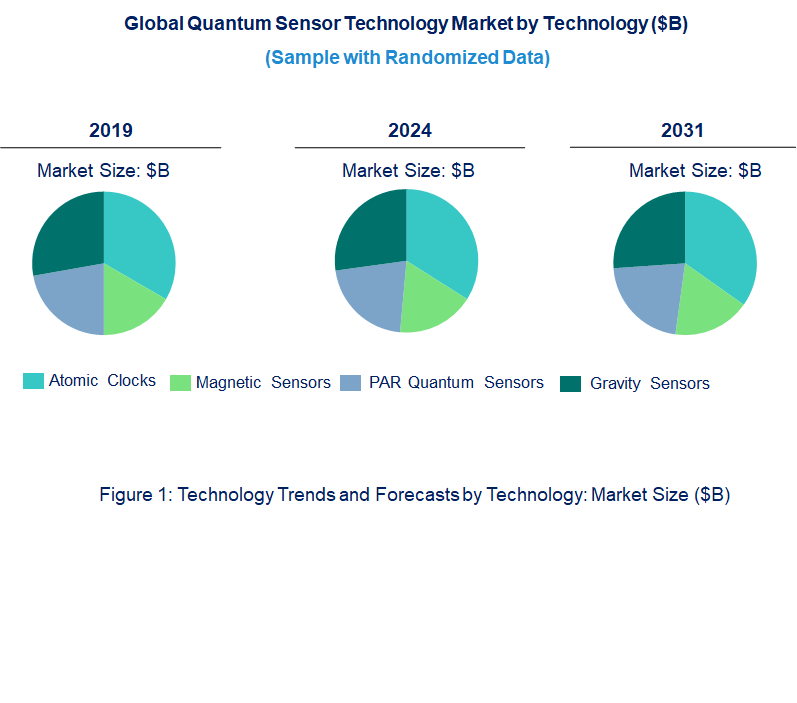
![Quantum Sensor Market Trend and Forecast by End Use Industry [Value from 2019 to 2031]:](https://lucintel.com/images/Quantum-Sensor-Technology-Market-Segment.png "Quantum Sensor Market Trend and Forecast by End Use Industry [Value from 2019 to 2031]:")
• Advances in Quantum Magnetometry: Quantum magnetometers of NV centers in diamonds are making ultra-sensitive detection of magnetic fields possible. This technology is revolutionizing medical diagnostics, from imaging the brain to analyzing materials, due to accurate, non-invasive analysis capabilities.
• Quantum Gravimetry: Quantum gravimeters use cold atom interferometry to detect gravitational forces with great accuracy. They are being used in geophysical, oil exploration, and infrastructural monitoring for detecting subsurface anomalies and the safety of structures.
• Quantum sensor integration with quantum communication networks. Quantum sensors are increasingly integrated with quantum communication systems for more security and more rapid data transfer. This interaction is of utmost importance for applications that demand secure navigation and communications, such as defense or autonomous systems.
• Miniaturization and portability. Miniaturized quantum sensors have influenced their use in portable and wearable devices. These compact designs thus enhance their user base within health monitoring, environmental sensing, and mobile navigation technologies.
• Quantum Sensors for Space Exploration: Currently, space agencies are using quantum sensors to provide precise navigation and resource mapping. These sensors have a high sensitivity to gravitational changes and magnetic anomalies, as these factors are crucial in planetary exploration, satellite positioning, and asteroid detection. These emerging trends point to the technology’s development capability. Quantum sensors are changing the nature of precision and reliability in measurement technologies while advancing magnetometry, gravimetry, communication integration, miniaturization, and space exploration capabilities. Quantum sensor adoption is changing the game, unlocking healthcare, infrastructure, and more.
• Campbell Scientific: Campbell Scientific has added quantum-based environmental sensors in their product line, providing an improvement in the level of precision for atmospheric and soil measurements. These sensors are important to agriculture, environmental monitoring, and research efforts because they help scientists track climate conditions and optimize crop management techniques.
• GWR Instruments: GWR Instruments focuses on the development of advanced quantum gravimeters designed for industrial and research applications. They enable high-resolution gravitational measurements, making them critical for any structural integrity assessment and for enhancing precision in geophysical and geotechnical applications, including oil and gas exploration. LI-COR: LI-COR has improved its quantum light sensor technology with better calibrations and durability, aimed at long-term field applications. Such improvements could have profound impacts on ecological studies in supporting efforts at precision farming, environmental conservation, and climate research, as monitoring light conditions would be conducted with high accuracy in dynamic outdoor environments. Quantum sensor technology recently released to the market is expected to revolutionize several industries, including navigation and autonomous systems, environmental monitoring, and geophysical research. Recent innovations from leading players promise enhanced accuracy and portability, easier functionality, and a larger scope of applications in quantum sensors that will serve as the impetus for the next generation of precise measurement solutions.
• Quantum Technologies Advancements: Recent advances in quantum mechanics, such as cold atom interferometry and nitrogen-vacancy centers, improve the sensitivity of quantum sensors and broaden their applications. Quantum sensors can, therefore, be very useful in geophysical and medical applications and establish the use by sectors that need high precision.
• Precision in Navigation and Defense: Quantum sensors have proven measurement of gravity forces and magnetic fields for applications in inertial navigation, as well as defense systems. The growing requirement for such high-precision, GPS-insensitive systems is finding its way into the aerospace and defense industries along with autonomous vehicles, thereby fueling further market growth.
• Increasing R&D Spending: Governments and the private sectors are investing heavily in quantum research, which is spurring advancements in quantum sensing technology. This investment is accelerating the development of next-generation quantum sensors with enhanced capabilities for commercial applications, particularly in resource exploration, environmental monitoring, and healthcare diagnostics.
• Combination with IoT and Smart Technologies: Quantum sensors are now being integrated into IoT and smart systems for the real-time analytics of data in different industries. Integrating quantum sensors into sectors like agriculture, environmental science, and logistics creates new opportunities for growth and innovation. Challenges
• High development and implementation costs: Quantum sensor systems appear difficult to develop and deploy because of their complexity and dependency on specific components. This factor restricts many small to medium-sized enterprises, which inevitably slows broader adoption.
• Technological Complexity and Scalability: Quantum sensors are still in the nascent stages of commercialization, and it is difficult to mass-produce the same items with uniform precision. This complexity hinders the drive for extensive incorporation of quantum sensors into the majority of industries, thus delaying full market penetration. Quantum sensors present a transformative technology with immense growth opportunities in high-precision sectors such as navigation, defense, and healthcare. Much needed to be done to bring quantum sensors into perspective for wider adoption. Other factors that influence the market positively include technological development, increased investment, and integration with smart systems. The growth of quantum sensors presents an opportunity to position them as a key example of next-generation sensor technologies, promoting their use in a wide range of industries.
• Aosense
• Apogee Instrument
• M Squared Lasers
• Muquans
• Robert Bosch
• Skye Instruments
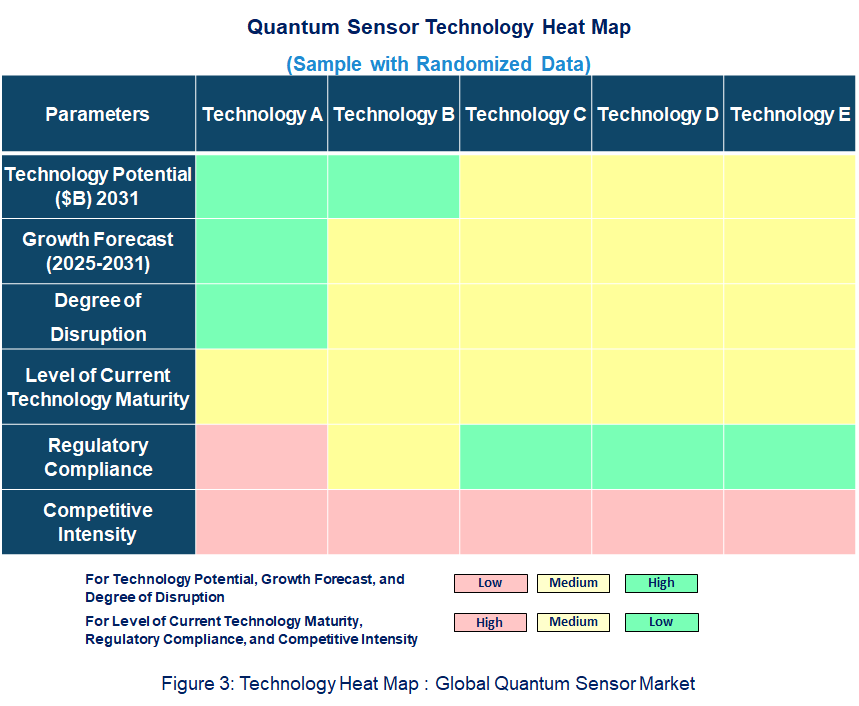
• Technology Readiness by Technology Type: Atomic clocks, leveraging quantum mechanical properties, are highly mature, with applications in GPS systems, telecommunications, and precise timekeeping. Their competitive level is high, with stringent regulatory compliance for accuracy. Magnetic sensors, using quantum properties like spin states, are advancing rapidly in industrial and medical applications, though scalability remains a challenge. PAR quantum sensors, for measuring light for agricultural and environmental applications, are evolving with moderate readiness but growing demand for precision farming. Gravity sensors, like quantum gravimeters, are highly developed for geophysical and geological research, with increasing adoption in infrastructure monitoring. Competitive intensity across these technologies is growing as companies seek to innovate, and regulatory frameworks are continuously updated to ensure precision and safety in applications.
• Competitive Intensity and Regulatory Compliance: The competitive intensity of technologies like atomic clocks, magnetic sensors, PAR quantum sensors, and gravity sensors is high, with multiple key players driving innovation. Atomic clocks dominate in precision timing and GPS applications, facing strict regulatory compliance standards for accuracy. Magnetic sensors, with applications in medical and industrial fields, are rapidly evolving, but scalability and precision remain a challenge. PAR quantum sensors are gaining momentum in agricultural and environmental markets, while regulatory standards are still developing. Gravity sensors are being adopted in geophysical surveys and infrastructure monitoring, where regulatory compliance ensures safety and accuracy in their measurements. The growing competition across these technologies is accelerating advancements but also emphasizing the importance of meeting regulatory standards.
• Disruption Potential of Different Technologies: Technologies like through-beam, retro-reflective, and reflective quantum sensor hold varying disruption potentials. Through-beam sensors offer the highest precision and sensitivity, disrupting industries that require long-range, high-accuracy measurements. Retro-reflective sensors, while more versatile and cost-effective, offer a moderate disruption by balancing performance with ease of installation and maintenance. Reflective sensors, being compact and cost-effective, have a lower disruption potential but are suitable for proximity-based applications and environments with space constraints. As these technologies evolve, their applications in sectors like navigation, healthcare, and industrial automation are growing, pushing the boundaries of traditional sensing capabilities.
• Atomic Clocks
• Magnetic Sensors
• PAR Quantum Sensors
• Gravity Sensors
• Military & Defense
• Automotive
• Oil & Gas
• Healthcare
• Others
• North America
• Europe
• Asia Pacific
• The Rest of the World
• Latest Developments and Innovations in the Quantum Sensor Technologies
• Companies / Ecosystems
• Strategic Opportunities by Technology Type


Choose a license that fits your team. Instant PDF delivery.
Prices exclude taxes. Instant delivery. Custom licensing available on request.
Market Report · May 18, 2026
Market Report · May 18, 2026
Market Report · May 18, 2026
Trusted partner for strategic intelligence and business growth


Receive a complimentary market analysis tailored to your industry. Our analysts will identify key growth opportunities and competitive dynamics specific to your business.

Market size, growth rate, and key trend analysis for your specific sector.

Top competitor positioning and market share analysis.

Strategic recommendations backed by data-driven insights.
Get curated market intelligence and competitive moves straight to your inbox.
By subscribing, you agree to receive our monthly insights. Unsubscribe anytime.
Receive a complimentary market analysis tailored to your industry. Our analysts will identify key growth opportunities and competitive dynamics specific to your business.
Market size, growth rate, and key trend analysis for your specific sector.
Top competitor positioning and market share analysis.
Strategic recommendations backed by data-driven insights.
Get curated market intelligence, emerging trends, and competitive moves straight to your inbox each month.
By subscribing, you agree to receive our monthly insights. Unsubscribe anytime.
We'll send your sample report shortly.