
Market Report · July 15, 2026

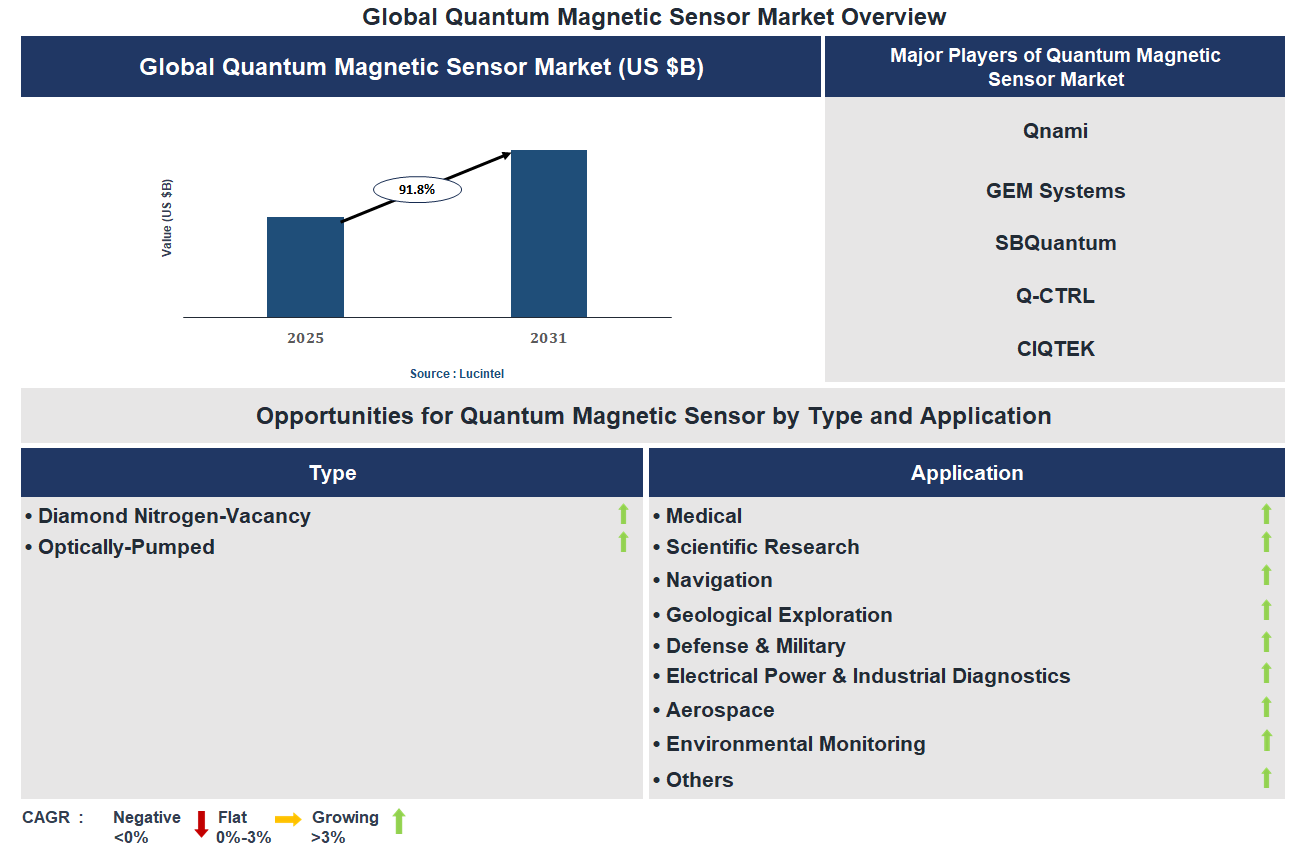
Key data points: The growth forecast = 91.8% annually for the next 7 years. Scroll below to get more insights. This market report covers trends, opportunities and forecasts in quantum magnetic sensor market to 2031 by type (diamond nitrogen-vacancy and optically-pumped), application (medical, scientific research, navigation, geological exploration, defense & military, electrical power & industrial diagnostics, aerospace, environmental monitoring, and others), and region (North America, Europe, Asia Pacific, and the Rest of the World)
We'll send your sample report shortly.
• Lucintel forecasts that, within the type category, diamond nitrogen-vacancy is expected to witness higher growth over the forecast period.
• Within the application category, medical is expected to witness the highest growth.
• In terms of region, APAC is expected to witness the highest growth over the forecast period. Gain valuable insights for your business decisions with our comprehensive 150+ page report. Sample figures with some insights are shown below.
• Increasing Adoption in Healthcare: The integration of quantum magnetic sensors in medical diagnostics is expanding, particularly in magnetoencephalography (MEG) and bio magnetic field detection. These sensors offer ultra-high sensitivity and spatial resolution, enabling early diagnosis of neurological disorders and cardiac conditions. As research progresses, their use is expected to grow, improving patient outcomes and reducing healthcare costs. This trend is driving innovation in sensor design and fostering collaborations between tech firms and healthcare providers, ultimately broadening the market’s scope and application diversity.
• Advancements in Sensor Technology: Innovations in quantum materials, such as diamond nitrogen-vacancy centers and superconducting quantum interference devices (SQUIDs), are enhancing sensor performance. These advancements lead to higher sensitivity, lower noise levels, and miniaturization, making sensors more practical for real-world applications. Improved fabrication techniques and quantum control methods are also reducing costs, facilitating wider adoption. This technological progress is critical for expanding the market into new sectors, including industrial non-destructive testing and environmental monitoring, and is expected to continue accelerating market growth.
• Growing Defense and Security Applications: Quantum magnetic sensors are increasingly utilized in defense for submarine detection, mine detection, and secure communication. Their ability to detect minute magnetic fields with high precision makes them invaluable for national security. Governments are investing heavily in research and development to enhance sensor capabilities, leading to strategic partnerships and increased market competition. This trend underscores the sensors strategic importance and is likely to propel market expansion, especially as defense budgets grow and technological needs become more sophisticated.
• Rising Demand for Portable and Miniaturized Sensors: The market is witnessing a shift toward compact, portable quantum magnetic sensors suitable for field applications. Advances in nanofabrication and integration techniques are enabling the development of handheld devices for use in environmental surveys, geological exploration, and emergency response. These portable sensors offer real-time data collection and ease of deployment, broadening their usability outside laboratory settings. This trend is making quantum sensors more accessible and versatile, thereby expanding their market reach and fostering new application opportunities.
• Increasing Focus on Industrial Applications: Industries such as oil and gas, mining, and manufacturing are adopting quantum magnetic sensors for non-invasive inspection, resource exploration, and quality control. Their high sensitivity allows for precise detection of subsurface anomalies and material defects, improving operational efficiency and safety. As industrial sectors recognize the benefits, investments in sensor development are rising. This trend is transforming traditional inspection methods, leading to smarter, more accurate industrial processes, and significantly expanding the market’s industrial segment. In summary, these emerging trends are collectively reshaping the quantum magnetic sensor market by enhancing sensor capabilities, broadening application areas, and fostering technological innovation. They are driving market growth, increasing competitiveness, and opening new avenues for deployment across diverse sectors, ultimately positioning quantum magnetic sensors as vital tools in future technological landscapes.

• Technological Advancements: Development of more sensitive and accurate quantum magnetic sensors has improved detection capabilities, enabling applications in medical imaging, mineral exploration, and security systems. These sensors offer higher resolution and lower noise levels, which significantly enhance performance and reliability, fostering broader adoption across industries.
• Miniaturization and Integration: Efforts to reduce sensor size and integrate quantum sensors with portable devices have increased their usability in field applications. Compact designs facilitate deployment in space-constrained environments, such as wearable health monitors and portable diagnostic tools, expanding market reach and user convenience.
• Commercialization and Investment: Increased funding from government agencies and private investors has accelerated the commercialization of quantum magnetic sensors. This influx of capital supports research, development, and manufacturing, leading to more affordable and accessible products, thus broadening market penetration.
• Industry-Specific Applications: Growing adoption in healthcare for magnetoencephalography (MEG), in defense for submarine detection, and in industrial automation for non-destructive testing has expanded the market scope. These specialized applications demonstrate the sensors versatility and drive demand across multiple sectors.
• Regulatory and Standardization Efforts: The establishment of industry standards and regulatory frameworks has facilitated market growth by ensuring safety, reliability, and interoperability of quantum magnetic sensors. These measures build consumer confidence and promote international trade, fostering a stable growth environment. In summary, recent developments in the quantum magnetic sensor market—spanning technological improvements, miniaturization, increased investment, industry-specific applications, and regulatory support—are collectively propelling the industry forward. These advancements are enhancing sensor performance, expanding application areas, and making quantum sensors more accessible, thereby significantly impacting market growth and positioning it for sustained expansion in the near future.
• Healthcare Diagnostics: Enhanced imaging and biomagnetic measurements are improving disease detection and monitoring, leading to more accurate and early diagnosis, which boosts patient outcomes and drives market expansion.
• Defense and Security: Quantum sensors offer superior detection of submarines, mines, and other threats, strengthening national security and creating new opportunities for defense applications.
• Industrial Non-Destructive Testing: High-precision magnetic field measurements enable better inspection of materials and structures, reducing downtime and preventing failures, thus increasing industrial safety and efficiency.
• Environmental Monitoring: Sensitive detection of geomagnetic variations aids in earthquake prediction and resource exploration, supporting sustainable development and environmental protection efforts.
• Scientific Research and Fundamental Physics: Quantum magnetic sensors facilitate groundbreaking research in physics and material sciences, fostering innovation and expanding the scope of scientific exploration. These growth opportunities are significantly impacting the quantum magnetic sensor market by broadening application horizons, enhancing technological capabilities, and fostering innovation. As a result, market growth is accelerating, attracting investments, and encouraging new product development, which collectively propel the industry toward a more integrated and advanced future.
• Technological Advancements: The rapid development of quantum computing and quantum sensing technologies has significantly enhanced the sensitivity and accuracy of magnetic sensors. These advancements enable detection of minute magnetic fields, which are crucial in applications like medical imaging, mineral exploration, and security systems. As research progresses, the cost of quantum components decreases, making sensors more accessible. The integration of AI and machine learning further improves sensor performance, fostering innovation. This continuous technological evolution is expected to sustain high growth rates and expand the market’s scope across various industries.
• Increasing Healthcare Applications: Quantum magnetic sensors are revolutionizing medical diagnostics, particularly in magnetoencephalography (MEG) and magnetic resonance imaging (MRI). Their ability to detect extremely weak magnetic signals allows for early diagnosis of neurological disorders and brain activity mapping with high precision. The rising prevalence of neurological conditions and the demand for non-invasive diagnostic tools drive investments in this sector. Moreover, government initiatives to promote advanced healthcare technologies are fueling market growth. As clinical validation progresses, the adoption of quantum sensors in healthcare is poised to expand, creating significant commercial opportunities.
• Growing Defense and Security Needs: The defense sector increasingly relies on quantum magnetic sensors for submarine detection, unexploded ordnance identification, and secure communication systems. Their high sensitivity and resistance to environmental noise make them ideal for strategic military applications. Governments worldwide are investing heavily in quantum technology to enhance national security, which directly benefits the quantum magnetic sensor market. Additionally, the ability to detect hidden metallic objects and monitor underground activities provides a strategic advantage. This growing demand from defense agencies is expected to sustain market growth and foster technological innovation.
• Rising Industrial and Commercial Use Cases: Industries such as oil and gas exploration, mineral prospecting, and manufacturing are adopting quantum magnetic sensors for precise detection and monitoring. These sensors improve the accuracy of subsurface imaging, leading to cost savings and operational efficiency. In addition, the increasing use of quantum sensors in quality control and nondestructive testing enhances product reliability. The expanding industrial applications, driven by the need for high-precision measurements, are fueling market expansion. As industries recognize the benefits of quantum sensing, investments are expected to rise, further accelerating market growth. The challenges facing quantum magnetic sensor market include:
• High Manufacturing Costs: The production of quantum magnetic sensors involves complex processes and expensive materials like superconductors and quantum dots. These costs hinder mass production and limit affordability for end-users. Additionally, maintaining the required cryogenic temperatures for certain quantum components adds to operational expenses. The high cost restricts widespread adoption, especially among small and medium enterprises. Overcoming these financial barriers requires technological innovations to reduce manufacturing expenses and improve scalability, which remains a significant challenge for market players.
• Technological Standardization and Compatibility: The lack of standardized protocols and interfaces for quantum sensors hampers interoperability across different systems and industries. Variations in design and performance specifications create integration challenges, slowing down deployment. Moreover, the rapid pace of technological change makes it difficult for regulatory bodies to establish comprehensive standards, leading to uncertainty. Achieving industry-wide standardization is essential for broader adoption, but it requires collaborative efforts among stakeholders, which is currently limited. This fragmentation poses a significant obstacle to market growth.
• Skilled Workforce Shortage: The specialized nature of quantum technology demands highly skilled researchers, engineers, and technicians. The current shortage of qualified personnel limits the pace of innovation and deployment. Educational institutions are gradually developing relevant curricula, but the talent gap remains substantial. This scarcity increases labor costs and delays project timelines, impacting market expansion. Addressing this challenge requires strategic investments in education and training programs to develop a skilled workforce capable of supporting the evolving quantum sensor industry. In summary, the quantum magnetic sensor market is driven by rapid technological innovations, expanding healthcare, defense, and industrial applications, while facing challenges related to high costs, standardization issues, and workforce shortages. These factors collectively influence the market’s growth potential, with technological progress promising significant opportunities, and economic and regulatory hurdles requiring strategic solutions. Overall, the market is poised for substantial expansion, provided stakeholders effectively navigate these complexities to harness the full potential of quantum sensing technologies.
• Qnami
• GEM Systems
• SBQuantum
• Q-CTRL
• CIQTEK
• Bosch
• Q.ANT
• Diamond Nitrogen-Vacancy
• Optically-Pumped
• Medical
• Scientific Research
• Navigation
• Geological Exploration
• Defense & Military
• Electrical Power & Industrial Diagnostics
• Aerospace
• Environmental Monitoring
• Others
• North America
• Europe
• Asia Pacific
• The Rest of the World
• United States: The U.S. leads in quantum sensor research, with significant investments from government agencies like the Department of Energy and DARPA. Major tech companies are developing advanced quantum magnetic sensors for applications in healthcare imaging, navigation, and defense. Recent breakthroughs include improved sensitivity and miniaturization, enabling broader commercial adoption. The U.S. also hosts numerous startups and research institutions pioneering quantum sensor technology, fostering a vibrant innovation ecosystem.
• China: China has made substantial progress in quantum sensor development, backed by government initiatives such as the "Quantum Information Science and Technology Innovation Action Plan." The country focuses on integrating quantum magnetic sensors into defense systems, security, and industrial applications. Recent advancements include enhanced sensor stability and scalability, with several large-scale projects demonstrating practical deployment. Chinas strategic investments aim to position it as a global leader in quantum technology by 2030.
• Germany: Germany emphasizes the integration of quantum magnetic sensors into industrial and healthcare sectors, supported by the European Unions research programs. Key developments include the commercialization of sensors for medical diagnostics and geophysical exploration. German research institutions are collaborating with industry to improve sensor robustness and cost-effectiveness. The country is also investing in quantum sensor standardization and certification to facilitate market growth within Europe.
• India: India is rapidly advancing in quantum sensor research, with government initiatives like the National Mission on Quantum Technologies and Applications. Focus areas include developing sensors for defense, navigation, and environmental monitoring. Recent progress involves improving sensor sensitivity and developing indigenous manufacturing capabilities. Indian startups and academia are actively participating in global collaborations, aiming to establish a competitive position in the emerging quantum sensor market.
• Japan: Japan continues to innovate in quantum magnetic sensor technology, driven by its strong electronics and semiconductor industries. Recent developments include high-precision sensors for medical imaging and industrial automation. The government supports quantum research through funding programs and industry partnerships. Japanese companies are working on integrating quantum sensors into existing systems, emphasizing reliability and miniaturization to meet industrial standards. The country aims to leverage its technological expertise to maintain a competitive edge in the global market.


• Qnami
• GEM Systems
• SBQuantum
• Q-CTRL
• CIQTEK
• Bosch
• Q.ANT Q5. Which quantum magnetic sensor market segment will be the largest in future? Answer: Lucintel forecasts that, within the type category, diamond nitrogen-vacancy is expected to witness higher growth over the forecast period. Q6. In quantum magnetic sensor market, which region is expected to be the largest in next 5 years? Answer: In terms of region, APAC is expected to witness the highest growth over the forecast period. Q7. Do we receive customization in this report? Answer: Yes, Lucintel provides 10% customization without any additional cost.


Choose a license that fits your team. Instant PDF delivery.
Prices exclude taxes. Instant delivery. Custom licensing available on request.
Market Report · July 15, 2026
Market Report · July 13, 2026
Market Report · July 13, 2026
Trusted partner for strategic intelligence and business growth


Receive a complimentary market analysis tailored to your industry. Our analysts will identify key growth opportunities and competitive dynamics specific to your business.

Market size, growth rate, and key trend analysis for your specific sector.

Top competitor positioning and market share analysis.

Strategic recommendations backed by data-driven insights.
Get curated market intelligence and competitive moves straight to your inbox.
By subscribing, you agree to receive our monthly insights. Unsubscribe anytime.
Receive a complimentary market analysis tailored to your industry. Our analysts will identify key growth opportunities and competitive dynamics specific to your business.
Market size, growth rate, and key trend analysis for your specific sector.
Top competitor positioning and market share analysis.
Strategic recommendations backed by data-driven insights.
Get curated market intelligence, emerging trends, and competitive moves straight to your inbox each month.
By subscribing, you agree to receive our monthly insights. Unsubscribe anytime.
We'll send your sample report shortly.