
Market Report · July 29, 2026

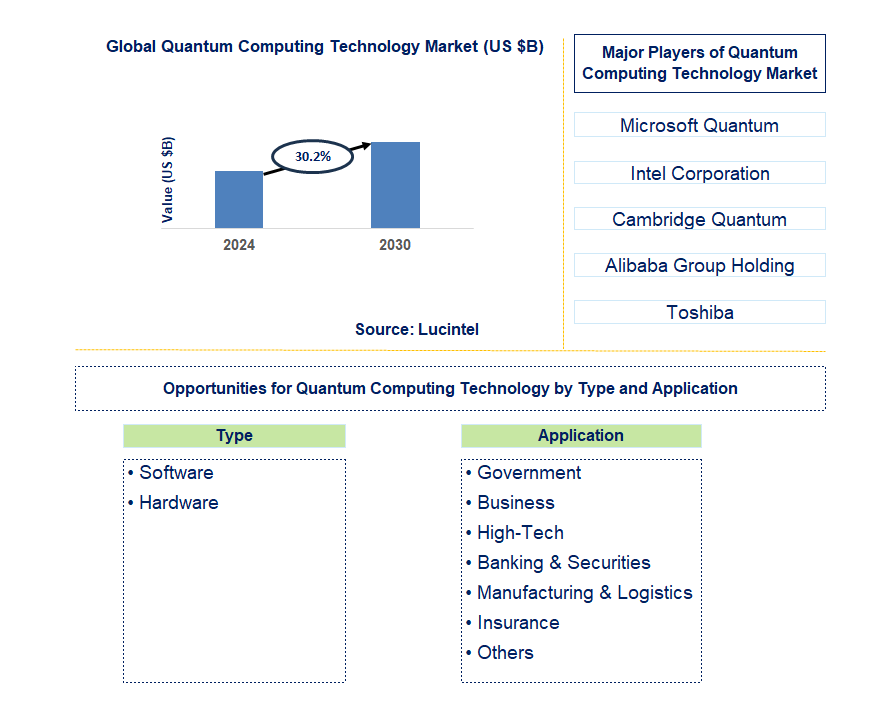
Key data points: The growth forecast = 30.2% annually next 6 years. Scroll below to get more insights. This market report covers trends, opportunities, and forecast in the global quantum computing technology market to 2030 by type (software and hardware), application (government, business, high-tech, banking & securities, manufacturing & logistics, insurance, and others), and region (North America, Europe, Asia Pacific, and the Rest of the World)
We'll send your sample report shortly.
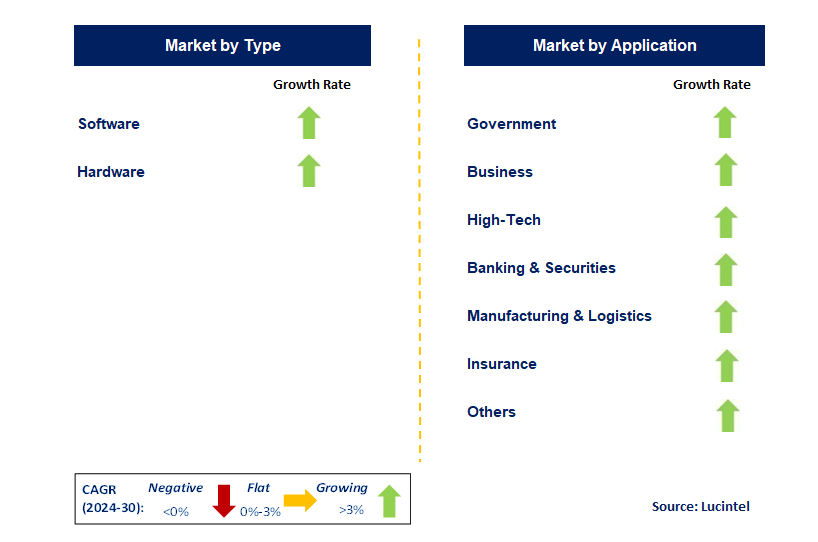
• Lucintel forecasts that software is expected to witness the higher growth over the forecast period.
• Within this market, government is expected to witness the highest growth.
• North America is expected to witness highest growth over the forecast period. A more than 150-page report is developed to help in your business decisions.
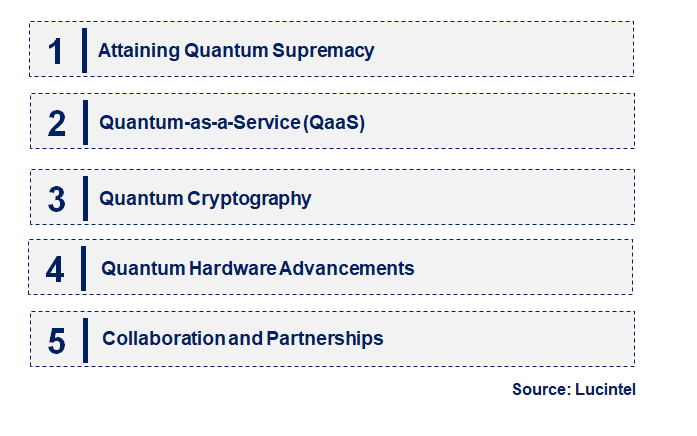
• Attaining Quantum Supremacy: Attaining quantum supremacy is, inter alia, a key milestone in which a quantum computer has solved a problem that classical computers have thus far been unable to solve. Companies such as Google and IBM are striving to reach and push the limits of quantum supremacy, which is futuristic in areas such as cryptography and complex simulations aimed at making quantum computers suitable for practical purposes.
• Quantum-as-a-Service (QaaS): Cloud-based quantum computing platforms are gaining popularity, allowing businesses to access quantum computing resources without owning expensive hardware. Providers like IBM and Microsoft are offering QaaS solutions, enabling organizations to experiment with quantum algorithms and develop applications. This trend is democratizing quantum computing and expanding its accessibility across industries.
• Quantum Cryptography: Focusing on quantum key distribution (QKD), there is significant energy in the development of quantum cryptography, equivalent to that of current scientific innovations. With the increasing rate of cyberbanking and the evolving ability of quantum computers to decrypt virtually any message, both businesses and governments are stressed about using quantum cryptography to protect important information. This is particularly evident in industries like finance and defense, where data security is paramount.
• Quantum Hardware Advancements: Advances in quantum hardware, such as superconducting qubits and trapped ions, are enhancing the scalability and stability of quantum systems. Companies are working to tackle problems like qubit coherence and error correction. These developments are critical in bringing quantum computing to commercialization and assuring the feasibility of quantum computing applications across all industries.
• Collaboration and Partnerships: Cooperation among the tech industry, scientific institutions, and government is becoming a notable feature in the pursuit of quantum computing. The combination of public and private strategies is providing the necessary dynamics to encourage new ideas and their distribution. This development is resulting in the quicker advancement of quantum technologies, making new innovations more common and enabling solutions to difficult international problems without solitary efforts. These trends are altering the quantum computing market by improving technological capabilities, enhancing security, and accessing more markets across different industries.
• Breakthroughs in Quantum Algorithms: The field of quantum algorithms has tremendously broadened the scope of optimization like never before. Breakthrough algorithms, such as Shor’s and Grover’s, are being improved for more effective implementations in quantum computing control for applications in the sectors of cryptography, finance, and pharmacy, with a significant edge over conventional computation systems.
• Development of Quantum Processors: With hundreds of working qubits produced by Google and IBM, these companies have achieved virtually unprecedented progress in producing quantum processors. They are pushing the frontiers of quantum computing by designing these processors for enhanced coherence and qubit error correction, enabling even more sophisticated samplings and computations.
• Quantum Networking: There is also growing interest in quantum networking, which involves linking quantum computers across a large expanse. China is at the forefront of advanced communications, where the QUESS project helps make it possible to securely send data through quantum encryption. This advancement will be crucial for the future use of a quantum internet.
• Deploying Quantum Simulation in Drug Discovery: The application of quantum computing in the pharmaceutical industry, particularly in drug design and molecular modeling, is gaining momentum. Quantum computing is used in the drug discovery process to model intricate molecular structures more effectively, thereby accelerating the processes involved and offering advanced solutions in personalized medicine.
• National Quantum Initiatives: Most nations, including the U.S., China, and Germany, have adopted national quantum initiatives aimed at promoting and fostering quantum research and development. These initiatives emphasize the development of quantum information science and technology to enhance new advancements and maintain competitiveness in quantum computing. These developments advance the commercialization of quantum computing, enabling it to address real-life challenges and catalyze development in various sectors.
• Financial Services: There is revolutionary potential in applying quantum computation to the financial services sector regarding risk assessment, analyzing complex portfolios, and detecting fraud. Banks and other financial organizations intend to implement quantum algorithms in their processes to enhance decision-making and secure transactions, thus making quantum a game-changing technology in this domain.
• Drug Development: In the pharmaceutical field, quantum computing is helping to speed up the process of drug discovery by allowing testing of molecular interactions at unprecedented speeds. This ability is essential in the search for potential drug candidates and in compound-structure optimization processes, thus providing significant potential for expansion in the healthcare and life sciences sectors.
• Optimization in Logistics: Given that quantum computing can address computationally intractable optimization challenges, it is well positioned in the logistics and supply chain sector. Businesses are looking to use quantum computing for route optimization for deliveries, optimization of inventory levels, and production schedules to enhance efficiency and reduce costs.
• Material Science: Applications of quantum simulations can be used to compute and foresee the characteristics of previously unexplored types of materials, which could advance the aerospace, automotive, and energy industries. This growth opportunity relies primarily on the further development of materials that are stronger, lighter, and more environmentally friendly, thus facilitating industrialization and innovation.
• Cybersecurity: As concerns over information storage and data security grow, advancements in quantum computing are paving the way for new developments in quantum encryption and cryptography. This technology provides solutions to the increasing need to secure sensitive data from threats posed by emerging quantum technologies, thus creating opportunities for growth in cybersecurity solutions and services. These growth opportunities position quantum computing as a game-changing technology across various relevant industries, driving innovations and enhancing capabilities.
• Technological Advancements: The rapid development of quantum hardware and protocols is among the major drivers of the market. Technologies such as superconducting qubits and error correction are making quantum computing practical, leading to increased consumption across various sectors.
• National Quantum Initiatives: National programs in countries such as the USA, China, and Germany are fostering R&D in quantum computing that will put these nations at the forefront of the technology and encourage global interaction.
• Commercial Applications: Demand for quantum computing is increasing as the use cases for quantum computers in financial services, healthcare, supply chains, and cybersecurity markets emerge. Industries are trying to use quantum computing in ways that conventional computers cannot, stimulating new business models and revenue options.
• Private Sector Investments: Investment from the private sector in quantum startups and research and development is increasing, thus speeding up the commercialization of quantum technologies. Such investments are crucial for the development and market placement of quantum devices.
• Quantum Cryptography: With the growth of information technology, the need for quantum cryptography has been increasing. As quantum key distribution (QKD) enables secure channels, it is a significant driver for communication in finance and defense. Challenges in the quantum computing technology market include:
• Technical Complexity: There are limits to the development of quantum systems, which can refer to problems of scaling, including qubit coherence and error correction. Resolving these and other issues is important for quantum computers to find business applications.
• High Costs: Manufacturing, designing, and researching quantum computing consumes significant funds and time. This restricts the operations of smaller firms in the field and delays the realization of mass use.
• Talent Shortage: The inadequate availability of quantum computing professionals, such as quantum physicists and engineers, is a core challenge. It is crucial to build a skilled labor force for technological progress and market expansion. In general, the market evolution for quantum computing is being driven by the potential for technological development and the impetus of government efforts, but progress is being hampered by technical challenges and high costs. How these factors will interplay will determine the future of quantum computing.
• Microsoft Quantum Architectures
• Intel Corporation
• Cambridge Quantum Computing
• Alibaba Group Holding Limited
• Toshiba
• Nokia Bell Labs
• IBM
• Software
• Hardware
• Government
• Business
• High-Tech
• Banking & Securities
• Manufacturing & Logistics
• Insurance
• Others
• North America
• Europe
• Asia Pacific
• The Rest of the World
• United States: Lockheed Martin, IBM, Google, and Microsoft are providing strong financial backing to UK-based endeavors in quantum computing, which have now assumed a commanding lead in this field. The National Quantum Initiative Act is also encouraging joint efforts between academic institutions, government, and the private sector towards fast-tracking quantum algorithms and hardware development. The U.S. seeks to maximize the use of quantum technology through national security and QKD while keeping pace with the increasing competition in the industry.
• China: China is catching up with other players in quantum computing due to major state-led programs. Major Chinese corporations, including Alibaba and Baidu, as well as universities, are engaged in the development of quantum communication and encryption technologies. To fulfill its ambition of becoming the first country to achieve quantum supremacy, China is working on the QUESS project, which focuses mainly on secure communication but has already developed the theories and technological principles of a quantum communication satellite.
• Germany: Germany is emerging as a quantum research hub within Europe. The “Quantum Technologies Flagship” project and other government-sponsored programs are actively forming and fostering R&D, while Siemens and other companies and startups are integrating quantum computing for industrial purposes. Germany’s policies that promote the development of quantum hardware, as well as the collaboration model of academia and industry, help strengthen Germany’s position on the quantum technology map.
• India: India has made significant progress in quantum computing technology, partly due to investments from the government and private businesses. One of the key programs to support R&D and build quantum infrastructure is the National Mission on Quantum Technologies and Applications (NM-QTA). Indian information technology enterprises are implementing quantum applications for cryptography and data protection, indicating that the national security and economic prospects of such technologies are attracting more attention.
• Japan: Japan has allocated considerable funds for the development of quantum computers, attracting investments under the government’s Quantum Leap Flagship Program aimed at establishing a quantum ecosystem. Leading companies such as Fujitsu and Toshiba are also conducting research activities in quantum simulations and algorithms. Japan aims to extend the application of quantum technologies in various fields, including pharmaceuticals and materials, which impacts Japan’s growth, making it a competitor in the quantum technologies race.


• Microsoft Quantum Architectures
• Intel Corporation
• Cambridge Quantum Computing
• Alibaba Group Holding Limited
• Toshiba
• Nokia Bell Labs
• IBM Q5. Which quantum computing technology market segment will be the largest in future? Answer: Lucintel forecasts that software is expected to witness the higher growth over the forecast period. Q6. In quantum computing technology market, which region is expected to be the largest in next 5 years? Answer: North America is expected to witness highest growth over the forecast period. Q.7 Do we receive customization in this report? Answer: Yes, Lucintel provides 10% customization without any additional cost.


Choose a license that fits your team. Instant PDF delivery.
Prices exclude taxes. Instant delivery. Custom licensing available on request.
Market Report · July 29, 2026
Market Report · July 20, 2026
Market Report · July 20, 2026
Trusted partner for strategic intelligence and business growth


Receive a complimentary market analysis tailored to your industry. Our analysts will identify key growth opportunities and competitive dynamics specific to your business.

Market size, growth rate, and key trend analysis for your specific sector.

Top competitor positioning and market share analysis.

Strategic recommendations backed by data-driven insights.
Get curated market intelligence and competitive moves straight to your inbox.
By subscribing, you agree to receive our monthly insights. Unsubscribe anytime.
Receive a complimentary market analysis tailored to your industry. Our analysts will identify key growth opportunities and competitive dynamics specific to your business.
Market size, growth rate, and key trend analysis for your specific sector.
Top competitor positioning and market share analysis.
Strategic recommendations backed by data-driven insights.
Get curated market intelligence, emerging trends, and competitive moves straight to your inbox each month.
By subscribing, you agree to receive our monthly insights. Unsubscribe anytime.
We'll send your sample report shortly.