
Report Feature
Pyrethroid Market Trends and Forecast
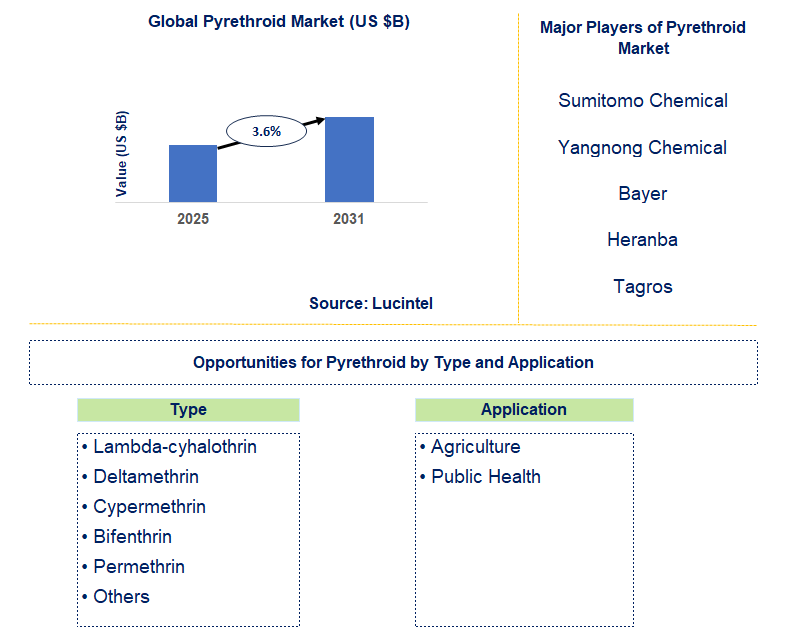
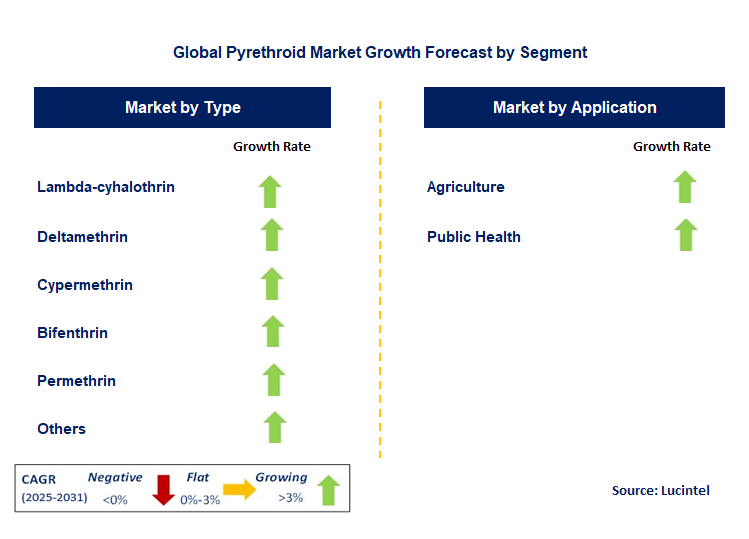
The future of the global pyrethroid market looks promising with opportunities in the agriculture and public health markets. The global pyrethroid market is expected to grow with a CAGR of 3.6% from 2025 to 2031. The major drivers for this market are the increasing demand for crop protection solutions, the rising awareness about vector-borne diseases control, and the growing adoption of eco-friendly pest control methods.• Lucintel forecasts that, within the type category, lambda-cyhalothrin is expected to witness the highest growth over the forecast period.
• Within the application category, agriculture is expected to witness higher growth.
• In terms of region, APAC is expected to witness the highest growth over the forecast period. Gain valuable insights for your business decisions with our comprehensive 150+ page report. Sample figures with some insights are shown below.
Emerging Trends in the Pyrethroid Market
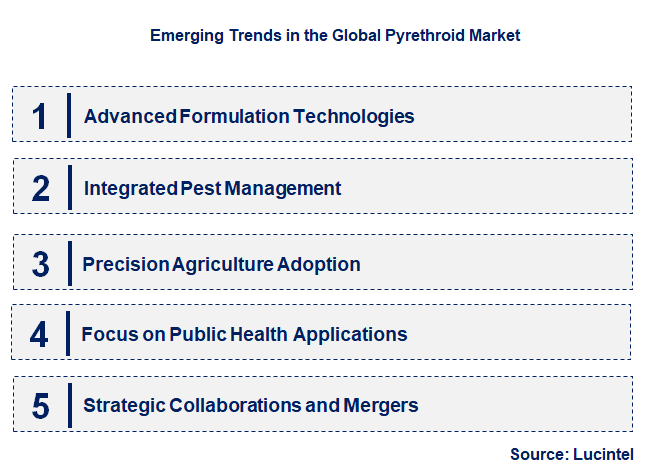
The pyrethroid market is being shaped by several key trends that reflect a global shift towards more precise, sustainable, and effective pest control solutions. These developments are a direct response to challenges like growing pest resistance, stricter environmental regulations, and the increasing demand for enhanced food security. Companies are focusing on innovation to adapt to these evolving market dynamics.• Advanced Formulation Technologies: The trend is toward microencapsulation and controlled-release formulations. This technology encapsulates the active pyrethroid ingredient, which allows for a slower, more sustained release. This not only enhances the insecticide’s efficacy and longevity but also reduces the required application rates and minimizes its off-target impact on beneficial insects and the environment.
• Integrated Pest Management: IPM is an emerging trend that emphasizes a holistic approach to pest control. Pyrethroids are being integrated into broader strategies that combine chemical application with biological controls, cultural practices, and other methods. This approach helps to prevent the development of pest resistance and reduces overall chemical usage, aligning with global sustainability goals.
• Precision Agriculture Adoption: The use of technologies like drones, GPS, and AI-guided application systems is becoming a significant trend. These technologies allow for the precise and targeted application of pyrethroids, ensuring that the insecticide is delivered only where it is needed. This leads to higher efficiency, reduced waste, and a lower environmental footprint.
• Focus on Public Health Applications: With the rising global incidence of vector-borne diseases like malaria and dengue fever, there is a growing trend of using pyrethroids in public health programs. This includes the use of pyrethroid-treated bed nets and indoor residual spraying. The market is seeing an increase in R&D to develop long-lasting and safe formulations specifically for these applications.
• Strategic Collaborations and Mergers: To navigate a competitive and highly regulated market, companies are increasingly engaging in mergers, acquisitions, and strategic collaborations. This trend allows key players to expand their product portfolios, enhance their research capabilities, and gain a stronger foothold in new geographic regions, especially in fast-growing markets like Asia-Pacific. These trends are collectively reshaping the pyrethroid market by pushing it towards a more technologically advanced, sustainable, and application-specific future. The emphasis is moving beyond simple efficacy to include environmental stewardship, resistance management, and the integration of pyrethroids into sophisticated, multi-faceted pest control systems for both agricultural and public health needs.
Recent Development in the Pyrethroid Market
The pyrethroid market has been impacted by key developments in technology, consumer demand, and regulatory policies. These changes are driving a shift towards more innovative and sustainable products. The industry is responding by developing novel formulations, adopting new application methods, and focusing on specific market segments to maintain relevance and growth in an evolving global landscape.• New Formulations for Efficacy: New formulations, such as microencapsulation, are improving efficacy. Impact: This technology allows for a slower release of the active ingredient, providing longer residual control and reducing the frequency of application. It enhances the overall effectiveness of the product while minimizing environmental exposure and the risk to non-target organisms.
• Regulatory Shifts Driving Demand: Restrictions on other insecticides, like neonicotinoids, are driving demand for pyrethroids. Impact: As an alternative to chemistries facing regulatory scrutiny, pyrethroids are gaining market share. This shift is particularly prominent in major agricultural markets like North America and Europe, where growers are turning to pyrethroids to protect their crops.
• Technological Integration: Precision agriculture technologies are being integrated into pyrethroid application. Impact: The use of drones and AI-powered systems allows for precise, targeted spraying, which optimizes the use of pyrethroids. This not only increases efficiency and reduces costs for farmers but also addresses environmental concerns by minimizing chemical run-off and overspray.
• Resistance Management Solutions: Companies are developing dual-action formulations to combat pest resistance. Impact: The widespread use of pyrethroids has led to resistance in certain pest species. To counter this, manufacturers are creating products that combine pyrethroids with other insecticide classes, leveraging complementary modes of action to restore efficacy and ensure long-term pest control.
• Growing Public Health Segment: Pyrethroid use is increasing in public health for vector control. Impact: With the rising prevalence of mosquito-borne diseases like dengue and malaria, there is an increased need for effective solutions. Pyrethroid-treated nets and indoor residual sprays are becoming vital tools in public health initiatives, driving significant market growth in this segment. These developments are shaping a more sophisticated and dynamic pyrethroid market. The industry is moving toward more complex, multi-faceted solutions that address key challenges, including pest resistance and environmental concerns. The collective impact of these innovations is a more efficient, sustainable, and application-specific range of products.
Strategic Growth Opportunities in the Pyrethroid Market
The pyrethroid market presents numerous growth opportunities across key applications, driven by evolving consumer needs and technological advancements. These opportunities lie in a strategic focus on segments that are experiencing increasing demand and where pyrethroids offer a unique and effective solution. By targeting these areas, companies can enhance their market position and drive sustainable business growth.• Agricultural Crop Protection: Expanding pyrethroid applications in high-value crops like fruits and vegetables. Impact: While traditionally strong in row crops like cotton and soybeans, there is a significant growth opportunity to develop specific pyrethroid formulations for fruits and vegetables. These crops have a higher value per acre and require precise pest management, offering a high-profit, specialized market segment.
• Vector Control in Public Health: Capitalizing on the growing demand for pyrethroids in vector-borne disease control. Impact: As global health organizations and governments increase their efforts to combat diseases like malaria and dengue, the demand for pyrethroid-based products, such as insecticide-treated bed nets and indoor sprays, is surging. This presents a major growth opportunity, especially in developing regions.
• Professional Pest Control: Developing targeted pyrethroid products for the professional pest control sector. Impact: This segment, which includes commercial and residential pest control services, offers a stable, high-margin market. Opportunities exist in creating specialized, long-lasting formulations for indoor and outdoor use, and in developing training programs for applicators to ensure safe and effective use.
• Animal Health Applications: Increasing the use of pyrethroids in veterinary medicine for parasite control. Impact: Pyrethroids are highly effective against external parasites on livestock and companion animals. The growing global livestock industry and increased pet ownership create a strong and reliable market for pyrethroid-based animal health products, including pour-ons, sprays, and dips.
• Stored Grain Protection: Focusing on pyrethroid solutions for post-harvest protection of grains. Impact: Protecting stored grains from pests is crucial for preventing food waste and ensuring food security. Pyrethroids can be applied to grains and storage facilities to prevent infestations, offering a valuable and growing market opportunity as global grain trade and storage infrastructure expand. These strategic opportunities are driving innovation and market expansion in the pyrethroid industry. By focusing on these high-growth applications, companies can leverage the versatility and effectiveness of pyrethroids to address critical needs in agriculture, public health, and animal health, thereby ensuring continued market relevance and profitability.
Pyrethroid Market Driver and Challenges
The pyrethroid market is influenced by a complex interplay of major drivers and challenges, including technological, economic, and regulatory factors. The market’s growth is propelled by key forces like rising food demand and technological innovation, while it simultaneously grapples with significant hurdles such as pest resistance and increasing regulatory scrutiny. Understanding these dynamics is crucial for navigating the market. The factors responsible for driving the pyrethroid market include: 1. Increasing Global Food Demand: A rapidly growing global population requires a substantial increase in food production. This fuels the demand for effective crop protection solutions like pyrethroids to prevent pest-related crop losses. The emphasis on agricultural productivity to ensure food security is a primary market driver. 2. Vector-Borne Disease Control: The rising incidence of diseases such as malaria and dengue fever has increased the need for effective vector control. Pyrethroids are a frontline tool in public health programs, used in treated bed nets and residual sprays, which drives significant and consistent demand. 3. Restrictions on Other Insecticides: Government regulations have increasingly restricted the use of certain insecticide classes, particularly neonicotinoids. This regulatory shift has created a substitution demand for pyrethroids, as they are often a preferred alternative for crop protection and pest control. 4. Technological Advancements: Innovation in formulation technologies, like microencapsulation, is enhancing product performance. These advancements improve the longevity, efficacy, and environmental profile of pyrethroids, making them more attractive to a wider range of users and applications. 5. Expansion of Key Crop Areas: The global expansion of acreage for major crops like soybeans and cotton. These crops are particularly susceptible to pyrethroid-targeted pests, and the increase in their cultivation directly translates to a greater need for pyrethroid insecticides. Challenges in the pyrethroid market are: 1. Growing Pest Resistance: Widespread and prolonged use of pyrethroids has led to the development of resistance in key pest species. This reduces the products’ effectiveness and necessitates the development of new, more complex formulations or alternative control methods. 2. Stringent Regulatory Scrutiny: Regulatory bodies worldwide are implementing stricter rules on pesticide use, including maximum residue limits (MRLs). These regulations can limit the applications of certain pyrethroids, increase R&D costs, and slow down new product registrations. 3. Environmental and Health Concerns: Pyrethroids can have adverse effects on non-target organisms, such as beneficial insects and aquatic life. Public and regulatory concerns over their environmental impact and potential human health risks pose a significant challenge to market growth and public acceptance. The pyrethroid market is experiencing a push-pull effect. While a growing population and public health needs drive strong demand, the industry must overcome significant challenges related to pest resistance and environmental regulation. Success in this market hinges on a company’s ability to innovate and provide solutions that are not only effective but also sustainable and compliant with evolving global standards.List of Pyrethroid Companies
Companies in the market compete on the basis of product quality offered. Major players in this market focus on expanding their manufacturing facilities, R&D investments, infrastructural development, and leverage integration opportunities across the value chain. With these strategies pyrethroid companies cater increasing demand, ensure competitive effectiveness, develop innovative products & technologies, reduce production costs, and expand their customer base. Some of the pyrethroid companies profiled in this report include-• Sumitomo Chemical
• Yangnong Chemical
• Bayer
• Heranba
• Tagros
• Meghmani
• Shanghai Tenglong Agrochem
• Jiangsu RedSun
• Aestar
• Gharda
Pyrethroid Market by Segment
The study includes a forecast for the global pyrethroid market by type, application, and region.Pyrethroid Market by Type [Value from 2019 to 2031]:
• Lambda-cyhalothrin
• Deltamethrin
• Cypermethrin
• Bifenthrin
• Permethrin
• Others
Pyrethroid Market by Application [Value from 2019 to 2031]:
• Agriculture
• Public Health
Pyrethroid Market by Region [Value from 2019 to 2031]:
• North America
• Europe
• Asia Pacific
• The Rest of the World
Country Wise Outlook for the Pyrethroid Market
The pyrethroid market is experiencing dynamic shifts driven by agricultural demands, public health concerns, and evolving regulations. These synthetic insecticides, valued for their effectiveness against a broad spectrum of pests and relatively low toxicity to mammals, are integral to crop protection and vector control. Recent developments across key countries reflect a global push for more sustainable, efficient, and targeted pest management solutions.• United States: The U.S. market is driven by rising demand for pest control in agriculture and public health, with increasing adoption in residential and commercial sectors. The focus is on developing newer, more potent formulations and advanced delivery systems, like microencapsulation, to enhance efficacy while minimizing environmental impact.
• China: As a major producer and consumer, China’s pyrethroid market is growing rapidly, fueled by agricultural expansion and restrictions on older pesticides. There is a strong emphasis on microencapsulated formulations to reduce drift and meet tightening regulations. The use of precision-spray drones and AI-guided application systems is also a significant development.
• Germany: The German pyrethroid market is characterized by a strong emphasis on sustainability and stringent regulations. Developments are centered on creating more selective formulations with reduced environmental impact, aligning with the country’s focus on bio-pesticides and integrated pest management (IPM) strategies.
• India: India is both a leading producer and a major consumer of pyrethroids, with the market propelled by the need to enhance agricultural productivity for its burgeoning population. Recent developments include increased awareness of sustainable farming practices and a shift towards safer, more eco-friendly alternatives.
• Japan: The Japanese market is distinguished by its strong focus on technological innovation and high-quality products. Companies in Japan are at the forefront of developing advanced pyrethroid formulations and unique delivery systems that offer high efficacy, rapid knockdown, and enhanced safety for both humans and the environment.

Features of the Global Pyrethroid Market
Market Size Estimates: Pyrethroid market size estimation in terms of value ($B). Trend and Forecast Analysis: Market trends (2019 to 2024) and forecast (2025 to 2031) by various segments and regions. Segmentation Analysis: Pyrethroid market size by type, application, and region in terms of value ($B). Regional Analysis: Pyrethroid market breakdown by North America, Europe, Asia Pacific, and Rest of the World. Growth Opportunities: Analysis of growth opportunities in different types, applications, and regions for the pyrethroid market. Strategic Analysis: This includes M&A, new product development, and competitive landscape of the pyrethroid market. Analysis of competitive intensity of the industry based on Porter’s Five Forces model.
FAQ
Q1. What is the growth forecast for pyrethroid market? Answer: The global pyrethroid market is expected to grow with a CAGR of 3.6% from 2025 to 2031. Q2. What are the major drivers influencing the growth of the pyrethroid market? Answer: The major drivers for this market are the increasing demand for crop protection solutions, the rising awareness about vector-borne diseases control, and the growing adoption of eco-friendly pest control methods. Q3. What are the major segments for pyrethroid market? Answer: The future of the pyrethroid market looks promising with opportunities in the agriculture and public health markets. Q4. Who are the key pyrethroid market companies? Answer: Some of the key pyrethroid companies are as follows:• Sumitomo Chemical
• Yangnong Chemical
• Bayer
• Heranba
• Tagros
• Meghmani
• Shanghai Tenglong Agrochem
• Jiangsu RedSun
• Aestar
• Gharda Q5. Which pyrethroid market segment will be the largest in future? Answer: Lucintel forecasts that, within the type category, lambda-cyhalothrin is expected to witness the highest growth over the forecast period. Q6. In pyrethroid market, which region is expected to be the largest in next 5 years? Answer: In terms of region, APAC is expected to witness the highest growth over the forecast period. Q7. Do we receive customization in this report? Answer: Yes, Lucintel provides 10% customization without any additional cost.
Table of Contents
Methodology
- In-depth interviews of the major players in this market
- Detailed secondary research from competitors’ financial statements and published data
- Extensive searches of published works, market, and database information pertaining to industry news, company press releases, and customer intentions
- A compilation of the experiences, judgments, and insights of Lucintel’s professionals, who have analyzed and tracked this market over the years.


Buy Now
Choose a license that fits your team. Instant PDF delivery.
Prices exclude taxes. Instant delivery. Custom licensing available on request.
Key Questions
- • What are some of the most promising, high-growth opportunities for the pyrethroid market by type (lambda-cyhalothrin, deltamethrin, cypermethrin, bifenthrin, permethrin, and others), application (agriculture and public health), and region (North America, Europe, Asia Pacific, and the Rest of the World)?
- • Which segments will grow at a faster pace and why?
- • Which region will grow at a faster pace and why?
- • What are the key factors affecting market dynamics? What are the key challenges and business risks in this market?
- • What are the business risks and competitive threats in this market?
- • What are the emerging trends in this market and the reasons behind them?
- • What are some of the changing demands of customers in the market?
- • What are the new developments in the market? Which companies are leading these developments?
- • Who are the major players in this market? What strategic initiatives are key players pursuing for business growth?
- • What are some of the competing products in this market and how big of a threat do they pose for loss of market share by material or product substitution?
- • What M&A activity has occurred in the last 5 years and what has its impact been on the industry? For any questions related to Pyrethroid Market, Pyrethroid Market Size, Pyrethroid Market Growth, Pyrethroid Market Analysis, Pyrethroid Market Report, Pyrethroid Market Share, Pyrethroid Market Trends, Pyrethroid Market Forecast, Pyrethroid Companies, write Lucintel analyst at email: helpdesk@lucintel.com. We will be glad to get back to you soon.


