
Market Report · July 29, 2026

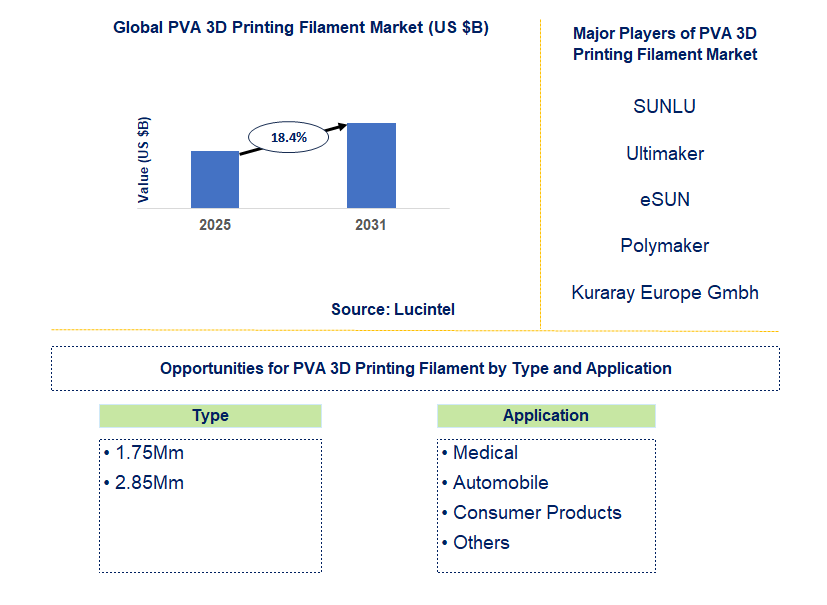
Key data points: The growth forecast = 18.4% annually for the next 7 years. Scroll below to get more insights. This market report covers Trends, opportunities and forecasts in PVA 3D printing filament market to 2031 by type (1.75mm and 2.85mm), application (medical, automobile, consumer products, and others), and region (North America, Europe, Asia Pacific, and the Rest of the World)
We'll send your sample report shortly.
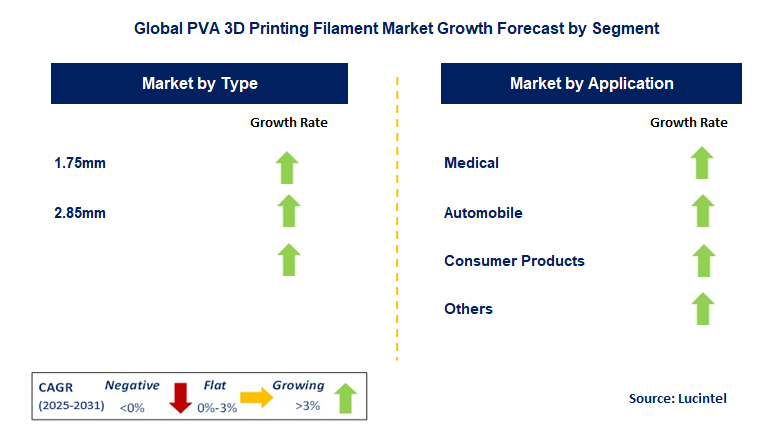
• Lucintel forecasts that, within the type category, 1.75mm is expected to witness higher growth over the forecast period due to its higher availability and its extensive use in prototyping and consumer applications.
• Within the application category, medical is expected to witness the highest growth
• In terms of region, North America is expected to witness the highest growth over the forecast period due to growing demand in the medical and manufacturing sectors.
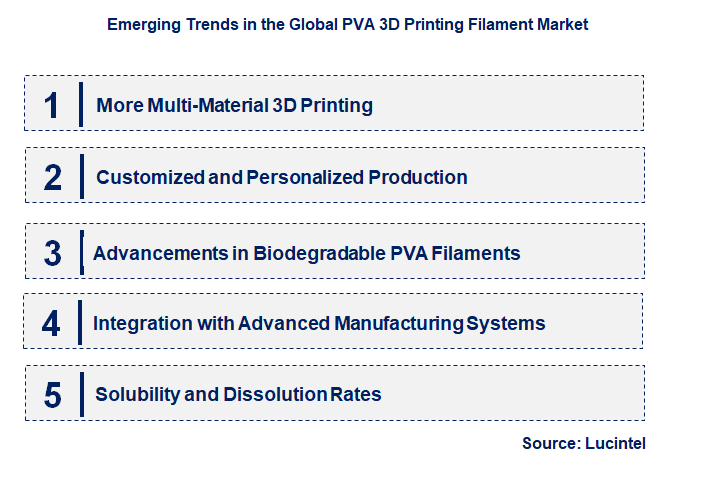
• More Multi-Material 3D Printing: PVA filaments are being increasingly used as support materials in multi-material 3D printing, especially in applications where intricate parts are needed in industries like automotive and aerospace. The support structures can easily be removed using PVA's water-solubility, making it suitable for multi-material 3D printing. Increased demand for multi-material 3D printing has thus increased demand for PVA filaments.
• Customized and Personalized Production: The demand for customized products from medical implants towards consumer products is driving PVA 3D printing filaments. Increasingly, in healthcare, there is a need for personally designed 3D-printed medical devices, contributing to the demand for versatile materials such as PVA. The ability to print support structures that dissolve after use without affecting the final product’s integrity is crucial to this trend, allowing for complex, personalized designs that are both functional and precise.
• Advancements in Biodegradable PVA Filaments: Sustainability is a key driver of change in the 3D printing industry, and the demand for biodegradable PVA filaments is growing. These filaments are made from eco-friendly materials that can break down in natural environments, reducing the environmental impact of 3D printing. As consumers and industries move toward greener alternatives, biodegradable PVA filaments are gaining popularity, offering an environmentally sustainable solution for additive manufacturing without compromising performance.
• Integration with Advanced Manufacturing Systems: PVA 3D printing filaments are increasingly being integrated into automated and advanced manufacturing systems. The PVA filaments used in the current industrial scale of 3D printing operations are improving efficiency by enabling high-speed production with minimal material waste. This trend is on the rise because of demand for faster cycles of production in the automotive and aerospace sectors. As the advanced manufacturing system couples with PVA filament technology, large-scale 3D printing is now more enhanced.
• Solubility and Dissolution Rates: Many manufacturers are trying to increase the rate at which PVA filaments dissolve and also gain even better dissolution. As a result of innovations in the formulation, PVA filaments have been developed that disintegrate rapidly and completely within water, reducing print time significantly and also improving the quality of parts printed overall. This trend is very important for high-precision and intricate designs in such fields as medical device manufacturing and rapid prototyping. Emerging trends are giving new shapes to the PVA 3D printing filament market, driving innovations in materials, sustainability, and industrial applications. As these trends evolve over time, the market is expected to grow, opening up new opportunities for manufacturers to increase capabilities and meet the increasing demand for high-quality, efficient, and eco-friendly 3D printing solutions.
• Improved Mechanical Properties: The work in recent times majorly focused on improving the mechanical properties of PVA filaments. It is seen that manufacturers are bringing more filaments with better adhesion strength, more strength, and higher dissolution rates, thus making them more efficient to apply in multi-material 3D printing. This helps to increase the flexibility of PVA filaments as it enables the creation of much more complex and robust parts in 3D printing, especially in aerospace and automotive.
• New Formulations for Better Printability: Manufacturers have developed new formulations of PVA filaments with enhanced printability, such as less warping and better adhesion to the print bed. This is meant to make the experience of users even better and PVA filaments more available to a larger population of 3D printing users, such as hobbyists and educational institutions. Better printability also reduces waste and production time.
• Cost Reduction and Production Scaling: As the demand for PVA filaments increases, manufacturers are looking to reduce the cost of production of PVA filaments. Improvements in production technology, such as better extrusion processes, are allowing for mass production of PVA filaments at lower costs. This makes PVA filaments more accessible to a larger group of users, which helps in the overall acceptance of the technology in various industries.
• Sustainability Initiatives in PVA Production: Companies are increasingly adopting sustainable practices in the production of PVA filaments, including using renewable resources and reducing energy consumption. The development of biodegradable and recyclable PVA filaments is helping meet the growing demand for eco-friendly 3D printing materials. These initiatives are in line with global sustainability goals and are helping position PVA filaments as a more environmentally responsible option in the 3D printing market.
• Increase in the Production Capacity: The high demand for PVA 3D printing filaments increased the production capacity of leading filament manufacturers. Companies have been expanding their manufacturing capabilities to meet the growing demand from industries like automotive, healthcare, and education. It is through the increase in production capacity that manufacturers are able to provide a wider range of PVA filaments in various colors, diameters, and formulations catering to different user requirements. Recent updates in the market for PVA 3D printing filaments improve material characteristics, enhance the printability factor, and popularize the demand for PVA filaments throughout various industries. The PVA filament market shall experience further increase in production while scaling up efforts to make processes sustainable.
• Increased Adoption in Healthcare and Medical Applications: The healthcare industry is increasingly adopting PVA 3D printing filaments for applications such as personalized implants, prosthetics, and surgical guides. PVA's water-solubility is ideal for creating dissolvable support structures, which is particularly valuable in medical 3D printing, where precision and safety are crucial. Opportunities lie in furthering PVA formulations for improving the biocompatibility and strength of printed medical devices. Since customized medical solutions are highly sought for, the use of PVA filaments is to grow considerable in this area.
• Increasing Adoption in Educational and Research Institutes: Educational institutions and research facilities are major consumers of PVA 3D printing filaments due to their ability to teach complex concepts through practical 3D models and prototypes. PVA filaments are often used for creating intricate models that require support structures that can be easily dissolved after printing. As 3D printing technology becomes more deeply integrated into curricula and applications in research, the demand for PVA filaments in education is likely to increase, allowing suppliers to continue to develop even more cost-effective and high-performance filaments targeted at these applications.
• Growth in the Automotive and Aerospace Markets: PVA filaments are increasingly being adopted in the automotive and aerospace markets because they allow for the printing of lightweight, complex parts with dissolvable support structures. The manufacturing processes of these industries require 3D printing solutions for high-precision prototyping and end-use parts. With the growing demand for more flexible and sustainable production methods, the need for PVA filaments in these sectors will keep increasing. Improvement in the strength and durability of PVA filaments with its ease of dissolution for intricate designs will be the main opportunity.
• Increasing Applications in Consumer Goods and Customization: The demand for custom consumer goods such as jewelry, fashion accessories, and home decor is on an increase, and PVA filaments are ideal for such a market. Customization requires the capability of uniquely designing things within complex geometries, and PVA filaments offer an efficient solution for creating support structures that can easily be broken off once printed. The demand for PVA filaments in the consumer goods sector will increase as the consumers require more customized products. Manufacturers will be required to develop high-quality filaments to suit the needs of highly customized production.
• Sustainability Focus and Eco-Friendly Solutions: Sustainability is emerging as a major trend in the 3D printing industry, and PVA filaments are in a good position to capitalize on this trend. As more conscious consumers and industries seek their sustainability aspects, biodegradable and water-soluble PVA filaments will become widely used in various applications. In comparison with other 3D filaments, they lead the way regarding environmentally friendly developments, reducing waste for them to be printed without stubborn support, which can significantly be removed within water. This increasing demand for eco-friendly products will soon establish a significant market for these filaments among sectors such as packaging, automotive, and healthcare. These strategic growth opportunities reflect the multiple uses and potential of PVA filaments in 3D printing. As the expansion of the healthcare, education, automotive, consumer goods, and sustainability-focused sectors, among others, continues, the demand for PVA filaments is expected to grow continuously. Manufacturers and suppliers can drive innovation and support the development of advanced 3D printing solutions by capitalizing on these opportunities.
• SUNLU
• Ultimaker
• eSUN
• Polymaker
• Kuraray Europe
• Silver Am Technology
• Bambu Labs
• Formfutura
• Shenzhen Hello 3D Technology
• Gizmo Dorks
• 1.75mm
• 2.85mm
• Medical
• Automobile
• Consumer Products
• Others
• North America
• Europe
• Asia Pacific
• The Rest of the World
• United States: The U.S. market of PVA 3D printing filament has expanded rapidly due to the advancements of additive manufacturing technology, especially within the aerospace and medical device manufacturing industries. Leading producers have been launching new PVA formulations in the market, which are stronger and dissolve faster, making them compatible with more complex designs for 3D printing. On-demand services for 3D printing are also emerging in large numbers in the U.S., thus increasing the demand for PVA filaments because they are necessary support structures in intricate support structures during a printing process.
• China: In China, the PVA 3D printing filament market is thriving because of the strong manufacturing base and increased adoption of 3D printing technologies in the country. High solubility and printability PVA filaments have generated interest in education, automotive, and electronics industries. An extension of 3D printing infrastructure investment by China, coupled with government policies focused on sustainable technology, is growing the consumption rate of PVA filaments in the country. Additionally, China-based companies have been increasingly engaging in local manufacturing of PVA filaments, reducing their dependency on imports.
• Germany: Germany remains at the top position in Europe with the PVA 3D printing filament market, catalyzed by the strength of the industrial base and demand for the high precision 3D printing in industries such as automotive, engineering, and healthcare. The new technologies within the PVA filament emphasized its more durable and easier-to-use nature in order to produce the intricate geometries and the support structures more efficiently. Increasing interest in customized 3D printing solutions and a demand for materials that can dissolve in water for support of complex designs are among the key growth drivers for PVA filament adoption in Germany.
• India: PVA 3D printing filaments are seeing growth in the Indian market due to the acceptance of additive manufacturing by industries in aerospace, education, and manufacturing. Indian companies are currently looking into PVA filament's potential for the creation of support structures in multi-material 3D printing with a growing emphasis on research and development. PVA filaments are highly popular for educational and prototyping applications. The increased number of 3D printing startups in India is driving demand for specialized filaments, and PVA's water-solubility makes it particularly valued for its efficiency in producing test models and prototypes.
• Japan: PVA 3D printing filament has seen a remarkable growth in the Japanese market. This is mainly due to its advanced technology and focus on precision engineering. In sectors like robotics, automotive, and electronics, innovation has taken the center stage, and therefore, the need for PVA filaments has increased to produce complex parts with dissolvable support materials. Japanese manufacturers are also working on the environmental sustainability of PVA filaments, and biodegradable and eco-friendly variants are gaining popularity nowadays. This is in tandem with Japan's green manufacturing practices and reducing waste.


• SUNLU
• Ultimaker
• eSUN
• Polymaker
• Kuraray Europe
• Silver Am Technology
• Bambu Labs
• Formfutura
• Shenzhen Hello 3D Technology
• Gizmo Dorks Q5. Which PVA 3D printing filament market segment will be the largest in future? Answer: Lucintel forecasts that, within the type category, 1.75mm is expected to witness higher growth over the forecast period due to its higher availability and its extensive use in prototyping and consumer applications. Q6. In PVA 3D printing filament market, which region is expected to be the largest in next 5 years? Answer: In terms of region, North America is expected to witness the highest growth over the forecast period due to growing demand in the medical and manufacturing sectors. Q7. Do we receive customization in this report? Answer: Yes, Lucintel provides 10% customization without any additional cost.


Choose a license that fits your team. Instant PDF delivery.
Prices exclude taxes. Instant delivery. Custom licensing available on request.
Market Report · July 29, 2026
Market Report · July 20, 2026
Market Report · July 20, 2026
Trusted partner for strategic intelligence and business growth


Receive a complimentary market analysis tailored to your industry. Our analysts will identify key growth opportunities and competitive dynamics specific to your business.

Market size, growth rate, and key trend analysis for your specific sector.

Top competitor positioning and market share analysis.

Strategic recommendations backed by data-driven insights.
Get curated market intelligence and competitive moves straight to your inbox.
By subscribing, you agree to receive our monthly insights. Unsubscribe anytime.
Receive a complimentary market analysis tailored to your industry. Our analysts will identify key growth opportunities and competitive dynamics specific to your business.
Market size, growth rate, and key trend analysis for your specific sector.
Top competitor positioning and market share analysis.
Strategic recommendations backed by data-driven insights.
Get curated market intelligence, emerging trends, and competitive moves straight to your inbox each month.
By subscribing, you agree to receive our monthly insights. Unsubscribe anytime.
We'll send your sample report shortly.