
Pure Electric Autonomous Manned Aircraft Market Report: Trends, Forecast and Competitive Analysis to 2035

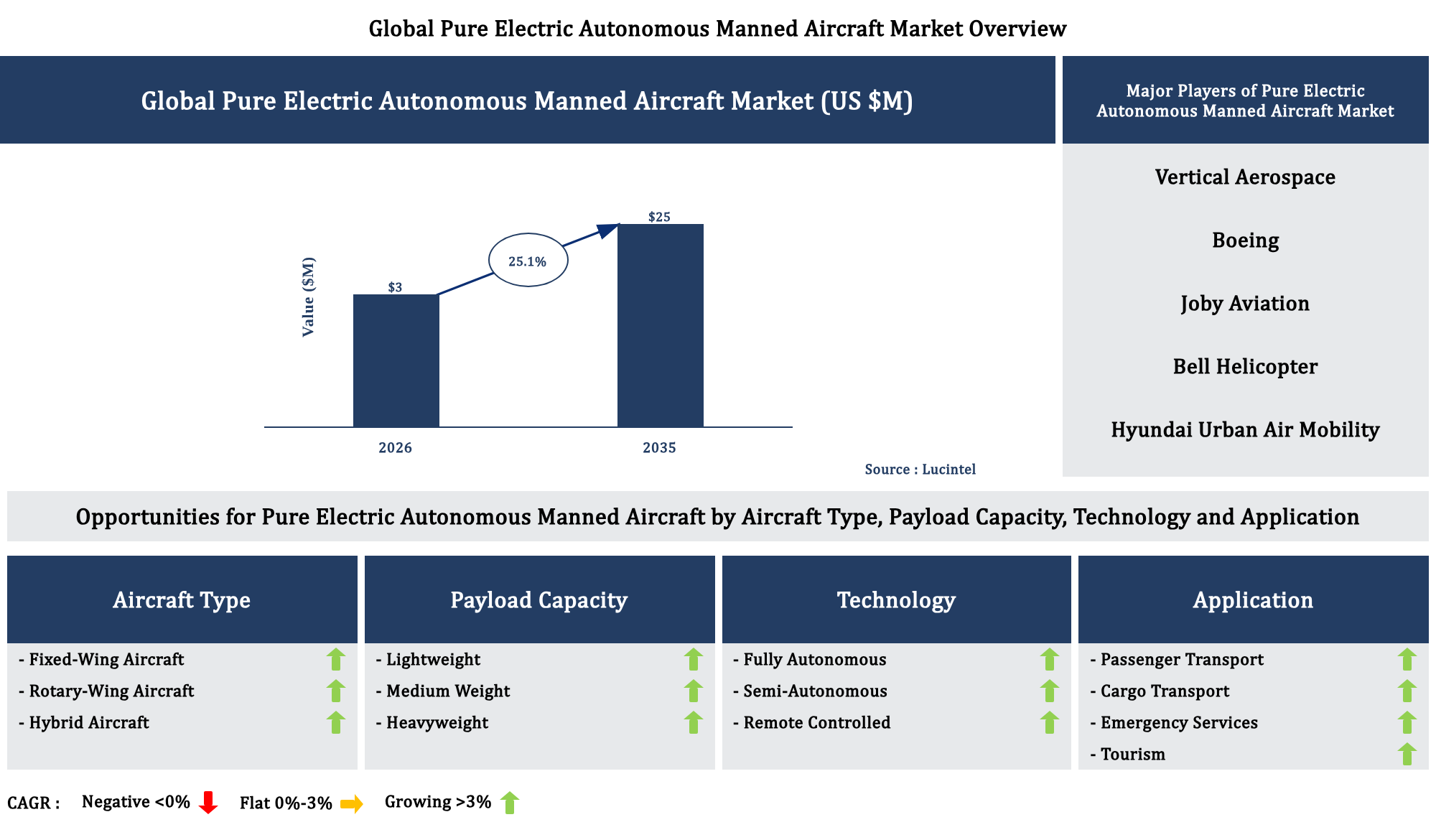
Key data points: The market size in 2035 = $25 million, growth forecast = 25.1% annually for the next 8 years. Scroll below to get more insights. This market report covers trends, opportunities and forecasts in pure electric autonomous manned aircraft market to 2035 by aircraft type (fixed-wing aircraft, rotary-wing aircraft, and hybrid aircraft), payload capacity (lightweight, medium weight, and heavyweight), technology (fully autonomous, semi-autonomous, and remote controlled), application (passenger transport, cargo transport, emergency services, and tourism), and region (North America, Europe, Asia Pacific, and the Rest of the World)

Publisher: Lucintel Last Updated: July 2026
See Pricing

Download Sample Report

| ✨ New Download Sample report — Get instant insights! | ✨ New Download Sample report — Get instant insights!

Pure Electric Autonomous Manned Aircraft Market Report: Trends, Forecast and Competitive Analysis to 2035

Pure Electric Autonomous Manned Aircraft Market

The future of the global pure electric autonomous manned aircraft market looks promising with opportunities in the passenger transport, cargo transport, emergency service, and tourism markets. The global pure electric autonomous manned aircraft market is expected to reach an estimated $25 million by 2035 with a CAGR of 25.1% from 2026 to 2035. The major drivers for this market are the increasing demand for sustainable aviation solutions, the rising adoption of autonomous flight technologies, and the growing need for efficient electric aircraft operations.

  • Lucintel forecasts that, within the aircraft type category, hybrid aircraft is expected to witness the highest growth over the forecast period due to the increasing focus on efficient and sustainable aircraft technologies.
  • Within the application category, passenger transport is expected to witness the highest growth due to the rising demand for autonomous passenger mobility solutions.
  • In terms of regions, North America is expected to witness the highest growth over the forecast period due to the growing investments in advanced aviation innovation and development.

Gain valuable insights for your business decisions with our comprehensive 150+ page report. Sample figures with some insights are shown below.
Pure Electric Autonomous Manned Aircraft Market

Emerging Trends in the Pure Electric Autonomous Manned Aircraft Market

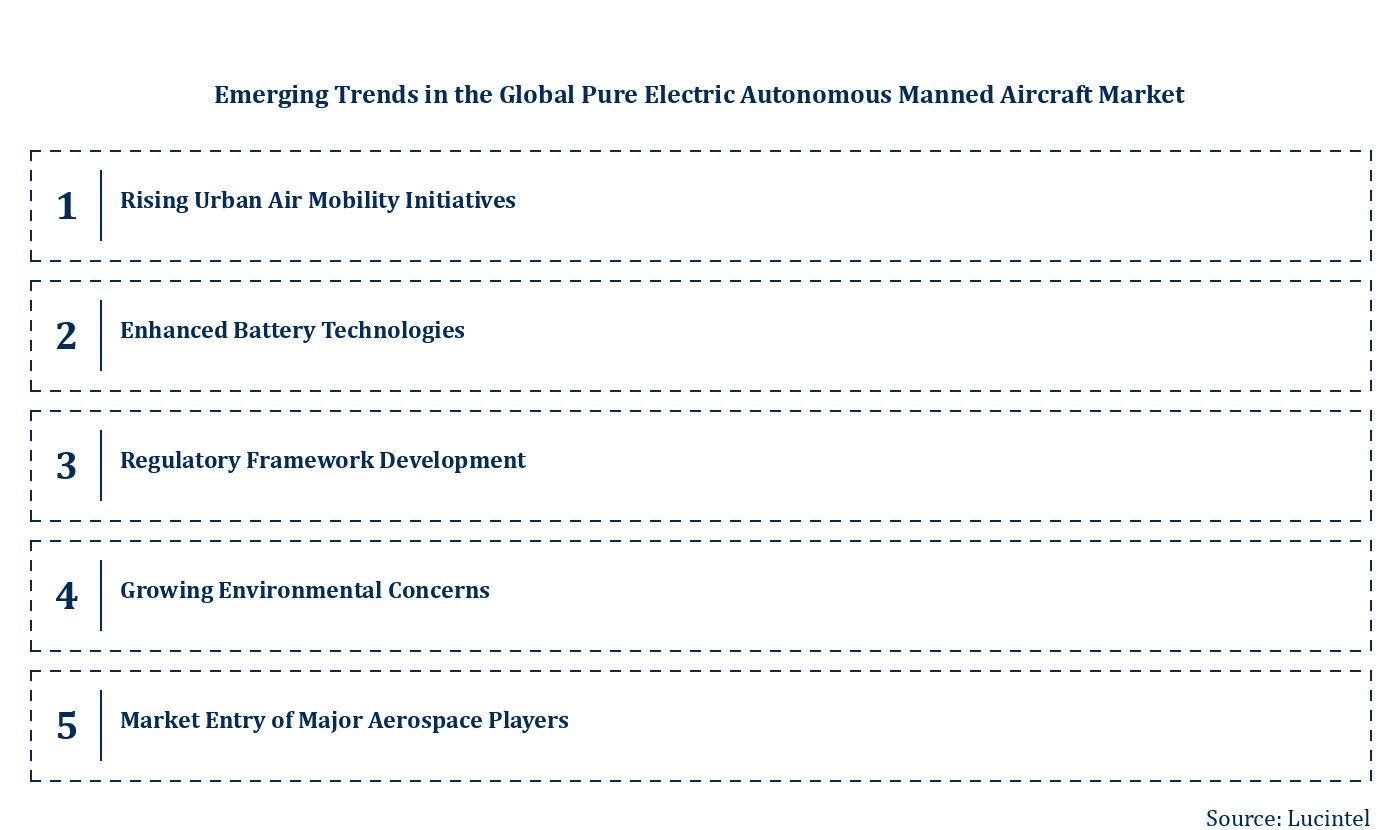
The pure electric autonomous manned aircraft market is experiencing rapid evolution driven by technological advancements, environmental concerns, and changing regulatory landscapes. As the demand for sustainable and efficient transportation solutions grows, industry players are exploring innovative ways to develop electric-powered aircraft that can operate autonomously and safely. These developments are not only transforming traditional aviation but also opening new opportunities for urban mobility, cargo delivery, and regional connectivity. The markets trajectory is shaped by a combination of technological, regulatory, and consumer-driven factors, making it a dynamic and promising sector poised for significant growth in the coming years.

  • Rising Urban Air Mobility Initiatives: Increasing investments in urban air mobility (UAM) projects are accelerating the adoption of electric autonomous aircraft for short-distance travel within cities. These aircraft aim to reduce congestion, improve travel times, and lower emissions, making urban transportation more sustainable. Governments and private companies are collaborating to develop infrastructure and regulatory frameworks, fostering a conducive environment for market expansion. The integration of autonomous electric aircraft into urban transit systems is expected to revolutionize city commuting, offering faster, cleaner, and more flexible mobility options.
  • Enhanced Battery Technologies: Advances in battery chemistry and energy storage are critical to the viability of electric aircraft. Improvements in battery capacity, charging speed, and weight reduction are enabling longer flight ranges and higher payload capacities. These technological enhancements directly impact aircraft performance, safety, and operational costs, making electric autonomous aircraft more competitive with traditional fuel-powered options. As battery technology continues to evolve, it will unlock new applications and increase the market’s overall adoption rate, supporting sustainable aviation goals.
  • Regulatory Framework Development: Governments and aviation authorities are actively working to establish standards and regulations for autonomous electric aircraft. Clear guidelines on safety, certification, and airspace management are essential for market growth. Progressive regulatory policies are fostering investor confidence and encouraging innovation, while also addressing safety concerns associated with autonomous operations. The development of comprehensive regulatory frameworks will facilitate smoother integration of electric autonomous aircraft into existing airspace systems, ensuring safe and efficient deployment at scale.
  • Growing Environmental Concerns: Increasing awareness of climate change and environmental sustainability is driving demand for zero-emission transportation solutions. Electric autonomous aircraft offer a cleaner alternative to traditional aircraft, significantly reducing carbon emissions and noise pollution. This environmental focus is influencing market strategies, with companies prioritizing eco-friendly designs and renewable energy integration. The push for sustainability is also attracting government incentives and funding, further accelerating market growth. As environmental considerations become central to transportation planning, electric autonomous aircraft are positioned as a key component of greener mobility solutions.
  • Market Entry of Major Aerospace Players: Leading aerospace and technology companies are entering the electric autonomous aircraft market, bringing expertise, resources, and innovation. Their involvement is accelerating product development, reducing time-to-market, and increasing competition. Strategic partnerships and investments are fostering a robust ecosystem for research, testing, and commercialization. The entry of established players enhances credibility, attracts funding, and drives technological breakthroughs. This competitive landscape is expected to lead to a broader range of offerings, lower costs, and faster adoption, ultimately reshaping the market into a more dynamic and innovative sector.

These emerging trends are collectively transforming the pure electric autonomous manned aircraft market by fostering innovation, improving safety and efficiency, and aligning with global sustainability goals. The convergence of technological advancements, regulatory support, and environmental priorities is creating a fertile environment for rapid growth and diversification, positioning electric autonomous aircraft as a pivotal element in the future of transportation.
Pure Electric Autonomous Manned Aircraft Market by country

Recent Developments in the Pure Electric Autonomous Manned Aircraft Market

The pure electric autonomous manned aircraft market is experiencing rapid innovation driven by advancements in battery technology, automation, and sustainable transportation needs. These developments are transforming the aerospace industry by offering eco-friendly, efficient, and safer flight options. As governments and private sectors invest heavily in green mobility, the market is poised for significant growth. Emerging technologies and regulatory support are further accelerating adoption, creating new opportunities for manufacturers, service providers, and consumers. This evolving landscape promises to reshape how people and goods are transported through the air.

  • Growing Adoption of Electric Propulsion Systems: The shift towards electric propulsion is reducing emissions and operational costs, making aircraft more sustainable. Advances in battery capacity and efficiency are enabling longer flights and higher payloads, expanding market potential. This development attracts airlines and private operators seeking eco-friendly alternatives, fostering innovation and competition. As electric propulsion becomes mainstream, it will significantly influence aircraft design, maintenance, and operational strategies, ultimately leading to a cleaner, more efficient aerospace industry.
  • Increased Focus on Autonomous Flight Technologies: Automation in aircraft enhances safety, reduces pilot workload, and improves operational efficiency. Recent developments include advanced sensors, AI-driven navigation, and real-time data processing, enabling fully autonomous or semi-autonomous flights. These innovations are attracting regulatory attention and investment, paving the way for widespread adoption. Autonomous systems can optimize routes, reduce delays, and lower costs, making air travel more accessible and reliable. This shift is expected to revolutionize air mobility, especially in urban and remote areas.
  • Rising Demand for Manned Electric Aircraft for Urban Mobility: Urban air mobility (UAM) is gaining momentum as electric manned aircraft offer quick, quiet, and eco-friendly transportation within cities. Recent prototypes and pilot projects demonstrate their potential to alleviate ground traffic congestion and reduce pollution. The development of compact, easy-to-operate aircraft tailored for urban environments is attracting public and private sector interest. As infrastructure and regulations evolve, these aircraft are poised to become integral to future urban transportation networks, transforming city commuting and logistics.
  • Advancements in Battery Technology and Energy Storage: Breakthroughs in battery chemistry and energy density are critical for extending flight range and payload capacity of electric aircraft. Innovations such as solid-state batteries and fast-charging systems are reducing weight and charging times, making electric flights more practical. These improvements directly impact aircraft performance, operational costs, and safety. Enhanced energy storage solutions are enabling longer, more reliable flights, thus broadening market applications from regional travel to cargo delivery, and fostering sustainable aviation growth.
  • Regulatory Frameworks Supporting Electric and Autonomous Aircraft: Governments and aviation authorities are developing policies to facilitate the integration of electric and autonomous aircraft into existing airspace. Recent regulations focus on safety standards, certification processes, and air traffic management for unmanned and electric aircraft. These frameworks are essential for market expansion, providing clarity and confidence to investors and manufacturers. Streamlined approval processes and supportive policies will accelerate deployment, encourage innovation, and ensure safe, efficient adoption of new aircraft technologies across the industry.

These developments are collectively transforming the market by promoting sustainable, safe, and efficient air mobility solutions. They are attracting investments, fostering innovation, and shaping regulatory landscapes, which will lead to increased adoption and market growth. The overall impact is a more environmentally friendly, technologically advanced, and accessible aerospace industry poised for significant expansion.

Strategic Growth Opportunities in the Pure Electric Autonomous Manned Aircraft Market

The pure electric autonomous manned aircraft market is poised for significant expansion driven by technological advancements, environmental concerns, and evolving transportation needs. Increasing demand for sustainable and efficient air travel solutions presents vast opportunities for innovation and market penetration. Strategic investments in R&D, regulatory support, and infrastructure development will be crucial in unlocking the full potential of this emerging sector. Stakeholders must navigate technical, safety, and regulatory challenges to capitalize on these growth prospects effectively.

  • Growing Demand for Sustainable Air Travel Solutions: The shift towards eco-friendly transportation is fueling interest in electric aircraft, reducing carbon emissions and operational costs. Governments and private sectors are investing in green aviation initiatives, creating opportunities for market players to develop innovative electric propulsion systems. This trend aligns with global climate goals, encouraging adoption across commercial, cargo, and passenger segments, thereby expanding the market scope and driving technological advancements.
  • Advancements in Battery Technology Enable Longer Flight Ranges: Improvements in battery energy density, charging speed, and safety are critical for the commercial viability of electric aircraft. Enhanced battery performance allows for longer, more reliable flights, making electric aircraft suitable for regional and even some long-haul routes. Continuous R&D efforts are expected to lower costs and increase efficiency, opening new markets and applications for autonomous electric manned aircraft in both urban and remote areas.
  • Increasing Adoption of Autonomous Flight Technologies: The integration of autonomous systems enhances safety, reduces pilot workload, and improves operational efficiency. Regulatory bodies are gradually establishing frameworks for autonomous flight, encouraging industry players to develop and deploy pilotless or semi-autonomous aircraft. This technological shift offers significant cost savings, operational flexibility, and new service models, positioning autonomous electric aircraft as a transformative force in the aviation industry.
  • Rising Investments and Strategic Partnerships Drive Market Growth: Major aerospace firms, startups, and investors are channeling funds into electric aircraft development, fostering innovation and commercialization. Strategic collaborations between technology providers, airlines, and government agencies accelerate product development and regulatory approval processes. These investments facilitate infrastructure development, such as charging stations and maintenance facilities, essential for market expansion and establishing a robust ecosystem for electric autonomous manned aircraft.
  • Regulatory Frameworks and Certification Processes Are Evolving: Governments and aviation authorities are working to develop standards and certification procedures for electric and autonomous aircraft. Clear regulations are vital for market confidence, safety assurance, and widespread adoption. Streamlined certification processes will reduce time-to-market for new aircraft models, attract investments, and foster innovation. As regulatory landscapes mature, they will play a pivotal role in enabling commercial operations and scaling the deployment of electric autonomous manned aircraft globally.

The overall impact of these opportunities is set to revolutionize the aviation landscape by making air travel more sustainable, efficient, and accessible. Strategic focus on technological innovation, regulatory support, and infrastructure development will accelerate market growth, creating new revenue streams and transforming transportation paradigms. This evolution promises a cleaner, safer, and more connected future for the aviation industry worldwide.

Pure Electric Autonomous Manned Aircraft Market Drivers and Challenges

The pure electric autonomous manned aircraft market is influenced by a variety of technological, economic, and regulatory factors. Rapid advancements in electric propulsion and autonomous systems are transforming the aerospace landscape, enabling safer, more efficient, and environmentally friendly flight options. Economic incentives and increasing demand for sustainable transportation are further propelling market growth. However, regulatory hurdles, safety concerns, and technological limitations pose significant challenges. The interplay of these drivers and challenges shapes the trajectory of this emerging industry, requiring stakeholders to navigate complex technological developments, policy frameworks, and market dynamics to realize the full potential of electric autonomous manned aircraft.

The factors responsible for driving the pure electric autonomous manned aircraft market include:-

  • Technological Innovation: The rapid development of electric propulsion systems, lightweight materials, and autonomous navigation technologies is a primary driver. These innovations reduce aircraft weight, improve energy efficiency, and enhance safety features, making electric autonomous flight more feasible and attractive. Continuous R&D investments are accelerating the deployment of advanced systems, fostering market confidence and expanding application scopes across urban air mobility, regional travel, and military sectors.
  • Environmental Regulations and Sustainability Goals: Governments worldwide are implementing stricter environmental policies to reduce carbon emissions and combat climate change. Electric aircraft produce zero emissions, aligning with global sustainability targets. This regulatory push incentivizes manufacturers and operators to adopt electric propulsion, creating a favorable environment for market expansion. Additionally, public awareness of environmental issues is increasing demand for greener transportation options, further fueling growth.
  • Rising Urban Air Mobility Demand: Urban congestion and the need for rapid, efficient transportation solutions are driving interest in electric autonomous aircraft for urban air mobility (UAM). These aircraft can bypass ground traffic, reduce travel times, and improve connectivity within cities. The growing investments in UAM infrastructure and pilot projects are indicative of a burgeoning market, with commercial viability expected to expand as technology matures.
  • Cost Reduction and Operational Efficiency: Electric propulsion systems have the potential to significantly lower operating costs compared to traditional fuel-based aircraft. Reduced fuel expenses, lower maintenance requirements, and simplified operational procedures make electric autonomous aircraft economically attractive. These cost benefits are encouraging airlines, private operators, and government agencies to adopt electric solutions, thereby expanding market opportunities.

The challenges in the pure electric autonomous manned aircraft market are:

  • Regulatory and Certification Barriers: The lack of comprehensive regulatory frameworks and certification standards for electric autonomous aircraft hampers market growth. Authorities are cautious about safety, airworthiness, and operational protocols, which can delay approvals and increase development costs. Establishing global standards is complex, requiring collaboration among regulators, manufacturers, and industry stakeholders to ensure safety without stifling innovation.
  • Technological Limitations and Safety Concerns: Battery energy density, charging infrastructure, and system reliability remain significant technological hurdles. Limited flight endurance and range restrict operational scope, while safety concerns about autonomous decision-making and system failures pose risks. Overcoming these technological barriers is essential for gaining public trust and ensuring safe, reliable operations.
  • Infrastructure and Market Readiness: The lack of dedicated charging stations, maintenance facilities, and air traffic management systems tailored for electric autonomous aircraft presents logistical challenges. Additionally, market readiness depends on pilot programs, public acceptance, and investment in supporting infrastructure. Without adequate ecosystem development, scaling the market will be difficult, delaying widespread adoption.

The pure electric autonomous manned aircraft market is driven by technological advancements, environmental policies, urban mobility needs, and cost efficiencies. However, regulatory uncertainties, technological constraints, and infrastructure gaps pose significant challenges. The overall impact of these factors will determine the pace and scope of market growth. Successful navigation of these drivers and challenges will be crucial for establishing a sustainable, innovative, and safe electric autonomous aircraft industry, ultimately transforming future air transportation systems.

List of Pure Electric Autonomous Manned Aircraft Market Companies

Companies in the market compete on the basis of product quality offered. Major players in this market focus on expanding their manufacturing facilities, R&D investments, infrastructural development, and leverage integration opportunities across the value chain. Through these strategies pure electric autonomous manned aircraft market companies cater increasing demand, ensure competitive effectiveness, develop innovative products & technologies, reduce production costs, and expand their customer base. Some of the pure electric autonomous manned aircraft market companies profiled in this report include-

  • Vertical Aerospace
  • Boeing
  • Joby Aviation
  • Bell Helicopter
  • Hyundai Urban Air Mobility
  • Northrop Grumman
  • EHang
  • Lilium
  • Mooney Aviation
  • Airbus

Pure Electric Autonomous Manned Aircraft Market by Segment

The study includes a forecast for the global pure electric autonomous manned aircraft market by aircraft type, payload capacity, technology, application, and region.

  • Pure Electric Autonomous Manned Aircraft Market by Aircraft Type [Value from 2019 to 2035]:
    • Fixed-Wing Aircraft
    • Rotary-Wing Aircraft
    • Hybrid Aircraft
  • Pure Electric Autonomous Manned Aircraft Market by Payload Capacity [Value from 2019 to 2035]:
    • Lightweight
    • Medium Weight
    • Heavyweight
  • Pure Electric Autonomous Manned Aircraft Market by Technology [Value from 2019 to 2035]:
    • Fully Autonomous
    • Semi-Autonomous
    • Remote Controlled
  • Pure Electric Autonomous Manned Aircraft Market by Application [Value from 2019 to 2035]:
    • Passenger Transport
    • Cargo Transport
    • Emergency Services
    • Tourism
  • Pure Electric Autonomous Manned Aircraft Market by Region [Value from 2019 to 2035]:
    • North America
    • Europe
    • Asia Pacific
    • The Rest of the World

Country Wise Outlook for the Pure Electric Autonomous Manned Aircraft Market

The pure electric autonomous manned aircraft market is experiencing rapid growth driven by technological advancements, increasing demand for sustainable transportation, and regulatory support worldwide. As countries seek innovative solutions to reduce carbon emissions and improve mobility, this sector is witnessing significant developments. Governments and private companies are investing heavily in research, infrastructure, and pilot projects to accelerate adoption. The market's evolution reflects a shift towards greener, more efficient air travel options, with autonomous capabilities enhancing safety and operational efficiency. These trends are shaping the future landscape of urban air mobility and long-distance travel, making it a critical area of focus for aerospace innovation globally.

  • United States: The US leads in technological innovation, with major companies like Boeing and startups developing autonomous electric aircraft. Regulatory agencies are actively working on certification standards, and several pilot programs are underway in urban air mobility corridors, emphasizing safety and integration with existing air traffic systems. Funding from government agencies and private investors is fueling R&D efforts, accelerating commercialization timelines.
  • China: China is rapidly advancing in electric aircraft technology, supported by government initiatives aimed at reducing urban congestion and pollution. Several domestic firms are testing autonomous electric aircraft for urban air mobility and regional connectivity. The government’s strategic focus on aerospace innovation and infrastructure development is fostering a conducive environment for market growth, with collaborations between tech giants and aerospace firms gaining momentum.
  • Germany: Germany is emphasizing sustainable aviation solutions, with a focus on integrating electric propulsion into existing aerospace industries. Leading research institutions and aerospace companies are developing prototypes of autonomous electric aircraft, supported by EU funding and national policies promoting green mobility. The country is also exploring regulatory frameworks to facilitate safe operation and certification of these aircraft.
  • India: India is witnessing increasing interest in electric and autonomous aircraft to address urban congestion and improve regional connectivity. Several startups and established aerospace firms are conducting pilot projects, often supported by government initiatives like the Make in India program. Infrastructure development and regulatory reforms are key focus areas to enable market expansion and adoption of electric autonomous aircraft.
  • Japan: Japan is leveraging its technological expertise to develop advanced electric and autonomous aircraft solutions. Major corporations are investing in R&D, with pilot projects testing autonomous electric aircraft for urban mobility and disaster response. The government is actively promoting innovation through subsidies and regulatory support, aiming to position Japan as a leader in sustainable aerospace technology.

Features of the Pure Electric Autonomous Manned Aircraft Market

  • Market Size Estimates: Pure electric autonomous manned aircraft market size estimation in terms of value ($M).
  • Trend and Forecast Analysis: Market trends (2019 to 2025) and forecast (2026 to 2035) by various segments and regions.
  • Segmentation Analysis: Pure electric autonomous manned aircraft market size by various segments, such as by aircraft type, payload capacity, technology, application, and region in terms of value ($M).
  • Regional Analysis: Pure electric autonomous manned aircraft market breakdown by North America, Europe, Asia Pacific, and Rest of the World.
  • Growth Opportunities: Analysis of growth opportunities in different aircraft types, payload capacity, technologies, applications, and regions for the pure electric autonomous manned aircraft market.
  • Strategic Analysis: This includes M&A, new product development, and competitive landscape of the pure electric autonomous manned aircraft market.
  • Analysis of competitive intensity of the industry based on Porter’s Five Forces model.

Top 5 Companies

  • Vertical Aerospace
  • Boeing
  • Joby Aviation
  • Bell Helicopter
  • Hyundai Urban Air Mobility

Table of Contents

1. Executive Summary
15.1 Competitive Analysis Overview

List of Figures

List of Tables

Methodology

Lucintel has been in the business of market research and management consulting since 2000 and has published over 1000 market intelligence reports in various markets / applications and served over 1,000 clients worldwide. This study is a culmination of four months of full-time effort performed by Lucintel's analyst team. The analysts used the following sources for the creation and completion of this valuable report:

  • In-depth interviews of the major players in this market
  • Detailed secondary research from competitors' financial statements and published data
  • Extensive searches of published works, market, and database information pertaining to industry news, company press releases, and customer intentions
  • A compilation of the experiences, judgments, and insights of Lucintel's professionals, who have analyzed and tracked this market over the years.

Extensive research and interviews are conducted across the supply chain of this market to estimate market share, market size, trends, drivers, challenges, and forecasts. Below is a brief summary of the primary interviews that were conducted by job function for this report.

Lucintel's methodology for market research

Thus, Lucintel compiles vast amounts of data from numerous sources, validates the integrity of that data, and performs a comprehensive analysis. Lucintel then organizes the data, its findings, and insights into a concise report designed to support the strategic decision-making process. The figure below is a graphical representation of Lucintel's research process.

Primary interviews by job function

Buy Now

Choose a license that fits your team. Instant PDF delivery.

Market Report

1 User PDF

$4,850
Buy Now

Market Report

2-5 Users PDF

$6,700
Buy Now

Market Report

Corporate PDF

$8,850
Buy Now

Market Report

Global PDF

$10,000
Buy Now

Prices exclude taxes. Instant delivery. Custom licensing available on request.

Frequently Asked Questions

What is the pure electric autonomous manned aircraft market size?
The global pure electric autonomous manned aircraft market is expected to reach an estimated $25 million by 2035.
What is the growth forecast for pure electric autonomous manned aircraft market?
The global pure electric autonomous manned aircraft market is expected to grow with a CAGR of 25.1% from 2026 to 2035.
What are the major drivers influencing the growth of the pure electric autonomous manned aircraft market?
The major drivers for this market are the increasing demand for sustainable aviation solutions, the rising adoption of autonomous flight technologies, and the growing need for efficient electric aircraft operations.
What are the major segments for pure electric autonomous manned aircraft market?
The future of the pure electric autonomous manned aircraft market looks promising with opportunities in the passenger transport, cargo transport, emergency service, and tourism markets.
Who are the key pure electric autonomous manned aircraft market companies?

Some of the key pure electric autonomous manned aircraft companies are as follows:

  • Vertical Aerospace
  • Boeing
  • Joby Aviation
  • Bell Helicopter
  • Hyundai Urban Air Mobility
  • Northrop Grumman
  • EHang
  • Lilium
  • Mooney Aviation
  • Airbus
Which pure electric autonomous manned aircraft market segment will be the largest in future?
Lucintel forecasts that, within the aircraft type category, hybrid aircraft is expected to witness the highest growth over the forecast period.
In pure electric autonomous manned aircraft market, which region is expected to be the largest in next 8 years?
In terms of region, North America is expected to witness the highest growth over the forecast period.
Do we receive customization in this report?
Yes, Lucintel provides 10% customization without any additional cost.

Key Questions

  • What are some of the most promising, high-growth opportunities for the pure electric autonomous manned aircraft market by aircraft type (fixed-wing aircraft, rotary-wing aircraft, and hybrid aircraft), payload capacity (lightweight, medium weight, and heavyweight), technology (fully autonomous, semi-autonomous, and remote controlled), application (passenger transport, cargo transport, emergency services, and tourism), and region (North America, Europe, Asia Pacific, and the Rest of the World)?
  • Which segments will grow at a faster pace and why?
  • Which region will grow at a faster pace and why?
  • What are the key factors affecting market dynamics? What are the key challenges and business risks in this market?
  • What are the business risks and competitive threats in this market?
  • What are the emerging trends in this market and the reasons behind them?
  • What are some of the changing demands of customers in the market?
  • What are the new developments in the market? Which companies are leading these developments?
  • Who are the major players in this market? What strategic initiatives are key players pursuing for business growth?
  • What are some of the competing products in this market and how big of a threat do they pose for loss of market share by material or product substitution?
  • What M&A activity has occurred in the last 5 years and what has its impact been on the industry?
Why Choose Us

The Lucintel Advantage

Trusted partner for strategic intelligence and business growth

25+ Years Excellence

25+ Years Excellence

Quarter century of proven expertise in management consulting and market research across global markets.
Game-Changer Ideas

Game-Changer Ideas

Innovative strategies and actionable insights that help clients become the smartest in their industry.
Global Reach

Global Reach

Extensive coverage across 50+ industries and markets worldwide with localized expertise.
Start Your Growth Journey

Get Your Free
Market Intelligence
Briefing

Receive a complimentary market analysis tailored to your industry. Our analysts will identify key growth opportunities and competitive dynamics specific to your business.

Custom Market Snapshot

Market size, growth rate, and key trend analysis for your specific sector.

Competitive Landscape Overview

Top competitor positioning and market share analysis.

Growth Opportunity Identification

Strategic recommendations backed by data-driven insights.

Subscribe

Subscribe to our Newsletter

Get curated market intelligence and competitive moves straight to your inbox.

By subscribing, you agree to receive our monthly insights. Unsubscribe anytime.

Industry Trends Market Signals Opportunities Competitor Moves