
Market Report · July 15, 2026

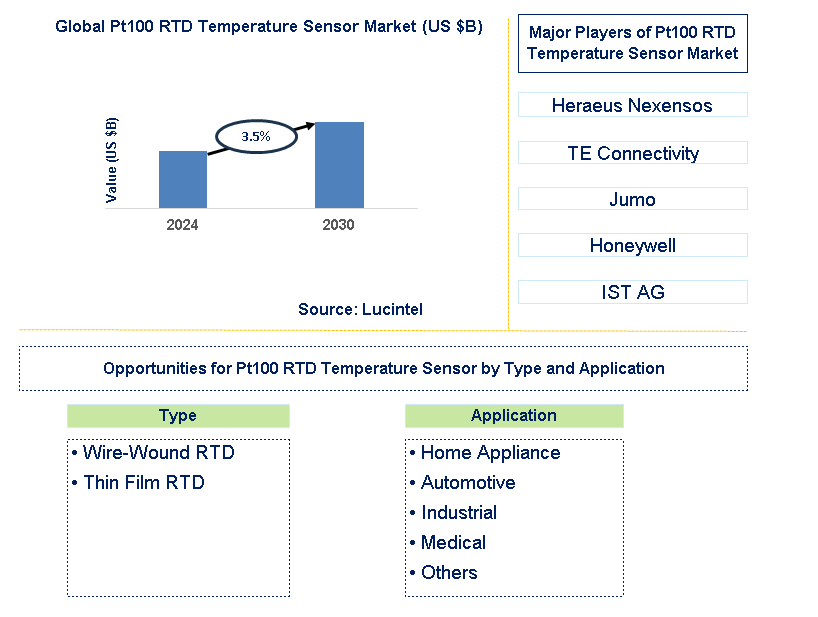
Key data points: The growth forecast = 3.5% annually for the next 6 years. Scroll below to get more insights. This market report covers trends, opportunities, and forecasts in the global Pt100 RTD temperature sensor market to 2030 by type (wire-wound RTD and thin film RTD), application (home appliance, automotive, industrial, medical, and others), and region (North America, Europe, Asia Pacific, and the Rest of the World)
We'll send your sample report shortly.
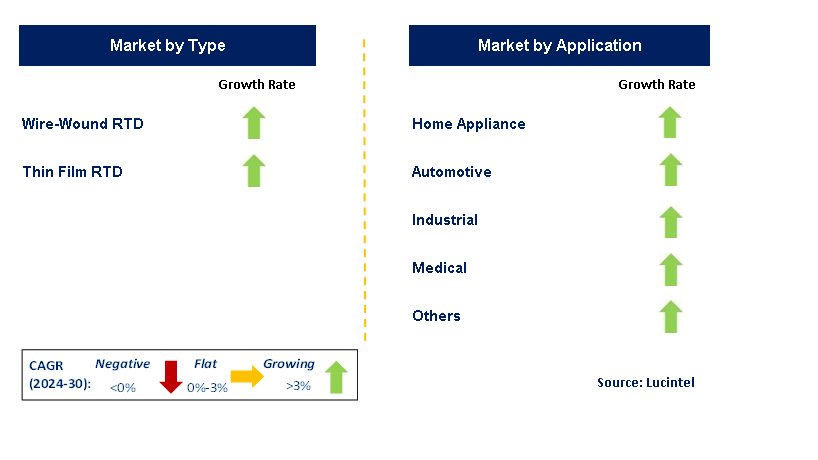
• Lucintel forecasts that, within the type category, wire-wound RTD is expected to witness a higher growth over the forecast period.
• Within the application category, home appliance is expected to witness a higher growth.
• In terms of regions, APAC is expected to witness highest growth over the forecast period. Gain valuable insight for your business decisions with our comprehensive 150+ page report
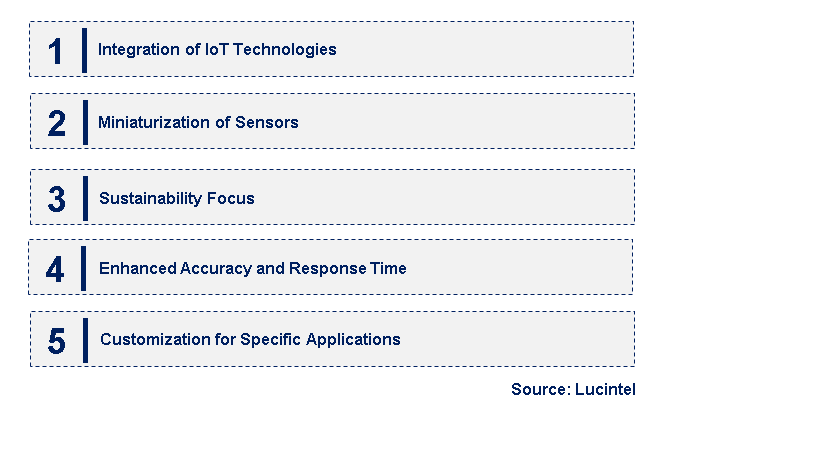
• Integration of IoT Technologies: The adoption of IoT in temperature monitoring is currently moving at an accelerated pace. Pt100 sensors are increasingly integrated into IoT platforms to collect and monitor real-time information concerning the environment being monitored. This integration tends to show a better improvement in terms of operational efficiency and predictive maintenance.
• Miniaturization of Sensors: The miniaturization trend is enabling compact Pt100 sensors to be designed for fitting into small areas. This advancement is extremely critical when applications involve precision temperature monitoring in confined places, such as in medical device applications.
• Sustainability Focus: Sustainability is increasingly focused on in the production of Pt100 sensors. Manufacturers are working with more "green materials" and processes, involving wider and more ambitious moves at the global level to reduce environmental impact and improve product lifecycle management.
• Enhanced Accuracy and Response Time: Increased accuracy and lower response time can be termed upgrades in Pt100 sensors brought about by advancements in materials and manufacturing processes. Such a tendency is of added importance for industries that greatly rely on the precision of temperature measurements for quality control and process optimization.
• Customization for Specific Applications: The demand for Pt100 sensors customized for specific applications across various industries is rising. Manufacturers are developing industry-specific solutions that address the problems faced by their clients, encouraging wider usage within those respective industries. These emerging trends are transforming the Pt100 RTD temperature sensors market in terms of design functionality, sustainability, and customization, leading to more common usage across a variety of applications.
• New Developments: The advancement of Pt100 sensors includes better thermal response and precision than before. Improved materials result in highly dependable performance in high-level applications while maintaining accurate temperature measurements over the years.
• Advancement in Integration of Wireless Technology: Pt100 RTD sensors are now designed with the integration of wireless technology, enabling remote data transmission. This functionality allows usability in any environment, facilitating real-time data analysis for proper decision-making processes.
• Pt100 Sensors with Smart Features: Often, there are smart features such as self-diagnostic and auto-calibration capabilities within Pt100 sensors. Consequently, this leads to a reduction in maintenance costs for users of end products.
• Enhanced Durability: Recent developments aim to make Pt100 sensors more robust, allowing them to survive severe environmental requirements while also focusing on long-lasting performance.
• Regulatory Compliance Improvements: Companies are enhancing the design of Pt100 sensors to meet changing regulatory requirements, ensuring compliance in all sectors. This compliance is crucial for competitiveness and consumer trust. These trends critically affect the Pt100 RTD temperature sensors market through upgrades in sensor performance, expansion of applications, and ensuring compliance with regulations, driving growth and innovation.
• Industrial Automation: The culture of manufacturing automation is increasing, and Pt100 sensors are essential for monitoring and control. They help achieve process control, making operations more efficient in terms of productivity and product quality.
• Healthcare Applications: With a demand for accurate temperature measurements in medical fields, there is significant scope for innovation in medical technology. Pt100 sensors can be utilized in medical equipment for patient monitoring.
• Energy Management: The implementation of Pt100 sensors optimizes energy use in the energy sector, emphasizing efficiency and sustainability, which stimulates high demand for these sensors in managing energy consumption.
• Food and Beverage Industry: The food and beverage industry requires high accuracy in temperature measurements. Pt100 sensors ensure the maintenance of safety measures within stipulated limits, presenting a significant opportunity for growth in this critical industry.
• Environmental Monitoring: Growing concerns about environmental protection and sustainability are increasing environmental monitoring activities. In such activities, Pt100 sensors enable monitoring of temperature fluctuations for climate research and management. These strategic growth opportunities present avenues for expansion in the Pt100 RTD temperature sensors market, encouraging both innovation and adaptation to align with the changing needs of diverse industries.
• Technological Advancements: Ongoing improvements in sensor technology and materials are significant to the continued expansion of this market. More accurate, robust, and network-enabled features of Pt100 sensors have become attractive for applications across various sectors.
• Growing Industrial Demand: Industrial demand is increasing due to the higher need for precise temperature measurement in industries such as manufacturing and energy. Companies seek reliable solutions to improve their processes and enhance product quality.
• Regulatory Standards: Strict regulations regarding temperature monitoring across various industries drive the adoption of Pt100 sensors, as businesses must conform to market demands.
• Automation Applications: The rise in industrial automation creates high demand for advanced temperature sensing, and these sensors serve as the core of automation systems, improving operational efficiency.
• Emerging Markets: The opening of opportunities in emerging markets—especially in the Asia-Pacific region—creates prospects for Pt100 sensor manufacturers. Increased industrialization and infrastructure investments support greater demand in these markets. Challenges in the Pt100 RTD temperature sensor market are:
• Higher Cost of Development: Advanced Pt100 sensors have a high cost of development and manufacturing, creating challenges for smaller entities that may struggle to compete and innovate in the market.
• Market Competition: Competing temperature sensing technologies, such as thermocouples and thermistors, present strong competition for Pt100 sensors. Companies must distinguish their products to maintain market share.
• Supply Chain Disruptions: Global supply chain disruptions may cause challenges in sourcing raw materials and components needed to manufacture Pt100 sensors, leading to delays and cost overruns for manufacturers. The interplay of these drivers and challenges significantly affects the Pt100 RTD temperature sensors market. By leveraging growth drivers and addressing challenges, stakeholders can enhance their strategies for sustainable growth in this dynamic market.
• Heraeus Nexensos
• TE Connectivity
• Jumo
• Honeywell
• IST AG
• Littelfuse
• Vishay
• Watlow
• Omega Engineering
• Labfacility
• Wire-Wound RTD
• Thin Film RTD
• Home Appliance
• Automotive
• Industrial
• Medical
• Others
• North America
• Europe
• Asia Pacific
• The Rest of the World
• United States: Trends in the U.S. Pt100 RTD market indicate a shift toward sensor miniaturization and digital connectivity. American manufacturers are focused on developing wireless RTD sensors that integrate directly into smart systems for real-time monitoring and data analytics. Improvements in materials help increase temperature accuracy and shorten response times. The high accuracy of temperature measurement solutions is especially demanded by the automotive and aerospace sectors, while regulatory support for automation technologies aids the market.
• China: Pt100 RTD sensor production in China is accelerating due to significant government support for smart manufacturing. Recent developments have seen low-cost RTD sensors designed for various industrial applications, including HVAC and precision instrumentation. The integration of Industry 4.0 technology with Pt100 sensors is enhancing efficiency and data management capabilities in China, solidifying its global market position.
• Germany: German engineering is synonymous with excellence, and Pt100 RTD sensors are no exception. The focus has been on high-precision sensors that comply with industrial standards, particularly in the pharmaceuticals and food products sectors. Eco-friendly materials for construction in this sector have gained importance in sensor development. German companies are investing in R&D to create durable sensors that offer reliable performance under adverse conditions.
• India: The growing requirement for temperature control in the textile and pharmaceutical manufacturing industries is driving demand for Pt100 RTD temperature sensors in India. Current developments include local manufacturing initiatives to further reduce costs and improve supply chain efficiency. Companies are seeking to offer customized solutions to meet the varied needs of different industries, facilitating wider adoption of RTD sensors for various applications. This is critical for enhancing competitiveness in industrial processes.
• Japan: Japan continues to advance in Pt100 RTD sensor technology, focusing specifically on high-precision applications. Innovations include sensors that can withstand extreme conditions, applicable in aerospace and energy sectors. The use of IoT and AI aims to improve data accuracy and enable predictive maintenance, with the integration of Pt100 sensors into smart grids at the forefront. Japan aims to achieve energy efficiency and sustainability through these advancements.


• Heraeus Nexensos
• TE Connectivity
• Jumo
• Honeywell
• IST AG
• Littelfuse
• Vishay
• Watlow
• Omega Engineering
• Labfacility Q5. Which Pt100 RTD temperature sensor market segment will be the largest in future? Answer: Lucintel forecasts that, within the type category, wire-wound RTD is expected to witness the higher growth over the forecast period. Q6. In Pt100 RTD temperature sensor market, which region is expected to be the largest in next 5 years? Answer: In terms of regions, APAC is expected to witness highest growth over the forecast period. Q7. Do we receive customization in this report? Answer: Yes, Lucintel provides 10% customization without any additional cost.


Choose a license that fits your team. Instant PDF delivery.
Prices exclude taxes. Instant delivery. Custom licensing available on request.
Market Report · July 15, 2026
Market Report · July 13, 2026
Market Report · July 13, 2026
Trusted partner for strategic intelligence and business growth


Receive a complimentary market analysis tailored to your industry. Our analysts will identify key growth opportunities and competitive dynamics specific to your business.

Market size, growth rate, and key trend analysis for your specific sector.

Top competitor positioning and market share analysis.

Strategic recommendations backed by data-driven insights.
Get curated market intelligence and competitive moves straight to your inbox.
By subscribing, you agree to receive our monthly insights. Unsubscribe anytime.
Receive a complimentary market analysis tailored to your industry. Our analysts will identify key growth opportunities and competitive dynamics specific to your business.
Market size, growth rate, and key trend analysis for your specific sector.
Top competitor positioning and market share analysis.
Strategic recommendations backed by data-driven insights.
Get curated market intelligence, emerging trends, and competitive moves straight to your inbox each month.
By subscribing, you agree to receive our monthly insights. Unsubscribe anytime.
We'll send your sample report shortly.