
Market Report · July 22, 2026

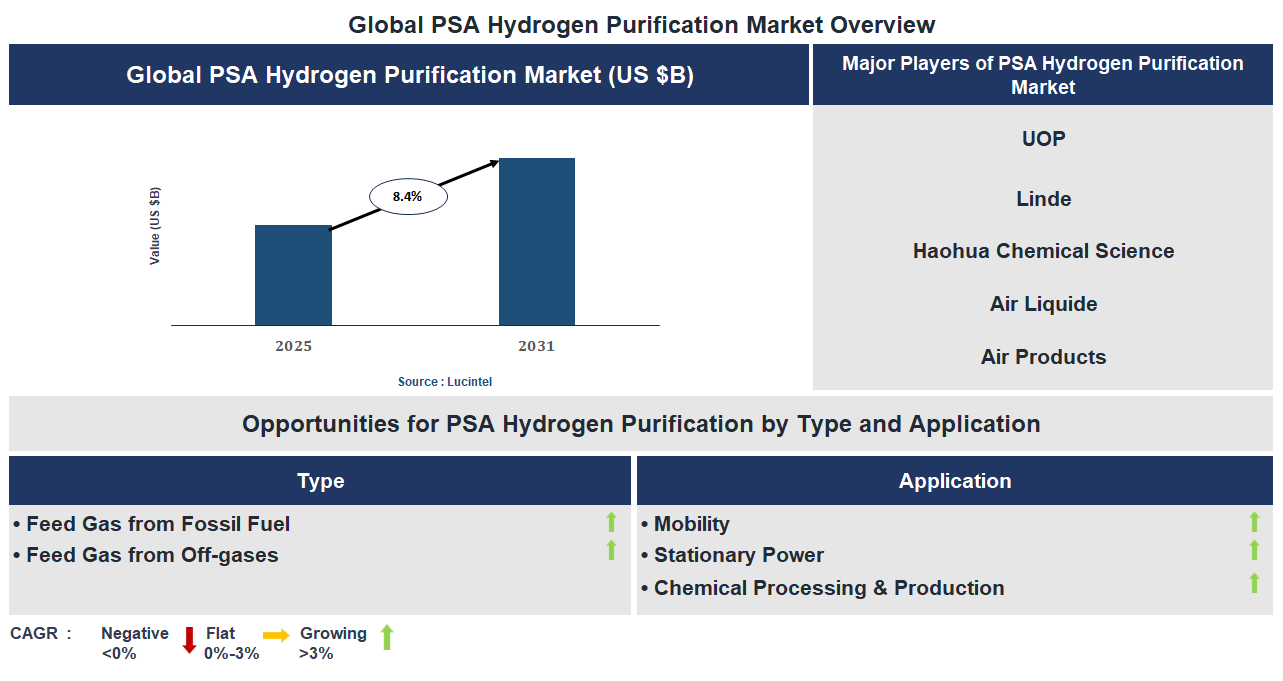
Key data points: The growth forecast = 8.4% annually for the next 7 years. Scroll below to get more insights. This market report covers trends, opportunities and forecasts in PSA hydrogen purification market to 2031 by type (feed gas from fossil fuel and feed gas from off-gases), application (mobility, stationary power, and chemical processing & production), and region (North America, Europe, Asia Pacific, and the Rest of the World)
We'll send your sample report shortly.
• Lucintel forecasts that, within the type category, feed gas from fossil fuel is expected to witness higher growth over the forecast period.
• Within the application category, mobility is expected to witness the highest growth.
• In terms of region, APAC is expected to witness the highest growth over the forecast period. Gain valuable insights for your business decisions with our comprehensive 150+ page report. Sample figures with some insights are shown below.
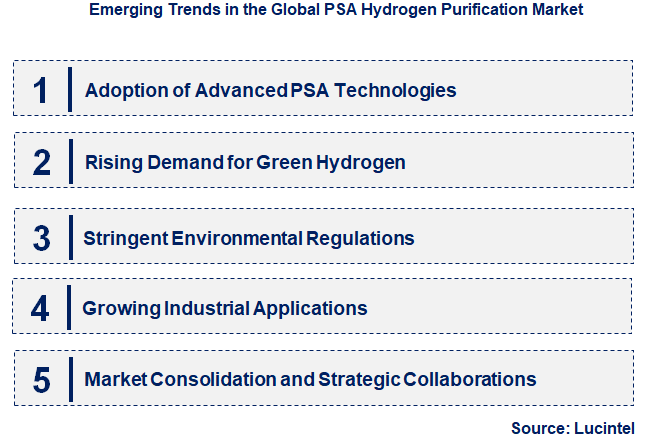
• Adoption of Advanced PSA Technologies: The integration of cutting-edge PSA systems with automation and IoT capabilities is transforming hydrogen purification. These innovations enable real-time monitoring, predictive maintenance, and optimized operation, leading to higher purity levels and reduced downtime. As a result, companies can achieve greater efficiency and lower operational costs, making hydrogen production more sustainable and economically viable. This trend is also fostering the development of smarter, more adaptable purification units suitable for diverse industrial applications.
• Rising Demand for Green Hydrogen: Increasing emphasis on renewable energy sources is driving the shift towards green hydrogen, produced via electrolysis powered by renewable energy. PSA technology is increasingly being adapted to purify hydrogen derived from renewable sources, supporting decarbonization goals across sectors like transportation, power generation, and industry. This trend is expanding market opportunities, encouraging investments in sustainable infrastructure, and aligning with global climate commitments, thereby positioning PSA hydrogen purification as a critical component in the green energy transition.
• Stringent Environmental Regulations: Governments worldwide are implementing stricter environmental standards to reduce carbon emissions and promote clean energy. These regulations are compelling industries to adopt more efficient and environmentally friendly hydrogen purification methods. PSA systems, known for their low environmental impact compared to traditional methods, are gaining favor. Compliance with these regulations not only helps companies avoid penalties but also enhances their corporate sustainability profiles, fostering innovation in purification technologies to meet evolving standards.
• Growing Industrial Applications: The expanding use of hydrogen in various industries such as refining, ammonia production, and electronics manufacturing is boosting demand for high-purity hydrogen. PSA technology is increasingly being tailored to meet the specific purity requirements of these sectors. This diversification of applications is driving market growth, encouraging technological advancements, and fostering collaborations between technology providers and end-users to develop customized solutions that enhance process efficiency and product quality.
• Market Consolidation and Strategic Collaborations: The PSA hydrogen purification market is witnessing increased mergers, acquisitions, and strategic alliances among key players. These collaborations aim to pool technological expertise, expand geographic reach, and accelerate innovation. Market consolidation helps companies strengthen their competitive position, improve supply chain resilience, and offer comprehensive solutions. Such strategic partnerships are vital for addressing the complex challenges of hydrogen purification, fostering innovation, and capturing emerging opportunities in a rapidly evolving market landscape. In summary, these trends are collectively reshaping the PSA hydrogen purification market by driving technological innovation, expanding application scope, and aligning industry practices with environmental sustainability goals. They are fostering a more competitive, efficient, and sustainable market environment, positioning PSA hydrogen purification as a pivotal technology in the global shift towards clean energy.
• Technological Innovation: Introduction of advanced PSA systems with higher efficiency and lower energy consumption has improved hydrogen purity levels, reducing operational costs and enhancing overall process sustainability.
• Integration with Renewable Energy: Increasing integration of PSA hydrogen purification units with renewable energy sources like wind and solar has enabled greener hydrogen production, aligning with global decarbonization goals.
• Market Expansion in Emerging Regions: Growth in Asia-Pacific and Latin America due to rising industrialization and government incentives has expanded the market footprint, creating new opportunities for local and international players.
• Regulatory and Policy Support: Governments worldwide are implementing stricter environmental regulations and offering subsidies for clean hydrogen technologies, which has accelerated market adoption and innovation.
• Strategic Partnerships and Mergers: Major industry players are forming alliances and acquiring smaller firms to enhance technological capabilities, expand product portfolios, and strengthen market presence. These developments are collectively driving the PSA hydrogen purification market towards greater efficiency, sustainability, and global reach. They are fostering innovation, reducing costs, and supporting the transition to cleaner energy sources, thereby shaping a promising future for hydrogen-based applications across multiple industries.
• Industrial Manufacturing: Enhanced hydrogen purity improves product quality and process efficiency, leading to increased adoption in chemical and refining industries. This growth boosts market revenue and encourages technological advancements to meet stringent purity standards.
• Fuel Cell Vehicles: Rising adoption of hydrogen fuel cell vehicles drives demand for high-purity hydrogen. This opportunity accelerates the shift toward sustainable transportation, fostering infrastructure development and technological innovation in hydrogen purification.
• Power Generation: Hydrogen is increasingly used in power plants for clean energy production. Improved purification methods ensure reliable, high-quality hydrogen supply, supporting the transition to renewable energy sources and expanding market scope.
• Electronics & Semiconductor: The electronics industry requires ultra-pure hydrogen for manufacturing processes. Growing demand for high-purity hydrogen enhances product performance and reliability, opening new avenues for market expansion.
• Hydrogen Storage & Distribution: Efficient purification is critical for safe and effective storage and distribution. Innovations in this area facilitate large-scale hydrogen deployment, enabling broader market penetration and supporting the hydrogen economy. In summary, these key growth opportunities are significantly impacting the PSA hydrogen purification market by driving technological innovation, expanding application scope, and supporting the global shift toward sustainable energy solutions. This evolution fosters increased market competitiveness and long-term growth prospects for industry stakeholders.
• Technological Innovation: The continuous development of advanced Pressure Swing Adsorption (PSA) technologies enhances purification efficiency, reduces operational costs, and improves scalability. Innovations such as modular systems and automation enable faster deployment and maintenance, making PSA systems more attractive across various industries. These technological improvements support the increasing adoption of hydrogen in sectors like transportation, power generation, and industrial processes, thereby fueling market growth.
• Rising Demand for Clean Energy: The global shift towards sustainable energy sources is a significant driver. Governments and corporations are investing heavily in hydrogen as a clean fuel alternative to reduce carbon emissions. The increasing adoption of fuel cell vehicles and renewable energy integration further amplifies the need for high-purity hydrogen, which PSA systems can efficiently produce. This demand is expected to sustain long-term growth in the market.
• Stringent Environmental Regulations: Governments worldwide are implementing strict regulations to curb greenhouse gas emissions and promote clean energy solutions. These policies incentivize industries to adopt hydrogen purification technologies that meet environmental standards. PSA systems, being environmentally friendly and energy-efficient, align well with these regulatory frameworks, encouraging their widespread adoption and market expansion.
• Industrial Growth and Infrastructure Development: Rapid industrialization, especially in emerging economies, is boosting the demand for hydrogen in refining, chemical manufacturing, and metal processing. Investments in hydrogen infrastructure, including refueling stations and storage facilities, are accelerating market growth. The need for reliable, high-purity hydrogen sources makes PSA technology a preferred choice, supporting the markets expansion. The challenges facing this PSA hydrogen purification market include:
• High Capital and Operating Costs: The initial investment for PSA hydrogen purification systems is substantial, which can be a barrier for small and medium enterprises. Additionally, operational expenses related to maintenance, energy consumption, and adsorbent replacement add to the overall costs. These financial factors can limit market penetration, especially in price-sensitive regions, and slow down the adoption rate of PSA technology.
• Technological Complexities and Limitations: While PSA technology is effective, it faces challenges such as limited capacity scalability and sensitivity to feed gas impurities. Maintaining optimal performance requires sophisticated control systems and skilled personnel. These technological complexities can hinder widespread deployment, particularly in remote or less-developed areas, and may necessitate ongoing research and development investments.
• Regulatory and Policy Uncertainties: The evolving regulatory landscape and lack of standardized policies across regions create uncertainties for market players. Changes in subsidies, safety standards, and environmental policies can impact project viability and investment decisions. This unpredictability can delay deployment timelines and deter new entrants, affecting overall market growth. In summary, the PSA hydrogen purification market is driven by technological advancements, increasing demand for clean energy, supportive regulations, and infrastructure development. However, high costs, technological challenges, and regulatory uncertainties pose significant hurdles. These factors collectively influence the markets growth potential, requiring stakeholders to strategize effectively to leverage opportunities while mitigating risks. The interplay of these drivers and challenges will shape the future landscape of hydrogen purification technologies and their role in the global energy transition.
• UOP
• Linde
• Haohua Chemical Science
• Air Liquide
• Air Products
• PKU PIONEER
• Ally Hi-Tech
• CALORIC
• Quadrogen
• Hanxing Energy
• Feed Gas from Fossil Fuel
• Feed Gas from Off-gases
• Mobility
• Stationary Power
• Chemical Processing & Production
• North America
• Europe
• Asia Pacific
• The Rest of the World
• United States: The US market has seen substantial investments in hydrogen infrastructure, with a focus on integrating PSA technology into existing industrial facilities. Innovations in membrane and adsorption techniques have improved purification efficiency. Government initiatives like the Hydrogen Shot aim to reduce costs and accelerate adoption. Several startups and established companies are collaborating to develop scalable solutions, and there is a growing emphasis on green hydrogen production using renewable energy sources. The US also benefits from a robust regulatory framework supporting clean energy transitions, boosting market growth.
• China: China is rapidly expanding its hydrogen economy, with significant government backing for hydrogen projects and infrastructure. The country is investing in large-scale PSA hydrogen purification plants to support its industrial and transportation sectors. Technological advancements are focused on reducing costs and increasing purity levels. China’s emphasis on green hydrogen, produced via renewable energy, is driving innovation in PSA systems. The government’s strategic plans aim to make China a global leader in hydrogen technology, with numerous pilot projects and collaborations between domestic companies and international partners.
• Germany: Germany is at the forefront of hydrogen technology development in Europe, emphasizing green hydrogen production. The country has implemented policies to promote the adoption of PSA hydrogen purification systems in industrial applications and refueling stations. German companies are innovating in adsorption materials and process optimization to improve efficiency and reduce costs. The government’s National Hydrogen Strategy aims to establish a comprehensive hydrogen infrastructure, fostering public-private partnerships. Germany’s focus on sustainability and renewable energy integration is making it a key player in the global hydrogen market.
• India: India is increasingly investing in hydrogen as part of its energy diversification strategy. The country is exploring PSA hydrogen purification technology to support its growing industrial base and renewable energy initiatives. Recent developments include pilot projects for green hydrogen production using solar and wind power. The government’s National Hydrogen Mission aims to promote research, manufacturing, and deployment of hydrogen technologies. Indian companies are collaborating with international firms to develop cost-effective PSA systems, with a focus on reducing reliance on fossil fuels and achieving energy security.
• Japan: Japan continues to lead in hydrogen technology innovation, with a strong focus on fuel cell applications and hydrogen infrastructure. The country is advancing PSA hydrogen purification systems to improve the quality and efficiency of hydrogen supply for transportation and industrial use. Japan’s strategic investments in hydrogen infrastructure, including refueling stations and storage facilities, support its goal of a hydrogen-based society. The government promotes public-private partnerships and international collaborations to accelerate technological development. Japan’s emphasis on safety, reliability, and sustainability positions it as a key player in the global hydrogen market.


• UOP
• Linde
• Haohua Chemical Science
• Air Liquide
• Air Products
• PKU PIONEER
• Ally Hi-Tech
• CALORIC
• Quadrogen
• Hanxing Energy Q5. Which PSA hydrogen purification market segment will be the largest in future? Answer: Lucintel forecasts that, within the type category, feed gas from fossil fuel is expected to witness higher growth over the forecast period. Q6. In PSA hydrogen purification market, which region is expected to be the largest in next 5 years? Answer: In terms of region, APAC is expected to witness the highest growth over the forecast period. Q7. Do we receive customization in this report? Answer: Yes, Lucintel provides 10% customization without any additional cost.


Choose a license that fits your team. Instant PDF delivery.
Prices exclude taxes. Instant delivery. Custom licensing available on request.
Market Report · July 22, 2026
Market Report · July 22, 2026
Market Report · July 17, 2026
Trusted partner for strategic intelligence and business growth


Receive a complimentary market analysis tailored to your industry. Our analysts will identify key growth opportunities and competitive dynamics specific to your business.

Market size, growth rate, and key trend analysis for your specific sector.

Top competitor positioning and market share analysis.

Strategic recommendations backed by data-driven insights.
Get curated market intelligence and competitive moves straight to your inbox.
By subscribing, you agree to receive our monthly insights. Unsubscribe anytime.
Receive a complimentary market analysis tailored to your industry. Our analysts will identify key growth opportunities and competitive dynamics specific to your business.
Market size, growth rate, and key trend analysis for your specific sector.
Top competitor positioning and market share analysis.
Strategic recommendations backed by data-driven insights.
Get curated market intelligence, emerging trends, and competitive moves straight to your inbox each month.
By subscribing, you agree to receive our monthly insights. Unsubscribe anytime.
We'll send your sample report shortly.