
Report Feature
Protein Detection & Quantification Market Trends and Forecast
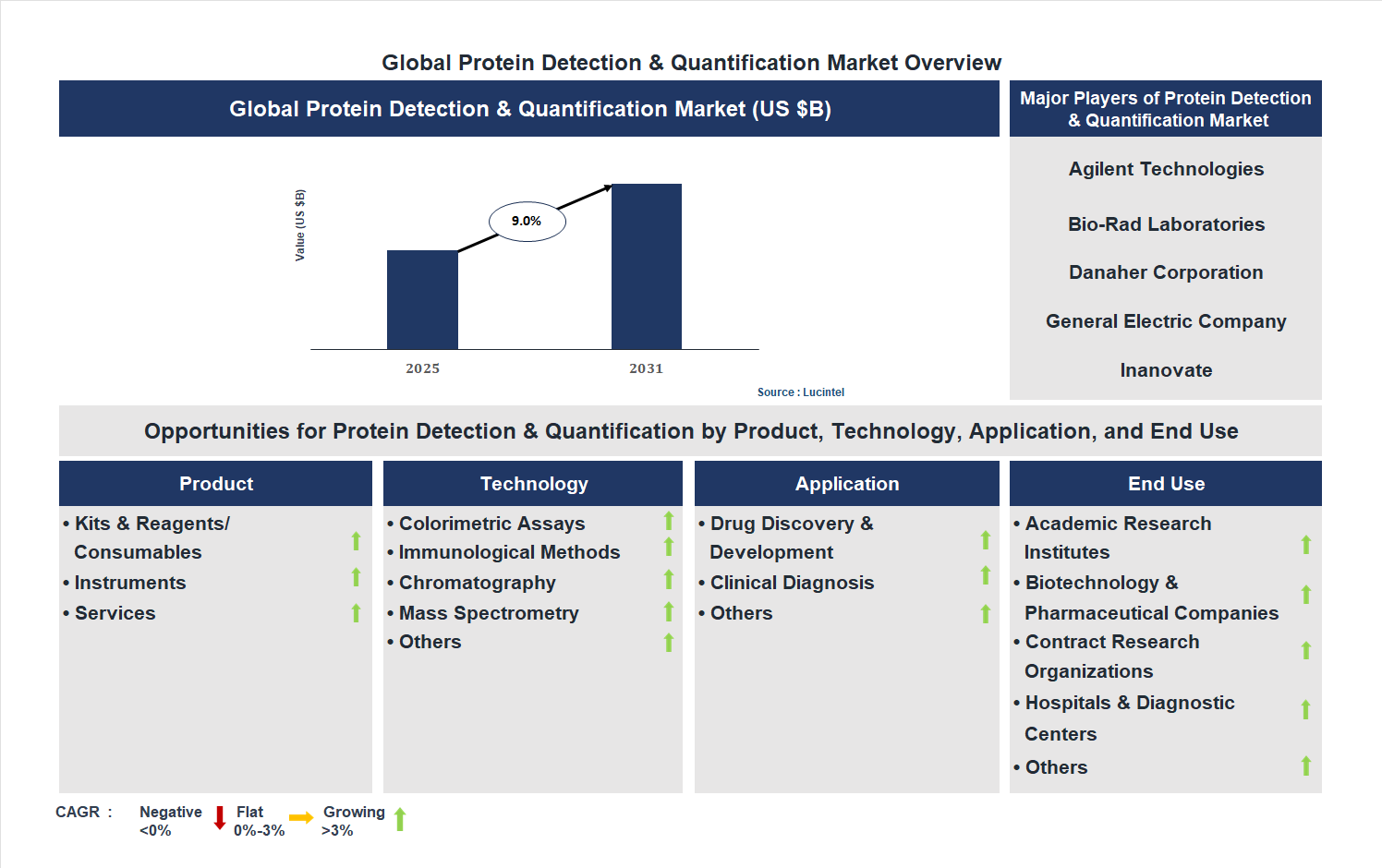
The future of the global protein detection & quantification market looks promising with opportunities in the academic research institute, biotechnology & pharmaceutical company, contract research organization, and hospital & diagnostic center markets. The global protein detection & quantification market is expected to grow with a CAGR of 9% from 2025 to 2031. The major drivers for this market are the increasing demand for accurate diagnostic tools, the rising focus on personalized medicine advancements, and the growing research in biotechnology & life sciences.• Lucintel forecasts that, within the product category, kit & reagent/consumable is expected to witness the highest growth over the forecast period.
• Within the end use category, hospital & diagnostic center is expected to witness the highest growth.
• In terms of region, APAC is expected to witness the highest growth over the forecast period. Gain valuable insights for your business decisions with our comprehensive 150+ page report. Sample figures with some insights are shown below.
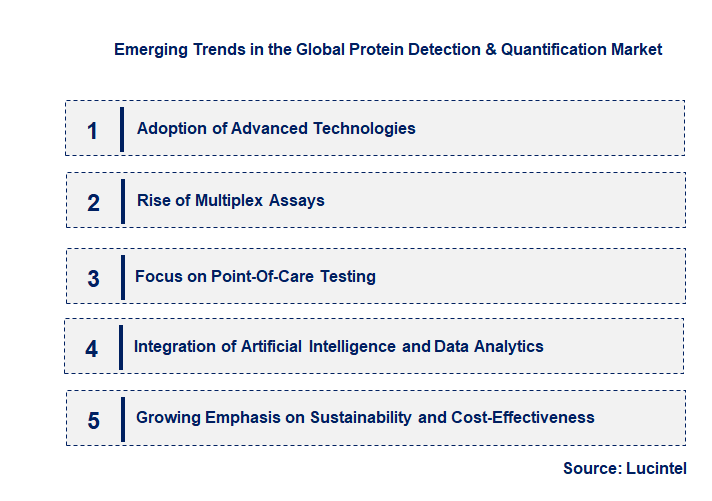
Emerging Trends in the Protein Detection & Quantification Market
The protein detection & quantification market is experiencing rapid evolution driven by technological advancements, increasing research activities, and a growing demand for precise diagnostic tools. As the biotech and pharmaceutical sectors expand, the need for accurate protein analysis becomes critical for drug development, disease diagnosis, and personalized medicine. Emerging trends are shaping the future landscape of this market, influencing product innovation, market strategies, and research methodologies. These developments are not only enhancing the accuracy and efficiency of protein detection but also broadening the scope of applications across healthcare, agriculture, and industrial sectors. Understanding these trends is essential for stakeholders aiming to stay competitive and leverage new opportunities.• Adoption of Advanced Technologies: The integration of novel techniques such as mass spectrometry, next-generation sequencing, and digital ELISA is revolutionizing protein detection. These technologies offer higher sensitivity, specificity, and throughput, enabling researchers to analyze complex protein mixtures with greater precision. The shift towards automation and miniaturization also reduces analysis time and costs, making protein quantification more accessible and scalable for various applications.
• Rise of Multiplex Assays: Multiplexing allows simultaneous detection of multiple proteins in a single sample, significantly increasing efficiency and data richness. This trend is driven by the need for comprehensive biomarker profiling in clinical diagnostics and personalized medicine. Multiplex assays reduce sample volume requirements and turnaround times, facilitating faster decision-making in research and clinical settings. The development of robust, high-throughput multiplex platforms is expected to further accelerate this trend.
• Focus on Point-of-Care Testing: The demand for portable, easy-to-use protein detection devices is growing, especially in remote or resource-limited settings. Point-of-care testing (POCT) enables rapid diagnosis and monitoring, improving patient outcomes and reducing healthcare costs. Innovations such as lab-on-a-chip and biosensor technologies are making POCT more accurate and affordable, expanding its application beyond traditional laboratories to clinics, homes, and field environments.
• Integration of Artificial Intelligence and Data Analytics: AI-driven algorithms and advanced data analytics are enhancing the interpretation of complex protein data. These tools improve assay accuracy, identify novel biomarkers, and facilitate personalized treatment strategies. The integration of AI is also streamlining data management, reducing human error, and enabling real-time decision-making, which is crucial for clinical and research applications.
• Growing Emphasis on Sustainability and Cost-Effectiveness: Market players are focusing on developing eco-friendly, cost-effective detection methods to meet regulatory standards and reduce environmental impact. Innovations include the use of biodegradable materials, reagent reduction, and energy-efficient processes. This trend aims to make protein detection more sustainable and accessible, especially in emerging markets, while maintaining high performance standards. In summary, these emerging trends are transforming the protein detection & quantification market by enhancing technological capabilities, increasing efficiency, and expanding application scope. They are driving innovation, improving diagnostic accuracy, and making protein analysis more accessible and sustainable. As these trends continue to evolve, they will significantly influence market growth, research directions, and healthcare outcomes worldwide.
Recent Development in the Protein Detection & Quantification Market
The protein detection & quantification market has experienced significant growth driven by advancements in biotechnology, increasing demand for personalized medicine, and the expanding applications across healthcare, research, and diagnostics. Innovations in detection technologies and rising investments in proteomics research are fueling market expansion. Additionally, the integration of automation and high-throughput screening methods is enhancing efficiency and accuracy. The markets evolution is also influenced by regulatory developments and the growing need for precise protein analysis in disease diagnosis and drug development. These factors collectively shape the current landscape, creating opportunities and challenges for industry stakeholders.• Technological Advancements: Introduction of novel detection methods such as mass spectrometry and fluorescence-based assays has improved sensitivity and specificity, enabling more accurate protein analysis. These innovations are reducing analysis time and costs, thus broadening application scope and increasing market adoption.
• Automation and High-Throughput Screening: The adoption of automated platforms and high-throughput techniques has significantly increased sample processing capacity. This development enhances efficiency in research and clinical labs, leading to faster data acquisition and supporting large-scale proteomics studies.
• Rising Demand in Personalized Medicine: The growing need for tailored therapeutic approaches has driven demand for precise protein quantification. This trend is particularly prominent in oncology and rare disease diagnostics, where accurate protein profiling is critical for treatment decisions.
• Regulatory and Standardization Initiatives: Implementation of standardized protocols and regulatory guidelines has improved data reproducibility and reliability. These developments foster greater confidence among clinicians and researchers, facilitating market growth and product approval processes.
• Expansion in Emerging Markets: Increasing investments and infrastructure development in emerging economies are expanding market reach. This growth is driven by rising healthcare awareness, government initiatives, and the need for advanced diagnostic tools, opening new revenue streams. The recent developments in the protein detection & quantification market are collectively enhancing analytical accuracy, operational efficiency, and market accessibility. These advancements are accelerating research, improving diagnostic precision, and supporting personalized medicine, thereby driving overall market growth and innovation.
Strategic Growth Opportunities in the Protein Detection & Quantification Market
The protein detection & quantification market is experiencing rapid growth driven by advancements in biotechnology, increasing research activities, and the rising prevalence of chronic diseases. As the demand for precise and efficient protein analysis tools increases across various sectors, key applications are emerging as significant growth drivers. These applications are transforming research methodologies, clinical diagnostics, and drug development processes, thereby expanding market opportunities. Understanding these growth opportunities is essential for stakeholders aiming to capitalize on emerging trends and enhance their competitive edge in this dynamic landscape.• Clinical Diagnostics: Enhanced accuracy and speed in disease detection : The application of protein detection in clinical diagnostics is revolutionizing disease identification, enabling early intervention and personalized treatment plans. This growth improves patient outcomes and reduces healthcare costs, making it a vital segment for market expansion.
• Drug Development & Biopharmaceuticals: Accelerated target identification and validation : Protein quantification techniques are crucial in drug discovery, allowing for precise measurement of biomarker levels and therapeutic targets. This accelerates the development pipeline, reduces costs, and enhances the success rate of new drug candidates.
• Research & Academia: Advanced research capabilities : The increasing adoption of sophisticated protein detection tools in academic and research institutions fosters innovation. It supports fundamental biological studies, leading to new discoveries and expanding the knowledge base, which in turn fuels market growth.
• Food & Beverage Industry: Quality control and safety assurance : Protein detection methods are increasingly used for ensuring food safety, detecting contaminants, and verifying product authenticity. This application enhances consumer confidence and complies with regulatory standards, opening new revenue streams.
• Agriculture & Biotechnology: Crop improvement and disease management : Protein quantification plays a vital role in developing genetically modified crops and managing plant diseases. This application supports sustainable agriculture practices and boosts productivity, contributing to market expansion. In summary, these key growth opportunities across applications are significantly impacting the protein detection & quantification market by driving innovation, improving efficiency, and expanding its scope across diverse sectors. This diversification enhances market resilience and offers substantial revenue potential for industry players.
Protein Detection & Quantification Market Driver and Challenges
The protein detection & quantification market is influenced by a variety of technological, economic, and regulatory factors. Advances in biotechnology and molecular biology have driven demand for more precise and efficient detection methods. Economic growth in healthcare and pharmaceutical sectors has increased investments in research and development, further propelling market expansion. Regulatory frameworks around safety, quality, and innovation also shape market dynamics, ensuring compliance and fostering innovation. Additionally, the rising prevalence of chronic diseases and the need for personalized medicine have created a significant demand for accurate protein analysis. These multifaceted drivers and challenges collectively shape the growth trajectory and competitive landscape of the market. The factors responsible for driving the protein detection & quantification market include:• Technological Advancements: The development of innovative detection techniques such as mass spectrometry, ELISA, and biosensors has significantly improved sensitivity, specificity, and throughput. These advancements enable researchers and clinicians to analyze proteins more accurately and rapidly, facilitating early diagnosis and personalized treatment. Continuous innovation in automation and miniaturization further enhances efficiency, reducing costs and turnaround times. As technology evolves, the market benefits from increased adoption across research labs, hospitals, and pharmaceutical companies, fueling growth and expanding application areas.
• Rising Prevalence of Chronic Diseases: The increasing incidence of diseases such as cancer, cardiovascular disorders, and neurodegenerative conditions has heightened the demand for reliable protein detection methods. Accurate quantification of biomarkers is crucial for early diagnosis, prognosis, and monitoring treatment efficacy. This growing health burden drives investments in research to identify novel protein biomarkers, thereby expanding the market. Moreover, the need for personalized medicine tailored to individual protein profiles further amplifies demand, making this a key growth driver.
• Growing Adoption in Drug Development and Biopharmaceuticals: The pharmaceutical industry relies heavily on protein analysis for drug discovery, development, and quality control. The demand for biologics and biosimilars necessitates precise protein quantification to ensure efficacy and safety. Advanced detection techniques streamline the development process, reduce time-to-market, and improve regulatory compliance. As biopharmaceuticals constitute a significant segment of the healthcare market, their growth directly influences the protein detection market, encouraging innovation and investment in new technologies.
• Increasing Research and Development Activities: The surge in R&D activities across academia, biotech, and pharma sectors is a major driver. Researchers require sophisticated tools for proteomics studies, biomarker discovery, and functional analysis. Funding from government agencies and private investors supports the development of novel detection platforms. This influx of research initiatives accelerates technological innovation and broadens application scopes, including diagnostics, therapeutics, and personalized medicine, thereby expanding market opportunities.
• Expansion of Diagnostic Applications: The integration of protein detection in diagnostic workflows has grown substantially. Techniques like immunoassays and mass spectrometry are now routinely used for disease diagnosis, prognosis, and monitoring. The demand for point-of-care testing and minimally invasive procedures further propels this trend. As healthcare systems worldwide emphasize early detection and personalized treatment, the market experiences increased adoption of protein quantification tools, fostering growth across clinical and research settings. The challenges facing this protein detection & quantification market include:
• High Cost of Advanced Technologies: Despite technological progress, many sophisticated detection platforms remain expensive, limiting accessibility for smaller labs and developing regions. The high capital investment and operational costs hinder widespread adoption, especially in resource-constrained settings. This financial barrier can slow market growth and restrict the reach of cutting-edge protein analysis tools, impacting overall market expansion and innovation dissemination.
• Regulatory and Standardization Issues: The lack of uniform regulatory standards for protein detection methods creates uncertainty and hampers commercialization. Variability in assay validation, quality control, and data interpretation complicates compliance and approval processes. This regulatory complexity can delay product launches, increase costs, and discourage innovation, ultimately affecting market growth and the adoption of new technologies.
• Data Management and Interpretation Challenges: The vast amount of data generated by advanced detection techniques necessitates robust data management systems and analytical tools. Challenges in data integration, interpretation, and reproducibility can compromise accuracy and reliability. These issues pose significant hurdles for clinical implementation and regulatory approval, potentially limiting the utility of protein detection technologies and slowing market progress. In summary, the protein detection & quantification market is driven by technological innovations, rising disease prevalence, and expanding applications in drug development and diagnostics. However, high costs, regulatory complexities, and data management challenges pose significant hurdles. The interplay of these factors influences the market’s growth trajectory, requiring strategic investments and regulatory harmonization to realize its full potential. Overall, the market is poised for substantial expansion, provided these challenges are effectively addressed through innovation and policy support.
List of Protein Detection & Quantification Companies
Companies in the market compete on the basis of product quality offered. Major players in this market focus on expanding their manufacturing facilities, R&D investments, infrastructural development, and leverage integration opportunities across the value chain. With these strategies protein detection & quantification companies cater increasing demand, ensure competitive effectiveness, develop innovative products & technologies, reduce production costs, and expand their customer base. Some of the protein detection & quantification companies profiled in this report include-• Agilent Technologies
• Bio-Rad Laboratories
• Danaher Corporation
• General Electric Company
• Inanovate
• Merck
• PerkinElmer
• RayBiotech Life
• Shimadzu Corporation
• Thermo Fisher Scientific
Protein Detection & Quantification Market by Segment
The study includes a forecast for the global protein detection & quantification market by product, technology, application, end use, and region.Protein Detection & Quantification Market by Product [Value from 2019 to 2031]:
• Kits & Reagents/Consumables
• Instruments
• Services
Protein Detection & Quantification Market by Technology [Value from 2019 to 2031]:
• Colorimetric Assays
• Immunological Methods
• Chromatography
• Mass Spectrometry
• Others
Protein Detection & Quantification Market by Application [Value from 2019 to 2031]:
• Drug Discovery & Development
• Clinical Diagnosis
• Others
Protein Detection & Quantification Market by End Use [Value from 2019 to 2031]:
• Academic Research Institutes
• Biotechnology & Pharmaceutical Companies
• Contract Research Organizations
• Hospitals & Diagnostic Centers
• Others
Protein Detection & Quantification Market by Region [Value from 2019 to 2031]:
• North America
• Europe
• Asia Pacific
• The Rest of the World
Country Wise Outlook for the Protein Detection & Quantification Market
The protein detection & quantification market has experienced significant growth driven by advancements in biotechnology, increasing demand for personalized medicine, and innovations in diagnostic tools. As global health challenges and research needs evolve, countries are investing heavily in developing more accurate, efficient, and cost-effective protein analysis technologies. These developments are shaping the future landscape of biomedical research, clinical diagnostics, and pharmaceutical applications, with each country contributing uniquely based on their research priorities and technological capabilities.• United States: The US leads in innovation with substantial investments in biotech startups and research institutions. Recent developments include the launch of next-generation mass spectrometry techniques and enhanced antibody-based detection methods. The FDAs approval of new diagnostic kits has accelerated clinical applications, while collaborations between academia and industry foster rapid technological advancements. The US also sees increased adoption of automation and AI-driven protein analysis tools, improving accuracy and throughput.
• China: China has rapidly expanded its biotech sector, focusing on affordable and scalable protein detection solutions. Recent advancements include the development of novel biosensors and portable diagnostic devices suitable for point-of-care testing. Government initiatives aim to boost domestic innovation, leading to increased patent filings and commercialization of new technologies. Chinese companies are also investing in integrating nanotechnology with protein detection, enhancing sensitivity and specificity for disease diagnosis and research.
• Germany: Germany remains a leader in precision diagnostics and analytical instrumentation. Recent developments involve the refinement of label-free detection methods such as surface plasmon resonance (SPR) and quartz crystal microbalance (QCM). The country emphasizes sustainable and environmentally friendly technologies, with innovations in miniaturized and automated systems. German firms are also collaborating with European research centers to develop standardized protocols, improving reproducibility and reliability in protein quantification.
• India: India is witnessing a surge in affordable diagnostic solutions driven by increasing healthcare needs and a large population base. Recent advancements include the development of low-cost ELISA kits and rapid test strips for infectious diseases. The government’s focus on expanding healthcare infrastructure and promoting startups has led to increased R&D activities. Indian companies are also exploring the integration of mobile technology with protein detection devices to facilitate remote diagnostics and telemedicine.
• Japan: Japan continues to innovate in high-precision analytical tools and nanotechnology-based detection systems. Recent developments include the use of quantum dot technology for highly sensitive protein detection and the integration of microfluidics for rapid analysis. Japan’s emphasis on aging population healthcare has spurred research into early disease biomarkers. Collaborations between academia and industry are fostering the development of compact, portable devices suitable for clinical and field use, emphasizing accuracy and user-friendliness.

Features of the Global Protein Detection & Quantification Market
Market Size Estimates: Protein detection & quantification market size estimation in terms of value ($B). Trend and Forecast Analysis: Market trends (2019 to 2024) and forecast (2025 to 2031) by various segments and regions. Segmentation Analysis: Protein detection & quantification market size by various segments, such as by product, technology, application, end use, and region in terms of value ($B). Regional Analysis: Protein detection & quantification market breakdown by North America, Europe, Asia Pacific, and Rest of the World. Growth Opportunities: Analysis of growth opportunities in different products, technologies, applications, end uses, and regions for the protein detection & quantification market. Strategic Analysis: This includes M&A, new product development, and competitive landscape of the protein detection & quantification market. Analysis of competitive intensity of the industry based on Porter’s Five Forces model.
FAQ
Q1. What is the growth forecast for protein detection & quantification market? Answer: The global protein detection & quantification market is expected to grow with a CAGR of 9% from 2025 to 2031. Q2. What are the major drivers influencing the growth of the protein detection & quantification market? Answer: The major drivers for this market are the increasing demand for accurate diagnostic tools, the rising focus on personalized medicine advancements, and the growing research in biotechnology & life sciences. Q3. What are the major segments for protein detection & quantification market? Answer: The future of the protein detection & quantification market looks promising with opportunities in the academic research institute, biotechnology & pharmaceutical company, contract research organization, and hospital & diagnostic center markets. Q4. Who are the key protein detection & quantification market companies? Answer: Some of the key protein detection & quantification companies are as follows:• Agilent Technologies
• Bio-Rad Laboratories
• Danaher Corporation
• General Electric Company
• Inanovate
• Merck
• PerkinElmer
• RayBiotech Life
• Shimadzu Corporation
• Thermo Fisher Scientific Q5. Which protein detection & quantification market segment will be the largest in future? Answer: Lucintel forecasts that, within the product category, kit & reagent/consumable is expected to witness the highest growth over the forecast period. Q6. In protein detection & quantification market, which region is expected to be the largest in next 5 years? Answer: In terms of region, APAC is expected to witness the highest growth over the forecast period. Q7. Do we receive customization in this report? Answer: Yes, Lucintel provides 10% customization without any additional cost.
Table of Contents
List of Figures
List of Tables
Methodology
- In-depth interviews of the major players in this market
- Detailed secondary research from competitors’ financial statements and published data
- Extensive searches of published works, market, and database information pertaining to industry news, company press releases, and customer intentions
- A compilation of the experiences, judgments, and insights of Lucintel’s professionals, who have analyzed and tracked this market over the years.


Buy Now
Choose a license that fits your team. Instant PDF delivery.
Prices exclude taxes. Instant delivery. Custom licensing available on request.
Key Questions
- • What are some of the most promising, high-growth opportunities for the protein detection & quantification market by product (kits & reagents/consumables, instruments, and services), technology (colorimetric assays, immunological methods, chromatography, mass spectrometry, and others), application (drug discovery & development, clinical diagnosis, and others), end use (academic research institutes, biotechnology & pharmaceutical companies, contract research organizations, hospitals & diagnostic centers, and others), and region (North America, Europe, Asia Pacific, and the Rest of the World)?
- • Which segments will grow at a faster pace and why?
- • Which region will grow at a faster pace and why?
- • What are the key factors affecting market dynamics? What are the key challenges and business risks in this market?
- • What are the business risks and competitive threats in this market?
- • What are the emerging trends in this market and the reasons behind them?
- • What are some of the changing demands of customers in the market?
- • What are the new developments in the market? Which companies are leading these developments?
- • Who are the major players in this market? What strategic initiatives are key players pursuing for business growth?
- • What are some of the competing products in this market and how big of a threat do they pose for loss of market share by material or product substitution?
- • What M&A activity has occurred in the last 5 years and what has its impact been on the industry? For any questions related to Protein Detection & Quantification Market, Protein Detection & Quantification Market Size, Protein Detection & Quantification Market Growth, Protein Detection & Quantification Market Analysis, Protein Detection & Quantification Market Report, Protein Detection & Quantification Market Share, Protein Detection & Quantification Market Trends, Protein Detection & Quantification Market Forecast, Protein Detection & Quantification Companies, write Lucintel analyst at email: helpdesk@lucintel.com. We will be glad to get back to you soon.


