
Market Report · July 15, 2026

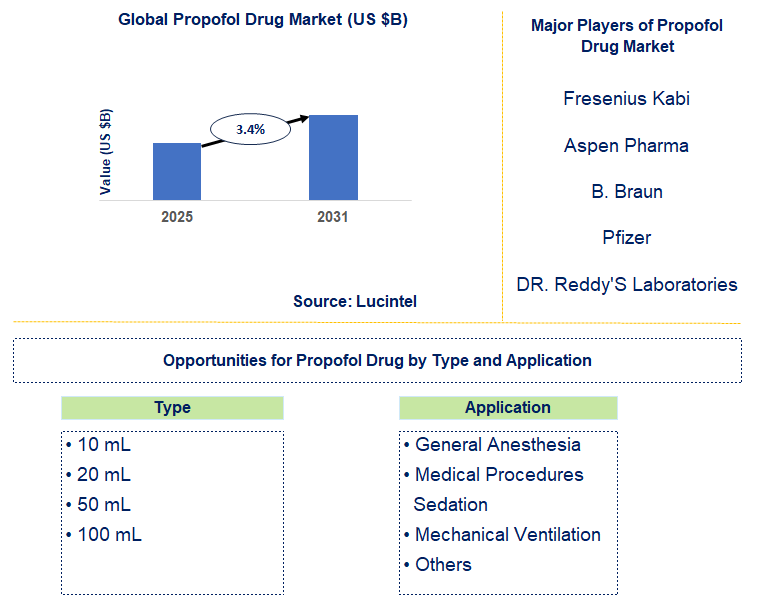
Key data points: The growth forecast = 3.4% annually for the next 7 years. Scroll below to get more insights. This market report covers Trends, opportunities and forecasts in propofol drug market to 2031 by type (10 mL, 20 mL, 50 mL, and 100 mL), application (general anesthesia, medical procedures sedation, mechanical ventilation, and others), and region (North America, Europe, Asia Pacific, and the Rest of the World)
We'll send your sample report shortly.
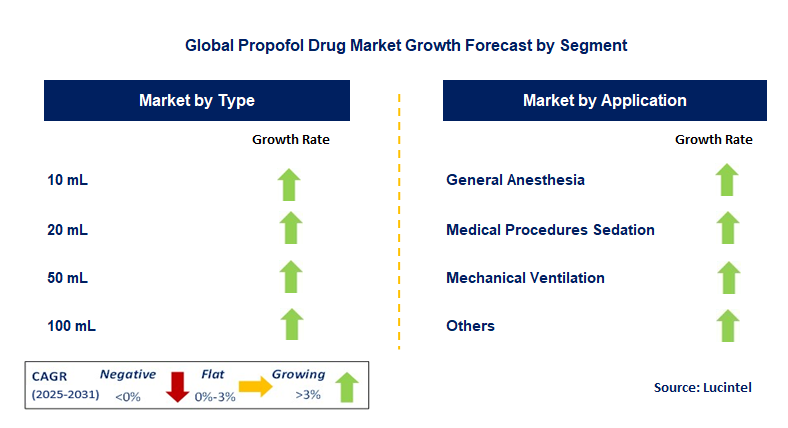
• Lucintel forecasts that, within the type category, 50 ml is expected to witness the highest growth over the forecast period.
• Within the application category, medical procedures sedation is expected to witness the highest growth.
• In terms of region, APAC is expected to witness the highest growth over the forecast period.
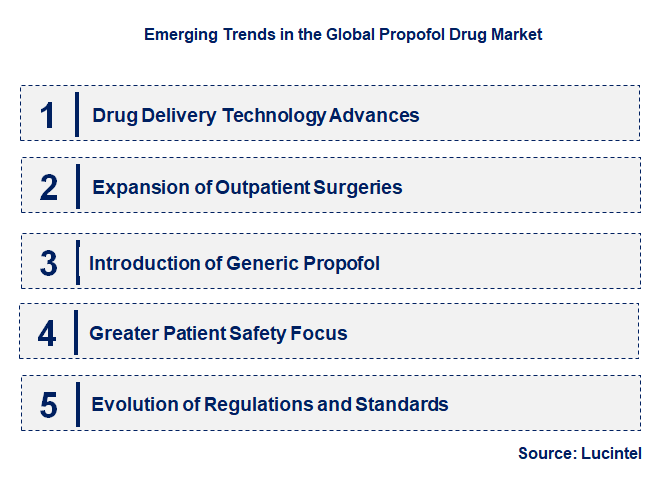
• Drug Delivery Technology Advances: Advances in drug delivery technology are rendering anesthesia procedures more precise and safer. Emerging infusion pumps and more accurate delivery devices are assisting in dosing management better. These advances minimize risks of overdosing and underdosing, which are some of the risks related to anesthesia, hence, enhancing patient outcomes. Additionally, technological advancements enable quicker recovery times that are attractive to patients and practitioners alike.
• Expansion of Outpatient Surgeries: Outpatient surgeries have been increasing, and this growth is propelling the demand for Propofol. The drug is often administered for sedation purposes during minor surgeries. This trend is caused by enhanced surgical technology and recovery times of patients, making many procedures possible outside of hospitals. Consequently, demand for propofol in out-of-hospital locations has increased immensely, especially in nations with advanced healthcare systems.
• Introduction of Generic Propofol: The advent of generic forms of propofol is increasing the affordability and availability of the drug, especially in developing markets. The generics have reduced the cost of Propofol, making it more accessible to healthcare facilities, thereby increasing its application. This trend has, however, resulted in price competition between manufacturers and issues of consistency in quality among the generics. Despite these issues, generics ensure wider market access.
• Greater Patient Safety Focus: An increased focus on patient safety in anesthesia procedures is leading to demand for safer propofol formulations and administration procedures. Physicians are seeking formulations that reduce the risk of side effects like respiratory depression and hypotension. This is fueling research and development in safer propofol formulations, making the drug a keystone of contemporary anesthesia procedures.
• Evolution of Regulations and Standards: With more emphasis being placed on quality control and patient safety, global regulatory authorities are changing standards for anesthetic medicines. This is resulting in tougher compliance for producers, which ensures Propofol products are at the highest levels of safety and efficacy. Through these changing regulations, only top-quality products enter the market, increasing consumer confidence. These emerging trends are revolutionizing the propofol drug market by enhancing safety, accessibility, and the range of its uses. With technology improving, the market will further develop with higher efficiency and accuracy, to the benefit of patients and healthcare providers alike. The emergence of generics and patient safety emphasis also marks a move towards more sustainable and cost-effective solutions, which will shape the competitive environment.
• New Formulations: There is growing interest by manufacturers to develop new formulations of propofol that enhance patient benefits. These new formulations are designed to decrease the frequency of side effects such as pain on injection and respiratory problems. The lipid-based formulations, for example, have increased the safety and effectiveness profile of propofol, which has in turn seen increased use in surgeries and intensive care units.
• Growth of Generic Propofol Products: Growth of generic propofol products has been a major development, particularly in the emerging markets where affordability is a major hindrance. Generic products have lowered the price of the drug to a level that is more affordable for hospitals and operating centers, hence the need to utilize the same more. This action is advantageous to healthcare systems with budget limitations and brings about a more competitive market environment.
• Regulatory Approvals and Safety Standards: Recent regulatory approvals in major markets, such as the United States and Europe, have been aimed at enhancing the safety and quality standards of propofol. New safety regulations for its administration during anesthesia procedures have been implemented to reduce risks. Manufacturers are making efforts to comply with these increased regulatory standards, ensuring that only the safest and most effective formulations enter the market.
• Expanded Usage Outside Surgical Settings: The usage of propofol outside of surgical settings, i.e., ICUs and for diagnostic testing, has witnessed considerable growth. It is attributed to the flexibility of the drug when it comes to sedation, as well as its rapid-onset effective action as an anesthetic. In the process, healthcare practitioners require drugs with extensive application usage. Propofol's flexibility is leading its applications in many diverse clinical applications.
• Emphasis on Supply Chain Enhancement: Disruptions in the supply chain have been a major issue for propofol production, especially in the wake of the COVID-19 pandemic. Consequently, producers are putting emphasis on enhancing their supply chain management and maintaining stable production. This involves ramping up the production capacity and raw material procurement to avoid shortages. These are key steps to maintaining a steady supply of Propofol for meeting increasing demand in hospitals and health care centers. These significant developments show how the propofol drug market is evolving to cater to changing healthcare providers' and patients' needs. With advances in technology, the increase in generics, and updates in regulation, the market is well-placed to experience further growth, ensuring propofol remains a crucial ingredient in contemporary medical procedures.
• Expansion of Outpatient Surgery Centers: The expansion of outpatient surgery centers is a huge opportunity for propofol producers. These centers need affordable anesthetics such as propofol for different minor surgical procedures. With more outpatient surgeries on the rise across the world because of improved surgical techniques and recovery periods, the demand for propofol will keep growing. Producers can take advantage of this trend by providing affordable and effective propofol formulations specifically designed for these facilities.
• More Use in ICU Sedation: Propofol finds extensive application in intensive care units (ICUs) for sedation. The demand for Propofol will grow as the number of critically ill patients necessitating intensive care increases, especially due to the aging population and increased incidence of long-term diseases. Pharmaceutical firms can look into creating customized forms of Propofol that address the specific needs of ICU patients and enhance both efficacy and safety.
• Pediatric Anesthesia Solution Development: There is increasing demand for pediatric-specific anesthesia solutions, specifically sedation during surgery or diagnosis. Propofol has been applied in pediatric anesthesia, and its development for that particular age group is a growth area. Companies can specialize in developing formulations that cater to the distinct needs of pediatric patients, including minimizing the risk of side effects and achieving optimal sedation levels.
• Target Emerging Markets: Emerging markets of Asia-Pacific and Africa offer immense growth prospects for propofol producers. As healthcare facilities are enhanced and operations are made more accessible in these areas, the market for good anesthetics is expanding. By increasing output and distribution networks, businesses are in a position to harness these emerging markets and benefit from rising healthcare spending in developing economies.
• Value-Added Services Introduction: Propofol producers can differentiate themselves by providing value-added services, including training healthcare professionals on best practices for propofol administration and patient safety. These services can assist hospitals and clinics in maximizing the use of the drug, enhancing patient outcomes, and reducing risks. This strategy can also increase customer loyalty and build relationships with healthcare institutions. These strategic growth opportunities articulate the way that the propofol drug market is transforming in order to meet shifting healthcare requirements. By placing their emphasis upon developing markets, specialized uses, and value-added services, corporations are able to set themselves up for success amidst an increasingly demanding and dynamic global landscape.
• Fresenius Kabi
• Aspen Pharma
• B. Braun
• Pfizer
• DR. Reddy'S Laboratories
• Rusoma
• Centurion Healthcare
• Wellona Pharma
• NEON
• Flagship Biotech
• 10 mL
• 20 mL
• 50 mL
• 100 mL
• General Anesthesia
• Medical Procedures Sedation
• Mechanical Ventilation
• Others
• North America
• Europe
• Asia Pacific
• The Rest of the World
• United States: The United States propofol drug market has seen great improvements fueled by the increasing popularity of outpatient and elective procedures. Besides, growth in the healthcare infrastructure and growing awareness of proper anesthesia practices are adding to the market growth. Approvals for new formulations and generic versions of Propofol are making it more widely available, further boosting its market penetration. Nonetheless, growing concerns regarding supply chain problems and production constraints are challenges to ongoing growth.
• China: In China, the market for propofol has grown significantly as a result of the accelerated growth in healthcare services and a high population base seeking medical services. The drive by the government to upgrade the healthcare system and provide more access to surgical procedures has propelled the need for anesthesia products. The effort by the nation to enhance medical facilities in urban and rural settings fuels market expansion. Yet, pricing pressure and the difficulty of maintaining consistent quality are the primary concerns for manufacturers.
• Germany: Germany has a well-developed healthcare system with stable demand for propofol. Some recent trends include attempts to save costs in hospitals without diminishing the quality of medical care. Propofol is still an important drug for anesthesia during operations and intensive care. The nation's emphasis on technological improvements in anesthesia procedures and equipment has led to increased accuracy in the delivery of drugs. The rising population of the elderly in Germany is likely to create more demand for surgeries, thus driving the Propofol market.
• India: India's fast-growing healthcare market and increasing number of surgical procedures have triggered the demand for propofol. The growth of the healthcare infrastructure, particularly in Tier 2 and Tier 3 cities, has been a major driver of market growth. The rising incidence of chronic diseases, including heart conditions, has contributed to higher surgeries that need anesthesia. India's generic drug market also works to make propofol more affordable and accessible. Yet, the country does have challenges regarding maintaining drug quality and compliance with regulations.
• Japan: The propofol market in Japan is supported by superior medical practice and a superior level of healthcare infrastructure. The market is experiencing developments in propofol formulations to enhance the safety of patients and minimize side effects. Due to the aging population in Japan, the demand for surgeries is on the rise, and the market for anesthetics is driven forward. Moreover, the stringent regulatory framework of the country guarantees medical drug quality standards. Nevertheless, supply chain interruptions and price competitiveness challenges are likely to hinder market development in the future.


• Fresenius Kabi
• Aspen Pharma
• B. Braun
• Pfizer
• DR. Reddy'S Laboratories
• Rusoma
• Centurion Healthcare
• Wellona Pharma
• NEON
• Flagship Biotech Q5. Which propofol drug market segment will be the largest in future? Answer: Lucintel forecasts that, within the type category, 50 ml is expected to witness the highest growth over the forecast period. Q6. In propofol drug market, which region is expected to be the largest in next 5 years? Answer: In terms of region, APAC is expected to witness the highest growth over the forecast period. Q7. Do we receive customization in this report? Answer: Yes, Lucintel provides 10% customization without any additional cost.


Choose a license that fits your team. Instant PDF delivery.
Prices exclude taxes. Instant delivery. Custom licensing available on request.
Market Report · July 15, 2026
Market Report · June 26, 2026
Market Report · May 18, 2026
Trusted partner for strategic intelligence and business growth


Receive a complimentary market analysis tailored to your industry. Our analysts will identify key growth opportunities and competitive dynamics specific to your business.

Market size, growth rate, and key trend analysis for your specific sector.

Top competitor positioning and market share analysis.

Strategic recommendations backed by data-driven insights.
Get curated market intelligence and competitive moves straight to your inbox.
By subscribing, you agree to receive our monthly insights. Unsubscribe anytime.
Receive a complimentary market analysis tailored to your industry. Our analysts will identify key growth opportunities and competitive dynamics specific to your business.
Market size, growth rate, and key trend analysis for your specific sector.
Top competitor positioning and market share analysis.
Strategic recommendations backed by data-driven insights.
Get curated market intelligence, emerging trends, and competitive moves straight to your inbox each month.
By subscribing, you agree to receive our monthly insights. Unsubscribe anytime.
We'll send your sample report shortly.