
Report Feature
Power SiC manufacturing Equipment Market Trends and Forecast
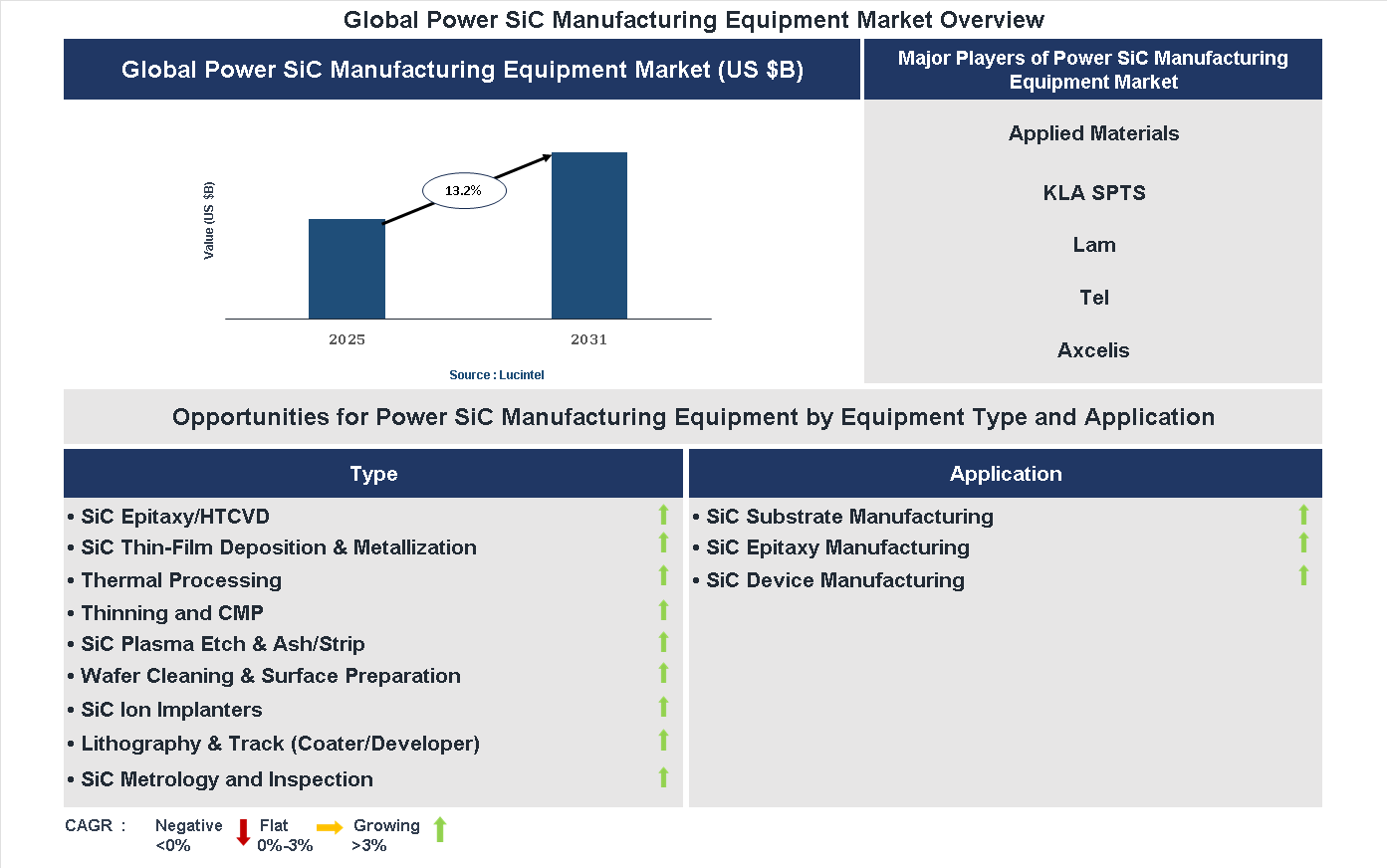
The future of the global power SiC manufacturing equipment market looks promising with opportunities in the sic substrate manufacturing, sic epitaxy manufacturing, and sic device manufacturing markets. The global power SiC manufacturing equipment market is expected to grow with a CAGR of 13.2% from 2025 to 2031. The major drivers for this market are the growing investment in capacity expansion wafer fab, the rising government support & subsidies for semiconductor production, and the increase in regional expansion of sic ecosystem.• Lucintel forecasts that, within the type category, SiC Epitaxy/HTCVD is expected to witness the highest growth over the forecast period.
• Within the application category, sic device manufacturing is expected to witness the highest growth.
• In terms of region, APAC is expected to witness the highest growth over the forecast period. Gain valuable insights for your business decisions with our comprehensive 150+ page report. Sample figures with some insights are shown below.
Emerging Trends in the Power SiC Manufacturing Equipment Market
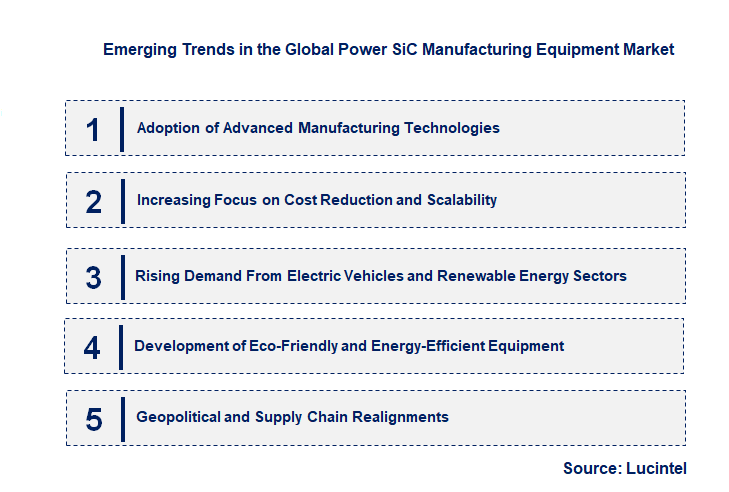
The power SiC manufacturing equipment market is experiencing rapid evolution driven by technological advancements, increasing demand for efficient power electronics, and a shift towards sustainable energy solutions. As industries seek higher performance and energy efficiency, manufacturers are investing in innovative equipment to produce Silicon Carbide (SiC) components. These developments are transforming the landscape of power electronics, electric vehicles, and renewable energy sectors. The markets growth is also fueled by geopolitical factors and supply chain realignments, prompting companies to adopt cutting-edge manufacturing technologies. Understanding these emerging trends is crucial for stakeholders aiming to capitalize on the markets future potential and stay competitive in this dynamic environment.• Adoption of Advanced Manufacturing Technologies: The integration of automation, AI, and IoT in SiC equipment enhances precision, reduces costs, and increases production efficiency. These technologies enable real-time monitoring and predictive maintenance, minimizing downtime and improving yield quality. As a result, manufacturers can meet rising demand more effectively while maintaining high standards. This trend is also fostering innovation in equipment design, leading to more scalable and flexible manufacturing solutions that cater to diverse application needs.
• Increasing Focus on Cost Reduction and Scalability: To meet market demands, companies are prioritizing cost-effective manufacturing processes and scalable equipment solutions. Innovations such as modular systems and high-throughput production lines are reducing capital expenditure and operational costs. This focus allows manufacturers to produce SiC components at a larger scale, making them more accessible for applications like electric vehicles and renewable energy systems. Cost reduction strategies are also driving competitive pricing, further accelerating market adoption and growth.
• Rising Demand from Electric Vehicles and Renewable Energy Sectors: The surge in electric vehicle adoption and renewable energy projects is significantly boosting the need for high-quality SiC components. Manufacturing equipment tailored for high-volume, high-precision production is in high demand to meet these sector-specific requirements. This trend is encouraging manufacturers to develop specialized equipment capable of producing larger quantities of SiC devices with consistent performance, thereby supporting the global transition to cleaner energy and transportation solutions.
• Development of Eco-Friendly and Energy-Efficient Equipment: Environmental concerns and energy efficiency goals are prompting the industry to innovate greener manufacturing solutions. Equipment that consumes less energy, produces fewer emissions, and utilizes sustainable materials is gaining prominence. These eco-friendly manufacturing processes not only reduce the carbon footprint but also align with regulatory standards and corporate sustainability commitments. This trend is shaping a more responsible and sustainable supply chain for SiC components, appealing to environmentally conscious consumers and stakeholders.
• Geopolitical and Supply Chain Realignments: Ongoing geopolitical tensions and trade restrictions are prompting companies to localize production and diversify supply chains. This shift is driving investments in domestic manufacturing equipment and technologies to ensure supply security. As a result, there is increased demand for versatile, adaptable equipment capable of operating under different regulatory and environmental conditions. These realignments are fostering innovation in manufacturing processes and encouraging regional market growth, ultimately making the supply chain more resilient and responsive to global market dynamics. In summary, these emerging trends are collectively reshaping the power SiC manufacturing equipment market by fostering technological innovation, reducing costs, supporting sustainable practices, and enhancing supply chain resilience. These developments are enabling manufacturers to meet the growing demand for high-performance SiC components across various sectors, positioning the market for sustained growth and increased competitiveness in the evolving landscape of power electronics.
Recent Development in the Power SiC Manufacturing Equipment Market
The power SiC manufacturing equipment market is experiencing rapid growth driven by advancements in semiconductor technology, increasing demand for energy-efficient solutions, and expanding applications in electric vehicles and renewable energy sectors. As the industry evolves, key developments are shaping the future landscape, influencing manufacturing processes, and market dynamics. These developments reflect technological innovations, strategic collaborations, and regulatory shifts that are propelling the market forward. Understanding these trends is essential for stakeholders aiming to capitalize on emerging opportunities and navigate competitive challenges effectively.• Technological Innovations in Equipment Design: New equipment designs incorporate higher precision and automation, enabling manufacturers to produce higher-quality Silicon Carbide (SiC) wafers with improved efficiency. These innovations reduce production costs and enhance scalability, making SiC devices more accessible for various applications. The impact is a significant boost in manufacturing capacity and product reliability, which accelerates market growth and broadens application scope.
• Increased Investment in R&D: Major industry players and governments are investing heavily in research and development to improve SiC manufacturing processes. This focus on innovation leads to the development of advanced equipment capable of handling larger wafers and reducing defect rates. The result is a more competitive market with improved product performance, fostering faster adoption of SiC technology across sectors like automotive and power grids.
• Strategic Collaborations and Partnerships: Companies are forming alliances to share expertise, technology, and resources, accelerating equipment development. These collaborations facilitate the integration of cutting-edge features and standardization across manufacturing platforms. The impact includes faster time-to-market for new equipment, increased market penetration, and enhanced technological capabilities, benefiting the entire supply chain.
• Adoption of Industry 4.0 and Automation: The integration of Industry 4.0 principles, including IoT, AI, and data analytics, is transforming manufacturing processes. Automated equipment with real-time monitoring improves yield, reduces downtime, and optimizes production workflows. This development enhances operational efficiency, lowers costs, and supports large-scale manufacturing demands, thereby strengthening market competitiveness.
• Regulatory and Environmental Policies: Governments are implementing stricter regulations on energy efficiency and emissions, encouraging the adoption of SiC devices. These policies drive demand for advanced manufacturing equipment capable of producing high-performance SiC components. The resulting market impact is increased investment in eco-friendly and energy-efficient equipment, fostering sustainable growth and innovation within the industry. In summary, these key developments are significantly impacting the power SiC manufacturing equipment market by enhancing technological capabilities, fostering strategic collaborations, and aligning with regulatory standards. They are driving increased production efficiency, reducing costs, and expanding application opportunities, which collectively propel the market toward a robust and sustainable future.
Strategic Growth Opportunities in the Power SiC Manufacturing Equipment Market
The power SiC manufacturing equipment market is experiencing rapid growth driven by advancements in semiconductor technology and increasing demand for high-efficiency power devices. As industries such as electric vehicles, renewable energy, and industrial automation expand, the need for reliable, high-performance silicon carbide (SiC) components intensifies. Manufacturing equipment tailored for SiC production is crucial to meet these demands, fostering innovation and scalability. Key applications such as electric vehicles, renewable energy systems, industrial power supplies, aerospace, and consumer electronics present significant growth opportunities. These developments are shaping the future landscape of power electronics, emphasizing efficiency, durability, and cost-effectiveness.• Enhanced Efficiency and Performance: The rising adoption of electric vehicles (EVs) drives demand for SiC power modules, which offer superior efficiency, faster switching, and reduced thermal losses. Manufacturing equipment tailored for high-volume production of SiC devices is critical to meet automotive industry standards. This growth accelerates the adoption of EVs by improving battery range and reducing charging times, ultimately transforming the automotive market and supporting sustainable transportation initiatives.
• Enabling Grid Integration and Storage: The expansion of renewable energy sources like solar and wind necessitates advanced power conversion systems. SiC-based inverters and converters improve efficiency and reliability, making renewable energy more viable and cost-effective. Manufacturing equipment that supports large-scale production of these components is vital for scaling renewable infrastructure, reducing energy losses, and enhancing grid stability, thereby accelerating the transition to clean energy.
• Improving Efficiency and Compactness: Industrial applications require robust, efficient power supplies for machinery and automation systems. SiC devices enable smaller, more efficient power modules that reduce energy consumption and heat generation. Manufacturing equipment designed for industrial SiC component production ensures high-quality, scalable solutions, which in turn boost productivity, lower operational costs, and support Industry 4.0 initiatives.
• High-Performance Power Modules for Extreme Conditions: The aerospace sector demands high-reliability power electronics capable of operating under extreme conditions. SiC technology offers high-temperature tolerance and superior performance, making it ideal for aerospace applications. Specialized manufacturing equipment for aerospace-grade SiC components ensures precision and quality, facilitating the development of advanced, lightweight power systems that enhance aircraft efficiency and safety.
• Compact and Energy-Efficient Devices: The consumer electronics industry benefits from SiCs ability to enable smaller, more energy-efficient power adapters and chargers. Manufacturing equipment that supports miniaturization and high-volume production of SiC components helps meet the growing demand for portable, high-performance devices. This growth enhances user experience, reduces energy consumption, and drives innovation in consumer electronics. In summary, these key growth opportunities across applications are significantly impacting the power SiC manufacturing equipment market by driving technological innovation, increasing production scalability, and reducing costs. As industries adopt SiC technology for improved efficiency and performance, the market is poised for substantial expansion, fostering a more sustainable and technologically advanced future.
Power SiC Manufacturing Equipment Market Driver and Challenges
The power SiC manufacturing equipment market is influenced by a range of technological, economic, and regulatory factors. Rapid advancements in semiconductor technology, increasing demand for energy-efficient solutions, and supportive government policies are key drivers. Conversely, high manufacturing costs, technological complexities, and regulatory hurdles pose significant challenges. These factors collectively shape the markets growth trajectory, influencing investment decisions, innovation, and competitive dynamics. Understanding these drivers and challenges is essential for stakeholders aiming to capitalize on emerging opportunities while navigating potential risks in this evolving landscape. The factors responsible for driving the power SiC manufacturing equipment market include:-• Technological Advancements: The continuous development of silicon carbide (SiC) technology enhances device performance, efficiency, and reliability. As industries such as electric vehicles, renewable energy, and industrial automation seek more efficient power solutions, the demand for advanced SiC manufacturing equipment increases. Innovations in equipment design, such as high-precision etching and deposition tools, enable manufacturers to produce higher-quality SiC components, fostering market growth. This technological progress not only improves product performance but also reduces manufacturing costs over time, making SiC devices more accessible and driving further adoption across various sectors.
• Rising Adoption of Electric Vehicles (EVs): The global shift towards electric mobility is a major driver for the power SiC manufacturing equipment market. SiC devices offer superior efficiency, higher voltage capabilities, and better thermal performance compared to traditional silicon-based components, making them ideal for EV powertrains. As automakers accelerate their EV production targets, the demand for SiC-based power modules and the equipment needed to manufacture them surges. This trend is supported by government incentives and stricter emission regulations, which collectively push automakers to adopt SiC technology, thereby fueling the growth of manufacturing equipment tailored for SiC production.
• Increasing Investment in Renewable Energy: The expansion of renewable energy sources such as solar and wind power necessitates efficient power conversion systems. SiC devices are crucial in these applications due to their high efficiency and ability to operate at higher temperatures and voltages. Consequently, manufacturers are investing heavily in SiC manufacturing equipment to meet the rising demand for power electronics in renewable energy infrastructure. This investment not only supports the deployment of cleaner energy solutions but also stimulates the development of advanced manufacturing tools, further propelling market growth and technological innovation.
• Growing Focus on Energy Efficiency and Sustainability: Governments and industries worldwide are emphasizing energy conservation and sustainable practices. SiC technology plays a vital role in achieving these goals by enabling more efficient power conversion and reducing energy losses. The push for greener solutions encourages manufacturers to adopt sophisticated SiC manufacturing equipment capable of producing high-performance devices. This focus on sustainability drives market expansion as companies seek to meet regulatory standards and consumer expectations for environmentally friendly products, fostering innovation in manufacturing processes and equipment. The challenges facing this Market include:-
• High Manufacturing Costs: Producing SiC devices requires sophisticated, high-precision equipment, which involves significant capital investment. The complexity of SiC wafer fabrication, including high-temperature processes and advanced epitaxial growth techniques, results in elevated manufacturing costs. These costs can hinder market growth, especially for smaller players or emerging markets, as the initial investment and operational expenses may outweigh short-term benefits. Additionally, the need for specialized materials and cleanroom environments further escalates costs, creating barriers to widespread adoption and scaling of SiC manufacturing facilities.
• Technological Complexities: The manufacturing of SiC devices involves complex processes such as high-temperature epitaxy, wafer bonding, and precision etching. These processes require advanced equipment and expertise, which can be challenging to develop and maintain. Technological hurdles include managing defect densities, ensuring material purity, and achieving consistent device performance. Overcoming these complexities demands continuous research and development, which can be time-consuming and costly. If not addressed effectively, these challenges could slow down innovation and limit the scalability of SiC manufacturing, impacting overall market growth.
• Regulatory and Certification Challenges: The power electronics industry is subject to stringent safety, quality, and environmental regulations. Complying with these standards requires rigorous testing, certification, and quality assurance processes, which can delay product launches and increase costs. Additionally, evolving regulatory frameworks related to environmental impact and material sourcing pose compliance challenges for manufacturers. Navigating these regulatory landscapes demands significant resources and expertise, potentially hindering rapid market expansion. Failure to meet regulatory requirements can result in penalties, product recalls, or loss of market access, emphasizing the importance of robust compliance strategies. In summary, the power SiC manufacturing equipment market is driven by technological innovation, the rising adoption of electric vehicles, investments in renewable energy, and a focus on energy efficiency. However, high manufacturing costs, technological complexities, and regulatory hurdles present notable challenges. These factors collectively influence market dynamics, requiring stakeholders to balance innovation with cost management and compliance. Overall, the markets growth prospects remain promising, provided that technological and regulatory challenges are effectively addressed, enabling the industry to capitalize on the increasing demand for efficient power electronics solutions.
List of Power SiC manufacturing Equipment Companies
Companies in the market compete on the basis of product quality offered. Major players in this market focus on expanding their manufacturing facilities, R&D investments, infrastructural development, and leverage integration opportunities across the value chain. With these strategies power SiC manufacturing equipment companies cater increasing demand, ensure competitive effectiveness, develop innovative products & technologies, reduce production costs, and expand their customer base. Some of the power SiC manufacturing equipment companies profiled in this report include-• Applied Materials
• KLA SPTS
• Lam
• Tel
• Axcelis
• Centrotherm
• ULVAC
• PVA TePla
• NAURA
• Kokusai
Power SiC manufacturing Equipment Market by Segment
The study includes a forecast for the global power SiC manufacturing equipment market by type, application, and region.Power SiC manufacturing Equipment Market by Type [Value from 2019 to 2031]:
• SiC Epitaxy/HTCVD
• SiC Thin-Film Deposition & Metallization
• Thermal Processing
• Thinning and CMP
• SiC Plasma Etch & Ash/Strip
• Wafer Cleaning & Surface Preparation
• SiC Ion Implanters
• Lithography & Track (Coater/Developer)
• SiC Metrology and I
Power SiC manufacturing Equipment Market by Application [Value from 2019 to 2031]:
• SiC Substrate Manufacturing
• SiC Epitaxy Manufacturing
• SiC Device Manufacturing
Power SiC manufacturing Equipment Market by Region [Value from 2019 to 2031]:
• North America
• Europe
• Asia Pacific
• The Rest of the World
Country Wise Outlook for the Power SiC Manufacturing Equipment Market
The power SiC manufacturing equipment market is experiencing rapid growth driven by increasing demand for high-efficiency power electronics across various industries. Technological advancements, government policies promoting clean energy, and the rising adoption of electric vehicles are fueling innovation and investment in this sector. Countries are focusing on enhancing manufacturing capabilities to meet global demand, leading to significant developments in equipment design, automation, and production processes. As the market evolves, key players are expanding their footprints, and new entrants are emerging with innovative solutions. This dynamic environment reflects the strategic importance of Silicon Carbide (SiC) technology in shaping the future of power electronics worldwide.• United States: The U.S. market is witnessing substantial investments in SiC manufacturing equipment, driven by the growth of electric vehicle (EV) and renewable energy sectors. Leading companies are developing advanced automation and high-capacity production lines to meet domestic and international demand. Government initiatives supporting clean energy and EV adoption are further boosting market growth. R&D activities are focused on improving equipment efficiency and reducing costs, with collaborations between industry and academia enhancing technological innovation.
• China: China remains a dominant player in the power SiC manufacturing equipment market, with significant government backing to develop domestic semiconductor and power electronics industries. The country is investing heavily in expanding manufacturing capacity and upgrading existing facilities. Local firms are adopting cutting-edge automation technologies to increase production efficiency. Chinas focus on self-sufficiency and reducing reliance on imports is driving rapid advancements in equipment design and process optimization, positioning it as a key global hub for SiC technology.
• Germany: Germanys market is characterized by a strong emphasis on high-quality manufacturing and technological innovation. The country is leveraging its expertise in industrial automation and precision engineering to develop advanced SiC manufacturing equipment. German firms are collaborating with European and global partners to enhance production capabilities and integrate sustainable practices. The focus on energy efficiency and renewable energy integration is propelling the adoption of SiC technology, with a growing emphasis on developing environmentally friendly manufacturing solutions.
• India: India is emerging as a significant market for Power SiC Manufacturing Equipment, supported by government initiatives promoting electric mobility and renewable energy. Investments are increasing in setting up new manufacturing facilities and upgrading existing ones. Indian companies are adopting automation and Industry 4.0 practices to improve production efficiency. The market is also witnessing collaborations with international firms to access advanced technologies, aiming to reduce costs and enhance local manufacturing capabilities.
• Japan: Japan continues to innovate in the power SiC manufacturing equipment market, with a focus on improving equipment performance and energy efficiency. The country’s strong semiconductor industry and technological expertise are driving advancements in equipment design and automation. Japanese firms are investing in R&D to develop next-generation manufacturing solutions that support the growing demand for high-performance power devices. Additionally, Japan emphasizes sustainable manufacturing practices and integrating eco-friendly technologies into production processes to maintain its competitive edge.

Features of the Global Power SiC manufacturing Equipment Market
Market Size Estimates: Power SiC manufacturing equipment market size estimation in terms of value ($B). Trend and Forecast Analysis: Market trends (2019 to 2024) and forecast (2025 to 2031) by various segments and regions. Segmentation Analysis: Power SiC manufacturing equipment market size by type, application, and region in terms of value ($B). Regional Analysis: Power SiC manufacturing equipment market breakdown by North America, Europe, Asia Pacific, and Rest of the World. Growth Opportunities: Analysis of growth opportunities in different types, applications, and regions for the power SiC manufacturing equipment market. Strategic Analysis: This includes M&A, new product development, and competitive landscape of the power SiC manufacturing equipment market. Analysis of competitive intensity of the industry based on Porter’s Five Forces model.
FAQ
Q1. What is the growth forecast for power SiC manufacturing equipment market? Answer: The global power SiC manufacturing equipment market is expected to grow with a CAGR of 13.2% from 2025 to 2031. Q2. What are the major drivers influencing the growth of the power SiC manufacturing equipment market? Answer: The major drivers for this market are the growing investment in capacity expansion wafer fab, the rising government support & subsidies for semiconductor production, and the increase in regional expansion of sic ecosystem. Q3. What are the major segments for power SiC manufacturing equipment market? Answer: The future of the power SiC manufacturing equipment market looks promising with opportunities in the sic substrate manufacturing, sic epitaxy manufacturing, and sic device manufacturing markets. Q4. Who are the key power SiC manufacturing equipment market companies? Answer: Some of the key power SiC manufacturing equipment companies are as follows:• Applied Materials
• KLA SPTS
• Lam
• Tel
• Axcelis
• Centrotherm
• ULVAC
• PVA TePla
• NAURA
• Kokusai Q5. Which power SiC manufacturing equipment market segment will be the largest in future? Answer: Lucintel forecasts that, within the type category, SiC Epitaxy/HTCVD is expected to witness the highest growth over the forecast period. Q6. In power SiC manufacturing equipment market, which region is expected to be the largest in next 5 years? Answer: In terms of region, APAC is expected to witness the highest growth over the forecast period. Q7. Do we receive customization in this report? Answer: Yes, Lucintel provides 10% customization without any additional cost.
Table of Contents
List of Figures
List of Tables
Methodology
- In-depth interviews of the major players in this market
- Detailed secondary research from competitors’ financial statements and published data
- Extensive searches of published works, market, and database information pertaining to industry news, company press releases, and customer intentions
- A compilation of the experiences, judgments, and insights of Lucintel’s professionals, who have analyzed and tracked this market over the years.


Buy Now
Choose a license that fits your team. Instant PDF delivery.
Prices exclude taxes. Instant delivery. Custom licensing available on request.
Key Questions
- • What are some of the most promising, high-growth opportunities for the power SiC manufacturing equipment market by type (SiC epitaxy/HTCVD, SiC thin-film deposition & metallization, thermal processing, thinning and CMP, SiC plasma etch & ash/strip, wafer cleaning & surface preparation, SiC ion implanters, lithography & track (coater/developer), and SiC metrology and inspection), application (sic substrate manufacturing, sic epitaxy manufacturing, and sic device manufacturing), and region (North America, Europe, Asia Pacific, and the Rest of the World)?
- • Which segments will grow at a faster pace and why?
- • Which region will grow at a faster pace and why?
- • What are the key factors affecting market dynamics? What are the key challenges and business risks in this market?
- • What are the business risks and competitive threats in this market?
- • What are the emerging trends in this market and the reasons behind them?
- • What are some of the changing demands of customers in the market?
- • What are the new developments in the market? Which companies are leading these developments?
- • Who are the major players in this market? What strategic initiatives are key players pursuing for business growth?
- • What are some of the competing products in this market and how big of a threat do they pose for loss of market share by material or product substitution?
- • What M&A activity has occurred in the last 5 years and what has its impact been on the industry? For any questions related to Power SiC manufacturing Equipment Market, Power SiC manufacturing Equipment Market Size, Power SiC manufacturing Equipment Market Growth, Power SiC manufacturing Equipment Market Analysis, Power SiC manufacturing Equipment Market Report, Power SiC manufacturing Equipment Market Share, Power SiC manufacturing Equipment Market Trends, Power SiC manufacturing Equipment Market Forecast, Power SiC manufacturing Equipment Companies, write Lucintel analyst at email: helpdesk@lucintel.com. We will be glad to get back to you soon.


