
Report Feature
Power Knee Market Trends and Forecast
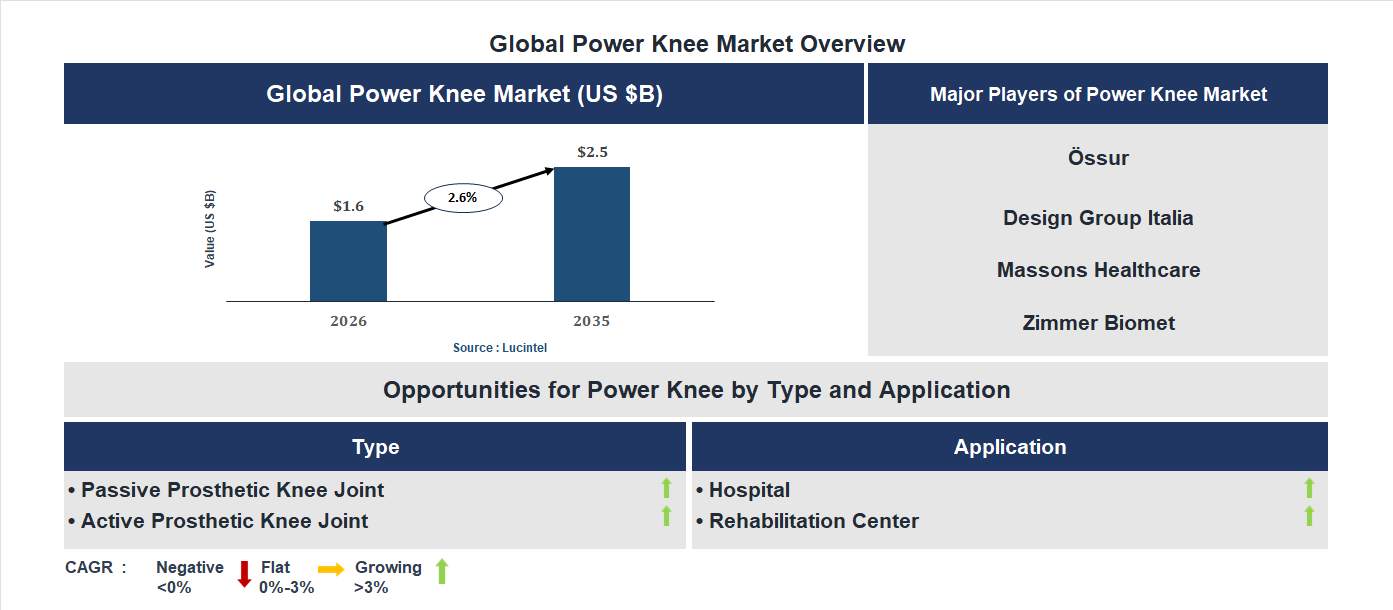
The future of the global power knee market looks promising with opportunities in the hospital and rehabilitation center markets. The global power knee market is expected to reach an estimated $2.5 billion by 2035 with a CAGR of 2.6% from 2026 to 2035. The major drivers for this market are the increasing demand for advanced prosthetic devices, the rising prevalence of lower limb amputations, and the growing adoption of powered mobility solutions.• Lucintel forecasts that, within the type category, active prosthetic knee joint is expected to witness higher growth over the forecast period.
• Within the application category, rehabilitation center is expected to witness higher growth.
• In terms of region, APAC is expected to witness the highest growth over the forecast period. Gain valuable insights for your business decisions with our comprehensive 150+ page report. Sample figures with some insights are shown below.
Emerging Trends in the Power Knee Market
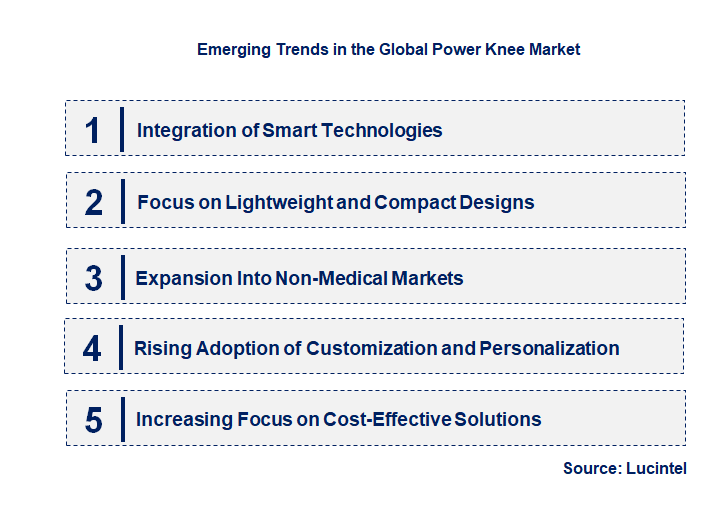
The power knee market is experiencing rapid growth driven by technological advancements, increasing demand for mobility solutions, and a focus on improving the quality of life for individuals with mobility impairments. As healthcare needs evolve and wearable technology becomes more sophisticated, the market is witnessing innovative product launches and expanding applications. These developments are not only enhancing user experience but also broadening the scope of use cases, from medical rehabilitation to everyday mobility support. The following key trends highlight the major forces shaping the future of the power knee market and its potential for transformative impact across various sectors.• Integration of Smart Technologies: The incorporation of sensors, AI, and IoT connectivity is revolutionizing Power Knee devices. These smart features enable real-time monitoring, personalized adjustments, and data collection for better treatment outcomes. Users benefit from enhanced comfort, safety, and performance, while healthcare providers gain valuable insights for tailored rehabilitation programs. This trend is driving the development of more intuitive and adaptive devices, making Power Knees more effective and user-friendly.
• Focus on Lightweight and Compact Designs: Manufacturers are prioritizing the development of lightweight, ergonomic Power Knees to improve user comfort and mobility. Advances in materials such as carbon fiber and lightweight alloys reduce device weight without compromising strength. Smaller, discreet designs facilitate ease of use in daily activities and encourage wider adoption among users who may be deterred by bulky equipment. This trend enhances user confidence and promotes greater integration of Power Knees into everyday life.
• Expansion Into Non-Medical Markets: Beyond medical rehabilitation, Power Knees are increasingly being adopted in sports, military, and industrial sectors. Athletes use them for enhanced performance and injury prevention, while military personnel benefit from improved mobility in challenging terrains. Industrial workers utilize Power Knees to reduce fatigue and increase productivity. This diversification broadens market opportunities, stimulates innovation, and accelerates product development tailored to specific non-medical needs.
• Rising Adoption Of Customization And Personalization: The demand for tailored Power Knee solutions is growing, driven by individual user needs and preferences. Customizable features include adjustable settings, fit, and support levels, ensuring optimal comfort and functionality. Advances in 3D printing and modular designs facilitate rapid customization, leading to higher user satisfaction and better outcomes. Personalization also helps address diverse mobility challenges, making Power Knees more accessible and effective for a wider range of users.
• Increasing Focus On Cost-Effective Solutions: As market competition intensifies, manufacturers are striving to reduce costs while maintaining quality. The development of affordable Power Knee devices aims to make advanced mobility solutions accessible to a broader population, including those in emerging markets. Economies of scale, innovative manufacturing techniques, and modular product architectures contribute to cost reductions. This trend is crucial for expanding market reach, encouraging adoption, and fostering inclusive mobility solutions across different socioeconomic groups. These trends are collectively reshaping the power knee market by fostering innovation, enhancing user experience, and broadening application areas. The integration of smart technology, focus on lightweight design, diversification into new markets, personalization, and cost reduction strategies are driving growth and making Power Knees more accessible, effective, and versatile. These developments are poised to significantly improve mobility solutions and quality of life for users worldwide.
Recent Development in the Power Knee Market
The power knee market is experiencing rapid advancements driven by technological innovations and increasing demand for mobility solutions. As populations age and active lifestyles grow, the need for effective mobility aids and rehabilitation devices is expanding. Market players are focusing on developing smarter, more efficient products to meet diverse consumer needs. These developments are shaping the future landscape of mobility assistance, offering improved quality of life and independence for users worldwide.• Growing Demand for Assistive Devices: The increasing aging population and rising prevalence of mobility impairments are fueling demand for power knee devices. Consumers seek advanced solutions that enhance mobility, reduce fatigue, and improve independence. Manufacturers are investing in innovative designs and features to cater to this expanding market segment. This trend is expected to significantly boost sales and adoption rates, creating new opportunities for growth and technological development.
• Technological Innovations in Power Knee Devices: Recent developments include integration of AI, sensors, and IoT for smarter functionality. These innovations enable real-time adjustments, personalized settings, and remote monitoring, improving user experience and safety. Enhanced battery life and lightweight materials further increase device efficiency and comfort. Such technological progress is transforming power knees into more intuitive and reliable solutions, attracting a broader consumer base and expanding market potential.
• Increasing Focus on Customization and User Comfort: Manufacturers are prioritizing personalized fit and ergonomic design to meet individual needs. Customizable features such as adjustable settings, comfort padding, and adaptive support are becoming standard. This focus improves user compliance and satisfaction, especially for long-term users. As a result, the market is witnessing a shift towards more user-centric products, fostering higher adoption rates and expanding the customer base.
• Rising Investment in R&D and Strategic Collaborations: Companies are increasing R&D efforts to develop advanced, cost-effective power knee solutions. Strategic partnerships with healthcare providers, tech firms, and research institutions are accelerating innovation. These collaborations facilitate knowledge exchange and resource sharing, leading to faster product development and regulatory approvals. Such investments are crucial for maintaining competitive advantage and driving market growth in a rapidly evolving industry.
• Expansion into Emerging Markets: Market players are targeting emerging economies with rising healthcare infrastructure and increasing awareness of mobility aids. Local manufacturing, affordable pricing, and tailored marketing strategies are key to capturing these markets. Expansion efforts are opening new revenue streams and diversifying the customer base. This growth is expected to significantly influence global market dynamics, making power knee devices more accessible and affordable worldwide. These developments are collectively transforming the power knee market by enhancing product innovation, expanding accessibility, and improving user experience. The integration of advanced technologies and strategic market expansion is driving growth, making power knee devices more effective and widely available. As a result, the market is poised for substantial expansion, offering improved mobility solutions and a better quality of life for users globally.
Strategic Growth Opportunities in the Power Knee Market
The power knee market is experiencing rapid growth driven by advancements in wearable technology, increasing demand for mobility solutions, and a rising aging population. Innovations in materials and design are enhancing device efficiency and comfort, expanding applications across healthcare, sports, and rehabilitation sectors. Strategic investments and collaborations are further accelerating market expansion, creating new opportunities for manufacturers and service providers. This evolving landscape offers significant potential for improving the quality of life and mobility for diverse user groups worldwide.• Increasing Adoption of Wearable Assistive Devices: The rising need for mobility aids among the elderly and disabled populations is fueling demand for Power Knee devices. Technological advancements have made these devices more lightweight, durable, and user-friendly, encouraging wider adoption. Healthcare providers are integrating Power Knee solutions into rehabilitation programs, enhancing patient outcomes. Additionally, sports enthusiasts and active individuals seek these devices for injury prevention and performance enhancement, broadening market scope and driving innovation in device design and functionality.
• Technological Innovations Enhancing Device Performance: Continuous R&D efforts are leading to smarter, more efficient Power Knee systems with improved sensors, battery life, and control algorithms. Integration of AI and machine learning enables personalized assistance and adaptive support, increasing device effectiveness. Material innovations improve comfort and durability, making devices suitable for daily use. These technological strides are expanding applications beyond traditional rehabilitation, including sports training and military use, thus opening new revenue streams and market segments.
• Growing Focus on Rehabilitation and Healthcare Applications: The increasing prevalence of mobility impairments due to stroke, injury, or degenerative diseases is boosting demand for Power Knee solutions in medical settings. Hospitals and clinics are adopting these devices for physical therapy, enabling faster recovery and improved mobility. Governments and healthcare organizations are investing in assistive technologies to reduce long-term care costs. The integration of Power Knee devices into telemedicine and remote monitoring systems further enhances their role in personalized patient care, expanding market opportunities.
• Rising Investment and Strategic Collaborations: Major companies and startups are investing heavily in Power Knee technology development, fostering innovation and competitive differentiation. Strategic partnerships between device manufacturers, healthcare providers, and research institutions accelerate product development and commercialization. Funding from government grants and venture capital supports market expansion efforts. These collaborations facilitate the integration of advanced features, regulatory approvals, and market entry, ultimately driving growth and establishing Power Knee as a vital component in mobility solutions.
• Expanding Market Across Emerging Economies: Rapid urbanization and increasing healthcare infrastructure in emerging economies are creating new opportunities for Power Knee devices. Rising awareness about mobility aids and aging populations is driving demand in regions like Asia-Pacific, Latin America, and Africa. Local manufacturing and distribution partnerships reduce costs and improve accessibility. Government initiatives and subsidies further promote adoption. As affordability improves, these markets are poised for significant growth, contributing to global market expansion and diversification of application areas. The power knee markets growth opportunities are poised to significantly enhance mobility solutions, improve patient outcomes, and foster technological innovation. Strategic focus on emerging markets, technological advancements, and collaborative efforts will shape the future landscape, making these devices more accessible and effective across various sectors. This evolution will ultimately lead to broader adoption, improved quality of life, and sustained market expansion.
Power Knee Market Driver and Challenges
The power knee market is influenced by a variety of technological, economic, and regulatory factors that shape its growth trajectory. Advances in biomedical engineering and wearable technology are driving innovation, making devices more effective and accessible. Economic factors such as increasing healthcare expenditure and aging populations are expanding demand. Regulatory frameworks ensure safety and efficacy, fostering consumer confidence. However, challenges like high costs, regulatory hurdles, and technological limitations pose obstacles. Understanding these drivers and challenges is essential for stakeholders aiming to capitalize on market opportunities and address potential risks effectively. The factors responsible for driving the power knee market include:• Technological Innovation: The development of advanced materials and sensor technologies has significantly improved the functionality and comfort of power knee devices. Innovations such as lightweight components, improved battery life, and smarter control systems enhance user experience and outcomes. These technological advancements enable more precise movement assistance, making devices suitable for a broader range of users, including athletes and elderly patients. As research continues, the market is expected to see further improvements, driving adoption and expanding applications.
• Aging Population and Increasing Prevalence of Knee Disorders: The global rise in aging populations has led to a higher incidence of knee-related ailments such as osteoarthritis and joint degeneration. These conditions often require surgical intervention or assistive devices, creating a substantial demand for power knee solutions. Additionally, the growing awareness of minimally invasive treatments and rehabilitation options encourages patients and healthcare providers to opt for advanced assistive devices, fueling market growth.
• Rising Healthcare Expenditure and Reimbursement Policies: Increased healthcare spending worldwide, especially in developed countries, supports the adoption of innovative medical devices like power knees. Favorable reimbursement policies and insurance coverage further reduce out-of-pocket costs for patients, making these devices more accessible. Governments and healthcare providers are investing in advanced rehabilitation technologies to improve patient outcomes, which directly benefits the power knee market.
• Growing Focus on Rehabilitation and Mobility Solutions: There is a rising emphasis on improving mobility and quality of life for individuals with mobility impairments. Power knees are increasingly integrated into rehabilitation programs, helping patients regain independence and reduce caregiver burden. The integration of smart features, such as activity tracking and remote monitoring, enhances their utility. This focus on personalized, effective mobility solutions is a key driver for market expansion.
• Strategic Collaborations and Product Launches: Partnerships between technology firms, medical device manufacturers, and healthcare providers facilitate innovation and market penetration. Launching new, improved power knee models with enhanced features attracts a broader customer base. These collaborations also help in navigating regulatory pathways and expanding distribution channels, accelerating market growth and adoption. The challenges facing the power knee market include:
• High Cost of Devices: Power knee devices involve advanced technology and materials, making them expensive. The high upfront cost limits accessibility, especially in developing regions with constrained healthcare budgets. Additionally, maintenance and replacement costs can be prohibitive for some users, restricting widespread adoption. Cost-related barriers hinder market growth and necessitate strategies to reduce prices or improve affordability.
• Regulatory and Approval Hurdles: The medical device industry faces stringent regulatory requirements to ensure safety and efficacy. Navigating complex approval processes can delay product launches and increase costs for manufacturers. Variations in regulations across countries further complicate international market entry. These hurdles can slow innovation and limit the availability of new devices, impacting overall market growth.
• Technological Limitations and User Acceptance: Despite advancements, some power knee devices still face issues related to battery life, weight, and responsiveness. User acceptance can be hindered by device complexity or discomfort during prolonged use. Additionally, technological limitations may restrict functionality, reducing effectiveness and user satisfaction. Overcoming these barriers requires ongoing research and user-centric design improvements to ensure broader acceptance and utilization. The power knee market is driven by technological advancements, demographic shifts, economic support, and strategic collaborations, which collectively foster growth. However, high costs, regulatory challenges, and technological limitations pose significant hurdles. These factors collectively influence market dynamics, requiring stakeholders to innovate, adapt, and strategize effectively. Addressing challenges while leveraging drivers will be crucial for sustainable growth and wider adoption of power knee solutions, ultimately improving mobility and quality of life for users worldwide.
List of Power Knee Companies
Companies in the market compete on the basis of product quality offered. Major players in this market focus on expanding their manufacturing facilities, R&D investments, infrastructural development, and leverage integration opportunities across the value chain. With these strategies power knee companies cater increasing demand, ensure competitive effectiveness, develop innovative products & technologies, reduce production costs, and expand their customer base. Some of the power knee companies profiled in this report include-• Össur
• Design Group Italia
• Massons Healthcare
• Zimmer Biomet
Power Knee Market by Segment
The study includes a forecast for the global power knee market by type, application, and region.Power Knee Market by Type [Value from 2019 to 2035]:
• Passive Prosthetic Knee Joint
• Active Prosthetic Knee Joint
Power Knee Market by Application [Value from 2019 to 2035]:
• Hospital
• Rehabilitation Center
Power Knee Market by Region [Value from 2019 to 2035]:
• North America
• Europe
• Asia Pacific
• The Rest of the World
Country Wise Outlook for the Power Knee Market
The power knee market has experienced significant growth driven by technological advancements, increasing demand for mobility solutions, and aging populations worldwide. Innovations in wearable robotics and smart assistive devices have expanded applications across healthcare, rehabilitation, and personal mobility sectors. Countries are investing heavily in research and development to enhance device efficiency, comfort, and affordability. Regulatory frameworks are evolving to accommodate these emerging technologies, fostering a competitive landscape. As the market matures, collaborations between tech firms and healthcare providers are becoming more prevalent, aiming to improve user outcomes and expand market reach globally.• United States: The US market has seen rapid adoption of Power Knee devices, driven by a strong healthcare infrastructure and high R&D investment. Leading companies are focusing on integrating AI and IoT for smarter, more adaptive devices. Regulatory approvals have facilitated faster market entry, and partnerships with healthcare providers are expanding access. The aging population and rising prevalence of mobility impairments continue to fuel demand, with significant growth in rehabilitation centers and home care applications.
• China: China is experiencing a surge in Power Knee adoption due to government initiatives supporting robotics and healthcare innovation. Domestic manufacturers are increasing their R&D efforts to develop cost-effective, lightweight devices tailored for local needs. The market is also benefiting from rising healthcare expenditure and a large patient base requiring mobility assistance. Strategic collaborations with international firms are enhancing technological capabilities, and government policies are encouraging the integration of advanced assistive devices into public health programs.
• Germany: Germanys market is characterized by a focus on high-quality, technologically advanced Power Knee solutions, driven by a robust healthcare system and strict regulatory standards. The country emphasizes research collaborations between academia and industry to improve device performance. There is a growing trend toward personalized assistive devices, with a particular focus on elderly care and rehabilitation. Additionally, Germany is investing in sustainable and energy-efficient designs, aligning with broader European Union initiatives on healthcare innovation.
• India: India is witnessing increasing demand for affordable Power Knee devices, primarily driven by a large population with mobility impairments and rising healthcare awareness. Local startups and manufacturers are developing low-cost, durable solutions suitable for diverse terrains and economic conditions. Government schemes aimed at disability rehabilitation and healthcare infrastructure development are supporting market growth. The focus is on creating accessible devices that can be widely distributed in rural and urban areas, with ongoing efforts to improve after-sales support and user training.
• Japan: Japans power knee market is expanding due to its aging population and high prevalence of mobility-related health issues. The country emphasizes advanced, compact, and energy-efficient devices, integrating cutting-edge robotics and sensor technologies. Collaborations between tech firms and healthcare providers are fostering innovative solutions tailored for elderly users. Japan also prioritizes regulatory compliance and safety standards, ensuring high-quality products. The market is seeing increased adoption in rehabilitation centers, assisted living facilities, and home care, with ongoing research into enhancing device adaptability and user comfort.

Features of the Global Power Knee Market
Market Size Estimates: Power knee market size estimation in terms of value ($B). Trend and Forecast Analysis: Market trends (2019 to 2025) and forecast (2026 to 2035) by various segments and regions. Segmentation Analysis: Power knee market size by type, application, and region in terms of value ($B). Regional Analysis: Power knee market breakdown by North America, Europe, Asia Pacific, and Rest of the World. Growth Opportunities: Analysis of growth opportunities in different types, applications, and regions for the power knee market. Strategic Analysis: This includes M&A, new product development, and competitive landscape of the power knee market. Analysis of competitive intensity of the industry based on Porter’s Five Forces model.
FAQ
Q1. What is the market size and growth forecast for power knee market? Answer: The global power knee market is expected to reach an estimated $2.5 billion by 2035 and grow with a CAGR of 2.6% from 2026 to 2035. Q2. What are the major drivers influencing the growth of the power knee market? Answer: The major drivers for this market are the increasing demand for advanced prosthetic devices, the rising prevalence of lower limb amputations, and the growing adoption of powered mobility solutions. Q3. What are the major segments for power knee market? Answer: The future of the power knee market looks promising with opportunities in the hospital and rehabilitation center markets. Q4. Who are the key power knee market companies? Answer: Some of the key power knee companies are as follows:• Össur
• Design Group Italia
• Massons Healthcare
• Zimmer Biomet Q5. Which power knee market segment will be the largest in future? Answer: Lucintel forecasts that, within the type category, active prosthetic knee joint is expected to witness higher growth over the forecast period. Q6. In power knee market, which region is expected to be the largest in next 5 years? Answer: In terms of region, APAC is expected to witness the highest growth over the forecast period. Q7. Do we receive customization in this report? Answer: Yes, Lucintel provides 10% customization without any additional cost.
Table of Contents
List of Figures
List of Tables
Methodology
- In-depth interviews of the major players in this market
- Detailed secondary research from competitors’ financial statements and published data
- Extensive searches of published works, market, and database information pertaining to industry news, company press releases, and customer intentions
- A compilation of the experiences, judgments, and insights of Lucintel’s professionals, who have analyzed and tracked this market over the years.


Buy Now
Choose a license that fits your team. Instant PDF delivery.
Prices exclude taxes. Instant delivery. Custom licensing available on request.
Key Questions
- • What are some of the most promising, high-growth opportunities for the power knee market by type (passive prosthetic knee joint and active prosthetic knee joint), application (hospital and rehabilitation center), and region (North America, Europe, Asia Pacific, and the Rest of the World)?
- • Which segments will grow at a faster pace and why?
- • Which region will grow at a faster pace and why?
- • What are the key factors affecting market dynamics? What are the key challenges and business risks in this market?
- • What are the business risks and competitive threats in this market?
- • What are the emerging trends in this market and the reasons behind them?
- • What are some of the changing demands of customers in the market?
- • What are the new developments in the market? Which companies are leading these developments?
- • Who are the major players in this market? What strategic initiatives are key players pursuing for business growth?
- • What are some of the competing products in this market and how big of a threat do they pose for loss of market share by material or product substitution?
- • What M&A activity has occurred in the last 7 years and what has its impact been on the industry? For any questions related to Power Knee Market, Power Knee Market Size, Power Knee Market Growth, Power Knee Market Analysis, Power Knee Market Report, Power Knee Market Share, Power Knee Market Trends, Power Knee Market Forecast, Power Knee Companies, write Lucintel analyst at email: helpdesk@lucintel.com. We will be glad to get back to you soon.


