
Report Feature
Portable Smart Translator Market Trends and Forecast
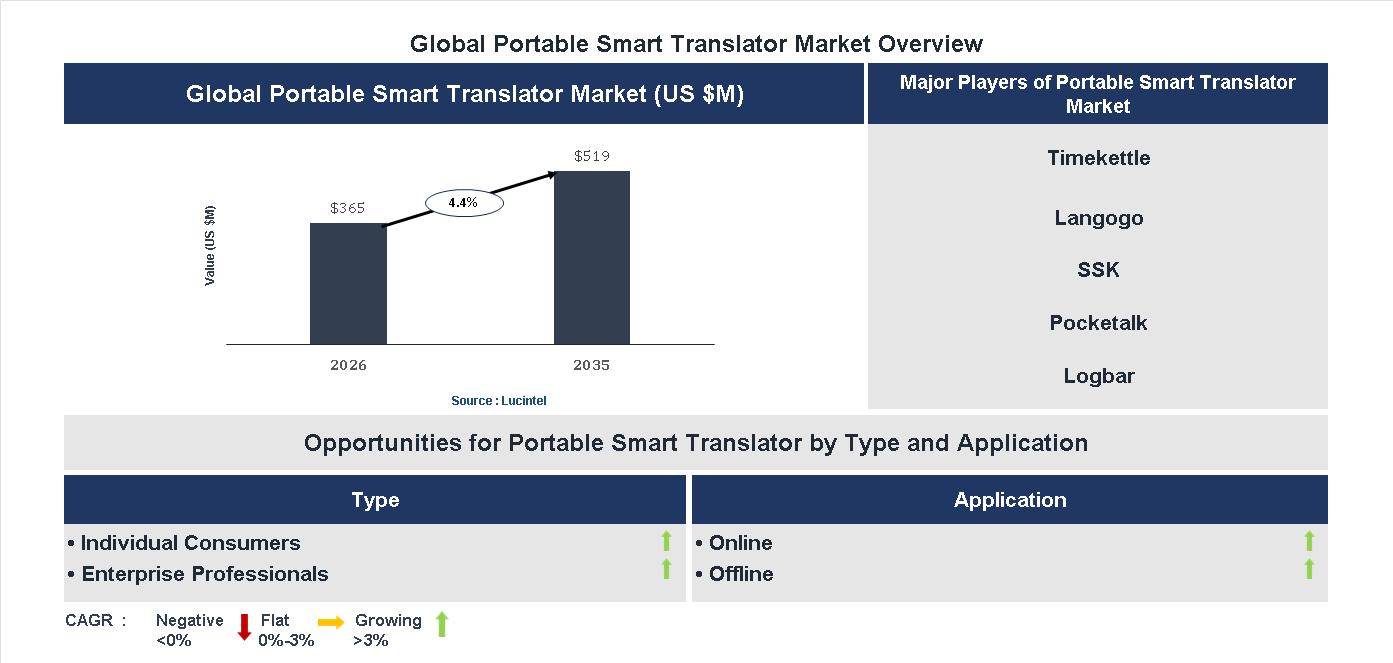
The future of the global portable smart translator market looks promising with opportunities in the online and offline markets. The global portable smart translator market is expected to reach an estimated $519 million by 2035 with a CAGR of 4.4% from 2026 to 2035. The major drivers for this market are the increasing need for real-time language translation, the rising demand for travel convenience tools, and the growing adoption of tech-enabled communication devices.• Lucintel forecasts that, within the type category, individual consumer is expected to witness higher growth over the forecast period.
• Within the application category, online is expected to witness higher growth.
• In terms of region, APAC is expected to witness the highest growth over the forecast period. Gain valuable insights for your business decisions with our comprehensive 150+ page report. Sample figures with some insights are shown below.
Emerging Trends in the Portable Smart Translator Market
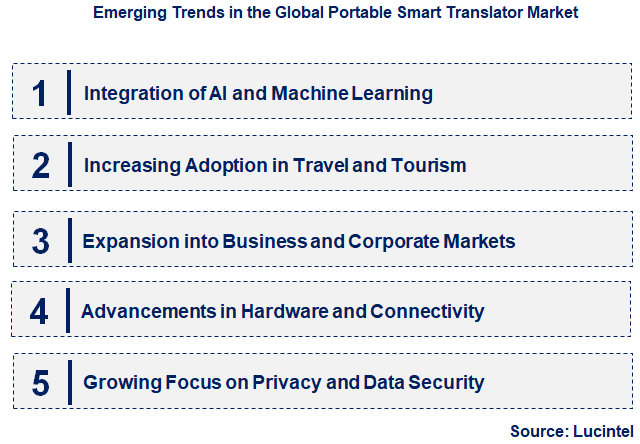
The portable smart translator market is experiencing rapid growth driven by advancements in artificial intelligence, increasing globalization, and the demand for seamless communication across language barriers. As technology becomes more accessible and affordable, consumers and businesses alike are seeking innovative solutions to facilitate real-time translation. This market is characterized by diverse applications, from travel and education to corporate communication, and is influenced by evolving consumer preferences and technological innovations. The following key trends highlight the major developments shaping this dynamic industry and their implications for future growth and market strategies.• Integration of AI and Machine Learning: The use of AI and machine learning algorithms enhances translation accuracy and contextual understanding. These technologies enable devices to learn from user interactions, improving over time and providing more natural, human-like translations. This trend boosts user confidence and broadens application scope, making smart translators more reliable for complex conversations and specialized terminology. As AI continues to evolve, we can expect even more sophisticated, intuitive translation solutions that adapt to various languages and dialects, significantly expanding market potential.
• Increasing Adoption in Travel and Tourism: Portable smart translators are becoming essential tools for travelers seeking to overcome language barriers. Their ease of use, compact design, and real-time translation capabilities improve travel experiences by facilitating communication with locals, navigating foreign environments, and accessing local services. This trend is driven by rising international travel and the need for instant, reliable translation tools. As tourism rebounds post-pandemic, the demand for portable translators is expected to grow, encouraging manufacturers to develop more user-friendly and multilingual devices tailored for travelers.
• Expansion into Business and Corporate Markets: Companies are adopting portable smart translators to enhance international communication, support global customer service, and facilitate cross-border collaborations. These devices help reduce language misunderstandings, improve efficiency, and foster better relationships with international clients. The trend is driven by globalization and the need for real-time, accurate translation in business settings. As organizations seek to streamline multilingual communication, the market for professional-grade portable translators is expanding, prompting innovations that cater to enterprise needs, including integration with other communication tools.
• Advancements in Hardware and Connectivity: Innovations in hardware, such as improved microphones, speakers, and battery life, are making portable translators more effective and durable. Enhanced connectivity options like 4G/5G and Wi-Fi enable seamless data transfer and real-time translation without lag. These improvements increase device reliability and usability in various environments, from remote areas to urban settings. As hardware continues to evolve, consumers benefit from faster, more accurate translations, and manufacturers can offer more feature-rich products, further driving market growth and competitiveness.
• Growing Focus on Privacy and Data Security: As translation devices handle sensitive information, there is an increasing emphasis on protecting user data. Manufacturers are implementing robust encryption, secure data storage, and privacy policies to address concerns about data breaches and misuse. This trend is critical for gaining consumer trust, especially in corporate and government applications. The focus on security not only enhances user confidence but also complies with evolving data protection regulations worldwide. As privacy concerns grow, companies that prioritize security features are likely to gain a competitive edge in the market. These trends are collectively transforming the portable smart translator market by making devices more intelligent, reliable, and secure. They are expanding applications across travel, business, and everyday communication, thereby reshaping how people and organizations overcome language barriers. As technological innovations continue and market demands evolve, the industry is poised for sustained growth and increased adoption worldwide.
Recent Development in the Portable Smart Translator Market
The portable smart translator market is experiencing rapid growth driven by increasing globalization, technological advancements, and the demand for real-time communication tools. Innovations in AI and machine learning are enhancing translation accuracy and user experience. The market is expanding across various sectors, including travel, business, and education, creating new opportunities for manufacturers and service providers. As consumers seek seamless multilingual interactions, companies are investing heavily in developing more efficient, portable translation devices to meet these evolving needs.• Growing Demand for Real-Time Communication: The rise in international travel and cross-border business has increased the need for instant translation devices. Consumers and professionals require quick, accurate translations to facilitate smooth communication, boosting market growth. Advances in AI enable these devices to understand context and slang, improving user experience. This demand is expected to continue rising, encouraging innovation and expanding market reach across different regions and sectors.
• Technological Advancements in AI and Machine Learning: Innovations in AI are significantly improving translation accuracy and contextual understanding. Machine learning algorithms enable devices to learn from interactions, enhancing performance over time. These advancements allow for more natural conversations and support multiple languages simultaneously. As technology evolves, portable translators are becoming more sophisticated, appealing to a broader consumer base and increasing adoption in various industries, including tourism, healthcare, and education.
• Expansion into New Geographic Markets: Emerging markets in Asia, Africa, and Latin America present substantial growth opportunities for portable smart translators. Increasing internet penetration and smartphone usage facilitate adoption. Localized language support and affordable pricing strategies are driving market penetration in these regions. Companies are tailoring products to meet specific linguistic and cultural needs, which enhances market competitiveness and accelerates global expansion.
• Integration with Other Devices and Platforms: Compatibility with smartphones, wearables, and smart home devices is enhancing the functionality of portable translators. Integration allows for seamless user experiences, such as voice commands and app-based controls, increasing convenience. This interconnectedness broadens the device’s utility, making it more attractive to consumers. As ecosystems develop, market players are focusing on creating versatile, multi-platform solutions to capture a larger share of the growing multilingual communication market.
• Increasing Adoption in Business and Education Sectors: Businesses and educational institutions are adopting portable translators to facilitate multilingual communication and learning. Companies use these devices for international meetings, customer support, and training, improving efficiency and customer satisfaction. Educational institutions incorporate them into language learning programs, enhancing student engagement. This sector-specific adoption is driving demand, encouraging manufacturers to develop specialized features, and expanding the market’s scope beyond individual consumers. These developments are transforming the portable smart translator market by enhancing device capabilities, expanding geographic reach, and integrating with other technologies. The increasing demand across sectors and regions is fueling innovation and competition. As a result, the market is poised for sustained growth, offering new opportunities for businesses and improving multilingual communication worldwide.
Strategic Growth Opportunities in the Portable Smart Translator Market
The portable smart translator market is experiencing rapid expansion driven by increasing globalization, technological advancements, and the demand for real-time language translation. Consumers and businesses seek seamless communication across diverse languages, fueling innovation in portable translation devices. Market growth is also supported by rising travel, international trade, and the need for instant, accurate language assistance. Companies are investing heavily in AI and machine learning to enhance translation accuracy and user experience, creating significant opportunities for market players to capture new customer segments and expand globally.• Growing Adoption of AI-Powered Translation Devices: The integration of artificial intelligence and machine learning in portable translators enhances translation accuracy, speed, and contextual understanding. This technological advancement attracts more users seeking reliable, real-time language solutions for travel, business, and education. As AI continues to evolve, the market will see increased demand for smarter, more intuitive devices capable of handling complex conversations and dialects, driving overall market growth.
• Expansion into Emerging Markets with Increasing Travel and Trade: Emerging economies with rising tourism and international trade present significant opportunities for portable smart translators. As travel becomes more accessible and cross-border business activities grow, demand for portable translation devices increases. Localized language support and affordable pricing strategies will enable market players to penetrate these regions, fostering global market expansion and capturing new customer bases.
• Integration of Portable Translators with Mobile and Wearable Devices: The convergence of portable translators with smartphones, smartwatches, and other wearable technology offers enhanced convenience and functionality. This integration allows users to access translation services seamlessly on devices they already carry, increasing adoption rates. It also enables real-time, on-the-go communication, making these devices more appealing for travelers, professionals, and students, thereby expanding market reach and user engagement.
• Rising Demand for Multilingual Support in Business and Education Sectors: Businesses operating internationally and educational institutions emphasizing multilingual communication are driving demand for portable translation solutions. These devices facilitate effective communication in meetings, conferences, and classrooms, reducing language barriers. As globalization intensifies, the need for versatile, portable translation tools that support multiple languages will grow, creating opportunities for market expansion into corporate and academic sectors.
• Development of Compact, User-Friendly, and Cost-Effective Devices: Consumer preference for easy-to-use, affordable translation devices fuels innovation in compact design and intuitive interfaces. Manufacturers focusing on affordability and simplicity will attract a broader customer base, including casual travelers and students. Cost-effective, portable devices with long battery life and multilingual capabilities will dominate the market, encouraging mass adoption and fostering competitive growth among industry players. These strategic growth opportunities are poised to significantly influence the portable smart translator market by enhancing technological capabilities, expanding into new regions, and addressing diverse user needs. As companies capitalize on AI integration, emerging markets, device connectivity, and affordability, the market will experience accelerated growth, increased competition, and broader adoption. Overall, these opportunities will shape a dynamic landscape, fostering innovation and global communication efficiency.
Portable Smart Translator Market Driver and Challenges
The portable smart translator market is influenced by a variety of technological, economic, and regulatory factors that shape its growth trajectory. Advances in artificial intelligence, machine learning, and speech recognition technologies have significantly enhanced translation accuracy and user experience. Economic factors such as increasing global travel and international business expansion drive demand for portable translation devices. Regulatory considerations, including data privacy laws and language standardization, also impact market development. Additionally, consumer preferences for compact, user-friendly devices and the integration of multilingual support further propel market expansion. However, challenges such as technological limitations, regulatory hurdles, and intense competition must be navigated to sustain growth in this dynamic industry. The factors responsible for driving the portable smart translator market include:• Technological Advancements: The rapid development of AI, speech recognition, and natural language processing technologies has revolutionized translation devices. These innovations enable real-time, highly accurate translations across multiple languages, enhancing user experience. As technology continues to evolve, devices become more intuitive, portable, and capable of supporting complex conversations, which broadens their application scope—from travel to business meetings. The integration of cloud computing and IoT connectivity further enhances device functionality, making portable smart translators more reliable and versatile. This ongoing technological progress is a key driver fueling market expansion and consumer adoption.
• Increasing Global Travel and Tourism: The rise in international travel and tourism has significantly increased demand for portable translation solutions. Travelers seek seamless communication tools to navigate foreign languages effortlessly, reducing language barriers and enhancing their experience. The proliferation of budget airlines and global tourism campaigns has expanded the customer base, especially among millennials and business travelers. Portable smart translators offer convenience, instant translation, and cultural immersion, making them essential travel accessories. As global mobility continues to grow, the market benefits from sustained demand driven by travelers seeking reliable, compact translation devices.
• Growing International Business and Remote Work: The globalization of business operations and the rise of remote work have created a substantial need for effective multilingual communication tools. Companies expanding into new markets require real-time translation to facilitate negotiations, customer support, and collaboration across language barriers. Portable smart translators enable professionals to communicate confidently in diverse linguistic environments without language constraints. This demand is further amplified by the increasing adoption of virtual meetings and cross-border partnerships. As international commerce intensifies, the market for portable translation devices is poised for significant growth, driven by the need for efficient, portable language solutions.
• Rising Adoption of AI and Machine Learning Technologies: The integration of AI and machine learning into portable translation devices has dramatically improved translation accuracy and contextual understanding. These technologies enable devices to learn from user interactions, adapt to specific dialects, and provide more natural translations. Enhanced voice recognition and contextual analysis reduce errors, making communication smoother. The continuous refinement of AI algorithms ensures that devices become smarter and more personalized over time. This technological sophistication attracts a broader consumer base, including professionals, students, and casual users, thereby fueling market growth and innovation.
• Increasing Smartphone Penetration and Connectivity: The widespread adoption of smartphones and high-speed internet has facilitated the integration of translation apps and portable devices. Consumers prefer multi-functional devices that combine translation capabilities with their existing smartphones, reducing the need for standalone gadgets. Cloud-based services enable real-time updates and multilingual support, making translation more accessible and efficient. The proliferation of 4G and 5G networks ensures seamless connectivity, allowing users to access translation services anytime, anywhere. This connectivity trend significantly expands the market reach and usability of portable smart translators, making them more appealing to a global audience. The challenges facing the portable smart translator market include:
• Technological Limitations and Accuracy Issues: Despite advancements, current translation technologies still face challenges in achieving perfect accuracy, especially with idiomatic expressions, slang, and contextual nuances. Misinterpretations can lead to communication breakdowns, reducing user trust and satisfaction. Additionally, hardware limitations such as battery life, processing power, and language database size can hinder device performance. Overcoming these technological constraints requires continuous innovation and investment, which can be costly. As a result, the market faces the challenge of balancing technological sophistication with affordability and reliability to meet diverse consumer needs.
• Regulatory and Data Privacy Concerns: The deployment of portable smart translators involves handling sensitive user data, raising privacy and security issues. Different countries have varying regulations regarding data collection, storage, and transmission, complicating global market expansion. Non-compliance can lead to legal penalties and damage to brand reputation. Moreover, users are increasingly concerned about their privacy, especially when devices record conversations or transmit data to cloud servers. Navigating complex regulatory landscapes and ensuring robust data protection measures are critical challenges that companies must address to sustain consumer trust and comply with international laws.
• Intense Market Competition and Price Pressures: The market is highly competitive, with numerous established technology giants and emerging startups vying for market share. This competition drives innovation but also leads to price wars, which can erode profit margins. Companies must continuously invest in R&D to differentiate their products through features, accuracy, and user experience. Additionally, rapid technological obsolescence can make devices outdated quickly, requiring frequent updates and new product launches. Managing competitive pressures while maintaining profitability and innovation is a significant challenge for market players aiming to capture and retain consumer interest. The portable smart translator market is driven by technological innovations, increasing global mobility, and the integration of AI, which collectively foster growth and consumer adoption. However, technological limitations, regulatory complexities, and fierce competition pose substantial challenges. Navigating these factors requires strategic investments in R&D, compliance, and differentiation. Overall, the markets future hinges on balancing technological progress with regulatory adherence and competitive positioning, ensuring sustainable growth in a rapidly evolving landscape.
List of Portable Smart Translator Companies
Companies in the market compete on the basis of product quality offered. Major players in this market focus on expanding their manufacturing facilities, R&D investments, infrastructural development, and leverage integration opportunities across the value chain. With these strategies portable smart translator companies cater increasing demand, ensure competitive effectiveness, develop innovative products & technologies, reduce production costs, and expand their customer base. Some of the portable smart translator companies profiled in this report include-• Timekettle
• Langogo
• SSK
• Pocketalk
• Logbar
• Ectaco
• Vasco Electronics
• Pulomi
• Lingo
• iFlytek
Portable Smart Translator Market by Segment
The study includes a forecast for the global portable smart translator market by type, application, and region.Portable Smart Translator Market by Type [Value from 2019 to 2035]:
• Individual Consumers
• Enterprise Professionals
Portable Smart Translator Market by Application [Value from 2019 to 2035]:
• Online
• Offline
Portable Smart Translator Market by Region [Value from 2019 to 2035]:
• North America
• Europe
• Asia Pacific
• The Rest of the World
Country Wise Outlook for the Portable Smart Translator Market
The portable smart translator market has experienced significant growth driven by advancements in artificial intelligence, increased global travel, and the demand for real-time language translation solutions. As technology becomes more accessible, countries are adopting innovative devices to facilitate communication across language barriers. This markets evolution reflects broader trends in digital transformation, consumer preferences for convenience, and the integration of smart devices into daily life. Key players are investing in improved accuracy, multilingual capabilities, and user-friendly interfaces to capture expanding markets. The following summaries highlight recent developments in the United States, China, Germany, India, and Japan, illustrating regional trends and innovations.• United States: The US market has seen rapid adoption of portable smart translators, driven by tech giants like Google and Apple, enhancing their translation apps. Startups are developing AI-powered devices with improved contextual understanding and voice recognition. There is a focus on integrating these devices with smart home systems and wearable technology, expanding their utility. Additionally, increased investment in R&D aims to improve translation accuracy and support for niche languages, catering to diverse user needs. The US also witnesses growing demand from travelers, businesses, and educational institutions seeking seamless communication tools.
• China: China has emerged as a major player in the portable smart translator market, with companies like iFlytek and Baidu launching innovative products. These devices emphasize multilingual support, including regional dialects, and incorporate advanced speech recognition technology. The Chinese market benefits from strong government backing for AI development, leading to rapid technological advancements. Domestic consumers favor affordable, feature-rich devices, prompting local brands to focus on cost-effective solutions. Additionally, integration with popular Chinese social media platforms and e-commerce channels has boosted sales and user engagement, making portable translators more accessible and widespread.
• Germany: In Germany, the market is characterized by a focus on high-quality, precision translation devices suitable for professional and industrial use. Companies like Siemens and Bosch are developing smart translators tailored for business meetings, conferences, and technical fields. There is an emphasis on data security and privacy, aligning with strict European regulations. German consumers also value durability and reliability, leading to innovations in rugged, portable devices capable of functioning in challenging environments. Collaborations with European language institutes are enhancing linguistic accuracy and cultural contextualization, making these devices essential for international business and diplomatic communication.
• India: The Indian market is witnessing rapid growth due to increasing smartphone penetration and a multilingual population. Local startups and global brands are launching affordable portable translators supporting multiple Indian languages and dialects. These devices are designed to address regional linguistic diversity, facilitating communication in rural and urban areas alike. The government’s push for digital literacy and AI adoption further accelerates market expansion. Additionally, partnerships with telecom providers and e-commerce platforms are making these devices more accessible. The focus remains on affordability, ease of use, and supporting local languages to cater to a broad demographic spectrum.
• Japan: Japan’s market emphasizes advanced technological integration and cultural nuances. Companies like Sony and Sharp are developing high-precision translators with features tailored for travelers, business professionals, and language learners. There is a strong focus on natural language processing and contextual understanding to improve conversational accuracy. The market also benefits from Japan’s technological innovation ecosystem, leading to the development of compact, stylish devices with long battery life. Additionally, collaborations with language education institutions are enhancing device capabilities for language learning and cultural exchange, making portable smart translators vital tools in Japan’s global communication landscape.

Features of the Global Portable Smart Translator Market
Market Size Estimates: Portable smart translator market size estimation in terms of value ($M). Trend and Forecast Analysis: Market trends (2019 to 2025) and forecast (2026 to 2035) by various segments and regions. Segmentation Analysis: Portable smart translator market size by type, application, and region in terms of value ($M). Regional Analysis: Portable smart translator market breakdown by North America, Europe, Asia Pacific, and Rest of the World. Growth Opportunities: Analysis of growth opportunities in different types, applications, and regions for the portable smart translator market. Strategic Analysis: This includes M&A, new product development, and competitive landscape of the portable smart translator market. Analysis of competitive intensity of the industry based on Porter’s Five Forces model.
FAQ
Q1. What is the portable smart translator market size? Answer: The global portable smart translator market is expected to reach an estimated $519 million by 2035. Q2. What is the growth forecast for portable smart translator market? Answer: The global portable smart translator market is expected to grow with a CAGR of 4.4% from 2026 to 2035. Q3. What are the major drivers influencing the growth of the portable smart translator market? Answer: The major drivers for this market are the increasing need for real-time language translation, the rising demand for travel convenience tools, and the growing adoption of tech-enabled communication devices. Q4. What are the major segments for portable smart translator market? Answer: The future of the portable smart translator market looks promising with opportunities in the online and offline markets. Q5. Who are the key portable smart translator market companies? Answer: Some of the key portable smart translator companies are as follows:• Timekettle
• Langogo
• SSK
• Pocketalk
• Logbar
• Ectaco
• Vasco Electronics
• Pulomi
• Lingo
• iFlytek Q6. Which portable smart translator market segment will be the largest in future? Answer: Lucintel forecasts that, within the type category, individual consumer is expected to witness higher growth over the forecast period. Q7. In portable smart translator market, which region is expected to be the largest in next 5 years? Answer: In terms of region, APAC is expected to witness the highest growth over the forecast period. Q8. Do we receive customization in this report? Answer: Yes, Lucintel provides 10% customization without any additional cost.
Table of Contents
List of Figures
List of Tables
Methodology
- In-depth interviews of the major players in this market
- Detailed secondary research from competitors’ financial statements and published data
- Extensive searches of published works, market, and database information pertaining to industry news, company press releases, and customer intentions
- A compilation of the experiences, judgments, and insights of Lucintel’s professionals, who have analyzed and tracked this market over the years.


Buy Now
Choose a license that fits your team. Instant PDF delivery.
Prices exclude taxes. Instant delivery. Custom licensing available on request.
Key Questions
- • What are some of the most promising, high-growth opportunities for the portable smart translator market by type (individual consumers and enterprise professionals), application (online and offline), and region (North America, Europe, Asia Pacific, and the Rest of the World)?
- • Which segments will grow at a faster pace and why?
- • Which region will grow at a faster pace and why?
- • What are the key factors affecting market dynamics? What are the key challenges and business risks in this market?
- • What are the business risks and competitive threats in this market?
- • What are the emerging trends in this market and the reasons behind them?
- • What are some of the changing demands of customers in the market?
- • What are the new developments in the market? Which companies are leading these developments?
- • Who are the major players in this market? What strategic initiatives are key players pursuing for business growth?
- • What are some of the competing products in this market and how big of a threat do they pose for loss of market share by material or product substitution?
- • What M&A activity has occurred in the last 7 years and what has its impact been on the industry? For any questions related to Portable Smart Translator Market, Portable Smart Translator Market Size, Portable Smart Translator Market Growth, Portable Smart Translator Market Analysis, Portable Smart Translator Market Report, Portable Smart Translator Market Share, Portable Smart Translator Market Trends, Portable Smart Translator Market Forecast, Portable Smart Translator Companies, write Lucintel analyst at email: helpdesk@lucintel.com. We will be glad to get back to you soon.


