
Report Feature
Portable Measurement Turbidimeter Market Trends and Forecast
The technologies in the portable measurement turbidimeter market have undergone significant changes in recent years, with a shift from traditional nephelometric turbidity measurement to more advanced techniques such as forward scattering, optical sensors, and digital signal processing (dsp). These advancements enable higher precision, faster readings, and more versatile applications, providing real-time turbidity monitoring for diverse industries like water treatment and food & beverage.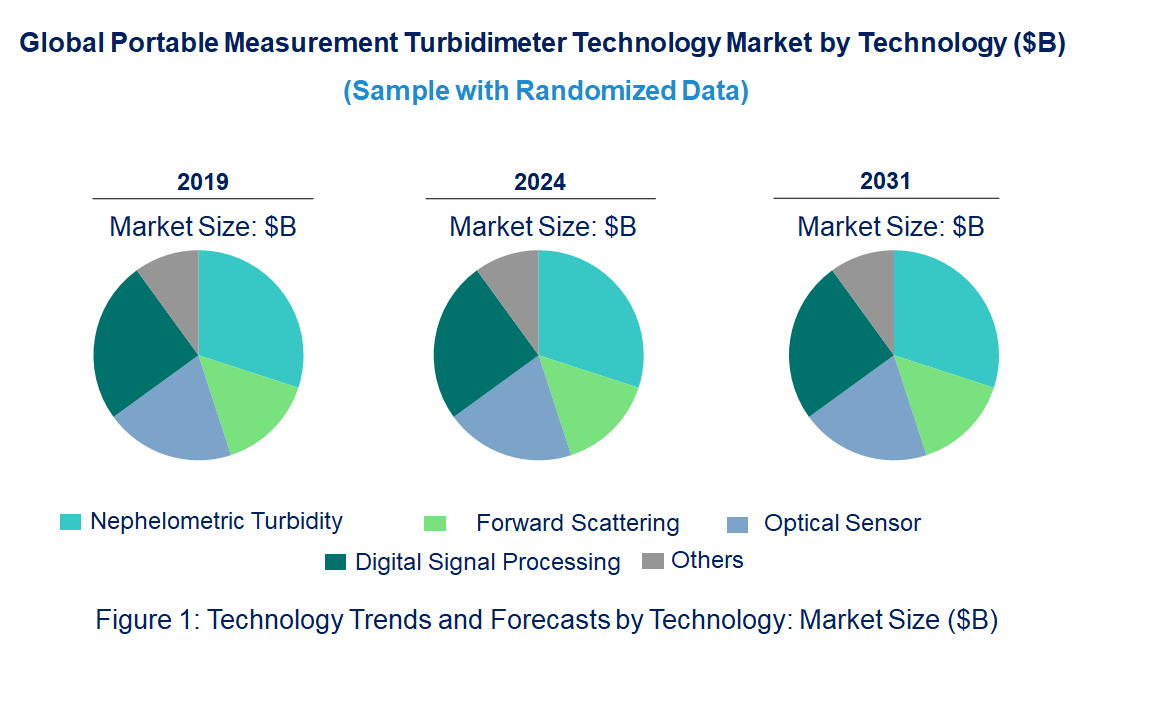
Emerging Trends in the Portable Measurement Turbidimeter Market
The portable measurement turbidimeter market is evolving with several emerging trends, shaping its future development.• Advancement in optical sensors: Optical sensors are increasingly being integrated into turbidimeters, offering enhanced accuracy and portability, making them ideal for real-time, field-based turbidity measurements.
• Growth in water treatment applications: As water quality monitoring becomes a priority globally, turbidimeters are being utilized more extensively in water treatment facilities to ensure compliance with safety standards.
• Integration with iot: The rise of iot-enabled turbidity sensors allows for remote monitoring and data collection, improving operational efficiency in industries like pharmaceuticals and food & beverage.
• Miniaturization of turbidimeter devices: Portable devices are becoming smaller and more compact, making them user-friendly and suitable for a variety of field applications.
• Rise in regulatory standards: With increasing regulations around water quality, especially in food and beverage industries, there is a growing demand for accurate turbidity measurement instruments that meet stringent quality standards. These trends are reshaping the market, pushing for more efficient, accurate, and adaptable turbidity measurement solutions.
Portable Measurement Turbidimeter Market : Industry Potential, Technological Development, and Compliance Considerations
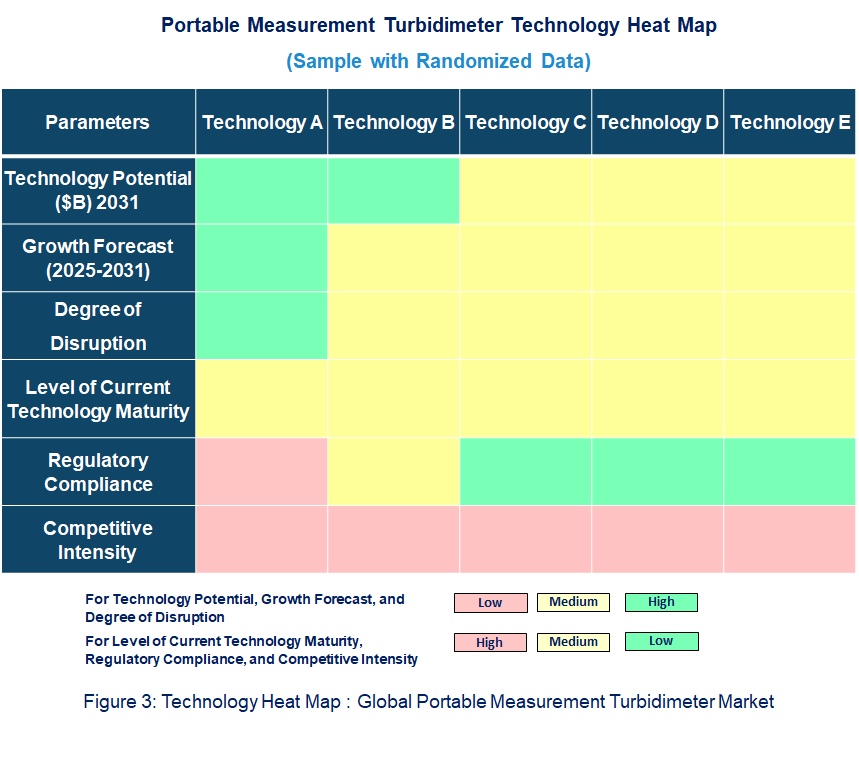
The portable measurement turbidimeter market has seen remarkable advancements in technology, offering more accurate and portable solutions for turbidity measurement in various industries such as water treatment, food & beverage, and pharmaceuticals.• Technology Potential: The potential of portable turbidimeters is significant, with improvements in technologies like nephelometric turbidity, forward scattering, optical sensors, and digital signal processing (DSP). These technologies enable real-time, on-site measurements with high accuracy, making them ideal for applications that require immediate results, such as water quality monitoring in environmental testing or real-time quality control in the food industry.
• Degree of Disruption: These advanced technologies disrupt traditional turbidity measurement techniques by providing more portable, user-friendly solutions that offer faster and more precise results. This reduces the reliance on stationary, laboratory-based systems, creating opportunities for on-site measurements in remote locations or during production processes. As a result, industries can make faster, data-driven decisions and streamline their operations.
• Level of Current Technology Maturity: The technology in the portable measurement turbidimeter market is highly mature, with commercial products widely available. However, ongoing research is focused on enhancing the sensitivity, connectivity (e.g., IoT integration), and miniaturization of devices, further increasing their application range.
• Regulatory Compliance: Regulatory compliance remains critical, particularly in industries like water treatment and food & beverage, which are governed by strict standards for quality control and environmental safety. Manufacturers must ensure that their portable turbidimeters meet these regulatory requirements, especially in regions with stringent environmental monitoring laws. In conclusion, the portable measurement turbidimeter market is poised for growth, driven by technological advancements and the increasing need for real-time, on-site turbidity measurement solutions across various industries.
Recent Technological development in Portable Measurement Turbidimeter Market by Key Players
Key players such as Thermo Fisher Scientific, Hanna Instruments, Xylem, Merck, and Hach have made notable advancements in the portable measurement turbidimeter market, contributing to its rapid evolution.• Thermo Fisher Scientific has improved its turbidity measurement solutions by integrating advanced optical sensors and enhancing user interfaces for more accurate, field-friendly measurements.
• Hanna Instruments has developed compact, portable turbidity meters with real-time connectivity and high-precision measurement capabilities, catering to both water treatment and food & beverage industries.
• Xylem has launched turbidimeters with integrated IoT functionality, offering remote monitoring, real-time data, and better operational insights for industries like water treatment.
• Merck continues to innovate with turbidity sensors focused on high accuracy, offering enhanced versatility in scientific and pharmaceutical applications.
• Hach focuses on digital turbidity meters with advanced DSP technology to provide precise and accurate measurements even in challenging field conditions. These advancements highlight the key developments that have shaped the market, ensuring that portable turbidimeters meet the increasing demands for accuracy, efficiency, and remote connectivity.
Portable Measurement Turbidimeter Market Driver and Challenges
The portable measurement turbidimeter market is driven by several factors, but also faces challenges that need to be addressed for further growth. The factors responsible for driving the portable measurement turbidimeter market are:• Rising demand for water quality monitoring: Increasing concerns over water contamination have led to a greater need for portable turbidimeters in water treatment.
• Regulatory compliance: Stringent regulations in industries like food & beverage and pharmaceuticals drive demand for accurate turbidity measurement solutions.
• Technological advancements: The development of more compact, accurate, and portable turbidimeters enhances user experience and broadens application areas.
• Global focus on environmental protection: The global emphasis on environmental sustainability promotes the use of turbidimeters to monitor pollution levels in water bodies. Challenges facing the global portable measurement turbidimeter market are:
• High initial cost: The advanced technology in portable turbidimeters may present a barrier for smaller organizations and developing markets.
• Calibration and maintenance: Regular calibration and maintenance requirements for high-precision devices can lead to additional operational costs.
• Complexity of advanced models: Some of the more advanced turbidity meters with integrated IoT and DSP technology may be challenging for non-technical users to operate effectively. In conclusion, the growth opportunities driven by technological innovation and regulatory pressures continue to fuel the portable measurement turbidimeter market, while overcoming challenges related to cost, maintenance, and usability will be key to ensuring continued success.
List of Portable Measurement Turbidimeter Companies
Companies in the market compete on the basis of product quality offered. Major players in this market focus on expanding their manufacturing facilities, R&D investments, infrastructural development, and leverage integration opportunities across the value chain. With these strategies portable measurement turbidimeter companies cater increasing demand, ensure competitive effectiveness, develop innovative products & technologies, reduce production costs, and expand their customer base. Some of the portable measurement turbidimeter companies profiled in this report includes.• Thermo Fisher Scientific
• Hanna Instruments
• Xylem
• Merck
• Hach
Portable Measurement Turbidimeter Market by Technology
• Technology Readiness by Technology Type: The intensity and regulatory compliance of portable turbidimeter technologies vary by type. Nephelometric turbidity is widely recognized for its reliability and is extensively used across industries, including water treatment, where regulatory standards are stringent. Forward scattering technology, while improving in sensitivity, is increasingly used in environmental and pharmaceutical applications, though it must meet evolving regulatory standards. Optical sensors are readily incorporated in portable devices, offering user-friendly solutions for various applications, but may face challenges in highly regulated sectors like food and beverage. Digital Signal Processing (DSP) technology is at a growing stage and offers enhanced processing capabilities, but its regulatory compliance remains under scrutiny in applications requiring precision. All technologies must contend with competition from both traditional methods and newer innovations, with a focus on improving measurement accuracy, portability, and regulatory adherence.
• Competitive Intensity and Regulatory Compliance: The portable measurement turbidimeter market is seeing growing competition from emerging and established technologies such as Nephelometric turbidity, forward scattering, optical sensors, and DSP. These technologies demonstrate varying levels of maturity. Nephelometric turbidity and forward scattering technologies are more established and widely used, while optical sensors are becoming increasingly prevalent for portable devices. DSP technology is still maturing, providing innovation in data processing. Regulatory compliance is crucial across all sectors, especially in applications like water treatment, where compliance with health and environmental standards is non-negotiable. Companies must meet both national and international standards to secure market share in these industries.
• Disruption Potential by Technology Type: Nephelometric turbidity, forward scattering, optical sensors, and DSP all have the potential to disrupt the portable turbidimeter market in different ways. Nephelometric turbidity offers high precision, disrupting traditional turbidity measurement methods by enabling fast, real-time measurements in the field. Forward scattering brings higher sensitivity for low-turbidity water, offering more accurate results in demanding applications such as environmental monitoring. Optical sensors, which are compact and portable, enable quicker, in-situ measurements, challenging older, more cumbersome systems. DSP technology enhances the speed and accuracy of turbidity readings, making it an attractive solution for industries requiring real-time, precise data. Collectively, these technologies drive innovation, enabling faster, more efficient turbidity monitoring that can transform sectors like water treatment, food & beverage, and pharmaceuticals.
Portable Measurement Turbidimeter Market Trend and Forecast by Technology [Value from 2019 to 2031]:
• Nephelometric Turbidity
• Forward Scattering
• Optical Sensor
• Digital Signal Processing (DSP)
• Others
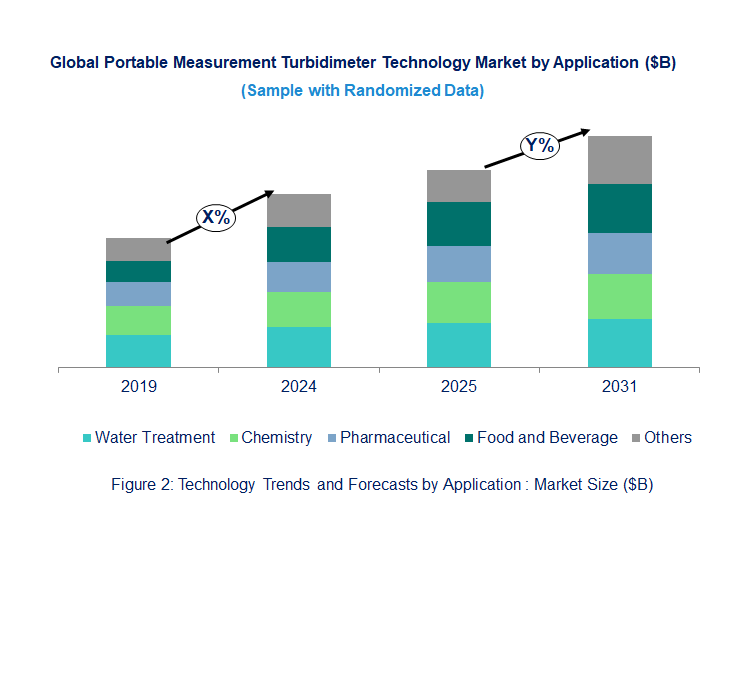
Portable Measurement Turbidimeter Market Trend and Forecast by Application [Value from 2019 to 2031]:
• Water Treatment
• Chemistry
• Pharmaceutical
• Food & Beverage
• Others
Portable Measurement Turbidimeter Market by Region [Value from 2019 to 2031]:
• North America
• Europe
• Asia Pacific
• The Rest of the World
• Latest Developments and Innovations in the Portable Measurement Turbidimeter Technologies
• Companies / Ecosystems
• Strategic Opportunities by Technology Type
Features of the Global Portable Measurement Turbidimeter Market
Market Size Estimates: Portable measurement turbidimeter market size estimation in terms of ($B). Trend and Forecast Analysis: Market trends (2019 to 2024) and forecast (2025 to 2031) by various segments and regions. Segmentation Analysis: Technology trends in the global portable measurement turbidimeter market size by various segments, such as application and technology in terms of value and volume shipments. Regional Analysis: Technology trends in the global portable measurement turbidimeter market breakdown by North America, Europe, Asia Pacific, and the Rest of the World. Growth Opportunities: Analysis of growth opportunities in different applications, technologies, and regions for technology trends in the global portable measurement turbidimeter market. Strategic Analysis: This includes M&A, new product development, and competitive landscape for technology trends in the global portable measurement turbidimeter market. Analysis of competitive intensity of the industry based on Porter’s Five Forces model.Table of Contents
Methodology
- In-depth interviews of the major players in this market
- Detailed secondary research from competitors’ financial statements and published data
- Extensive searches of published works, market, and database information pertaining to industry news, company press releases, and customer intentions
- A compilation of the experiences, judgments, and insights of Lucintel’s professionals, who have analyzed and tracked this market over the years.


Buy Now
Choose a license that fits your team. Instant PDF delivery.
Prices exclude taxes. Instant delivery. Custom licensing available on request.
Key Questions
- • What are some of the most promising potential, high-growth opportunities for the technology trends in the global portable measurement turbidimeter market by technology (nephelometric turbidity, forward scattering, optical sensor, digital signal processing (dsp), and others), application (water treatment, chemistry, pharmaceutical, food & beverage, and others), and region (North America, Europe, Asia Pacific, and the Rest of the World)?
- • Which technology segments will grow at a faster pace and why?
- • Which regions will grow at a faster pace and why?
- • What are the key factors affecting dynamics of different technology? What are the drivers and challenges of these technologies in the global portable measurement turbidimeter market?
- • What are the business risks and threats to the technology trends in the global portable measurement turbidimeter market?
- • What are the emerging trends in these technologies in the global portable measurement turbidimeter market and the reasons behind them?
- • Which technologies have potential of disruption in this market?
- • What are the new developments in the technology trends in the global portable measurement turbidimeter market? Which companies are leading these developments?
- • Who are the major players in technology trends in the global portable measurement turbidimeter market? What strategic initiatives are being implemented by key players for business growth?
- • What are strategic growth opportunities in this portable measurement turbidimeter technology space?
- • What M & A activities did take place in the last five years in technology trends in the global portable measurement turbidimeter market?


