
Report Feature
Portable Gas Detection Equipment Market Trends and Forecast
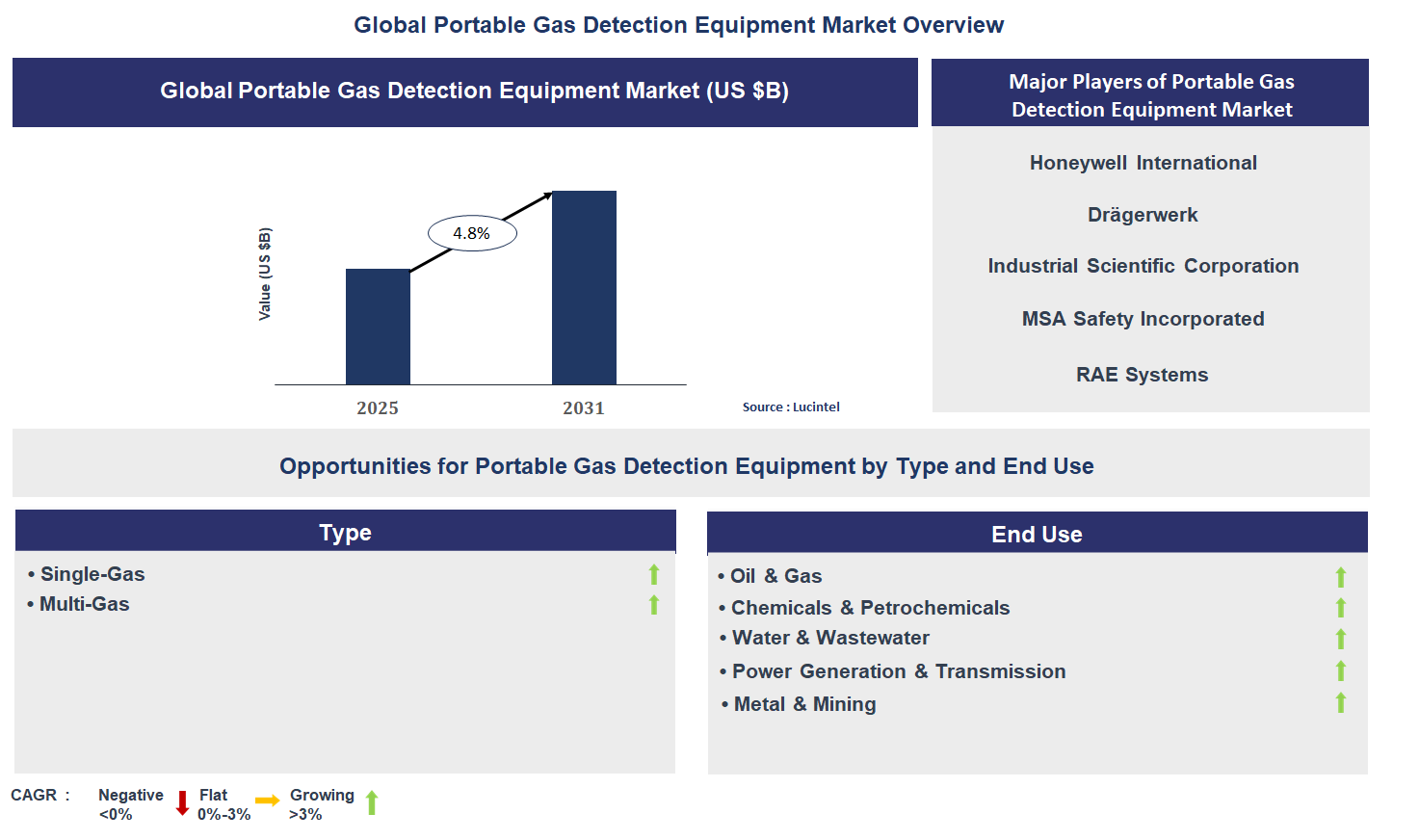
The future of the global portable gas detection equipment market looks promising with opportunities in the oil & gas, chemical & petrochemical, water & wastewater, power generation & transmission, and metal & mining markets. The global portable gas detection equipment market is expected to grow with a CAGR of 4.8% from 2025 to 2031. The major drivers for this market are the increasing focus on worker safety standards, the rising incidents of industrial gas leaks, and the growing demand from oil & gas sector.• Lucintel forecasts that, within the type category, multi-gas is expected to witness higher growth over the forecast period.
• Within the end use category, oil & gas is expected to witness the highest growth.
• In terms of region, APAC is expected to witness the highest growth over the forecast period. Gain valuable insights for your business decisions with our comprehensive 150+ page report. Sample figures with some insights are shown below.
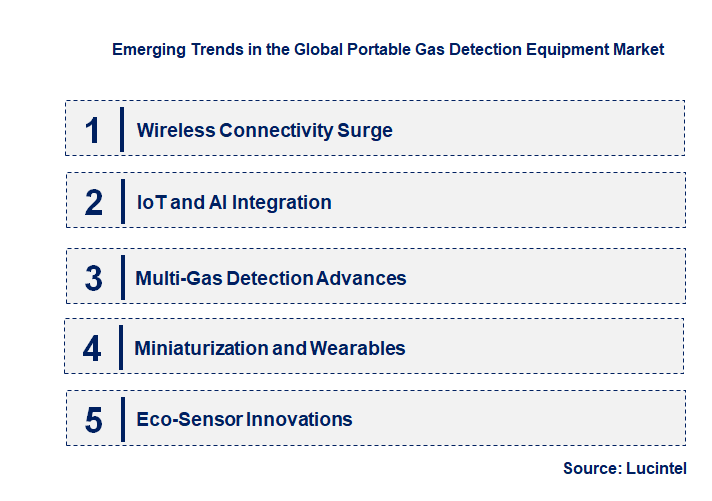
Emerging Trends in the Portable Gas Detection Equipment Market
Portable gas detection trends focus on smart integrations and sustainability amid industrial expansions, with IoT and AI leading for real-time hazard mitigation. Regulatory pressures amplify multi-gas capabilities, while miniaturization enables wearable solutions. These evolutions prioritize connectivity and eco-compliance for versatile safety ecosystems.• Wireless Connectivity Surge: Bluetooth and Wi-Fi enable remote data sharing, integrating with cloud platforms for centralized alerts. Deployed in mining, they facilitate quick evacuations. Impact enhances response times, reduces false alarms, and supports fleet management, driving efficiency in dynamic environments.
• IoT and AI Integration: Sensors with machine learning predict leaks via pattern analysis, optimizing maintenance in refineries. Trials show reduced downtime through proactive notifications. This trend elevates accuracy, enables predictive analytics, and aligns with Industry 4.0 for scalable safety.
• Multi-Gas Detection Advances: Devices monitor combustibles, toxics, and oxygen simultaneously, suiting chemical plants. Enhanced electrochemical sensors improve selectivity. Impact broadens applications, cuts equipment needs, and boosts compliance, fostering cost-effective hazard coverage.
• Miniaturization and Wearables: Compact designs with extended batteries fit harsh sites, like construction vests. Ergonomic builds aid mobility. This expands personal protection, improves user adoption, and integrates with PPE for seamless monitoring.
• Eco-Sensor Innovations: Low-power, biodegradable materials reduce environmental impact, meeting EU standards. Used in wastewater, they minimize waste. Impact attracts green investments, eases regulations, and supports sustainable ops in emerging markets. These trends reshape the portable gas detection equipment market by embedding intelligence and portability, transcending traditional monitoring. They mitigate risks, amplify industrial resilience, and unlock hybrid applications, positioning the sector for inclusive, tech-driven safety advancements.
Recent Development in the Portable Gas Detection Equipment Market
Portable gas detection developments highlight IoT launches and partnerships amid safety surges. Firms deploy multi-sensor units for upstream gains, tackling leaks with AI. These target compliance and portability, bridging industrial gaps.• MSA ALTAIR io 4 Launch: Connected multi-gas detector enables real-time fleet tracking via cloud. Rolled out for oilfields. Impact boosts worker safety, cuts response delays, and exemplifies scalable connectivity.
• Dräger X-am 5800 Debut: Six-gas portable with AI alerts for chemicals, integrating electrochemical tech. Deployed in Europe. This heightens precision, reduces exposures, and advances regulatory adherence.
• Metravi GD-09-6M Release: Pumping multi-detector uses hybrid circuits for mining. Launched in Asia. Impact optimizes confined-space ops, lowers costs, and supports infrastructure booms.
• Honeywell BW Max XT II Localization: Multi-gas unit produced for hazardous areas, with H2S focus. Expanded in North America. This ensures rapid deployment, enhances monitoring, and aids emission controls.
• Riken Keiki GX-Force Introduction: Four-gas unit for offshore, emphasizing explosion prevention. Targeted Japan. Impact fortifies seismic resilience, streamlines alerts, and diversifies energy safety. These developments impact the portable gas detection equipment market by fortifying smart features and reach. They yield efficiencies, meet standards, and innovate, making detection pivotal for resilient industries.
Strategic Growth Opportunities in the Portable Gas Detection Equipment Market
Portable gas detection opportunities span oil & gas to utilities, leveraging IoT for hazard mitigation. Emission rules and infrastructure booms unlock segments, with wearables enabling mobile scalability. These pathways yield adaptive, high-safety ecosystems.• Oil and Gas Monitoring: Multi-gas units detect H2S in rigs, backed by OSHA compliance. Partnerships scale offshore. Impact prevents blowouts, ensures extractions, and captures premium safety markets.
• Mining Hazard Detection: Wearables track methane in tunnels, optimizing ventilation. Subsidies spur adoptions. This boosts productivity, lowers incidents, and taps resource expansions.
• Construction Site Safety: Portable detectors for VOCs in urban builds, integrating apps. E-commerce aids access. Impact safeguards workers, meets building codes, and supports mega-projects.
• Chemical Plant Compliance: AI-enhanced sensors for toxics, aligning with EU norms. Trials expand uses. This streamlines processes, reduces fines, and fosters industrial growth.
• Water Treatment Applications: Units monitor chlorine leaks in facilities, with biogas ties. Policy incentives grow. Impact enhances purity, cuts environmental risks, and integrates renewables. These opportunities impact the portable gas detection equipment market by diversifying into high-risk niches. They spur R&D, collaborations, and investments, propelling compliant, versatile safety worldwide.
Portable Gas Detection Equipment Market Driver and Challenges
Portable gas detection dynamics interlace technological, economic, and regulatory forces, with safety mandates offsetting cost barriers. Drivers like IoT propel innovations, while maintenance hurdles challenge scalability. This balance steers toward efficient, compliant solutions. The factors responsible for driving the portable gas detection equipment market include: 1. Stringent Safety Regulations: OSHA and EU-OSHA enforce hazard monitoring, mandating detectors in high-risk sites. Policies spur upgrades. Implications accelerate adoptions, cut incidents, and align with global standards for worker protection. 2. Industrial Expansion Booms: Petrochemical and mining growth heightens leak risks, demanding portables. Urbanization amplifies needs. This stimulates volumes, creates jobs, and builds resilient supply networks. 3. Technological Sensor Advances: Electrochemical and infrared improvements boost sensitivity, enabling multi-gas units. AI integrations optimize. Implications lower false alarms, extend life, and enable diverse apps. 4. Workplace Hazard Awareness: Rising incidents fuel training and PPE integrations, favoring wearables. Campaigns educate. This drives demand, fosters innovations, and enhances compliance cultures. 5. Emission Control Mandates: Methane tracking under Paris goals promotes eco-detectors in energy. Incentives aid. Implications unlock green segments, reduce footprints, and attract ESG funds. Challenges in the portable gas detection equipment market are: 1. High Initial Costs: Advanced IoT units burden SMEs, limiting fleets. Tariffs add premiums. This slows penetrations, concentrates markets, and demands affordable alternatives. 2. Maintenance Demands: Calibration and sensor replacements strain ops, varying by region. Expertise gaps persist. This hikes long-term expenses, risks inaccuracies, and tests adoptions. 3. Sensor Lifespan Limits: Degradation in extremes shortens usability, needing frequent swaps. Tech variances complicate. This erodes reliability, inflates costs, and underscores R&D imperatives. These drivers and challenges synthesize a robust portable gas detection equipment market, where regulations eclipse barriers via ingenuity. Drivers lead, enabling safety-aligned expansions, while hurdles refine durable, cost-effective models for viability.List of Portable Gas Detection Equipment Companies
Companies in the market compete on the basis of product quality offered. Major players in this market focus on expanding their manufacturing facilities, R&D investments, infrastructural development, and leverage integration opportunities across the value chain. With these strategies portable gas detection equipment companies cater increasing demand, ensure competitive effectiveness, develop innovative products & technologies, reduce production costs, and expand their customer base. Some of the portable gas detection equipment companies profiled in this report include-• Honeywell International
• Drägerwerk
• Industrial Scientific Corporation
• MSA Safety Incorporated
• RAE Systems
• Crowcon Detection Instruments
• BW Technologies
• Siemens
• Tyco Gas & Flame Detection
• UEi Test Instruments
Portable Gas Detection Equipment Market by Segment
The study includes a forecast for the global portable gas detection equipment market by type, end use, and region.Portable Gas Detection Equipment Market by Type [Value from 2019 to 2031]:
• Single-Gas
• Multi-Gas
Portable Gas Detection Equipment Market by End Use [Value from 2019 to 2031]:
• Oil & Gas
• Chemicals & Petrochemicals
• Water & Wastewater
• Power Generation & Transmission
• Metal & Mining
Portable Gas Detection Equipment Market by Region [Value from 2019 to 2031]:
• North America
• Europe
• Asia Pacific
• The Rest of the World
Country Wise Outlook for the Portable Gas Detection Equipment Market
The portable gas detection equipment market is expanding with heightened workplace safety mandates and industrial growth, emphasizing wireless and multi-gas innovations. Advancements in IoT integration and miniaturization enhance real-time monitoring, addressing hazards in oil & gas, mining, and manufacturing. In key economies, regulatory compliance and R&D investments drive adoption, mitigating risks from gas leaks while fostering sustainable operations.• United States: Shale gas booms and OSHA regulations spur demand for wireless detectors, with MSA Safety launching ALTAIR io 4 for enhanced worker connectivity. GE Research‘s Compact Vapor Chemical Agent Detector advances wearable tech for first responders. These innovations reduce emissions via methane monitoring, boost efficiency in refineries, and align with EPA incentives for safer, greener industries.
• China: Rapid petrochemical expansions under dual-carbon goals accelerate indigenous sensor development, with Hanwei Electronics enhancing IoT-enabled multi-gas units for coal plants. Pilot programs mandate greenhouse monitoring in steel mills, cutting import reliance. This strengthens safety in high-risk sites, supports emission reductions, and positions China as a regional manufacturing leader.
• Germany: EU-OSHA standards propel Dräger‘s X-am 5800 multi-gas detector for chemical facilities, integrating AI for predictive alerts. Partnerships focus on bio-based sensors for automotive emissions. These advancements ensure compliance in precision engineering, lower downtime in North Sea ops, and promote eco-friendly monitoring for diversified energy sectors.
• India: ONGC‘s infrastructure pushes adopt Metravi‘s GD-09-6M pumping detector for oilfields, backed by Environment Protection Act. Urbanization fuels demand in construction, with subsidies aiding wireless units. This enhances rural safety, reduces leak incidents, and supports national hydrogen missions for cleaner industrial growth.
• Japan: Technological refinements by Riken Keiki‘s GX-Force four-gas unit target offshore fields, aligning with emission controls. IoT integrations aid seismic-resilient designs for utilities. These developments ensure supply stability, integrate with smart grids, and bolster precision manufacturing amid energy diversification.

Features of the Global Portable Gas Detection Equipment Market
Market Size Estimates: Portable gas detection equipment market size estimation in terms of value ($B). Trend and Forecast Analysis: Market trends (2019 to 2024) and forecast (2025 to 2031) by various segments and regions. Segmentation Analysis: Portable gas detection equipment market size by type, end use, and region in terms of value ($B). Regional Analysis: Portable gas detection equipment market breakdown by North America, Europe, Asia Pacific, and Rest of the World. Growth Opportunities: Analysis of growth opportunities in different type, end uses, and regions for the portable gas detection equipment market. Strategic Analysis: This includes M&A, new product development, and competitive landscape of the portable gas detection equipment market. Analysis of competitive intensity of the industry based on Porter’s Five Forces model.
FAQ
Q1. What is the growth forecast for portable gas detection equipment market? Answer: The global portable gas detection equipment market is expected to grow with a CAGR of 4.8% from 2025 to 2031. Q2. What are the major drivers influencing the growth of the portable gas detection equipment market? Answer: The major drivers for this market are the increasing focus on worker safety standards, the rising incidents of industrial gas leaks, and the growing demand from oil & gas sector. Q3. What are the major segments for portable gas detection equipment market? Answer: The future of the portable gas detection equipment market looks promising with opportunities in the oil & gas, chemical & petrochemical, water & wastewater, power generation & transmission, and metal & mining markets. Q4. Who are the key portable gas detection equipment market companies? Answer: Some of the key portable gas detection equipment companies are as follows:• Honeywell International
• Drägerwerk
• Industrial Scientific Corporation
• MSA Safety Incorporated
• RAE Systems
• Crowcon Detection Instruments
• BW Technologies
• Siemens
• Tyco Gas & Flame Detection
• UEi Test Instruments Q5. Which portable gas detection equipment market segment will be the largest in future? Answer: Lucintel forecasts that, within the type category, multi-gas is expected to witness higher growth over the forecast period. Q6. In portable gas detection equipment market, which region is expected to be the largest in next 5 years? Answer: In terms of region, APAC is expected to witness the highest growth over the forecast period. Q7. Do we receive customization in this report? Answer: Yes, Lucintel provides 10% customization without any additional cost.
Table of Contents
List of Figures
List of Tables
Methodology
- In-depth interviews of the major players in this market
- Detailed secondary research from competitors’ financial statements and published data
- Extensive searches of published works, market, and database information pertaining to industry news, company press releases, and customer intentions
- A compilation of the experiences, judgments, and insights of Lucintel’s professionals, who have analyzed and tracked this market over the years.


Buy Now
Choose a license that fits your team. Instant PDF delivery.
Prices exclude taxes. Instant delivery. Custom licensing available on request.
Key Questions
- • What are some of the most promising, high-growth opportunities for the portable gas detection equipment market by type (single-gas and multi-gas), end use (oil & gas, chemicals & petrochemicals, water & wastewater, power generation & transmission, and metal & mining), and region (North America, Europe, Asia Pacific, and the Rest of the World)?
- • Which segments will grow at a faster pace and why?
- • Which region will grow at a faster pace and why?
- • What are the key factors affecting market dynamics? What are the key challenges and business risks in this market?
- • What are the business risks and competitive threats in this market?
- • What are the emerging trends in this market and the reasons behind them?
- • What are some of the changing demands of customers in the market?
- • What are the new developments in the market? Which companies are leading these developments?
- • Who are the major players in this market? What strategic initiatives are key players pursuing for business growth?
- • What are some of the competing products in this market and how big of a threat do they pose for loss of market share by material or product substitution?
- • What M&A activity has occurred in the last 5 years and what has its impact been on the industry? For any questions related to Portable Gas Detection Equipment Market, Portable Gas Detection Equipment Market Size, Portable Gas Detection Equipment Market Growth, Portable Gas Detection Equipment Market Analysis, Portable Gas Detection Equipment Market Report, Portable Gas Detection Equipment Market Share, Portable Gas Detection Equipment Market Trends, Portable Gas Detection Equipment Market Forecast, Portable Gas Detection Equipment Companies, write Lucintel analyst at email: helpdesk@lucintel.com. We will be glad to get back to you soon.


