
Report Feature
Polyvinyl Alcohol Film Market Trends and Forecast
The future of the global polyvinyl alcohol film market looks promising with opportunities in the detergent packaging, agrochemical packaging, laundry bag, and embroidery markets. The global polyvinyl alcohol film market is expected to reach an estimated $2,602 million by 2035 with a CAGR of 4.7% from 2026 to 2035. The major drivers for this market are the growing use in food packaging applications, the increasing adoption of biodegradable packaging materials, and the rising demand for pharmaceutical packaging applications.• Lucintel forecasts that, within the type category, polarizer PVA film is expected to witness higher growth over the forecast period.
• Within the product type category, detergent packaging is expected to witness the highest growth.
• In terms of region, APAC is expected to witness the highest growth over the forecast period.
Gain valuable insights for your business decisions with our comprehensive 150+ page report. Sample figures with some insights are shown below.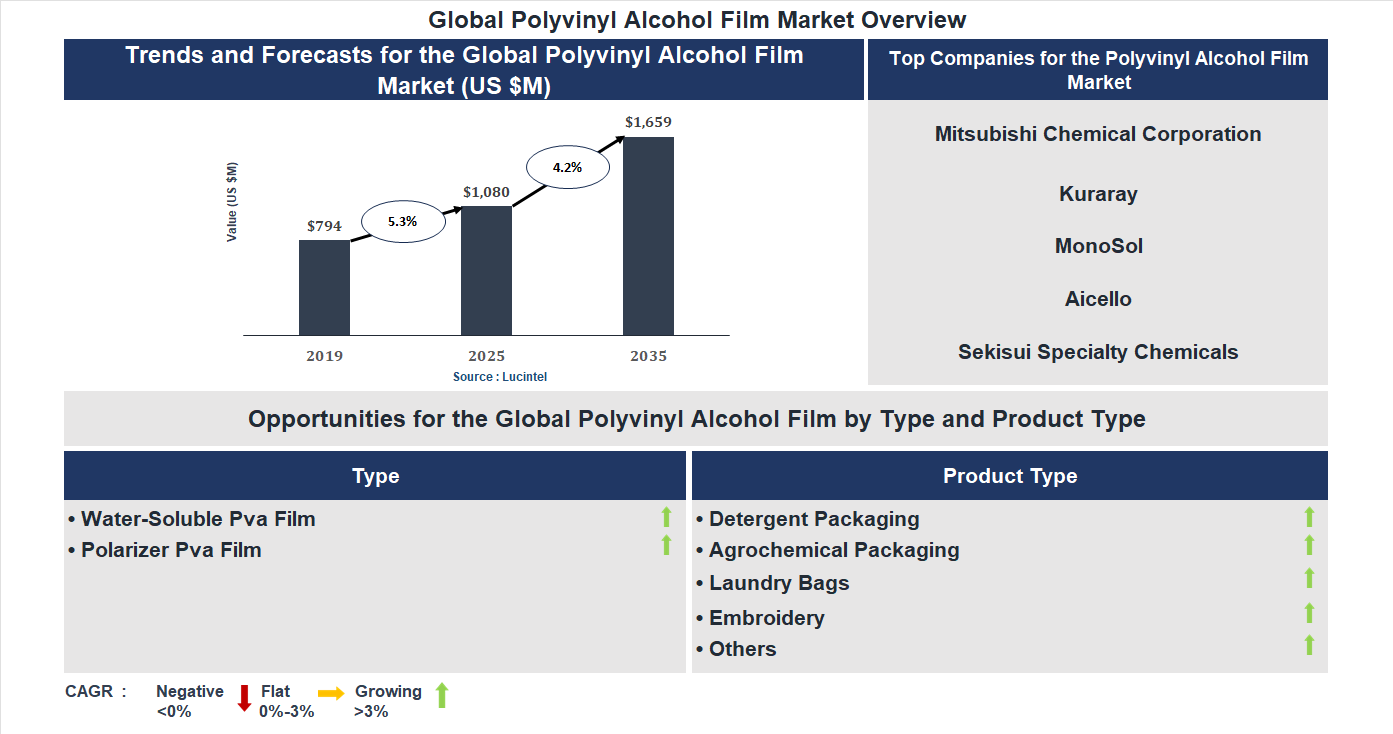
Emerging Trends in the Polyvinyl Alcohol Film Market
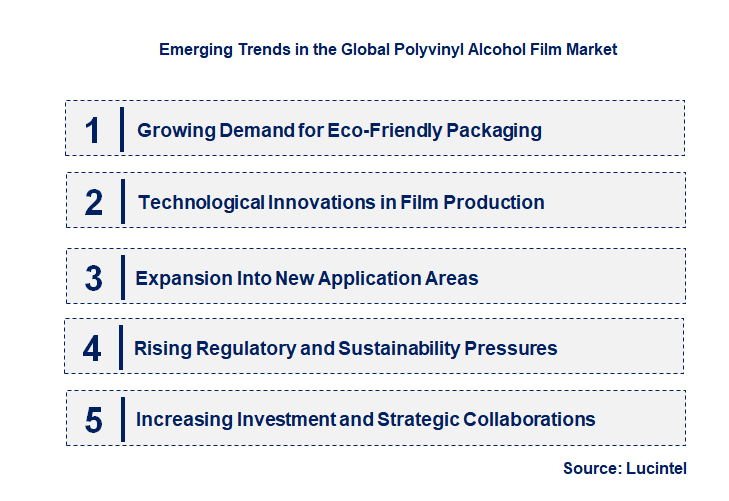
The polyvinyl alcohol film market is experiencing rapid evolution driven by technological advancements, changing consumer preferences, and environmental considerations. As industries seek sustainable and innovative packaging solutions, the market is adapting to meet these demands through new product developments and strategic collaborations. The increasing application of PVA films across various sectors such as packaging, agriculture, and electronics is fueling growth. Additionally, regulatory pressures for eco-friendly materials are prompting manufacturers to innovate. These developments are collectively reshaping the landscape, making the market more dynamic, sustainable, and competitive. Here are five key emerging trends shaping the PVA film market.• Growing Demand for Eco-Friendly Packaging: The shift towards sustainable packaging solutions is a major trend. Consumers and regulatory bodies are pushing for biodegradable and recyclable materials, prompting manufacturers to develop eco-friendly PVA films. These films offer excellent barrier properties and biodegradability, making them suitable for food packaging, medical applications, and more. This trend is driving innovation in PVA formulations to enhance environmental benefits while maintaining performance standards, ultimately reducing plastic waste and supporting circular economy initiatives.
• Technological Innovations in Film Production: Advances in manufacturing processes are enabling the production of high-quality, customizable PVA films. Techniques such as extrusion and coating are becoming more sophisticated, allowing for thinner, stronger, and more versatile films. These innovations improve the functional properties of PVA films, expanding their application scope. Enhanced production efficiency and cost-effectiveness are also key benefits, making PVA films more accessible to various industries and encouraging wider adoption.
• Expansion into New Application Areas: PVA films are increasingly being used beyond traditional packaging, including in agriculture for seed coatings, in electronics for flexible displays, and in medical devices for drug delivery. This diversification is driven by the unique properties of PVA, such as transparency, flexibility, and biocompatibility. The expansion into these sectors opens new revenue streams for manufacturers and accelerates market growth, while also fostering cross-industry innovation and collaboration.
• Rising Regulatory and Sustainability Pressures: Governments and industry bodies are implementing stricter regulations on single-use plastics and promoting sustainable materials. This regulatory environment incentivizes companies to develop biodegradable PVA films that comply with environmental standards. Sustainability pressures are also encouraging transparency in supply chains and product lifecycle management. These factors are compelling manufacturers to innovate rapidly and align their strategies with global sustainability goals, influencing product development and market positioning.
• Increasing Investment and Strategic Collaborations: The market is witnessing heightened investments from both established players and startups aiming to capitalize on emerging opportunities. Strategic collaborations, joint ventures, and partnerships are facilitating technology transfer and market expansion. Investment in R&D is focused on improving film properties and sustainability features. This trend enhances competitive dynamics, accelerates innovation, and helps companies establish a stronger foothold in the evolving PVA film landscape.
These trends are collectively transforming the polyvinyl alcohol film market by fostering innovation, expanding application horizons, and emphasizing sustainability. They are driving the industry toward more environmentally responsible, technologically advanced, and versatile solutions, ultimately reshaping the competitive landscape and market growth trajectory.
Recent Developments in the Polyvinyl Alcohol Film Market
The polyvinyl alcohol film market is experiencing rapid growth driven by technological advancements, increasing demand across various industries, and environmental considerations. Innovations in film manufacturing and expanding applications are creating new opportunities for market players. As industries seek sustainable and high-performance materials, PVA films are becoming essential in packaging, electronics, and medical sectors. These developments are shaping the future landscape of the market, offering significant potential for growth and diversification.• Growing Demand in Packaging Industry: The increasing need for eco-friendly, durable, and transparent packaging solutions is boosting the adoption of PVA films. Their biodegradability and moisture resistance make them ideal for food packaging, reducing environmental impact. This trend is driven by consumer preferences for sustainable products and stricter regulations on plastic waste. As a result, manufacturers are investing in innovative PVA film formulations, expanding market reach and creating new revenue streams.
• Advancements in Biodegradable Film Technology: Recent innovations have enhanced the biodegradability of PVA films, aligning with global sustainability goals. These eco-friendly films are now used in agriculture, packaging, and medical applications, reducing plastic pollution. The development of water-soluble and compostable PVA films has opened new markets, especially in regions with strict environmental regulations. This technological progress is expected to accelerate market growth and attract environmentally conscious consumers and industries.
• Expansion in Electronics and Electrical Applications: PVA films are increasingly used in electronics for insulation, flexible displays, and packaging of electronic components. Their excellent film-forming properties, chemical resistance, and flexibility make them suitable for high-tech applications. As the electronics industry grows rapidly, demand for specialized PVA films is rising, driving innovation in film properties. This expansion is expected to boost market revenues and foster collaborations between material scientists and electronics manufacturers.
• Rising Use in Medical and Pharmaceutical Sectors: The biocompatibility and water solubility of PVA films make them ideal for medical applications such as drug delivery systems, wound dressings, and surgical films. The COVID-19 pandemic further accelerated demand for medical-grade films, highlighting their importance in healthcare. Ongoing research into functionalized PVA films for targeted drug release and tissue engineering is expanding their application scope. This growth is anticipated to significantly influence the market, attracting investments and fostering innovation.
• Increasing Focus on Sustainable and Recyclable Materials: Environmental concerns are prompting industries to adopt recyclable and sustainable materials, boosting the demand for PVA films. Their ability to be recycled and biodegraded aligns with circular economy principles. Governments and regulatory bodies are encouraging the use of such materials, leading to increased R&D investments. This focus is fostering the development of high-performance, eco-friendly PVA films, which are expected to dominate future markets and influence industry standards.
The overall impact of these developments is a dynamic, expanding market characterized by innovation, sustainability, and diversified applications. These opportunities are driving growth, attracting investments, and fostering technological advancements, ultimately shaping a more sustainable and high-performance future for the polyvinyl alcohol film market.
Strategic Growth Opportunities in the Polyvinyl Alcohol Film Market
The polyvinyl alcohol film market is experiencing significant growth driven by increasing demand across various industries such as packaging, textiles, and electronics. Innovations in biodegradable and eco-friendly materials are expanding application scopes. Rising environmental concerns and stringent regulations are encouraging manufacturers to develop sustainable solutions. Additionally, technological advancements in film manufacturing processes are enhancing product quality and performance. These factors collectively create substantial opportunities for market expansion, attracting investments and fostering competitive innovation in the PVA film industry.• Growing Demand for Eco-Friendly Packaging Solutions: The shift towards sustainable packaging is boosting the adoption of biodegradable PVA films, which are non-toxic and environmentally safe. Industries such as food, pharmaceuticals, and consumer goods are increasingly replacing traditional plastics with PVA films due to their excellent barrier properties and biodegradability. This trend is driven by consumer awareness, regulatory pressures, and corporate sustainability commitments, creating a lucrative opportunity for manufacturers to develop innovative, eco-conscious PVA film products.
• Expansion of PVA Films in the Electronics Industry: PVA films are increasingly used in electronics for applications like flexible displays, circuit boards, and insulation materials due to their excellent film-forming and adhesive properties. The rising demand for lightweight, flexible, and durable electronic components is fueling this growth. Advancements in PVA film formulations are enabling better performance in electronic applications, opening new avenues for market players to cater to the expanding electronics sector, especially in wearable devices and smart gadgets.
• Increasing Use of PVA Films in Textile and Paper Industries: The textile industry utilizes PVA films for coating and finishing fabrics, enhancing durability and water resistance. Similarly, in the paper industry, PVA films are used for lamination and surface treatments to improve strength and printability. The demand for high-performance, water-soluble, and biodegradable films in these sectors is rising, driven by sustainability initiatives and product innovation. This creates opportunities for manufacturers to develop specialized PVA films tailored for textile and paper applications.
• Technological Advancements Improving Film Properties and Applications: Innovations in manufacturing processes, such as extrusion and casting techniques, are enhancing the quality, clarity, and barrier properties of PVA films. These advancements enable the development of customized films with specific functionalities like UV resistance, heat stability, and improved mechanical strength. Such technological progress broadens the application scope of PVA films across various industries, encouraging market growth and enabling companies to meet diverse customer requirements more effectively.
• Rising Investments in Research and Development for Sustainable PVA Solutions: Increased R&D efforts are focused on creating biodegradable, water-soluble, and environmentally friendly PVA films. These innovations aim to reduce reliance on conventional plastics and address environmental concerns. Governments and private sectors are investing heavily in sustainable material development, fostering new product launches and process improvements. This trend is expected to accelerate market growth, promote eco-conscious manufacturing practices, and expand the application landscape of PVA films globally.
The overall market outlook is positively influenced by these growth opportunities, which collectively drive innovation, sustainability, and application diversification. As industries increasingly prioritize eco-friendly and high-performance materials, the PVA film market is poised for substantial expansion, attracting investments and fostering competitive advancements that will shape its future trajectory.
Polyvinyl Alcohol Film Market Driver and Challenges
The polyvinyl alcohol film market is influenced by a variety of technological, economic, and regulatory factors that shape its growth trajectory. Advances in manufacturing processes and material innovations drive demand for high-quality, sustainable films. Economic conditions, including industrial expansion and consumer preferences, also play a significant role. Additionally, regulatory frameworks concerning environmental standards and safety regulations impact market dynamics. Navigating these drivers and challenges is essential for stakeholders aiming to capitalize on emerging opportunities while addressing potential barriers. Understanding these factors provides a comprehensive view of the market’s current landscape and future potential.The factors responsible for driving the polyvinyl alcohol film market include:-
• Technological Innovation: The development of advanced manufacturing techniques has led to the production of high-performance PVA films with enhanced properties such as biodegradability, strength, and clarity. These innovations meet increasing consumer demand for sustainable packaging solutions and specialized industrial applications. As technology continues to evolve, manufacturers can produce films with tailored functionalities, expanding their application scope across food packaging, textiles, and electronics. This ongoing innovation not only boosts market growth but also helps companies stay competitive in a rapidly changing environment.
• Growing Demand for Sustainable Packaging: Increasing environmental awareness and stringent regulations are pushing industries toward eco-friendly packaging options. PVA films are biodegradable and water-soluble, making them attractive alternatives to traditional plastics. The food and beverage sector, in particular, is adopting PVA films for packaging due to their safety and eco-friendly nature. This shift is supported by consumer preferences for sustainable products, which encourages manufacturers to invest in PVA film development. As sustainability becomes a key purchasing criterion, the market is poised for significant expansion driven by this demand.
• Expansion in End-Use Industries: The rising use of PVA films across various sectors such as food packaging, textiles, paper coatings, and electronics is a major growth driver. In food packaging, PVA films provide excellent barrier properties and safety, making them ideal for moisture-sensitive products. In textiles, they are used for coating and finishing, enhancing durability and appearance. The electronics industry utilizes PVA films for insulation and protective layers. The diversification of applications across these industries fuels market growth, as companies seek versatile, high-performance materials to meet evolving industry standards and consumer needs.
• Regulatory Support and Environmental Policies: Governments worldwide are implementing policies to reduce plastic waste and promote sustainable materials. Regulations favoring biodegradable and water-soluble films create a conducive environment for PVA film adoption. Incentives, subsidies, and stricter bans on conventional plastics encourage industries to switch to eco-friendly alternatives. These regulatory measures not only stimulate market growth but also ensure compliance with environmental standards, fostering innovation and investment in PVA film technologies. As policies become more stringent, the market is expected to benefit from increased demand driven by regulatory compliance.
• Technological Advancements in Water Solubility and Biodegradability: Innovations aimed at improving the water solubility and biodegradability of PVA films are critical drivers. Enhanced water solubility allows for easier disposal and cleaning, making these films suitable for applications like laundry pods and agricultural films. Improved biodegradability ensures minimal environmental impact, aligning with global sustainability goals. These advancements expand the application scope and appeal to environmentally conscious consumers and industries. As research continues, the market will likely see the introduction of more efficient, eco-friendly PVA films, further fueling growth and adoption.
The challenges facing this Market include:-
• High Production Costs: The manufacturing of high-quality PVA films involves complex processes and expensive raw materials, which contribute to elevated production costs. These costs can hinder market penetration, especially in price-sensitive regions or industries. Additionally, the need for specialized equipment and energy-intensive processes increases operational expenses. As a result, manufacturers may face difficulties in offering competitive pricing, limiting market expansion and adoption in cost-conscious sectors. Overcoming these cost barriers requires technological improvements and economies of scale, which may take time to realize.
• Environmental Concerns and Disposal Issues: Despite their biodegradability, PVA films pose disposal challenges due to their water solubility and potential environmental impact if not properly managed. Improper disposal can lead to water pollution and ecological disturbances. Additionally, the degradation process may release substances that could affect aquatic life. Regulatory scrutiny regarding environmental safety and waste management practices adds complexity to market growth. Developing effective disposal and recycling methods is essential to mitigate these concerns and ensure sustainable market development.
• Limited Awareness and Market Penetration: Lack of awareness about the benefits and applications of PVA films restricts their adoption across various industries. Many potential users remain unfamiliar with the environmental advantages and performance capabilities of these films, leading to slow market penetration. Additionally, resistance from established plastic manufacturers and the dominance of traditional materials pose barriers to entry. Overcoming these challenges requires targeted marketing, education, and demonstration of the economic and environmental benefits of PVA films to accelerate adoption and expand market reach.
The polyvinyl alcohol film market is shaped by significant technological advancements, increasing demand for sustainable packaging, expanding industrial applications, supportive regulatory frameworks, and ongoing innovations in eco-friendly materials. However, high production costs, disposal concerns, and limited awareness present notable challenges. These drivers and obstacles collectively influence the market’s growth trajectory, requiring stakeholders to innovate, educate, and adapt to evolving environmental and economic landscapes. The market’s future will depend on balancing technological progress with sustainable practices and strategic market development efforts.
List of Polyvinyl Alcohol Film Companies
Companies in the market compete on the basis of product quality offered. Major players in this market focus on expanding their manufacturing facilities, R&D investments, infrastructural development, and leverage integration opportunities across the value chain. With these strategies polyvinyl alcohol film companies cater increasing demand, ensure competitive effectiveness, develop innovative products & technologies, reduce production costs, and expand their customer base. Some of the polyvinyl alcohol film companies profiled in this report include-• Mitsubishi Chemical Corporation
• Kuraray
• MonoSol
• Aicello
• Sekisui Specialty Chemicals
Polyvinyl Alcohol Film Market by Segment
The study includes a forecast for the global polyvinyl alcohol film market by type, product type, and region.Polyvinyl Alcohol Film Market by Type [Value from 2019 to 2035]:
• Water-Soluble Pva Film
• Polarizer Pva Film
Polyvinyl Alcohol Film Market by Product Type [Value from 2019 to 2035]:
• Detergent Packaging
• Agrochemical Packaging
• Laundry Bags
• Embroidery
• Others
Polyvinyl Alcohol Film Market by Region [Value from 2019 to 2035]:
• North America
• Europe
• Asia Pacific
• The Rest of the World
Country Wise Outlook for the Polyvinyl Alcohol Film Market
The polyvinyl alcohol film market has experienced significant growth driven by increasing demand across packaging, medical, and industrial sectors. Technological advancements, sustainability initiatives, and expanding applications have shaped recent developments in key regions. Countries are focusing on innovation, regulatory compliance, and eco-friendly solutions to stay competitive. The market‘s evolution reflects broader trends toward sustainable materials and high-performance films, with regional variations influenced by economic growth, industrialization, and environmental policies. Understanding these regional dynamics is crucial for stakeholders aiming to capitalize on emerging opportunities and address challenges in the global PVA film landscape.• United States: The U.S. market has seen increased adoption of biodegradable PVA films, driven by stringent environmental regulations and consumer demand for sustainable packaging. Innovations in film formulations have improved barrier properties and flexibility, expanding applications in food packaging and medical industries. Major players are investing in R&D to develop eco-friendly solutions, while regulatory agencies promote recycling and waste reduction initiatives. The growth is also supported by the expanding healthcare sector, which utilizes PVA films for drug delivery and medical packaging. Overall, the U.S. market is characterized by technological advancements and a focus on sustainability.
• China: China remains the largest producer and consumer of PVA films, with rapid industrialization fueling demand across packaging, textiles, and electronics sectors. Recent developments include the adoption of environmentally friendly manufacturing processes and increased investment in high-performance, biodegradable PVA films. The government’s emphasis on environmental protection has led to stricter regulations, encouraging companies to innovate and adopt sustainable practices. Domestic companies are expanding their product portfolios to include specialty films for medical and industrial applications. The market growth is also driven by rising exports and the increasing integration of advanced manufacturing technologies.
• Germany: Germany’s PVA film market is marked by a focus on high-quality, innovative products tailored for industrial and medical applications. The country emphasizes sustainable production methods, with many companies adopting eco-friendly raw materials and energy-efficient processes. Recent developments include the integration of nanotechnology to enhance film properties and the development of biodegradable variants to meet EU environmental standards. Germany’s strong industrial base and emphasis on research and development foster continuous innovation. The market benefits from robust healthcare and packaging sectors, with increasing demand for environmentally sustainable solutions and high-performance films.
• India: The Indian PVA film market is experiencing rapid growth due to expanding packaging, textile, and medical sectors. Recent developments include the adoption of cost-effective manufacturing techniques and the development of biodegradable PVA films to address environmental concerns. Government initiatives promoting sustainable packaging and healthcare infrastructure are boosting demand. Local manufacturers are investing in R&D to improve film quality and diversify product offerings. The market is also benefiting from rising exports and foreign investments. As awareness of eco-friendly materials increases, Indian companies are focusing on developing sustainable, high-performance PVA films to meet domestic and international needs.
• Japan: Japan’s PVA film market is characterized by technological innovation and a strong focus on environmental sustainability. Recent developments include the creation of ultra-thin, high-strength films for electronics and packaging applications. Japanese firms are investing in research to develop biodegradable and recyclable PVA films, aligning with national environmental policies. The market benefits from advanced manufacturing capabilities and a well-established healthcare sector utilizing PVA films for medical devices and drug delivery systems. Additionally, collaborations between industry and academia are fostering innovation. Overall, Japan’s market emphasizes high quality, sustainability, and technological advancement to maintain its competitive edge.

Features of the Global Polyvinyl Alcohol Film Market
Market Size Estimates: Polyvinyl alcohol film market size estimation in terms of value ($M).Trend and Forecast Analysis: Market trends (2019 to 2025) and forecast (2026 to 2035) by various segments and regions.
Segmentation Analysis: Polyvinyl alcohol film market size by type, product type, and region in terms of value ($M).
Regional Analysis: Polyvinyl alcohol film market breakdown by North America, Europe, Asia Pacific, and Rest of the World.
Growth Opportunities: Analysis of growth opportunities in different type, product type, and regions for the polyvinyl alcohol film market.
Strategic Analysis: This includes M&A, new product development, and competitive landscape of the polyvinyl alcohol film market.
Analysis of competitive intensity of the industry based on Porter’s Five Forces model.

FAQ
Q1. What is the polyvinyl alcohol film market size?Answer: The global polyvinyl alcohol film market is expected to reach an estimated $2,602 million by 2035.
Q2. What is the growth forecast for polyvinyl alcohol film market?
Answer: The global polyvinyl alcohol film market is expected to grow with a CAGR of 4.7% from 2026 to 2035.
Q3. What are the major drivers influencing the growth of the polyvinyl alcohol film market?
Answer: The major drivers for this market are the growing use in food packaging applications, the increasing adoption of biodegradable packaging materials, and the rising demand for pharmaceutical packaging applications.
Q4. What are the major segments for polyvinyl alcohol film market?
Answer: The future of the polyvinyl alcohol film market looks promising with opportunities in the detergent packaging, agrochemical packaging, laundry bag, and embroidery markets.
Q5. Who are the key polyvinyl alcohol film market companies?
Answer: Some of the key polyvinyl alcohol film companies are as follows:
• Mitsubishi Chemical Corporation
• Kuraray
• MonoSol
• Aicello
• Sekisui Specialty Chemicals
Q6. Which polyvinyl alcohol film market segment will be the largest in future?Answer: Lucintel forecasts that, within the type category, polarizer PVA film is expected to witness higher growth over the forecast period.
Q7. In polyvinyl alcohol film market, which region is expected to be the largest in next 8 years?
Answer: In terms of region, APAC is expected to witness the highest growth over the forecast period.
Q8. Do we receive customization in this report?
Answer: Yes, Lucintel provides 10% customization without any additional cost.
Table of Contents
List of Figures
List of Tables
Methodology
- In-depth interviews of the major players in this market
- Detailed secondary research from competitors’ financial statements and published data
- Extensive searches of published works, market, and database information pertaining to industry news, company press releases, and customer intentions
- A compilation of the experiences, judgments, and insights of Lucintel’s professionals, who have analyzed and tracked this market over the years.


Buy Now
Choose a license that fits your team. Instant PDF delivery.
Prices exclude taxes. Instant delivery. Custom licensing available on request.
Key Questions
- • What are some of the most promising, high-growth opportunities for the polyvinyl alcohol film market by type (water-soluble PVA film and polarizer PVA film), product type (detergent packaging, agrochemical packaging, laundry bags, embroidery, and others), and region (North America, Europe, Asia Pacific, and the Rest of the World)?
- • Which segments will grow at a faster pace and why?
- • Which region will grow at a faster pace and why?
- • What are the key factors affecting market dynamics? What are the key challenges and business risks in this market?
- • What are the business risks and competitive threats in this market?
- • What are the emerging trends in this market and the reasons behind them?
- • What are some of the changing demands of customers in the market?
- • What are the new developments in the market? Which companies are leading these developments?
- • Who are the major players in this market? What strategic initiatives are key players pursuing for business growth?
- • What are some of the competing products in this market and how big of a threat do they pose for loss of market share by material or product substitution?
- • What M&A activity has occurred in the last 5 years and what has its impact been on the industry? For any questions related to Polyvinyl Alcohol Film Market, Polyvinyl Alcohol Film Market Size, Polyvinyl Alcohol Film Market Growth, Polyvinyl Alcohol Film Market Analysis, Polyvinyl Alcohol Film Market Report, Polyvinyl Alcohol Film Market Share, Polyvinyl Alcohol Film Market Trends, Polyvinyl Alcohol Film Market Forecast, Polyvinyl Alcohol Film Companies, write Lucintel analyst at email: helpdesk@lucintel.com. We will be glad to get back to you soon.


