
Market Report · July 22, 2026

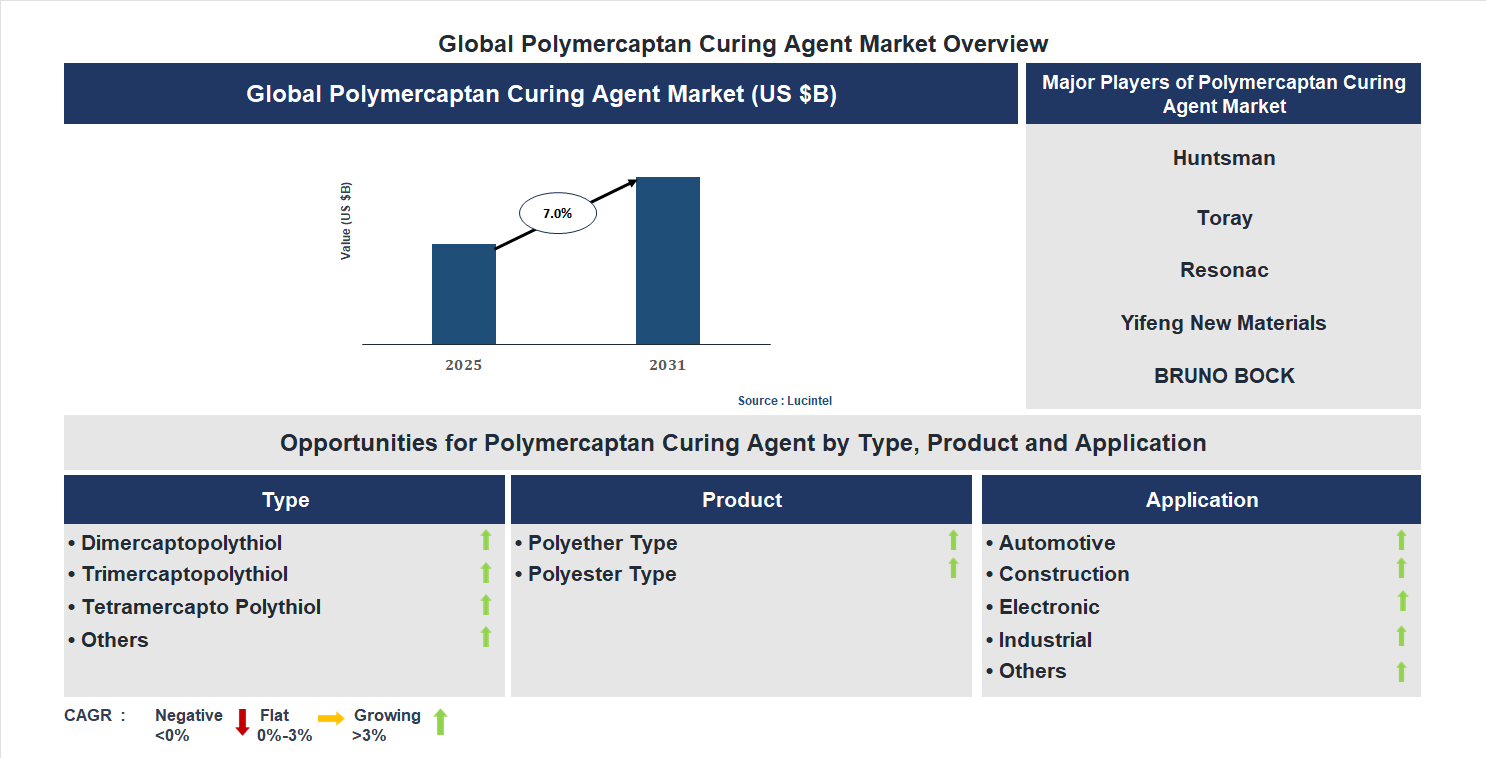
Key data points: The growth forecast = 7% annually for the next 7 years. Scroll below to get more insights. This market report covers trends, opportunities and forecasts in polymercaptan curing agent market to 2031 by type (dimercaptopolythiol, trimercaptopolythiol, tetramercapto polythiol, and others), product (polyether type and polyester type), application (automotive, construction, electronic, industrial, and others), and region (North America, Europe, Asia Pacific, and the Rest of the World)
We'll send your sample report shortly.
• Lucintel forecasts that, within the type category, dimercaptopolythiol is expected to witness the highest growth over the forecast period.
• Within the application category, construction is expected to witness the highest growth.
• In terms of region, APAC is expected to witness the highest growth over the forecast period. Gain valuable insights for your business decisions with our comprehensive 150+ page report. Sample figures with some insights are shown below.
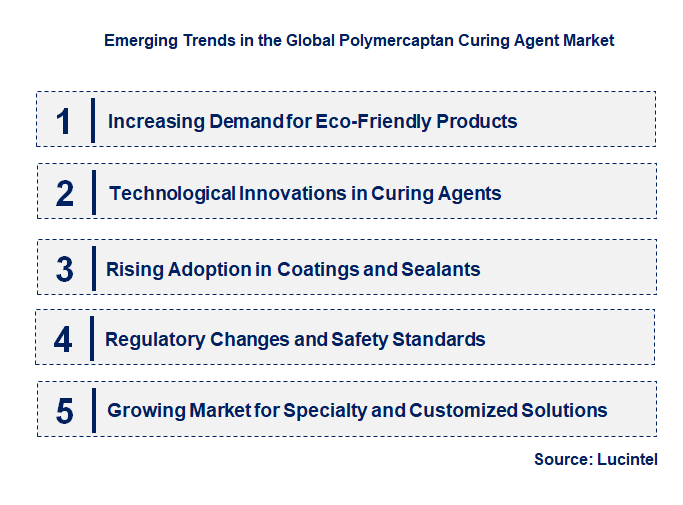
• Increasing Demand for Eco-Friendly Products: Growing environmental awareness and stricter regulations are pushing manufacturers to develop greener mercaptan curing agents. These eco-friendly variants reduce volatile organic compounds (VOCs) and hazardous emissions, aligning with global sustainability goals. This trend enhances market appeal among environmentally conscious consumers and industries seeking compliant solutions. As a result, companies investing in sustainable formulations are gaining competitive advantages, leading to a shift towards more environmentally responsible products in the market.
• Technological Innovations in Curing Agents: Advances in chemical formulations and processing technologies are enabling the development of more efficient and versatile mercaptan curing agents. These innovations improve curing times, enhance product durability, and expand application ranges. Enhanced performance characteristics are attracting industries requiring high-quality coatings and adhesives. The integration of nanotechnology and other cutting-edge methods is further driving product innovation, making these agents more adaptable to diverse industrial needs and boosting overall market growth.
• Rising Adoption in Coatings and Sealants: The coatings and sealants sectors are increasingly adopting mercaptan curing agents due to their excellent adhesion, flexibility, and chemical resistance. These properties are critical for applications in construction, automotive, and industrial maintenance. The demand is driven by the need for durable, weather-resistant, and quick-curing solutions. As these industries expand, the reliance on mercaptan-based curing agents is expected to grow, fueling market expansion and encouraging manufacturers to tailor products for specific industry requirements.
• Regulatory Changes and Safety Standards: Evolving safety standards and regulations concerning the handling and use of mercaptans are influencing market dynamics. Stricter guidelines aim to minimize health and environmental risks associated with mercaptan exposure. This trend compels manufacturers to innovate safer formulations and improve handling protocols. Compliance with these regulations not only ensures market access but also enhances brand reputation. The regulatory landscape is thus a key driver shaping product development and market strategies within this industry.
• Growing Market for Specialty and Customized Solutions: There is an increasing demand for specialized mercaptan curing agents tailored to specific industrial applications. Custom formulations offer enhanced performance, compatibility, and safety features, catering to niche markets. This trend reflects a shift towards personalized solutions that meet precise customer needs, fostering innovation and differentiation among manufacturers. The growth of this segment is expected to boost overall market size, encouraging R&D investments and collaborations to develop next-generation curing agents. In summary, these emerging trends are significantly reshaping the polymercaptan curing agent market by promoting sustainability, technological advancement, application diversification, regulatory compliance, and customization. These developments are driving market growth, fostering innovation, and setting new standards for safety and performance, ultimately leading to a more dynamic and responsible industry landscape.
• Introduction of bio-based mercaptan curing agents: These agents are derived from renewable resources, reducing environmental impact and aligning with sustainability goals. Their adoption is increasing in eco-conscious markets, boosting demand and encouraging manufacturers to innovate greener products.
• Development of high-performance curing agents: New formulations offer improved curing speed, enhanced mechanical properties, and better chemical resistance. This advancement benefits industries requiring durable and reliable coatings and adhesives, thereby expanding market applications.
• Regulatory pressures and environmental standards: Stricter regulations on volatile organic compounds (VOCs) and hazardous substances are prompting companies to develop low-VOC and non-toxic mercaptan curing agents. This shift is fostering innovation and opening new markets for safer products.
• Integration of nanotechnology: Incorporating nanomaterials into mercaptan curing agents enhances their performance, such as increased adhesion and durability. This technological integration is creating opportunities for high-end applications in aerospace and electronics.
• Expansion into emerging markets: Growing infrastructure and industrialization in regions like Asia-Pacific are driving demand for polymercaptan curing agents. Market players are establishing local manufacturing facilities and partnerships to capitalize on these opportunities. These recent developments are collectively transforming the polymercaptan curing agent market by making products more sustainable, high-performing, and compliant with regulations. The market is becoming more competitive and innovative, with a focus on environmentally friendly solutions and advanced technology. As a result, the industry is poised for sustained growth, driven by expanding applications and evolving customer preferences.
• Construction Industry: Sustainable and eco-friendly solutions: The demand for environmentally friendly curing agents is rising in construction, driven by green building initiatives. Polymercaptan curing agents offer low VOC emissions and enhanced durability, making them ideal for eco-conscious projects. This trend boosts market growth by attracting environmentally aware clients and complying with stringent regulations, ultimately expanding application scope in residential, commercial, and infrastructure projects.
• Automotive Sector: Lightweight and high-performance materials: The automotive industry seeks lightweight, durable materials to improve fuel efficiency and reduce emissions. Polymercaptan curing agents contribute to the development of advanced coatings and adhesives that meet these needs. Their adoption enhances vehicle performance and longevity, fostering growth in automotive manufacturing and repair sectors, especially with the rise of electric vehicles demanding innovative materials.
• Electronics and Electrical Industry: Enhanced protective coatings: The electronics sector requires protective coatings that offer resistance to moisture, heat, and chemicals. Polymercaptan curing agents provide excellent adhesion and chemical resistance, making them suitable for electronic components and devices. This application drives market expansion by supporting the miniaturization and durability of electronic products, especially in consumer electronics and industrial equipment.
• Paints and Coatings: High-performance coatings for industrial applications: The demand for durable, weather-resistant coatings in industrial settings is increasing. Polymercaptan curing agents enable the formulation of high-performance paints that withstand harsh environments. This growth opportunity enhances market penetration in sectors such as oil & gas, marine, and infrastructure, where protective coatings are critical.
• Adhesives and Sealants: Rapid curing and strong adhesion: The need for fast-curing, strong adhesives and sealants is rising across multiple industries. Polymercaptan curing agents facilitate quick curing times and superior adhesion properties, improving productivity and reliability. This trend supports growth in manufacturing, construction, and maintenance applications, especially where time efficiency is crucial. In summary, these growth opportunities are significantly impacting the polymercaptan curing agent market by expanding its application base, fostering innovation, and meeting evolving industry demands. As industries prioritize sustainability, performance, and efficiency, the market is poised for sustained growth and increased competitiveness.
• Technological Advancements: The development of innovative curing agents with improved efficiency and environmental profiles has significantly boosted market growth. New formulations offer faster curing times, enhanced durability, and lower VOC emissions, aligning with stricter environmental standards. These technological improvements enable manufacturers to produce higher-quality coatings and adhesives, expanding application scopes across industries such as construction, automotive, and electronics. Continuous R&D investments are expected to sustain this momentum, fostering market competitiveness and opening new avenues for product development.
• Growing Demand for Eco-Friendly Coatings: Increasing awareness of environmental issues and regulatory pressures have driven demand for eco-friendly, low-VOC, and solvent-free curing agents. Polymercaptan curing agents, known for their fast curing and excellent performance, are increasingly preferred in sustainable coatings. This trend is particularly prominent in regions with strict environmental regulations, such as North America and Europe. The shift towards greener products not only enhances brand reputation but also ensures compliance with evolving standards, thereby fueling market expansion.
• Expansion in End-Use Industries: The rising demand for durable, high-performance coatings in industries such as automotive, construction, and electronics is a major growth driver. The automotive sector, in particular, requires coatings with excellent corrosion resistance and quick curing times, which polymercaptan curing agents provide. Similarly, the construction industry’s focus on long-lasting, weather-resistant coatings boosts demand. The proliferation of electronic devices also necessitates specialized adhesives and coatings, further expanding market opportunities. This broad industrial application base ensures sustained demand and market resilience.
• Increasing Investment in Infrastructure and Industrial Projects: Governments and private sectors worldwide are investing heavily in infrastructure development, urbanization, and industrial expansion. These projects require advanced coatings and adhesives that utilize polymercaptan curing agents for their superior performance. The surge in construction activities, especially in emerging economies, directly correlates with increased consumption of curing agents. This investment-driven growth provides a robust foundation for market expansion, encouraging manufacturers to scale production and innovate to meet rising demand. The challenges facing this polymercaptan curing agent market include:-
• Environmental and Regulatory Concerns: Despite their advantages, polymercaptan curing agents face scrutiny due to environmental and health concerns related to their chemical composition. Stricter regulations aimed at reducing VOC emissions and hazardous substances increase compliance costs for manufacturers. Navigating these regulatory landscapes requires significant investment in R&D and reformulation efforts, which can slow down product development and market entry. Non-compliance risks include legal penalties and damage to brand reputation, making regulatory adherence a critical challenge for sustained market growth.
• Raw Material Price Volatility: The market heavily depends on raw materials such as mercaptans and other petrochemical derivatives, which are subject to price fluctuations due to geopolitical tensions, supply chain disruptions, and crude oil market dynamics. Price volatility can lead to increased production costs and reduced profit margins for manufacturers. It also complicates pricing strategies and inventory management, potentially impacting supply stability and customer relationships. Managing raw material risks is essential for maintaining competitive pricing and ensuring consistent product availability.
• High Development and Compliance Costs: Developing new formulations that meet environmental standards and customer requirements involves substantial R&D investments. Additionally, compliance with evolving regulations necessitates ongoing testing, certification, and process modifications, which incur significant costs. These financial burdens can act as barriers for smaller players and slow down innovation cycles. The need for continuous investment in quality assurance and regulatory compliance can strain resources, potentially limiting market entry for new entrants and affecting overall industry growth. In summary, the polymercaptan curing agent market is driven by technological innovations, environmental sustainability trends, expanding industrial applications, and infrastructure investments. However, environmental concerns, raw material price fluctuations, and high compliance costs pose notable challenges. These factors collectively influence market dynamics, requiring stakeholders to innovate continuously, adapt to regulatory changes, and manage costs effectively. Overall, the markets growth prospects remain promising, provided that companies can navigate these complexities through strategic planning and sustainable practices.
• Huntsman
• Toray
• Resonac
• Yifeng New Materials
• BRUNO BOCK
• Dimercaptopolythiol
• Trimercaptopolythiol
• Tetramercapto Polythiol
• Others
• Polyether Type
• Polyester Type
• Automotive
• Construction
• Electronic
• Industrial
• Others
• North America
• Europe
• Asia Pacific
• The Rest of the World
• United States: The U.S. market has seen increased adoption of eco-friendly mercaptan curing agents, driven by stringent environmental regulations and demand for sustainable products. Innovations in formulation have improved curing efficiency and reduced VOC emissions. Major players are investing in R&D to develop high-performance, low-toxicity agents suitable for automotive and aerospace applications. The growth of the construction sector and rising demand for durable coatings further propel market expansion. Additionally, collaborations between industry leaders and research institutions are fostering technological advancements, positioning the U.S. as a key innovator in this sector.
• China: China remains the largest consumer and producer of mercaptan curing agents, with rapid industrialization fueling market growth. Recent developments include the introduction of bio-based and environmentally friendly formulations to meet stricter regulations. The expansion of the automotive and electronics industries has increased demand for high-quality curing agents. Local manufacturers are investing in capacity expansion and technological upgrades to enhance product quality and reduce costs. Government initiatives promoting sustainable manufacturing practices are also encouraging innovation. Overall, China’s market is characterized by aggressive growth, technological advancements, and a focus on eco-friendly solutions.
• Germany: Germany’s market is marked by a focus on high-performance, durable curing agents for industrial applications, especially in automotive and machinery sectors. Recent developments include the integration of nanotechnology to improve curing efficiency and product longevity. The country’s emphasis on sustainability has led to the adoption of greener formulations with lower environmental impact. German companies are also investing in digitalization and automation to optimize production processes. Regulatory compliance with European Union standards remains a priority, driving innovation in low-emission and biodegradable mercaptan curing agents. These efforts position Germany as a leader in high-quality, sustainable curing solutions.
• India: The Indian market is witnessing rapid growth due to expanding construction, automotive, and electronics sectors. Recent developments include the introduction of cost-effective, locally produced mercaptan curing agents that meet international quality standards. The government’s focus on infrastructure development and industrial growth is boosting demand. Companies are adopting advanced manufacturing techniques to improve product performance and reduce environmental impact. There is also a rising trend toward bio-based and eco-friendly formulations driven by increasing environmental awareness. Market players are forming strategic alliances to enhance distribution and technological capabilities, supporting India’s position as a key emerging market.
• Japan: Japan’s market is characterized by technological innovation and a focus on high-performance curing agents for electronics, automotive, and industrial applications. Recent developments include the integration of nanomaterials to enhance curing speed and durability. The country’s stringent environmental regulations have prompted the development of low-toxicity, biodegradable mercaptan agents. Japanese firms are investing heavily in R&D to develop advanced formulations that offer superior performance and sustainability. The adoption of automation and digital manufacturing processes is improving efficiency and product consistency. Japan’s emphasis on quality and innovation continues to drive its leadership in the global mercaptan curing agent market.


• Huntsman
• Toray
• Resonac
• Yifeng New Materials
• BRUNO BOCK Q5. Which polymercaptan curing agent market segment will be the largest in future? Answer: Lucintel forecasts that, within the type category, dimercaptopolythiol is expected to witness the highest growth over the forecast period. Q6. In polymercaptan curing agent market, which region is expected to be the largest in next 5 years? Answer: In terms of region, APAC is expected to witness the highest growth over the forecast period. Q7. Do we receive customization in this report? Answer: Yes, Lucintel provides 10% customization without any additional cost.


Choose a license that fits your team. Instant PDF delivery.
Prices exclude taxes. Instant delivery. Custom licensing available on request.
Market Report · July 22, 2026
Market Report · July 22, 2026
Market Report · July 22, 2026
Trusted partner for strategic intelligence and business growth


Receive a complimentary market analysis tailored to your industry. Our analysts will identify key growth opportunities and competitive dynamics specific to your business.

Market size, growth rate, and key trend analysis for your specific sector.

Top competitor positioning and market share analysis.

Strategic recommendations backed by data-driven insights.
Get curated market intelligence and competitive moves straight to your inbox.
By subscribing, you agree to receive our monthly insights. Unsubscribe anytime.
Receive a complimentary market analysis tailored to your industry. Our analysts will identify key growth opportunities and competitive dynamics specific to your business.
Market size, growth rate, and key trend analysis for your specific sector.
Top competitor positioning and market share analysis.
Strategic recommendations backed by data-driven insights.
Get curated market intelligence, emerging trends, and competitive moves straight to your inbox each month.
By subscribing, you agree to receive our monthly insights. Unsubscribe anytime.
We'll send your sample report shortly.