
Report Feature
Polybutadiene Market Trends and Forecast
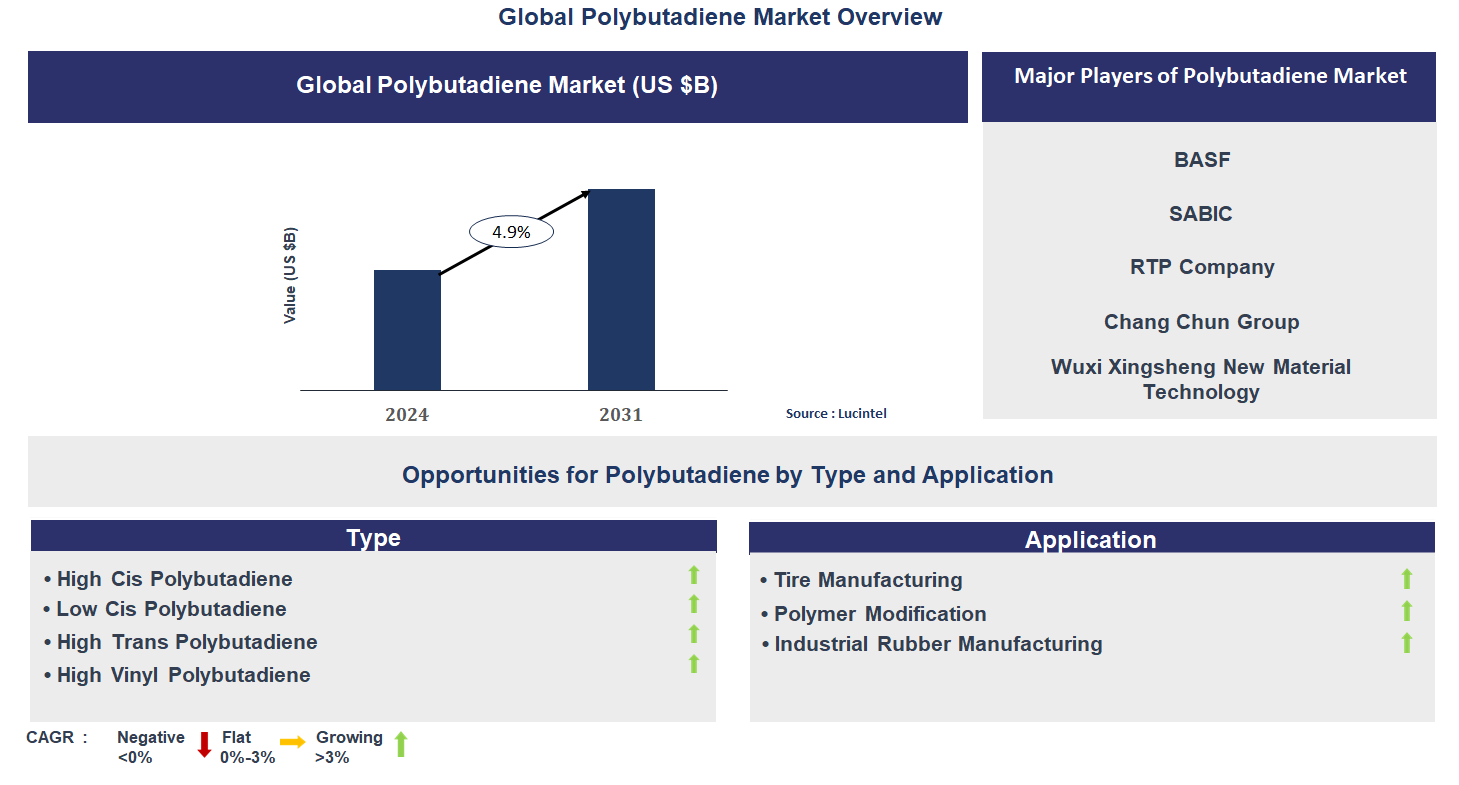
The future of the global polybutadiene market looks promising with opportunities in the tire manufacturing, polymer modification, and industrial rubber manufacturing markets. The global polybutadiene market is expected to grow with a CAGR of 4.9% from 2025 to 2031. The major drivers for this market are the increasing demand from automotive industry, the rising use in synthetic rubber, and the growing adoption in adhesives manufacturing.• Lucintel forecasts that, within the type category, high cis polybutadiene is expected to witness the highest growth over the forecast period.
• Within the application category, tire manufacturing will remain the largest segment.
• In terms of region, North America is expected to witness the highest growth over the forecast period. Gain valuable insights for your business decisions with our comprehensive 150+ page report. Sample figures with some insights are shown below.
Emerging Trends in the Polybutadiene Market
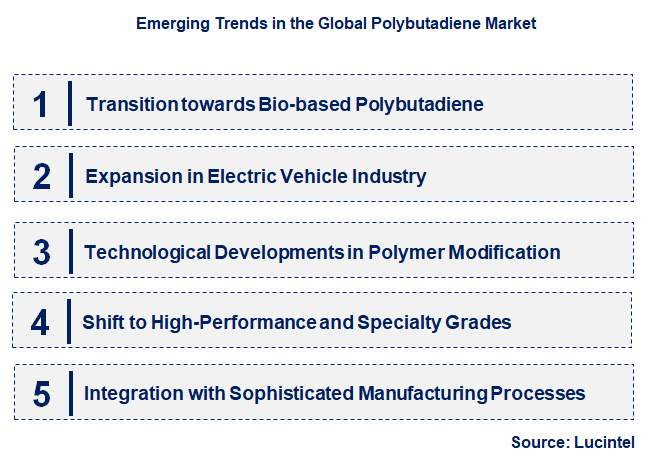
The polybutadiene industry is in the middle of a revolution, spurred on by a mix of technological innovation, changing consumer needs, and growing environmental concerns. These new trends are not only revolutionizing the production and application of polybutadiene, but also impacting supply chains, marketing strategies, and the general competitive landscape. Consequently, players in the market are investing in innovation, diversification of products, and sustainability to remain competitive and robust in a dynamic world.• Transition towards Bio-based Polybutadiene: One of the key trends is a move toward bio-based polybutadiene, which is manufactured from renewable feedstocks rather than petroleum. This is motivated by a worldwide drive towards sustainability and a need to decrease dependence on fossil energy. This trend affects the market by establishing a premium segment for sustainable products, inducing investments from organizations looking to enhance their green profile, and resulting in strategic alliances between chemical firms and bio-based raw material providers.
• Expansion in Electric Vehicle Industry: The explosive expansion of the electric vehicle (EV) sector is a primary upcoming trend. Polybutadiene is a crucial ingredient in the manufacturing of high-performance EV tires, which need low rolling resistance to achieve the best battery range. With expanding EV industry, there is a growing demand for polybutadiene specifically designed for these tires. This trend is developing a high-volume, high-growth segment that will continue to grow as the global transition to electric mobility gains momentum.
• Technological Developments in Polymer Modification: There is a significant new trend of the use of polybutadiene in polymer modification to extend and strengthen the properties of plastics and other polymers. With the incorporation of polybutadiene, companies are able to increase the impact resistance, flexibility, and toughness of materials employed in products from automotive components to consumer items. The trend is affecting the market by establishing new, high-value applications for polybutadiene outside its conventional application in tires.
• Shift to High-Performance and Specialty Grades: The industry is experiencing a pronounced trend toward the creation of high-performance and specialty grades of polybutadiene. These grades are designed to provide improved properties, including higher abrasion resistance and cold flexibility, for use in particular applications in industrial rubber products, footwear, and consumer goods. This trend is affecting the industry by stimulating manufacturers to invest in research and development to produce improved-performing products.
• Integration with Sophisticated Manufacturing Processes: The industry is witnessing the integration of sophisticated manufacturing processes, including solution polymerization, wherein there is better control of the molecular structure of the polybutadiene. This leads to higher-quality polymers with better performance characteristics. This trend is affecting the industry by facilitating more effective production, less waste, and enhanced overall quality of polybutadiene products. These trends together are collectively transforming the polybutadiene industry in shifting its direction towards a higher-value, more specialized, and technologically advanced future. The trend towards high-performance applications, new applications in electric vehicles, and pursuit of sustainable manufacturing is turning the business into one that is driven by innovation and differentiation rather than being a bulk commodity business.
Recent Development in the Polybutadiene Market
The polybutadiene market is evolving rapidly under the influence of a mix of global economic trends, technological advancements, and changing regulatory environments. Such recent trends are impacting production, supply chains, and end-user applications. The market is seeing a drive to expand capacity in order to address increasing demand while at the same time coping with the challenge of raw material uncertainty and stiff competition. The sector is retorting with emphasis on efficiency, product diversification, and strategic shift to sustainable and high-value uses.• Expanded Capacity in the Asia-Pacific Region: One key development is the continued capacity build-up for polybutadiene, particularly in the Asia-Pacific region. Chinese and Indian producers are expanding their capacities to satisfy the skyrocketing domestic demand from their own respective automotive and infrastructure industries. This is affecting the market by enhancing overall supply, sharpening competition among producers, and potentially paving the way for a more stable, but highly competitive, pricing landscape, which is favorable to downstream industries.
• Increased Adoption of Green Tires: Another development driving the market for polybutadiene is the increasing adoption of green tires by the automotive sector. These tires, which are made to minimize rolling resistance and enhance fuel economy, are a major growth driver for the polybutadiene market. Producers are introducing new grades of polybutadiene that drive the performance of green tires, influencing the market with a new, high-growth revenue opportunity and establishing polybutadiene as a key element in the global transformation to sustainable transportation.
• Strong Emphasis on High-Performance Grades: Recent trends reveal an important emphasis on the production of high-performance grades of polybutadiene. They are designing products with superior properties, including higher abrasion resistance and low-temperature flexibility, to satisfy the particular requirements of diverse industries. These developments are targeted at increasing the use of the material in more stressful applications, including high-performance footwear and industrial rubber products. This trend is affecting the market by challenging manufacturers to spend on R&D to develop improved-performing products.
• Strategic Alliances and Acquisitions: Some of the recent trends include a shift towards strategic alliances and acquisitions in the market. Larger companies are taking over smaller producers or partnering to have wider product offerings and access new technologies. For instance, certain international chemical players are partnering with tire companies to co-develop new, innovative tire solutions. This is affecting the market by leading to a more concentrated industry structure with fewer, but larger, companies.
• Effect of Global Supply Chain Disruptions: Geopolitical occurrences of late and logistics issues have generated tremendous disruptions to the global polybutadiene supply chain. Volatility in raw material supply and transportation prices has resulted in a risk-filled market condition. This trend is affecting the market by compelling businesses to rethink their procurement methodologies, with a focus on an increased emphasis on regionalized and localized production to reduce risk and achieve a more stable supply. These major developments are together influencing the market for polybutadiene by pushing it toward a more diversified, competitive, and sustainable marketplace. The pressure on capacity growth and increased strategic partnerships are offering new opportunities for growth, while threats such as raw material cost volatility are compelling firms to be more resilient. The adoption of technology innovation and emphasis on purity products is in essence transforming the market.
Strategic Growth Opportunities in the Polybutadiene Market
There are huge strategic growth prospects in the polybutadiene market fueled by changing safety regulations, technological innovations, and a worldwide trend towards sustainability. These opportunities lie outside of conventional applications and occur in niche, high-value markets across different industries. To take advantage of these chances, market players need to emphasize innovation, product differentiation, as well as strategic collaborations. By focusing on these particular growth areas, firms can gain a competitive advantage and achieve long-term profitability.• Growing in High-End Industrial Rubber Goods: The high-end industrial rubber goods market is a major strategic growth opportunity. Polybutadiene’s toughness, resilience, and superior abrasion resistance make it a suitable material for items like conveyor belts, seals, and gaskets in tough industrial environments. Global demand is being stimulated by the push for industrial modernization and automation. This affects the market by generating a high-volume, long-term end use that is less volatile to customary economic cycles and more congruent with a product focus on longevity and performance.
• Targeting the Adhesives and Sealants Market: The adhesives and sealants market provides a prime opportunity for growth. Liquid polybutadiene is being widely employed as a base polymer for many different adhesives and sealants because it has a high level of bonding capability and chemical resistance. This is caused by the need for high-performance, long-lasting bonding solutions from the construction and packaging sectors. This affects the market by offering a constant source of demand from a vital and continually developing segment.
• Capitalizing on the Medical and Healthcare Industry: The medical and healthcare industry offers a major growth potential. Polybutadiene is employed in medical equipment and devices that demand flexibility, strength, and biocompatibility, like in certain surgical equipment and tubing. The world’s demand for superior medical technology and the need to replace legacy materials are driving this potential. This affects the market by offering a new, high-volume application that is critical to public safety and health.
• Evolution into the Footwear and Sporting Goods Industry: The footwear and sporting goods industry presents a strategic opportunity. Polybutadiene is a critical element in athletic footwear soles and in commodities such as golf balls because of its greater resilience and abrasion resistance. The increasing worldwide demand for athletic and recreational products is propelling this opportunity. This impacts the market by providing a new revenue stream that is crucial for a wide range of consumer products.
• Focusing on Polymer Modification: A strategic opportunity lies in targeting polymer modification. Polybutadiene is widely used to enhance the impact resistance and toughness of plastics like polystyrene and acrylonitrile butadiene styrene (ABS). As producers try to develop more tough and multifunctional plastics for broad applications, the need for polybutadiene as a modifier will keep on increasing. This affects the market by providing a high-value application that is critical in the development of high-performance composite materials. These strategic growth opportunities are transforming the polybutadiene market by promoting a transition from bulk commodity business to that of specialized, high-value products. By focusing on high-growth industries and adopting the trend for sustainability, players can open new avenues of revenue streams, differentiate themselves from others, and gain a firmer market position in the future.
Polybutadiene Market Driver and Challenges
The polybutadiene market is characterized by a rich interplay of leading drivers and barriers that encompass many different technological, economic, and regulatory drivers. Drivers like increasing demand from leading industries and a transition to more sustainable practices, which encourage innovation, drive the growth of the market. However, this growth is tempered by significant challenges related to the volatility of raw material costs, intense competition, and the complex nature of the value chain. Understanding the dynamics between these forces is essential for comprehending the market’s current state and forecasting its future trajectory. The factors responsible for driving the polybutadiene market include: 1. Rising Automotive Sector and Tire Production: The major driving force for the polybutadiene market is the steady expansion of the automotive sector and consequently the attendant need for tyros. Polybutadiene is a critical constituent of tire treads, where its excellent abrasion resistance and low rolling resistance are vital to increasing tire life and fuel efficiency. This driver is being powered by increasing sales of vehicles, especially in developing markets, and by the global transition to electric vehicles. 2. Technology Development in Polymer Synthesis: Technology development in polybutadiene synthesis is a key driver. Advancements in new polymerization processes, including solution polymerization, have created sophisticated polybutadiene grades with superior properties for particular uses. This technology enables manufacturers to create materials with superior qualities, including higher resilience and reduced rolling resistance, which opens new market opportunities. 3. Growing Need for Polymer Modification: Growing need for polymer modification is one of the major drivers for the polybutadiene market. Polybutadiene finds extensive application as an agent for rubber toughening to enhance the impact strength and toughness of numerous plastics, such as high impact polystyrene (HIPS) and acrylonitrile butadiene styrene (ABS). With consumer product manufacturers and automotive component manufacturers aiming to enhance product performance, the use of polybutadiene keeps on increasing. 4. Increase in Construction and Industrial Markets: Growth in construction and industry is a major contributor. Polybutadiene finds application in industrial rubber products such as conveyor belts, hoses, and gaskets and construction adhesives and sealants. Asia-Pacific’s rapid industrialization and urbanization are propelling major infrastructure development projects that depend upon these products, leading to steady demand for polybutadiene. 5. Shift towards Eco-friendly Materials: Global transition towards sustainable and eco-friendly materials is the principal driving factor. Bio-based polybutadiene development and commercialization are opening up new opportunities for industry players to address an increasing need for green products. Demand is fueled by regulatory frameworks and consumer attitudes, compelling the sector to develop and look for alternatives to fossil fuel-based materials. Challenges in the polybutadiene market are: 1. Raw Material Price Volatility: The industry is greatly threatened by the volatility of raw material prices, most notably butadiene. Butadiene price is inherently tied to the crude oil price, which can rise or fall in an unpredictable manner in response to geopolitical factors and supply-demand pressures. This volatility in the cost of producing polybutadiene may result in volatile pricing, undermining the profitability of producers and users. 2. Fierce Competition from Substitute Materials: Polybutadiene is exposed to strong competition from substitute materials like Styrene Butadiene Rubber (SBR) and natural rubber. Although polybutadiene has a lot going for it, these conventional materials are mature and have become an integral part of manufacturing practices in most countries. The challenge of overcoming such resistance and proving the superior performance advantages of polybutadiene is a long-standing issue. 3. Environmental and Health Issues: The industry is confronted with issues of environmental and health concerns. The manufacturing process uses dangerous chemicals, and exposure to polybutadiene results in health problems at elevated levels. Consequently, there is stricter environmental regulation and occupational safety standards that can boost the cost of production and pose compliance issues for manufacturers. In summary, the polybutadiene market is at a crossroads, with strong drivers pushing it ahead and with crucial challenges that call for strategic adjustment. The increasing demand from traditional and novel industries combined with increased emphasis on sustainability and technological development is bringing about new opportunities for profitability and growth. But the market has to fight with the uncertainty of raw material prices, the continuous threat from competition by other materials, and the intrinsic ecological and health problems of its production. The future of the market would lie in how well companies can take advantage of these drivers while minimizing the challenges, most probably by emphasizing high-value, niche applications, operational efficiency, and adherence to sustainable production processes.List of Polybutadiene Companies
Companies in the market compete on the basis of product quality offered. Major players in this market focus on expanding their manufacturing facilities, R&D investments, infrastructural development, and leverage integration opportunities across the value chain. With these strategies polybutadiene companies cater increasing demand, ensure competitive effectiveness, develop innovative products & technologies, reduce production costs, and expand their customer base. Some of the polybutadiene companies profiled in this report include-• BASF
• SABIC
• RTP Company
• Chang Chun Group
• Wuxi Xingsheng New Material Technology
• Xiamen Keyuan Plastic
• Polyplastics
• LANXESS
• Kingfa Science & Technology
• Evonik Industries
Polybutadiene Market by Segment
The study includes a forecast for the global polybutadiene market by type, application, and region.Polybutadiene Market by Type [Value from 2019 to 2031]:
• High Cis Polybutadiene
• Low Cis Polybutadiene
• High Trans Polybutadiene
• High Vinyl Polybutadiene
Polybutadiene Market by Application [Value from 2019 to 2031]:
• Tire Manufacturing
• Polymer Modification
• Industrial Rubber Manufacturing
Polybutadiene Market by Region [Value from 2019 to 2031]:
• North America
• Europe
• Asia Pacific
• The Rest of the World
Country Wise Outlook for the Polybutadiene Market
The world polybutadiene market is going through a phase of rapid growth and transformation, led mainly by the automotive sector. As an important component in tire production because of its superior characteristics, including abrasion resistance and low rolling resistance, polybutadiene plays a crucial role in creating more fuel-efficient and high-performance tires. Apart from tire manufacturing, the versatility of the material has seen it find greater application in the modification of polymers, industrial rubber production, and other uses, driven by accelerating industrialization and global emphasis on sustainability.• United States: The US polybutadiene market is dominated by intensive development of high-performance applications, most prominently in automotive and aerospace sectors. Latest trends revolve around the manufacturing of bio-based polybutadiene to support increasing demands for environmentally friendly materials and to align with tighter environmental laws. The market is witnessing a transition towards specialized polybutadiene rubber grades for novel tire designs to enhance fuel economy in passenger and electric cars.
• China: China is the biggest and most rapidly expanding market for polybutadiene. Recent trends are led by a huge increase in tire manufacturing capacity expansion and bumper growth in the automotive industry, both conventional and electric vehicles. Chinese firms are investing extensively in new factory plants to supply both local and overseas demands. That’s affecting the market by boosting world supply and causing higher competition.
• Germany: Germany’s polybutadiene industry is a main component of Europe’s advanced engineering industry. A main development is the firm emphasis on bio-polybutadiene and other eco-friendly substitutes. Stimulated by stringent EU controls and a desire for ecologically friendly products, German producers are leading the research and development effort in this segment. This trend is building a high-value niche market for specialty and eco-friendly products.
• India: India’s polybutadiene market is at a serious growth stage, driven by its fast automotive and infrastructure development. The government stimulus of vehicle manufacturing and widening of road networks is driving a large rise in demand for tires and other rubber products. Recent trends include fresh investments in local polybutadiene rubber facilities, which are expected to cut import dependence and boost the nation’s manufacturing economy.
• Japan: Japan’s polybutadiene market is developed and well-integrate into its high-tech manufacturing and auto industries. One development is the emphasis on high-purity and technical-grade polybutadiene for application in high-technology uses such as specialty wires, cables, and high-performance tires. The market also has a strong niche in the electronics and medical devices markets, where the special properties of the material are well appreciated.

Features of the Global Polybutadiene Market
Market Size Estimates: Polybutadiene market size estimation in terms of value ($B). Trend and Forecast Analysis: Market trends (2019 to 2024) and forecast (2025 to 2031) by various segments and regions. Segmentation Analysis: Polybutadiene market size by type, application, and region in terms of value ($B). Regional Analysis: Polybutadiene market breakdown by North America, Europe, Asia Pacific, and Rest of the World. Growth Opportunities: Analysis of growth opportunities in different types, applications, and regions for the polybutadiene market. Strategic Analysis: This includes M&A, new product development, and competitive landscape of the polybutadiene market. Analysis of competitive intensity of the industry based on Porter’s Five Forces model.
FAQ
Q1. What is the growth forecast for polybutadiene market? Answer: The global polybutadiene market is expected to grow with a CAGR of 4.9% from 2025 to 2031. Q2. What are the major drivers influencing the growth of the polybutadiene market? Answer: The major drivers for this market are the increasing demand from automotive industry, the rising use in synthetic rubber, and the growing adoption in adhesives manufacturing. Q3. What are the major segments for polybutadiene market? Answer: The future of the polybutadiene market looks promising with opportunities in the tire manufacturing, polymer modification, and industrial rubber manufacturing markets. Q4. Who are the key polybutadiene market companies? Answer: Some of the key polybutadiene companies are as follows:• BASF
• SABIC
• RTP Company
• Chang Chun Group
• Wuxi Xingsheng New Material Technology
• Xiamen Keyuan Plastic
• Polyplastics
• LANXESS
• Kingfa Science & Technology
• Evonik Industries Q5. Which polybutadiene market segment will be the largest in future? Answer: Lucintel forecasts that, within the type category, high cis polybutadiene is expected to witness the highest growth over the forecast period. Q6. In polybutadiene market, which region is expected to be the largest in next 5 years? Answer: In terms of region, North America is expected to witness the highest growth over the forecast period. Q7. Do we receive customization in this report? Answer: Yes, Lucintel provides 10% customization without any additional cost.
Table of Contents
List of Figures
List of Tables
Methodology
- In-depth interviews of the major players in this market
- Detailed secondary research from competitors’ financial statements and published data
- Extensive searches of published works, market, and database information pertaining to industry news, company press releases, and customer intentions
- A compilation of the experiences, judgments, and insights of Lucintel’s professionals, who have analyzed and tracked this market over the years.


Buy Now
Choose a license that fits your team. Instant PDF delivery.
Prices exclude taxes. Instant delivery. Custom licensing available on request.
Key Questions
- • What are some of the most promising, high-growth opportunities for the polybutadiene market by type (high cis polybutadiene, low cis polybutadiene, high trans polybutadiene, and high vinyl polybutadiene), application (tire manufacturing, polymer modification, and industrial rubber manufacturing), and region (North America, Europe, Asia Pacific, and the Rest of the World)?
- • Which segments will grow at a faster pace and why?
- • Which region will grow at a faster pace and why?
- • What are the key factors affecting market dynamics? What are the key challenges and business risks in this market?
- • What are the business risks and competitive threats in this market?
- • What are the emerging trends in this market and the reasons behind them?
- • What are some of the changing demands of customers in the market?
- • What are the new developments in the market? Which companies are leading these developments?
- • Who are the major players in this market? What strategic initiatives are key players pursuing for business growth?
- • What are some of the competing products in this market and how big of a threat do they pose for loss of market share by material or product substitution?
- • What M&A activity has occurred in the last 5 years and what has its impact been on the industry? For any questions related to Polybutadiene Market, Polybutadiene Market Size, Polybutadiene Market Growth, Polybutadiene Market Analysis, Polybutadiene Market Report, Polybutadiene Market Share, Polybutadiene Market Trends, Polybutadiene Market Forecast, Polybutadiene Companies, write Lucintel analyst at email: helpdesk@lucintel.com. We will be glad to get back to you soon.


