
Market Report · July 29, 2026

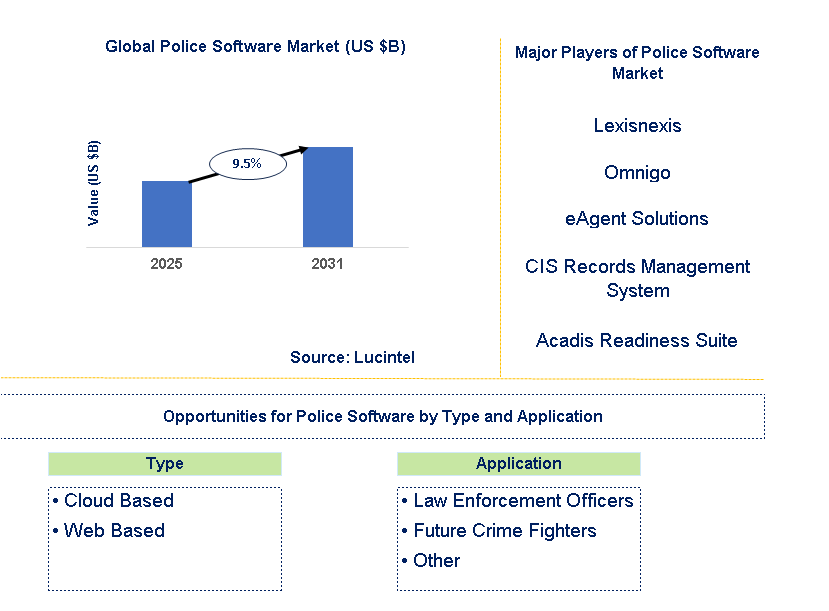
Key data points: The growth forecast = 9.5% annually for the next 7 years. Scroll below to get more insights. This market report covers Trends, opportunities and forecasts in police software market to 2031 by type (cloud based and web based), application (law enforcement officers, future crime fighters, and other), and region (North America, Europe, Asia Pacific, and the Rest of the World)
We'll send your sample report shortly.
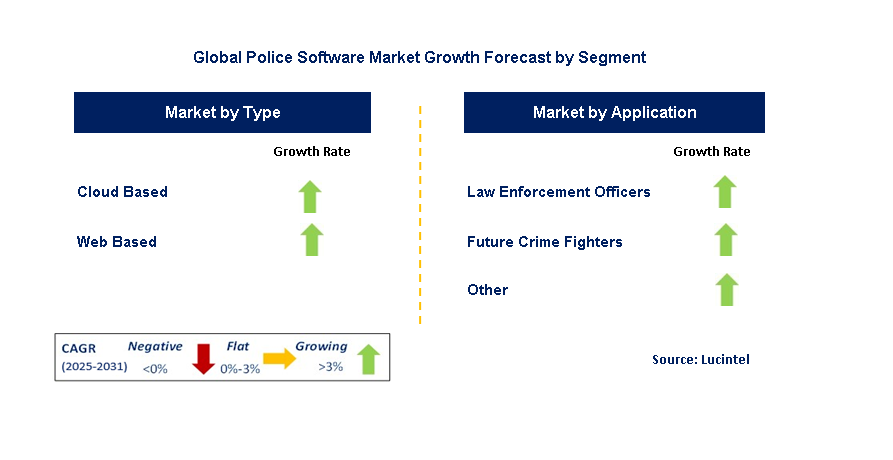
• Lucintel forecasts that, within the type category, cloud-based is expected to witness higher growth over the forecast period due to advanced features like storage and remote access.
• Within the application category, law enforcement officer is expected to witness higher growth.
• In terms of region, North America is expected to witness the highest growth over the forecast period due to growing government investments in law enforcement technology.
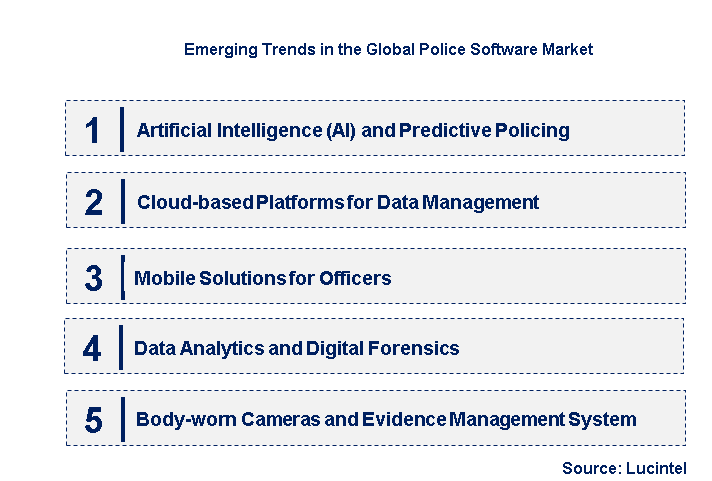
• Artificial Intelligence (AI) and Predictive Policing: AI is one of the significant forces driving the police software market by helping law enforcement agencies predict when criminal activity may take place. Predictive policing tools analyze data to predict the occurrence of crimes in certain locations and help to detect patterns of criminal behavior. AI-based solutions also aid in the detection of crime, like identifying faces or objects in a video recording from surveillance. This trend is helping police departments to allocate their resources more efficiently, reduce crime rates, and enhance public safety. As these AI tools are evolving, they are expected to be even more accurate and intertwined with policing strategies in the future.
• Cloud-based Platforms for Data Management: It has become an essential trend in the police software market to offer secure, scalable, and accessible platforms for managing large data on the basis of cloud computing. The trend for law enforcement agencies is shifting towards cloud-based solutions to store, analyze, and share data in real-time. This is making collaboration between departments better, improving transparency, and ensuring that officers have access to critical information at the scene of a crime. Cloud platforms also provide the flexibility to integrate with other digital tools, such as body cameras, GPS tracking systems, and crime analysis software.
• Mobile Solutions for Officers: Mobile technology is transforming how officers interact with police software. Police departments are increasingly adopting mobile solutions that allow officers to access data, update records, and communicate with other units while on the field. Mobile apps enhance officers’ ability to report incidents, conduct investigations, and access real-time information, improving operational efficiency. This is also helping the law enforcement agencies to respond more quickly to emergencies and enhance community policing. The mobile-enabled tools are allowing the officers to be more mobile, adaptable, and responsive in the field.
• Data Analytics and Digital Forensics: Data analytics is increasingly becoming an essential part of police software. Data analytics is being used by the law enforcement agencies to analyze and interpret large data. Investigation into cybercrimes, deleted information recovery, and electronic evidence analysis are now increasingly being conducted through digital forensics tools. Data analytics has the potential of helping police departments identify patterns within criminal activities and track criminal behavior across jurisdictions; it will be used to strengthen crime-solving strategies. Advanced data analytics and digital forensics tools in police software will keep growing with cybercrime and increased digital evidence.
• Body-worn Cameras and Evidence Management System: Increased implementation of body-worn cameras in law enforcement agencies across the world is acting as a catalyst that pushes demand for software solutions in order to manage the storage of video footage securely. Evidence management systems with integrated body cameras enable seamless storage, retrieval, and analysis of video evidence. These systems improve the accountability and transparency of law enforcement and ensure safe evidence storage in a readily available form. Dashboard cameras, drone footage, and other surveillance-related systems that record high volumes of data are becoming trends. In this regard, it can be understood that AI and cloud technology will reshape the police software market through mobile solutions and data analytics integrated with body-worn cameras. These trends contribute to efficiency enhancement, bettering crime-solving ability, and gaining public trust for law enforcement practice. As long as technology goes ahead, this police software market will continue with better data management, transparency, and public safety.
• AI-powered Crime Prediction Tools: Police departments are increasingly implementing AI-powered tools to predict where crimes are likely to occur. These predictive policing tools analyze historical crime data and other factors such as weather patterns and socio-economic conditions to forecast criminal activity. This technology is enabling law enforcement agencies to allocate resources more effectively and intervene before crimes occur, improving public safety and preventing crime. As AI technology continues to improve, predictive policing will become an even more valuable tool for law enforcement.
• Integration of Cloud-based Solutions: Cloud computing has become an essential part of police software, providing a secure, scalable, and cost-effective way to store and manage vast amounts of data. Law enforcement agencies are moving towards cloud-based platforms to streamline data sharing, improve collaboration between departments, and enhance accessibility to real-time information. The cloud also facilitates the integration of other technologies, such as mobile applications and body-worn cameras, making it easier to manage multiple systems from a central platform.
• Digital Evidence Management Systems: Police agencies are increasingly adopting digital evidence management systems that help store, organize, and track evidence digitally. These systems integrate with other tools such as body-worn cameras, drones, and surveillance systems, allowing law enforcement to manage and analyze video footage, photos, and documents more efficiently. Digital evidence management ensures that evidence is secure, accessible, and well-documented, improving transparency and accountability in policing.
• Mobile Solutions for the Field Officers: Policemen's work when deployed in the field is improving through mobile software solutions. The mobile applications enable officers to access critical information and submit reports from anywhere and link them to other departments. This development is improving response times and has enabled an effective investigation by officers in real-time. The shift toward mobile technology is also enhancing community policing as officers will be able to interact with the public and administer cases much better while on patrol.
• Improving Cyber Security for Police Data: With a rise in cyber threats, it is also seeing law enforcement agencies focus more on the cybersecurity of their software and data systems. The police software market is moving forward with respect to encryption, secure data storage, and the detection of threat technologies for secure information. This is important because law enforcement agencies handle a large volume of personal data, case files, and surveillance footage. Improved cybersecurity measures are safeguarding against data breaches and cyberattacks that can compromise the integrity of police operations. It will be transformative for the police software market as recent developments in AI, cloud computing, mobile solutions, evidence management, and cybersecurity start to revolutionize the capabilities of police departments as well as solve crimes efficiently with quicker response times and astringent protection of sensitive data related to citizens.
• Predictive Policing and Crime Prevention: Predictive policing software has been one of the high demands as law enforcement agencies seek ways to prevent crimes before they occur. There is a big need for AI-driven tools that analyze historical crime data and all other contributing factors to predict criminal activity. These tools will therefore enable police departments to use their resources much more effectively while making interventions beforehand to reduce crime rates. Predictive policing will, therefore, become a revolutionizing opportunity for the crime prevention strategy and a growth area for the police software market.
• Mobile Solutions for On-the-go Law Enforcement: With the increase in mobile device usage in law enforcement, this becomes a major growth area for mobile-based police software solutions. Through mobile applications, officers can access databases, file reports, and communicate with other officers during patrol. This will enhance the efficiency of operations and response rates. The mobile solution trend also assists in streamlining community policing, as officers can better interact with the public while also addressing concerns more promptly.
• Digital Evidence Management Systems: As law enforcement agencies collect more and more digital evidence, there is an increased need for robust evidence management systems. The software that organizes, stores, and tracks digital evidence, such as videos, photos, and documents, is a significant growth opportunity. These systems improve the security, accessibility, and transparency of evidence management, so that important evidence is not lost or tampered with. Evidence management software will continue to grow in demand as digital forensics become more important in criminal investigations.
• Cybersecurity Solutions for Law Enforcement Data: Cyber threats are on the rise, and law enforcement agencies are investing heavily in cybersecurity software to protect their data and systems. Law enforcement agencies handle large amounts of sensitive information that include personal data, case files, and surveillance footage, all of which should be kept safely and away from breaches. Providing cybersecurity solutions tailored to law enforcement agencies presents a significant growth opportunity in the police software market.
• AI and Data Analytics: With the integration of AI and data analytics into police software, new growth opportunities are opening up. AI can aid in crime detection and prediction, and reporting can be automated. Data analytics helps law enforcement agencies analyze vast datasets to identify trends, track criminal behavior, and improve decisions based on facts. The growth of AI and analytics in police software is expected to increase significantly, offering software providers an opportunity to develop advanced tools that can enhance policing effectiveness. The police software market provides ample growth opportunities, especially in predictive policing, mobile solutions, evidence management, cybersecurity, and AI-driven analytics. With the adoption of advanced technology by law enforcement agencies to enhance public safety and operational efficiency, software providers have a great opportunity to fulfill the evolving demands of the market.
• Lexisnexis
• Omnigo
• eAgent Solutions
• CIS Records Management System
• Acadis Readiness Suite
• ARMS
• IBM
• Inform
• InTime
• Legal Timeline And Graphics Software
• Cloud Based
• Web Based
• Law Enforcement Officers
• Future Crime Fighters
• Other
• North America
• Europe
• Asia Pacific
• The Rest of the World
• United States: The need for better public safety, accountability, and data management has driven the adoption of police software in the United States. Advanced solutions, including predictive policing tools, real-time data analysis, and integrated body camera systems, have become critical components of law enforcement agencies. Software is being used by law enforcement agencies to enhance incident reporting, streamline investigations, and improve case management. Cloud-based applications have also taken the stage; law enforcement can now securely share and store voluminous amounts of data. Additionally, crime analysis and predictive policing are incorporating AI and ML technology to help enhance decision-making processes.
• China: China is currently experiencing a tremendous growth spurt in police software, especially given its interest in surveillance, public safety, and national security. The government has invested in smart city initiatives, including the use of advanced police software to monitor criminal activities and, therefore, maintain public order. China has adopted facial recognition and AI-driven surveillance systems that real-time the public spaces. The integration of big data analytics into law enforcement systems has enabled authorities to predict criminal activity and deal with such threats promptly. These technologies are also being used to manage and analyze large datasets for criminal investigations and to improve operational efficiency.
• Germany: Germany's police software market is evolving with a focus on enhancing cybersecurity and data protection. The introduction of software solutions that ensure compliance with the European Union's General Data Protection Regulation (GDPR) has been pivotal in transforming police operations. German law enforcement agencies are incorporating AI-driven tools for crime detection, analysis, and digital forensics. In addition, the introduction of digital case management systems has allowed case information to be accessed in real time by officers, thus enhancing collaboration and case resolution. In general, the use of mobile applications by field officers also has increased the avenue of communication and operational efficiency.
• India: In India, the growth of police software market is evident as law enforcing authorities adapt technology to transform their operations. The application of software solutions related to reporting of crime, management of digital evidence, and investigation case management seems to be in demand. The government, in turn, is supporting digital transformation of police forces through some initiatives like the Crime and Criminal Tracking Network and Systems (CCTNS). This is an initiative that seeks to enhance information sharing between police stations and improve data accuracy. Mobile-based applications are also being used by Indian police officers to enhance field operations and public interaction, thereby making law enforcement more accessible and responsive to community needs.
• Japan: Japan has been at the forefront of integrating technology into policing. The Japanese police force is adopting software solutions for crime analysis, evidence management, and public safety. There are facial recognition and AI-based crime prediction tools being integrated with crime detection and prevention. Data-driven insights from Japanese police enable monitoring and managing public order in cities with heavy populations. Further, cloud-based platforms are slowly but surely penetrating the law enforcement data storage, analysis, and sharing. This is helping to improve collaboration between agencies and ensure that officers have access to real-time information, regardless of where they are located.


• Lexisnexis
• Omnigo
• eAgent Solutions
• CIS Records Management System
• Acadis Readiness Suite
• ARMS
• IBM
• Inform
• InTime
• Legal Timeline And Graphics Software Q5. Which police software market segment will be the largest in future? Answer: Lucintel forecasts that, within the type category, cloud-based is expected to witness higher growth over the forecast period due to advanced features like storage and remote access. Q6. In police software market, which region is expected to be the largest in next 5 years? Answer: In terms of region, North America is expected to witness the highest growth over the forecast period due to growing government investments in law enforcement technology. Q7. Do we receive customization in this report? Answer: Yes, Lucintel provides 10% customization without any additional cost.


Choose a license that fits your team. Instant PDF delivery.
Prices exclude taxes. Instant delivery. Custom licensing available on request.
Market Report · July 29, 2026
Market Report · July 20, 2026
Market Report · July 20, 2026
Trusted partner for strategic intelligence and business growth


Receive a complimentary market analysis tailored to your industry. Our analysts will identify key growth opportunities and competitive dynamics specific to your business.

Market size, growth rate, and key trend analysis for your specific sector.

Top competitor positioning and market share analysis.

Strategic recommendations backed by data-driven insights.
Get curated market intelligence and competitive moves straight to your inbox.
By subscribing, you agree to receive our monthly insights. Unsubscribe anytime.
Receive a complimentary market analysis tailored to your industry. Our analysts will identify key growth opportunities and competitive dynamics specific to your business.
Market size, growth rate, and key trend analysis for your specific sector.
Top competitor positioning and market share analysis.
Strategic recommendations backed by data-driven insights.
Get curated market intelligence, emerging trends, and competitive moves straight to your inbox each month.
By subscribing, you agree to receive our monthly insights. Unsubscribe anytime.
We'll send your sample report shortly.