
Market Report · July 31, 2026

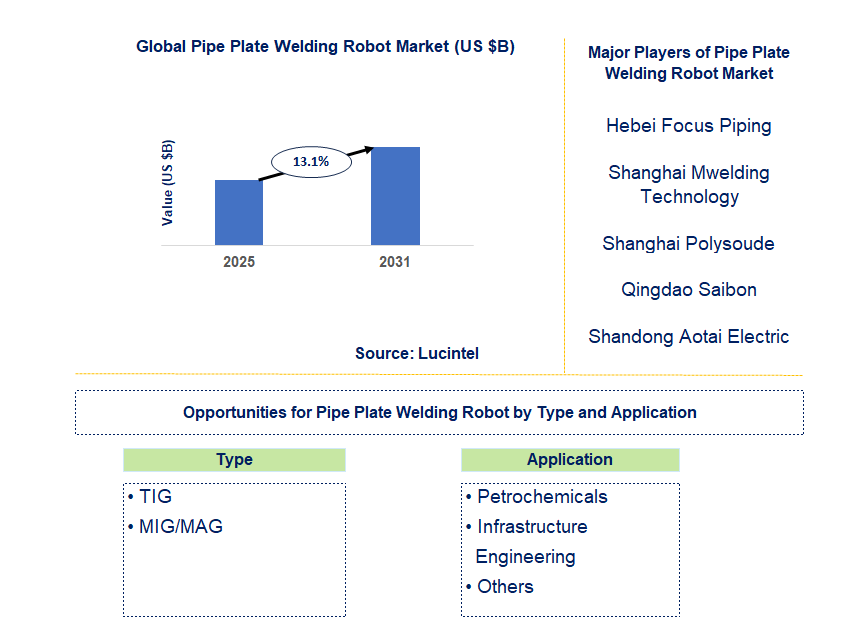
Key data points: The growth forecast = 13.1% annually for the next 7 years. Scroll below to get more insights. This market report covers Trends, opportunities and forecasts in pipe plate welding robot market to 2031 by type (TIG and MIG/MAG), application (petrochemicals, infrastructure engineering, and others), and region (North America, Europe, Asia Pacific, and the Rest of the World)
We'll send your sample report shortly.
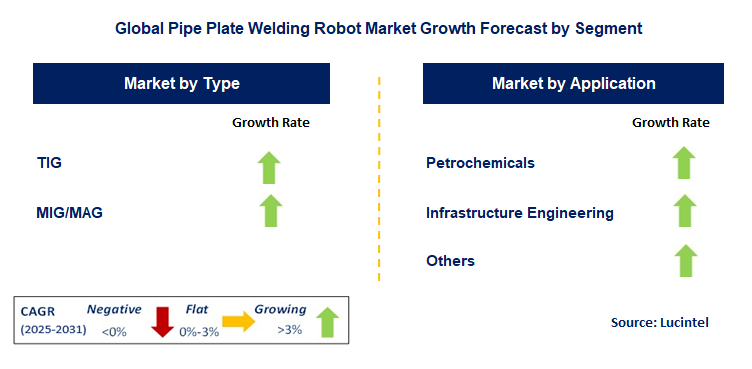
• Lucintel forecasts that, within the type category, mig/mag is expected to witness higher growth over the forecast period.
• Within the application category, petrochemical is expected to witness higher growth.
• In terms of region, APAC is expected to witness the highest growth over the forecast period.
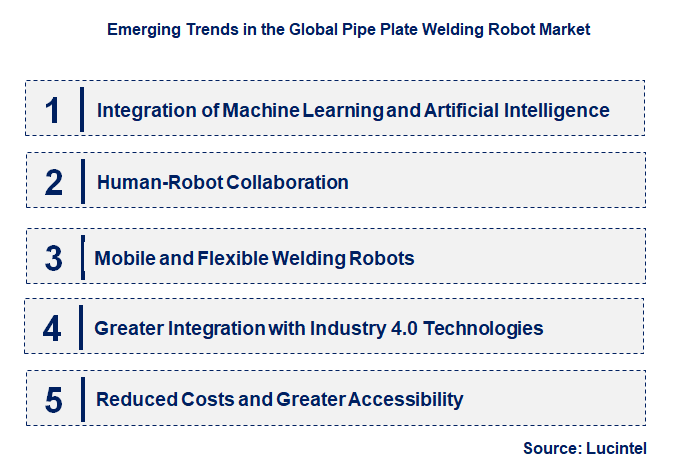
• Integration of Machine Learning and Artificial Intelligence: With the integration of machine learning and artificial intelligence into pipe plate welding robots, their capability to learn from complex tasks is being enhanced. These machines are capable of learning from past operations in order to optimize welding parameters and enhance weld quality. Robotic systems operated with artificial intelligence can also identify faults in real-time, making them more accurate and less prone to human errors. This integration has a greater effect in those industries where precision welding is a critical factor, including the aerospace and automotive industries.
• Human-Robot Collaboration: Cobots or collaborative robots are increasingly used in welding operations, allowing human and robot collaboration. These robots are meant to aid workers by doing risky or repetitive jobs, thus improving safety and productivity. Cobots with improved sensors and artificial intelligence can adjust to different welding operations, which allows for increased flexibility in production processes. The trend is highly useful in manufacturing sectors where labor is still necessary but where robot support can enhance efficiency and safety.
• Mobile and Flexible Welding Robots: There is increased demand for flexible and mobile pipe plate welding robots that can conform to different welding conditions. These robots are easily transportable from job site to job site, which makes them well-suited for construction and shipbuilding, where the welding environment can change dramatically. Mobile robots enable more productive operations, as they can be quickly repositioned, minimizing downtime and maximizing productivity. These systems are also facilitating the construction and installation of pipelines and other large structures.
• Greater Integration with Industry 4.0 Technologies: The combination of pipe plate welding robots with Industry 4.0 technologies like IoT, cloud computing, and big data analytics is revolutionizing the welding process. They facilitate real-time data capture and remote monitoring, which supports improved working efficiency and less downtime. Integration with Industry 4.0 helps manufacturers optimize welding processes, monitor performance, and ensure consistent quality across production runs. This trend is particularly prevalent in the manufacturing and automotive sectors, where high degrees of automation and data analysis are critical.
• Reduced Costs and Greater Accessibility: With the improvement of technology, the price of pipe plate welding robots is consistently going down, making them increasingly accessible to a wider variety of industries. Manufacturers are working on developing cost-effective robotic solutions that provide a high return on investment for small and medium-sized businesses. This trend is creating new markets for industries that were not in the past able to afford sophisticated robotic systems, broadening the market for pipe plate welding robots and their uptake in industries such as construction, oil and gas, and shipbuilding. The pipe plate welding robot market trends are primarily driven by developments in automation, AI, mobility, and cost reduction. As the technologies develop further, pipe plate welding robots are increasingly being incorporated into manufacturing processes in different industries. The rising adoption of Cobots, flexible robots, and Industry 4.0 technologies is not only enhancing productivity but also making welding operations more precise and efficient. The trends are putting the market on a path to significant growth, with an emphasis on precision, flexibility, and affordability.
• Robotic Welding Technology Advances: Recent technological advances in robotic welding have enabled the automation of intricate welding processes that were once carried out manually. It is now possible to equip robots to perform a broad array of welding processes, including TIG and MIG welding, with a high degree of accuracy. It is possible through these developments to produce welds faster, with greater accuracy and consistency, producing higher-quality products and lower-cost operations in car manufacturing, airplanes, and the construction industry.
• Higher Use of AI and Machine Learning: One of the latest highlights has been the integration of AI and machine learning into pipe plate welding robots. AI enables the robots to learn from every welding process and refine the process for improved outcomes. These systems are capable of modifying welding parameters in real-time, identifying defects, and correcting them automatically. This innovation is enhancing weld quality, minimizing human error, and boosting productivity, especially in industries that demand high-precision welding, like aerospace and shipbuilding.
• Flexible Welding Robots: Flexible welding robots have been created to offer more flexibility in different work environments. These robots can be used in various locations, like large construction projects or offshore oil rigs, where it is impossible to use traditional fixed welding systems. Mobile welding robots are simple to move and relocate, enabling easier operations and less manual labor. This technology is revolutionizing construction, energy, and shipbuilding industries where mobility is imperative.
• Robotic Welding Systems for Complex Geometries: Recent advancements in robotic welding systems have been aimed at enhancing the robots' capacity to weld complex geometries with high accuracy. The systems can now handle shapes that are irregular and complicated spots, thereby making them suitable for sectors such as aerospace and automotive manufacturing. High-tech sensors and vision systems enable robots to identify and adapt to shape and position variations, ensuring weld quality in hard-to-reach locations. This feature is pushing the application of welding robots in complex manufacturing environments.
• Cost Savings and Affordability for SMEs: Recent strides in lowering the cost of robotic systems have rendered sophisticated pipe plate welding robots more affordable for small and medium-sized businesses. Now that they are more affordable, these robots can be accessed by companies that once could not afford the initial cost. This shift is opening the market for robotic welding systems so that smaller manufacturers can enjoy automation, lower the cost of labor, and increase product quality. Recent innovations in the pipe plate welding robot market are furthering the abilities of these systems, making them more adaptable, affordable, and accurate. Ranging from AI integration to mobile robots and welding process advancements, these innovations are revolutionizing the welding sector. The growing implementation of sophisticated robotic solutions is boosting efficiency and precision across industries, setting the market for further growth.
• Oil and Gas Industry: The oil and gas sector is a major growth driver for the pipe plate welding robot market. Robot welding systems are gaining widespread application in pipeline construction and maintenance, where reliability and precision are paramount. The capability of robots to achieve repeat welds in hostile conditions, including offshore oil rigs, is a strong driver for the technology. The trend is anticipated to continue with increasing demand for safer and more efficient welding systems in the energy industry.
• Shipbuilding Industry: The shipbuilding sector is increasingly using robotic welding systems to weld pipes and plates. Robots can work in tight spaces and execute intricate welding operations, typical in ship building. As there is a higher demand for cost-efficient ship construction, the use of welding robots will continue to grow, allowing shipbuilders to lower labor expenses and enhance overall product quality.
• Aerospace and Automotive Sectors: The aerospace and automotive sectors are leading users of robotic welding systems because of the demand for high-precision, consistent welds. Robotic systems are especially beneficial in producing complicated components, where weld quality is critical. As these sectors continue to expand, the demand for welding robots with the ability to perform complex and challenging welding jobs will grow. This offers a tremendous chance for robot makers to create specialized systems that suit these industries.
• Construction and Infrastructure Projects: Construction companies are requiring more automated welding systems for massive infrastructure projects. Robotic welding technology is an ideal application in the construction of pipelines, bridges, and other huge structures, where constant quality and throughput are essential. The increasing demand for automation in construction is opening up new possibilities for welding robots, particularly with the industry aiming to enhance efficiency and lower labor costs.
• Emerging Markets: Emerging markets, especially in Southeast Asia, Latin America, and Africa, offer considerable growth prospects for the pipe plate welding robot market. As the regions invest in industrialization and infrastructure development, the demand for welding automation technology is likely to increase. The trend is providing opportunities for robot manufacturers to make inroads and provide affordable solutions to industries in these emerging economies. The pipe plate welding robot industry provides several growth opportunities in key industries such as oil and gas, shipbuilding, aerospace, automotive, and construction. As automation increasingly plays a key role in enhancing efficiency, lowering costs, and increasing quality, there are plenty of opportunities for companies to increase their footprint in developed and emerging economies. These opportunities for growth are likely to spur further innovation and implementation of robotic welding systems.
• Hebei Focus Piping
• Shanghai Mwelding Technology
• Shanghai Polysoude
• Qingdao Saibon
• Shandong Aotai Electric
• TIG
• MIG/MAG
• Petrochemicals
• Infrastructure Engineering
• Others
• North America
• Europe
• Asia Pacific
• The Rest of the World
• United States: Within the United States, the pipe plate welding robot market is evolving with greater uptake within industries like the oil and gas sector, the shipbuilding sector, and construction. U.S. companies are leveraging next-generation robotics and AI solutions to increase the accuracy, speed, and efficiency of welding processes. Robot systems are especially beneficial in the energy industry, where good welds need to be produced for pipeline installations. In addition, efforts are being made to merge Industry 4.0 technology with robotic systems to optimize processes, enhance productivity, and minimize downtime, establishing the U.S. as a leading provider of robotic welding solutions.
• China: China is fast expanding in the pipe plate welding robot market due to its growing manufacturing and infrastructure industries. As there is a growing need for automation in shipbuilding, energy, and construction sectors, China has heavily invested in the development of advanced welding robots. Chinese producers are working to increase the affordability and availability of robotic systems for small and medium businesses. The combination of machine learning and AI is also assisting Chinese businesses in enhancing welding precision and speed, enabling higher efficiency in production and the execution of large-scale projects.
• Germany: Germany is among the leaders in embracing robotics in welding processes, especially in sectors such as automobile manufacturing, shipbuilding, and construction. German businesses are famous for their precision pipe plate welding robots, which integrate robotics, laser technologies, and automation. With a strong emphasis on quality control and operational effectiveness, Germany has continued to advance state-of-the-art welding robots that satisfy high industry standards. The German market has also witnessed greater collaboration between companies and universities to promote innovation in welding robotics, further solidifying its leadership role in the world.
• India: India's pipe plate welding robot market is growing steadily, led mainly by the growth of the manufacturing, infrastructure, and energy industries. The increasing application of automation across the steel production, shipbuilding, and pipeline industries is driving the adoption of welding robots. Small and medium-sized enterprises are being enabled to use leading robotic solutions through cost-competitive automation solutions by Indian firms. In addition, there is an increasing need for trained personnel to service and maintain these systems, which will present a need for training and development in the labor force.
• Japan: Japan is a head in robotics for many decades and its pipe plate welding robot market continues to expand. The nation is especially interested in automating sophisticated welding operations in industries like the automotive, aerospace, and construction sectors. Japanese producers are creating sophisticated robotic systems with high accuracy and reliability, frequently combined with sensors and artificial intelligence for enhanced process monitoring. Japan's emphasis on innovation and high-quality standards is propelling the creation of robots that can perform various welding applications, making it a dominant force in the international welding robot market.


• Hebei Focus Piping
• Shanghai Mwelding Technology
• Shanghai Polysoude
• Qingdao Saibon
• Shandong Aotai Electric Q5. Which pipe plate welding robot market segment will be the largest in future? Answer: Lucintel forecasts that, within the type category, mig/mag is expected to witness higher growth over the forecast period. Q6. In pipe plate welding robot market, which region is expected to be the largest in next 5 years? Answer: In terms of region, APAC is expected to witness the highest growth over the forecast period. Q7. Do we receive customization in this report? Answer: Yes, Lucintel provides 10% customization without any additional cost.


Choose a license that fits your team. Instant PDF delivery.
Prices exclude taxes. Instant delivery. Custom licensing available on request.
Market Report · July 31, 2026
Market Report · July 22, 2026
Market Report · July 20, 2026
Trusted partner for strategic intelligence and business growth


Receive a complimentary market analysis tailored to your industry. Our analysts will identify key growth opportunities and competitive dynamics specific to your business.

Market size, growth rate, and key trend analysis for your specific sector.

Top competitor positioning and market share analysis.

Strategic recommendations backed by data-driven insights.
Get curated market intelligence and competitive moves straight to your inbox.
By subscribing, you agree to receive our monthly insights. Unsubscribe anytime.
Receive a complimentary market analysis tailored to your industry. Our analysts will identify key growth opportunities and competitive dynamics specific to your business.
Market size, growth rate, and key trend analysis for your specific sector.
Top competitor positioning and market share analysis.
Strategic recommendations backed by data-driven insights.
Get curated market intelligence, emerging trends, and competitive moves straight to your inbox each month.
By subscribing, you agree to receive our monthly insights. Unsubscribe anytime.
We'll send your sample report shortly.