
Report Feature
Photovoltaic Material Market Trends and Forecast
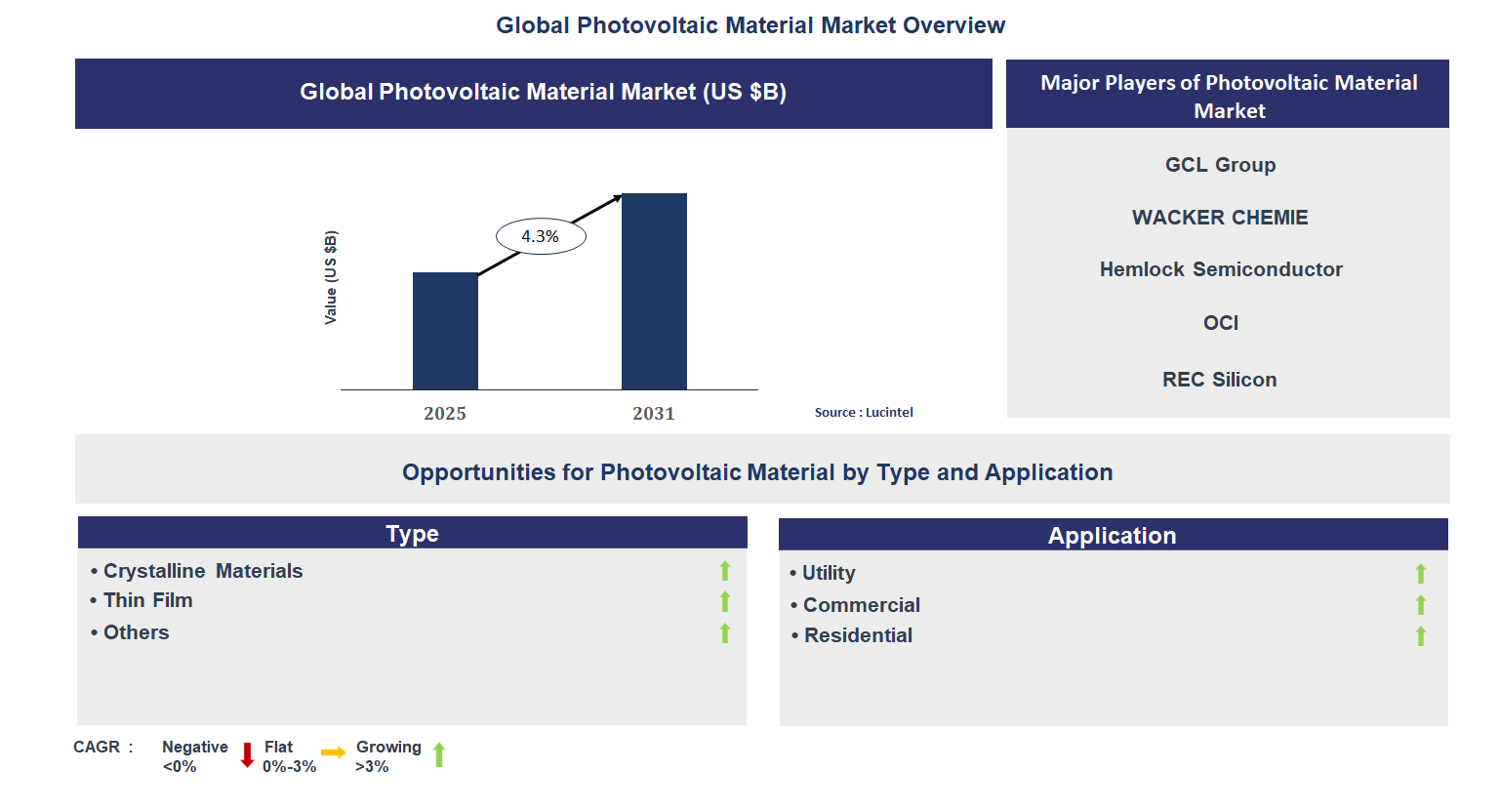
The future of the global photovoltaic material market looks promising with opportunities in the utility, commercial, and residential markets. The global photovoltaic material market is expected to grow with a CAGR of 4.3% from 2025 to 2031. The major drivers for this market are the increasing demand for efficient solar technologies, the rising investments in renewable energy projects, and the growing adoption of advanced photovoltaic materials.• Lucintel forecasts that, within the type category, thin film is expected to witness higher growth over the forecast period.
• Within the application category, utility is expected to witness the highest growth.
• In terms of region, APAC is expected to witness the highest growth over the forecast period. Gain valuable insights for your business decisions with our comprehensive 150+ page report. Sample figures with some insights are shown below.
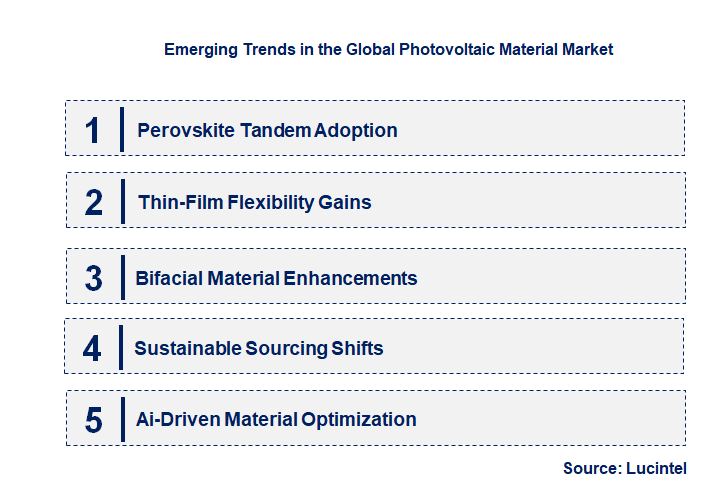
Emerging Trends in the Photovoltaic Material Market
Emerging trends in the photovoltaic material market reflect a shift toward high-efficiency hybrids and sustainable sourcing, amid escalating renewable integrations. Innovations in perovskites and thin-films are optimizing yields and flexibility, enabling broader adoption in urban and off-grid settings.• Perovskite Tandem Adoption: Perovskite-silicon tandems achieve over 30% efficiencies, stacking layers for spectrum-wide capture. This boosts outputs in varied climates, slashes LCOE for rooftops and farms, and accelerates commercialization via licensing, transforming utility-scale economics.
• Thin-Film Flexibility Gains: Lightweight CIGS and organic films suit curved BIPV and portables, reducing weights by half. Impacts expand wearables and vehicles, cut installation costs, and enable seamless building integrations, democratizing solar in space-constrained urban applications.
• Bifacial Material Enhancements: Dual-sided silicon with reflective coatings capture albedo for 10-30% yield uplifts. This optimizes agrivoltaics and ground-mounts, diversifies land uses, and shortens paybacks, supporting rural renewables without arable trade-offs.
• Sustainable Sourcing Shifts: Recyclable encapsulants and bio-based backsheets minimize waste in end-of-life panels. The trend aligns with regulations, cuts environmental footprints, and unlocks incentives, fostering circular economies in manufacturing hubs.
• AI-Driven Material Optimization: Analytics refine perovskite stability and silicon purity for predictive performance. This minimizes defects, enhances longevity, and tailors formulations, driving cost-effective scaling in global supply chains. These trends are reshaping the photovoltaic material market by prioritizing efficiency and circularity. They bridge performance gaps, spawn niche integrations, and align with decarbonization, elevating materials as enablers of scalable, resilient solar ecosystems.
Recent Development in the Photovoltaic Material Market
Recent developments in the photovoltaic material market underscore perovskite milestones and supply localizations amid capacity surges. These innovations are pivotal for yield leaps and resilience, facilitating global renewable scaling.• Trinasolar Tandem Record: Trinasolars perovskite-silicon cell hits 31.1% efficiency, licensing Oxford PV tech for mass production. This elevates low-light yields, cuts costs for farms, and accelerates domestic hybrids in export markets.
• DuPont Tedlar Frontsheet Launch: DuPont unveils protective frontsheets for mobiles and RVs at SNEC, enhancing durability in mild climates. It extends panel lifespans, broadens portable applications, and streamlines BIPV assemblies.
• India Ingot Commissioning: First 2GW ingot and wafer facilities online, tripling cell capacity via PLI. This curbs imports, empowers tenders, and fortifies silicon chains for rural and utility expansions.
• NEDO Next-Gen Projects: Japans 24-theme initiative funds perovskites and recycling for carbon neutrality. It advances flexible films, stabilizes tandems, and integrates grids, boosting urban resilience.
• EU Perovskite Partnership: Commissions €260M collaboration spurs material innovations for market edge. This fuels R&D in tandems, standardizes BIPV, and harmonizes policies across members. These developments are impacting the photovoltaic material market by embedding breakthroughs and local strengths. They mitigate vulnerabilities, catalyze efficiencies, and deepen sustainability, propelling toward inclusive energy infrastructures.
Strategic Growth Opportunities in the Photovoltaic Material Market
Strategic growth opportunities in the photovoltaic material market stem from sectoral synergies, as clean demands escalate. Advanced materials unlock potentials in high-yield areas, from grids to buildings, leveraging policies for expansive scaling.• Utility-Scale Farms: High-purity silicon and perovskites for megafarms yield bulk efficiencies. They overhaul LCOE via tandem gains, stabilize grids, and offset carbons in large operations.
• Residential Rooftops: Flexible thin-films enable home independence with metering. Bill cuts, value boosts, microgrid scalings resiliently in urban homes.
• Commercial Facades: BIPV perovskites merge generation in offices aesthetically. Cost trims, fulfillments, credits energize electrified HVAC pledges.
• Agrivoltaic Hybrids: Bifacial encapsulants optimize farmlands energy-crops. Diversifications preserve resources, boom rural renewables.
• Off-Grid Remote Kits: Lightweight organics power isolates durably. Developments enable digital access, micros via reliable provisions. These opportunities are impacting the photovoltaic material market by diversifying scopes and streams. They fuse applications, engage stakeholders, reinforce centrality in evolutions.
Photovoltaic Material Market Driver and Challenges
The photovoltaic material market is influenced by technological leaps, economic incentives, and regulatory harmonies advancing clean transitions. These dynamics are key for yield boosts, cost parity, and alignment with electrification imperatives. The factors responsible for driving the photovoltaic material market include: 1. Renewable Demand Escalations: Global clean shifts necessitate high-yield materials for grids. This spurs perovskite R&D, hybrid integrations, curbing emissions in utility scales. 2. Policy Incentive Frameworks: Subsidies fund deployments and manufacturing. They lower risks, unify benchmarks, embed materials in national renewables equitably. 3. Cost Deflation Advances: Scale and tandem refinements democratize access. Paybacks hasten, demands stimulate infrastructures competitively. 4. Electrification Sector Surges: Transport and digital needs expansive PV. Materials spur load balances versus fossil instabilities. 5. Tech Yield Boosts: Perovskite and thin-film amplify outputs. Footprints minimize, durabilities enhance, climates unlock. Challenges in the photovoltaic material market are: 1. Raw Material Volatility: Silica and rare earth fluctuations inflate costs. This strains margins, delays projects, pressures sourcing diversifications for stability. 2. Scalability Integration Barriers: Uniform perovskite depositions falter at volumes. Complexities delay commercializations, demand standardized protocols, risk quality variances. 3. Trade Restriction Impacts: Expanding tariffs and bans expose chains to frictions. They hike interim outlays, tangle timelines, challenge global flows. Drivers and challenges converge in the photovoltaic material market, netting positives through innovations. This balance nurtures trajectories, interlacing resilience equity into lasting motifs.List of Photovoltaic Material Companies
Companies in the market compete on the basis of product quality offered. Major players in this market focus on expanding their manufacturing facilities, R&D investments, infrastructural development, and leverage integration opportunities across the value chain. With these strategies photovoltaic material companies cater increasing demand, ensure competitive effectiveness, develop innovative products & technologies, reduce production costs, and expand their customer base. Some of the photovoltaic material companies profiled in this report include-• GCL Group
• WACKER CHEMIE
• Hemlock Semiconductor
• OCI
• REC Silicon
• TBEA
• SunEdision
• Sichuan Yongxiang
• KCC
• Tokuyama
Photovoltaic Material Market by Segment
The study includes a forecast for the global photovoltaic material market by type, application, and region.Photovoltaic Material Market by Type [Value from 2019 to 2031]:
• Crystalline Materials
• Thin Film
• Others
Photovoltaic Material Market by Application [Value from 2019 to 2031]:
• Utility
• Commercial
• Residential
Photovoltaic Material Market by Region [Value from 2019 to 2031]:
• North America
• Europe
• Asia Pacific
• The Rest of the World
Country Wise Outlook for the Photovoltaic Material Market
The photovoltaic material market is advancing swiftly, propelled by global renewable energy mandates and innovations in efficiency-enhancing compounds. Key nations are prioritizing perovskite and silicon hybrids, alongside localized production to mitigate supply risks, fostering resilient solar infrastructures for utility and distributed applications.• United States: The United States is expanding silicon and thin-film material manufacturing via incentives like the Inflation Reduction Act, with DOE funding next-generation targets for CIGS and CdTe. These efforts address rare earth disruptions, enhance BIPV and bifacial panels, and support utility-scale resilience amid trade tensions.
• China: China leads with Trinasolars tandem perovskite breakthroughs and vast wafer production dominance, licensing foreign tech for domestic scaling. These advancements lower costs for highland farms and exports, optimizing thin-film and silicon blends while curbing overcapacity through bidding reforms.
• Germany: Germany advances BIPV glass and patterned conductors via Fraunhofer ISE, integrating perovskites for facade efficiencies. EU grants promote rooftop and agrivoltaic uses, aligning with renewables targets and enhancing urban manufacturing durability against grid strains.
• India: India triples cell manufacturing with PLI schemes, commissioning ingot facilities and tendering for perovskites in rural kits. Domestic mandates curb imports, bolstering silicon wafers and thin-films for utility and off-grid, driving self-reliance and economic multipliers.
• Japan: Japan subsidizes lightweight perovskite films for urban BIPV and new building roofs, with NEDO projects advancing tandem stability. These innovations optimize space-limited deployments, enhancing electronics and transport integrations for resilient, high-efficiency solar.

Features of the Global Photovoltaic Material Market
Market Size Estimates: Photovoltaic material market size estimation in terms of value ($B). Trend and Forecast Analysis: Market trends (2019 to 2024) and forecast (2025 to 2031) by various segments and regions. Segmentation Analysis: Photovoltaic material market size by type, application, and region in terms of value ($B). Regional Analysis: Photovoltaic material market breakdown by North America, Europe, Asia Pacific, and Rest of the World. Growth Opportunities: Analysis of growth opportunities in different types, applications, and regions for the photovoltaic material market. Strategic Analysis: This includes M&A, new product development, and competitive landscape of the photovoltaic material market. Analysis of competitive intensity of the industry based on Porter’s Five Forces model.
FAQ
Q1. What is the growth forecast for photovoltaic material market? Answer: The global photovoltaic material market is expected to grow with a CAGR of 4.3% from 2025 to 2031. Q2. What are the major drivers influencing the growth of the photovoltaic material market? Answer: The major drivers for this market are the increasing demand for efficient solar technologies, the rising investments in renewable energy projects, and the growing adoption of advanced photovoltaic materials. Q3. What are the major segments for photovoltaic material market? Answer: The future of the photovoltaic material market looks promising with opportunities in the utility, commercial, and residential markets. Q4. Who are the key photovoltaic material market companies? Answer: Some of the key photovoltaic material companies are as follows:• GCL Group
• WACKER CHEMIE
• Hemlock Semiconductor
• OCI
• REC Silicon
• TBEA
• SunEdision
• Sichuan Yongxiang
• KCC
• Tokuyama Q5. Which photovoltaic material market segment will be the largest in future? Answer: Lucintel forecasts that, within the type category, thin film is expected to witness higher growth over the forecast period. Q6. In photovoltaic material market, which region is expected to be the largest in next 5 years? Answer: In terms of region, APAC is expected to witness the highest growth over the forecast period. Q7. Do we receive customization in this report? Answer: Yes, Lucintel provides 10% customization without any additional cost.
Table of Contents
List of Figures
List of Tables
Methodology
- In-depth interviews of the major players in this market
- Detailed secondary research from competitors’ financial statements and published data
- Extensive searches of published works, market, and database information pertaining to industry news, company press releases, and customer intentions
- A compilation of the experiences, judgments, and insights of Lucintel’s professionals, who have analyzed and tracked this market over the years.


Buy Now
Choose a license that fits your team. Instant PDF delivery.
Prices exclude taxes. Instant delivery. Custom licensing available on request.
Key Questions
- • What are some of the most promising, high-growth opportunities for the photovoltaic material market by type (crystalline materials, thin film, and others), application (utility, commercial, and residential), and region (North America, Europe, Asia Pacific, and the Rest of the World)?
- • Which segments will grow at a faster pace and why?
- • Which region will grow at a faster pace and why?
- • What are the key factors affecting market dynamics? What are the key challenges and business risks in this market?
- • What are the business risks and competitive threats in this market?
- • What are the emerging trends in this market and the reasons behind them?
- • What are some of the changing demands of customers in the market?
- • What are the new developments in the market? Which companies are leading these developments?
- • Who are the major players in this market? What strategic initiatives are key players pursuing for business growth?
- • What are some of the competing products in this market and how big of a threat do they pose for loss of market share by material or product substitution?
- • What M&A activity has occurred in the last 5 years and what has its impact been on the industry? For any questions related to Photovoltaic Material Market, Photovoltaic Material Market Size, Photovoltaic Material Market Growth, Photovoltaic Material Market Analysis, Photovoltaic Material Market Report, Photovoltaic Material Market Share, Photovoltaic Material Market Trends, Photovoltaic Material Market Forecast, Photovoltaic Material Companies, write Lucintel analyst at email: helpdesk@lucintel.com. We will be glad to get back to you soon.


