
Market Report · July 22, 2026

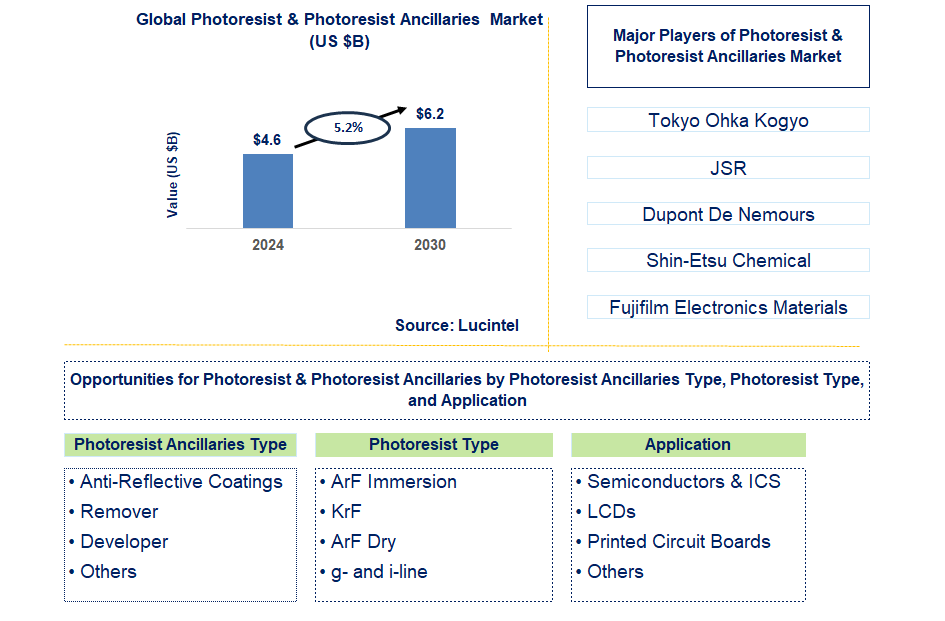
Key data points: The market size in 2030 = $6.2 billion, growth forecast = 5.2% annually next 6 years. Scroll below to get more insights. This market report covers trends, opportunities, and forecast in the global photoresist & photoresist ancillaries market to 2030 by photoresist ancillaries type (anti-reflective coatings, remover, developer, and others), photoresist type (ArF immersion, KrF, ArF dry and g- and i-line), application (semiconductors & ICS, LCDs, printed circuit boards, and others), and region (North America, Europe, Asia Pacific, and the Rest of the World)
We'll send your sample report shortly.
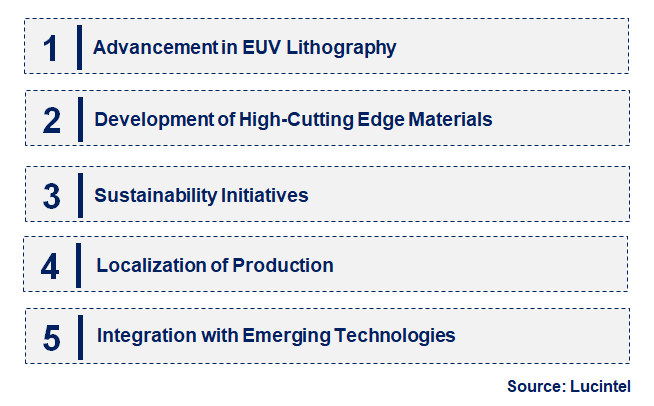
• Advancement in EUV Lithography: There is an increased inclination towards extreme ultraviolet (EUV) lithography in modern day semiconductor manufacturing. With the increased miniaturization of components in a chip, the integration of EUV photoresists is becoming a centre of focus in the available funding for the overall R&D efforts.
• Development of High-Cutting Edge Materials: There is a growing trend in the market for high resist volume towards designing and fabricating high resist materials which can endure the processes of advanced lithography that includes the use of nanoimprint as well as multi-patterning lithography.
• Sustainability Initiatives: There is an increasing attention to developing environmentally friendly photoresist materials and processes. With huge conservation efforts worldwide and consumerism being at an all-time high, companies have no choice but to seek for ecofriendly, regulatory and consumer targeted materials and practices.
• Localization of Production: There is an increasing tendency of establishing local production of photoresist in key geographical markets with the aim of reducing supply chain risks. This phenomenon can be seen in regions like the U.S and China where there is an increasing attempt to cut down on the dependence on overseas vendors.
• Integration with Emerging Technologies: Increasingly, the photoresists are being integrated with new technologies such as flexible electronics and 3D printing. This integration is fostering new advancements in the characteristics and the utilization of the materials. Photoresist and photoresist ancillaries market has been eased sufficiently with the emergence of westernization of more advanced, more rigorous, and, more, localized production processes. Energy consequential focus directed towards precise and EUV lithography materials is raising the bar higher and higher while the greenness and technology integration aspects are pleasing environmentalists and enhancing scope respectively.
• Specialization of Increasingly Advanced Materials for EUV Photoresists: There is currently great development of EUV photoresists aimed at the modern lithography equipment allowing the manufacture of small and efficient devices from semiconductors. This advancement is very important to cope with Moore’s Law.
• Growth in Local Production Facilities: There is an increasing trend towards the setting up of local production facilities especially in the U.S. and China. This tendency is propelled by the need to cut down on supply chain risks and strengthen manufacturing within the country.
• Sustainability and Green Chemistry: The company is shifting towards the use of more environmentally friendly photoresist materials. There is a trend in companies towards green chemistry in order to be compliant with the international market standards.
• Enhanced Collaboration with Research Institutions: Cooperation of industry stakeholders with research institutes is leading to new possibilities in the field of photoresist technologies development. Such partnerships are highly beneficial for the development of the new generation materials and processes.
• Expansion in Emerging Markets: The market for photoresist is growing in developing nations, the likes of India, and Southeast Asia. The market is on the upward trend as a response to the rising construction works in semiconductor manufacturing and electronic fields. These advancements are progressively affecting the photoresist & photoresist ancillaries market as it relates to improving technology, increasing sustainability, and engaging in local production. The emphasis on partnership and market penetration within developing economies is transforming the landscape of the industry fostering change and expansion.
• Advanced Semiconductor Manufacturing: As EUV lithography continues to emerge, this provides a great deal of scope for development in the market for photoresist compositions for advanced semiconductor fabrication. This involves imbuing materials with the ability to manufacture smaller and precise features.
• Flexible Electronics: The market has growth prospects since there is development of photo resist for flexible and printed electronics. This use case is growing with increased usage of smart wearable technologies and flexible displays.
• 3D Printing: This also opens a new avenue in the growth of use of photoresists for 3D printing technology. For high-detailed or high-complexity structures created through 3D printing, high-performance photoresists will be required, particularly in the health and automotive industries.
• Green and Sustainable Products: There is an increased market for green photoresist materials. Focusing on the production of greener products that meet the required standards can help in wooing consumers who are interested in high technology.
• Localized Production Capabilities: There is potential for resource mobilization by diversifying the company’s operations through capturing the local markets by building local production facilities in regions like the USA, China, and India. This method also assists in reducing supply chain risks and the ability to serve local needs more readily. These strategic growth opportunities highlight the evolving landscape of the photoresist & photoresist ancillaries market. There is also a way out by addressing the emerging trends by the stakeholders through advanced semiconductor applications, flexible electronics, and sustainability.
• Tokyo Ohka Kogyo
• JSR
• Dupont De Nemours
• Shin-Etsu Chemical
• Fujifilm Electronics Materials
• Sumitomo Chemical
• Merck Az Electronics
• Allresist
• Anti-Reflective Coatings
• Remover
• Developer
• Others
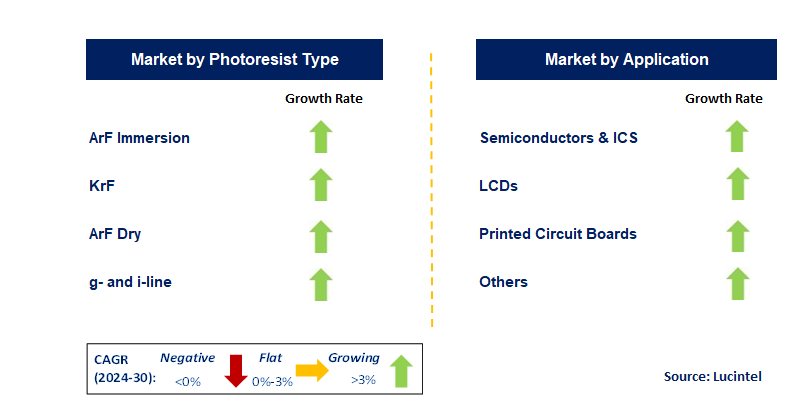
• ArF Immersion
• KrF
• ArF Dry
• g- and i-line
• Semiconductors & ICS
• LCDs
• Printed Circuit Boards
• Others
• North America
• Europe
• Asia Pacific
• The Rest of the World
• United States: With regard to these, recently, there has been improvement of extreme ultraviolet (EUV) photoresists by major semiconductor manufacturers like Intel and TSMC in the U. S. At present, the focus is on building the in-house capabilities for production to avoid large dependence on the suppliers from other countries. Another such trend is a growing investment for R&D on next generation photoresist orientation materials, which is to address adoption of advanced semiconductor fabrication.
• China: Like its other industries, China is also speeding up the development of photoresists for its growing semiconductor market. Efforts are being made to develop high-performance photoresist materials but this time sourced from within the country to curb imports. There are recent developments at the electronics market which include entering into joint ventures with foreign companies and increasing investments in advanced photoresist research and development to cope with the emerging needs in the market.
• Germany: Germany has taken significant steps towards the development of new photoresist materials for new lithography technologies, notably automotive and industrial electronics. The high-end manufacturing and green technology focus within the country is offering new opportunities in photoresist materials. The partnership of German semiconductor companies and research institutions is changing the game on how photoresists work and how efficient they can be in functionalities.
• India: With a drive to establish a semiconductor manufacturing capability, India’s photoresist market is gaining ground. Some of these new trends are localization of production and improvement of photoresist materials for electronics. Initiatives by the government to promote the domestic semiconductor industry are also helping the photoresist market register vast growth and development.
• Japan: In addition to that, Japan has been able to remain dominant in producing new photoresist materials especially those meant for advanced lithography systems. Photoresist manufacturers in Japan are actively developing the quality and usability of the photoresist products based on the advanced semiconductor technology. The strategy of Japan includes considerable resources allocated for R&D and partnership with world tech companies.
• Tokyo Ohka Kogyo
• JSR
• DuPont de Nemours
• Shin-Etsu Chemical
• Fujifilm Electronics Materials
• Sumitomo Chemical
• Merck Az Electronics
• Allresist Q6. Which photoresist & photoresist ancillaries market segment will be the largest in future? Answer: Lucintel forecasts that krf will remain the largest segment over the forecast period due to continuous technological progress in resolution enhancement techniques, such as off-axis illumination, proximity correction, and phase-shifting masks. Q7. In photoresist & photoresist ancillaries, which region is expected to be the largest in next 5 years? Answer: APAC will remain the largest region over the forecast period due to numerous influential industry leaders, growing trend towards device miniaturization, the emergence of autonomous and connected vehicles driven by the automotive sector's rapid growth, and increased consumer adoption of electronic devices. Q.8 Do we receive customization in this report? Answer: Yes, Lucintel provides 10% customization without any additional cost.


Choose a license that fits your team. Instant PDF delivery.
Prices exclude taxes. Instant delivery. Custom licensing available on request.
Market Report · July 22, 2026
Market Report · July 22, 2026
Market Report · July 22, 2026
Trusted partner for strategic intelligence and business growth


Receive a complimentary market analysis tailored to your industry. Our analysts will identify key growth opportunities and competitive dynamics specific to your business.

Market size, growth rate, and key trend analysis for your specific sector.

Top competitor positioning and market share analysis.

Strategic recommendations backed by data-driven insights.
Get curated market intelligence and competitive moves straight to your inbox.
By subscribing, you agree to receive our monthly insights. Unsubscribe anytime.
Receive a complimentary market analysis tailored to your industry. Our analysts will identify key growth opportunities and competitive dynamics specific to your business.
Market size, growth rate, and key trend analysis for your specific sector.
Top competitor positioning and market share analysis.
Strategic recommendations backed by data-driven insights.
Get curated market intelligence, emerging trends, and competitive moves straight to your inbox each month.
By subscribing, you agree to receive our monthly insights. Unsubscribe anytime.
We'll send your sample report shortly.