
Market Report · May 18, 2026

Key data points: The market size in 2035 = $268 million, growth forecast = 4.0% annually for the next 8 years. Scroll below to get more insights. This market report covers trends, opportunities and forecasts in phenolic resin in composite market to 2035 by process (compression molding, prepreg molding, hand layup, poltrusion, and others), application (automotive, E&E, aerospace & defense, mass transit, construction, and others), and region (North America, Europe, Asia Pacific, and the Rest of the World)
We'll send your sample report shortly.
• Lucintel forecasts that, within the process category, compression molding is expected to witness the highest growth over the forecast period.
• Within the application category, automotive is expected to witness the highest growth.
• In terms of region, APAC is expected to witness the highest growth over the forecast period.
Gain valuable insights for your business decisions with our comprehensive 150+ page report. Sample figures with some insights are shown below.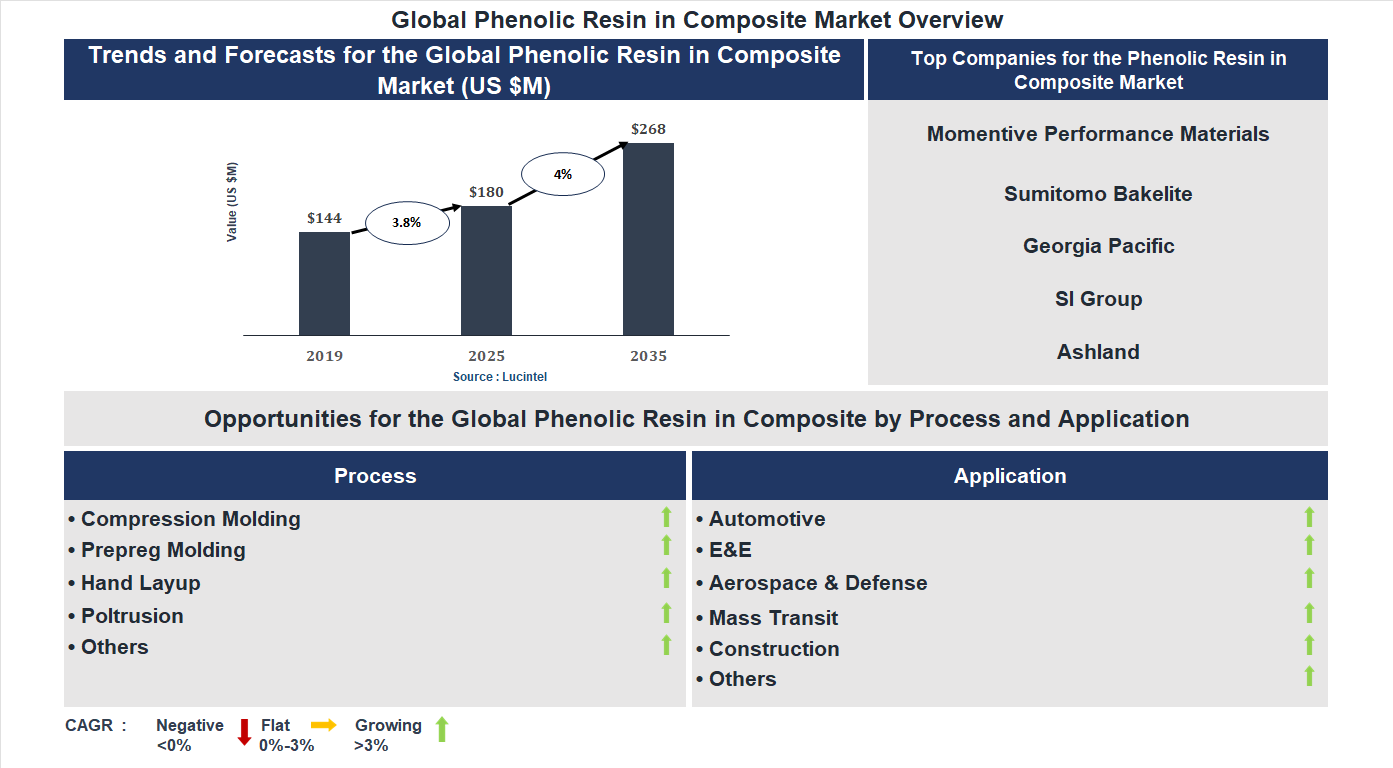
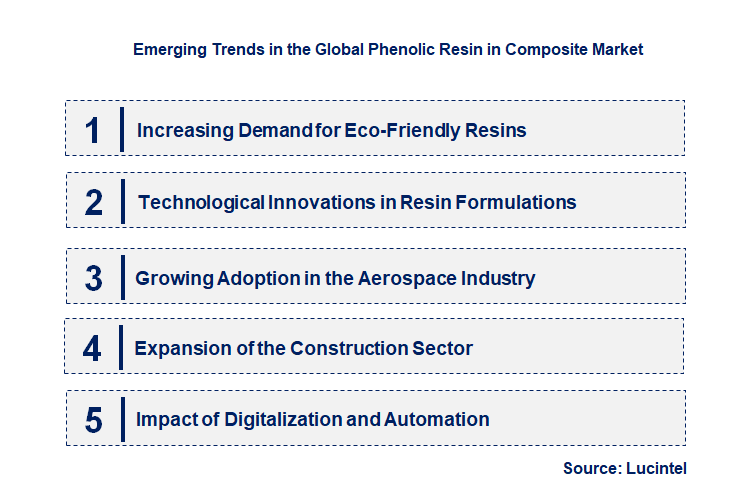
• Increasing Demand for Eco-Friendly Resins: Growing environmental awareness and stricter regulations are pushing manufacturers to develop bio-based and low-emission phenolic resins. These eco-friendly alternatives aim to reduce volatile organic compounds (VOCs) and carbon footprint, aligning with sustainability goals. This trend is expanding market opportunities in sectors prioritizing green materials, such as construction and automotive. Companies investing in sustainable resin technologies are gaining competitive advantages, fostering innovation, and meeting regulatory compliance, which ultimately enhances their market share and brand reputation.
• Technological Innovations in Resin Formulations: Advances in resin chemistry are leading to improved performance characteristics such as higher thermal stability, better flame retardancy, and enhanced mechanical properties. These innovations enable phenolic resins to be used in more demanding applications, including aerospace and high-performance composites. The development of modified resins with tailored properties is also expanding their versatility. Such technological progress is driving product differentiation, enabling manufacturers to meet specific customer needs and open new market segments, thereby fueling overall market growth.
• Growing Adoption in the Aerospace Industry: The aerospace sector‘s demand for lightweight, durable, and fire-resistant materials is boosting phenolic resin usage. These resins are ideal for core materials in sandwich panels and structural components due to their excellent thermal stability and flame retardance. As aerospace manufacturers seek to improve fuel efficiency and safety standards, phenolic resins are becoming increasingly integral. This trend is expected to significantly expand the market, with ongoing innovations further enhancing resin performance to meet the rigorous demands of aerospace applications.
• Expansion of the Construction Sector: Phenolic resins are increasingly used in construction for insulation, decorative panels, and fire-resistant coatings. The rising focus on energy efficiency and fire safety standards is driving demand for phenolic-based building materials. Additionally, the growth of green building initiatives encourages the use of sustainable and high-performance composites. This expansion is creating new opportunities for phenolic resin suppliers to develop specialized formulations suited for construction applications, thereby contributing to the overall market growth and diversification.
• Impact of Digitalization and Automation: The integration of digital technologies and automation in manufacturing processes is enhancing production efficiency, quality control, and customization capabilities. Advanced simulation tools and data analytics enable precise formulation adjustments and process optimization. This trend reduces costs, shortens development cycles, and allows for rapid response to market demands. As a result, companies can offer more innovative and tailored phenolic resin solutions, strengthening their competitive edge. Digitalization is also facilitating better supply chain management, ensuring timely delivery and fostering stronger customer relationships.
• Growing Aeman in Aerospace and Automotive Sectors: Phenolic resins are increasingly used in aerospace and automotive industries due to their high thermal stability, flame retardancy, and mechanical strength. This surge is driven by the need for lightweight, durable, and fire-resistant materials, which improve safety and performance. The expansion of these sectors, especially in electric vehicles and aircraft manufacturing, is expected to further boost phenolic resin consumption, creating lucrative opportunities for manufacturers and suppliers.
• Advancements in Bio-Based Phenolic Resins: The shift towards sustainable and eco-friendly materials has accelerated research into bio-based phenolic resins derived from renewable resources. These resins offer reduced environmental impact, lower carbon footprint, and comparable performance to traditional resins. The adoption of bio-based phenolic resins is gaining momentum in construction, packaging, and automotive applications, fostering innovation and opening new markets. This development aligns with global sustainability goals and regulatory pressures.
• Innovations in Manufacturing Processes: New manufacturing techniques, such as resin infusion and automated production, are enhancing efficiency, reducing costs, and improving resin quality. These innovations enable large-scale production with consistent properties, meeting the rising demand for high-performance composites. Improved process control also minimizes waste and energy consumption, supporting environmental sustainability. As a result, manufacturers can offer more competitive products, expand their market reach, and accelerate adoption across various industries.
• Increasing Adoption in Construction and Infrastructure: Phenolic resins are increasingly used in construction for insulation, laminates, and fire-resistant panels due to their excellent thermal and fire-retardant properties. The growing focus on building safety standards and energy efficiency is driving demand for phenolic-based composites. Infrastructure projects, especially in emerging economies, are adopting these materials for durability and safety reasons. This trend is expected to significantly expand the market, providing new growth avenues for industry players.
• Rising Focus on Environmental Regulations and Sustainability: Stricter environmental regulations are prompting manufacturers to develop eco-friendly phenolic resins with lower emissions and toxicity. Innovations in recycling and waste management are also gaining importance. These developments are encouraging the industry to adopt greener practices, which appeal to environmentally conscious consumers and clients. The focus on sustainability is shaping product development, influencing market dynamics, and fostering a shift towards more responsible manufacturing practices.
• Expansion into the Automotive Industry: Phenolic resins are increasingly used in automotive composites due to their excellent thermal stability, flame retardancy, and mechanical properties. As automakers focus on lightweight, durable, and fire-resistant materials to meet safety standards and fuel efficiency goals, phenolic-based composites are gaining traction. This growth is supported by innovations in resin formulations that improve processability and performance, enabling manufacturers to replace traditional materials with phenolic composites in interior and structural components.
• Growing Demand in the Construction Sector: The construction industry is adopting phenolic resins in composite applications such as insulation panels, decorative laminates, and structural components. Their fire-resistant and weatherproof properties make them ideal for building safety and durability. Increasing urbanization and infrastructure development in emerging economies are driving demand. Additionally, stringent fire safety regulations are encouraging the use of phenolic-based composites, prompting manufacturers to develop environmentally friendly and cost-effective solutions tailored for construction applications.
• Rising Adoption in Aerospace Composites: Phenolic resins are favored in aerospace due to their high thermal stability, low smoke emission, and flame retardant qualities. The demand for lightweight, high-performance materials in aircraft interiors and structural parts is boosting phenolic resin use. Advances in resin chemistry are enabling better processability and compatibility with fiber reinforcements. The aerospace sector’s focus on safety and sustainability further accelerates the adoption of phenolic-based composites, opening new avenues for market growth and innovation.
• Innovation in Sustainable Phenolic Resin Formulations: Environmental concerns are prompting the development of bio-based and low-emission phenolic resins. Companies are investing in green chemistry to produce sustainable resins that meet strict environmental regulations. These innovations reduce volatile organic compounds (VOCs) and improve recyclability, making phenolic composites more attractive for eco-conscious markets. The shift towards sustainable formulations is expected to expand applications in sectors demanding environmentally friendly materials, such as packaging, automotive, and construction.
• Strategic Regional Market Expansion: Emerging markets in Asia-Pacific, Latin America, and Africa present significant growth opportunities due to rapid industrialization and infrastructure development. Companies are establishing local manufacturing facilities and forming strategic alliances to penetrate these regions. Increased government initiatives supporting sustainable construction and automotive manufacturing further boost demand. Regional variations in regulations and raw material availability influence market strategies, enabling companies to tailor products for local needs and capitalize on the expanding global phenolic resin market.
• Technological Advancements: The development of innovative manufacturing techniques, such as low-emission production processes and bio-based phenolic resins, enhances product performance and sustainability. These advancements enable manufacturers to meet stricter environmental standards while improving resin properties like heat resistance and mechanical strength. As technology evolves, the market benefits from increased efficiency, reduced costs, and expanded application scopes, particularly in aerospace, automotive, and construction sectors. The adoption of digital tools and automation further accelerates production capabilities, fostering market growth.
• Growing Demand for Lightweight Materials: The increasing need for lightweight, high-strength materials in industries such as aerospace, automotive, and wind energy drives the demand for phenolic resin-based composites. These resins offer excellent thermal stability, flame retardancy, and mechanical properties, making them ideal for reducing overall vehicle weight and improving fuel efficiency. As environmental regulations tighten and fuel economy becomes a priority, manufacturers are adopting phenolic composites to meet these standards, thereby expanding market opportunities and encouraging innovation in composite formulations.
• Environmental Regulations and Sustainability Initiatives: Stringent environmental policies aimed at reducing volatile organic compound (VOC) emissions and promoting sustainable practices significantly influence the phenolic resin in composite market . Manufacturers are compelled to develop eco-friendly, low-emission resins that comply with global standards. The push toward bio-based phenolic resins and recyclable composites aligns with sustainability goals, fostering market growth. Regulatory compliance not only ensures market access but also enhances brand reputation, encouraging companies to invest in greener technologies and materials.
• Increasing Use in Construction and Infrastructure: The construction industry’s demand for durable, fire-resistant, and weather-resistant materials propels the use of phenolic resin composites. These resins are favored for their excellent thermal insulation, flame retardancy, and structural integrity, making them suitable for building panels, insulation, and decorative elements. The rise in infrastructure development, especially in emerging economies, boosts market demand. Additionally, the focus on sustainable and energy-efficient buildings further amplifies the adoption of phenolic-based composites in construction projects.
• Expansion in End-Use Industries: The diversification of phenolic resin applications across various sectors such as electrical and electronics, transportation, and industrial equipment fuels market growth. Their excellent electrical insulation properties and chemical resistance make them ideal for electrical components, circuit boards, and industrial machinery. The increasing adoption of phenolic composites in these sectors, driven by technological innovations and demand for high-performance materials, broadens the market scope and encourages ongoing research and development efforts.
• Fluctuating Raw Material Prices: The phenolic resin market heavily depends on raw materials like phenol and formaldehyde, whose prices are subject to volatility due to geopolitical tensions, supply chain disruptions, and fluctuating crude oil prices. These fluctuations impact production costs and profit margins for manufacturers. Companies face difficulties in pricing strategies and long-term planning, which can hinder market stability and growth. Managing supply chain risks and securing stable raw material sources are critical challenges for sustaining profitability.
• Stringent Environmental Regulations: While regulations promote sustainability, they also impose significant compliance costs on manufacturers. Restrictions on VOC emissions, waste disposal, and the use of hazardous chemicals necessitate investments in cleaner technologies and process modifications. These compliance requirements can increase operational expenses and extend product development timelines. Smaller players may struggle to meet these standards, leading to market consolidation and potential barriers to entry, which could slow overall market expansion.
• Competition and Market Fragmentation: The phenolic resin in composite market faces intense competition from alternative resins and composite materials, such as epoxy and polyester resins. Market fragmentation due to numerous regional players and varying standards complicates market dynamics. Price wars and innovation races can erode profit margins and hinder sustainable growth. Additionally, the need for continuous R&D to develop high-performance, eco-friendly resins demands significant investment, which may be challenging for smaller firms, impacting overall market stability.
• Momentive Performance Materials
• Sumitomo Bakelite
• Georgia Pacific
• SI Group
• Ashland
• Compression Molding
• Prepreg Molding
• Hand Layup
• Poltrusion
• Others
• Automotive
• E&E
• Aerospace & Defense
• Mass Transit
• Construction
• Others
• North America
• Europe
• Asia Pacific
• The Rest of the World
• United States: The U.S. market has seen increased investment in sustainable phenolic resins, driven by stricter environmental regulations. Innovations in bio-based resins are gaining traction, reducing reliance on fossil fuels. The aerospace and automotive sectors are adopting advanced phenolic composites for lightweight, durable components, boosting market growth. Additionally, research institutions are collaborating with industry players to develop high-performance, eco-friendly formulations.
• China: China remains the largest producer and consumer of phenolic resins, with rapid industrialization fueling demand. Recent developments include the adoption of green manufacturing processes and efforts to reduce emissions. The construction and electrical sectors are expanding their use of phenolic composites, especially in insulation and fire-resistant materials. The government’s focus on sustainable development is encouraging investments in bio-based and recyclable phenolic resins.
• Germany: Germany’s market is characterized by a focus on high-quality, innovative phenolic resins for automotive and construction applications. The country emphasizes sustainability, with manufacturers investing in eco-friendly production methods. Technological advancements include the development of phenolic resins with enhanced thermal stability and fire resistance. Germany’s strong research base is fostering new composite formulations that meet stringent European safety and environmental standards.
• India: India’s phenolic resin market is growing due to expanding infrastructure and automotive industries. Recent developments include the adoption of cost-effective, locally produced phenolic resins to reduce import dependence. The government’s initiatives toward sustainable manufacturing are encouraging the use of bio-based phenolic resins. Additionally, increasing demand for fire-resistant and heat-insulating materials in construction is driving market expansion.
• Japan: Japan is focusing on high-performance phenolic resins for aerospace, electronics, and automotive sectors. Innovations include the development of lightweight, high-strength composites with improved thermal and fire-resistant properties. The country is also investing in environmentally friendly manufacturing processes to comply with strict regulations. Collaborations between industry and academia are fostering advanced resin formulations, emphasizing durability and sustainability in composite applications.


• Momentive Performance Materials
• Sumitomo Bakelite
• Georgia Pacific
• SI Group
• Ashland
Q6. Which phenolic resin in composite market segment will be the largest in future?

Choose a license that fits your team. Instant PDF delivery.
Prices exclude taxes. Instant delivery. Custom licensing available on request.
Market Report · May 18, 2026
Market Report · May 16, 2026
Market Report · May 16, 2026
Trusted partner for strategic intelligence and business growth


Receive a complimentary market analysis tailored to your industry. Our analysts will identify key growth opportunities and competitive dynamics specific to your business.

Market size, growth rate, and key trend analysis for your specific sector.

Top competitor positioning and market share analysis.

Strategic recommendations backed by data-driven insights.
Get curated market intelligence and competitive moves straight to your inbox.
By subscribing, you agree to receive our monthly insights. Unsubscribe anytime.
Receive a complimentary market analysis tailored to your industry. Our analysts will identify key growth opportunities and competitive dynamics specific to your business.
Market size, growth rate, and key trend analysis for your specific sector.
Top competitor positioning and market share analysis.
Strategic recommendations backed by data-driven insights.
Get curated market intelligence, emerging trends, and competitive moves straight to your inbox each month.
By subscribing, you agree to receive our monthly insights. Unsubscribe anytime.
We'll send your sample report shortly.