
Phase Change Material Market Trends and Forecast
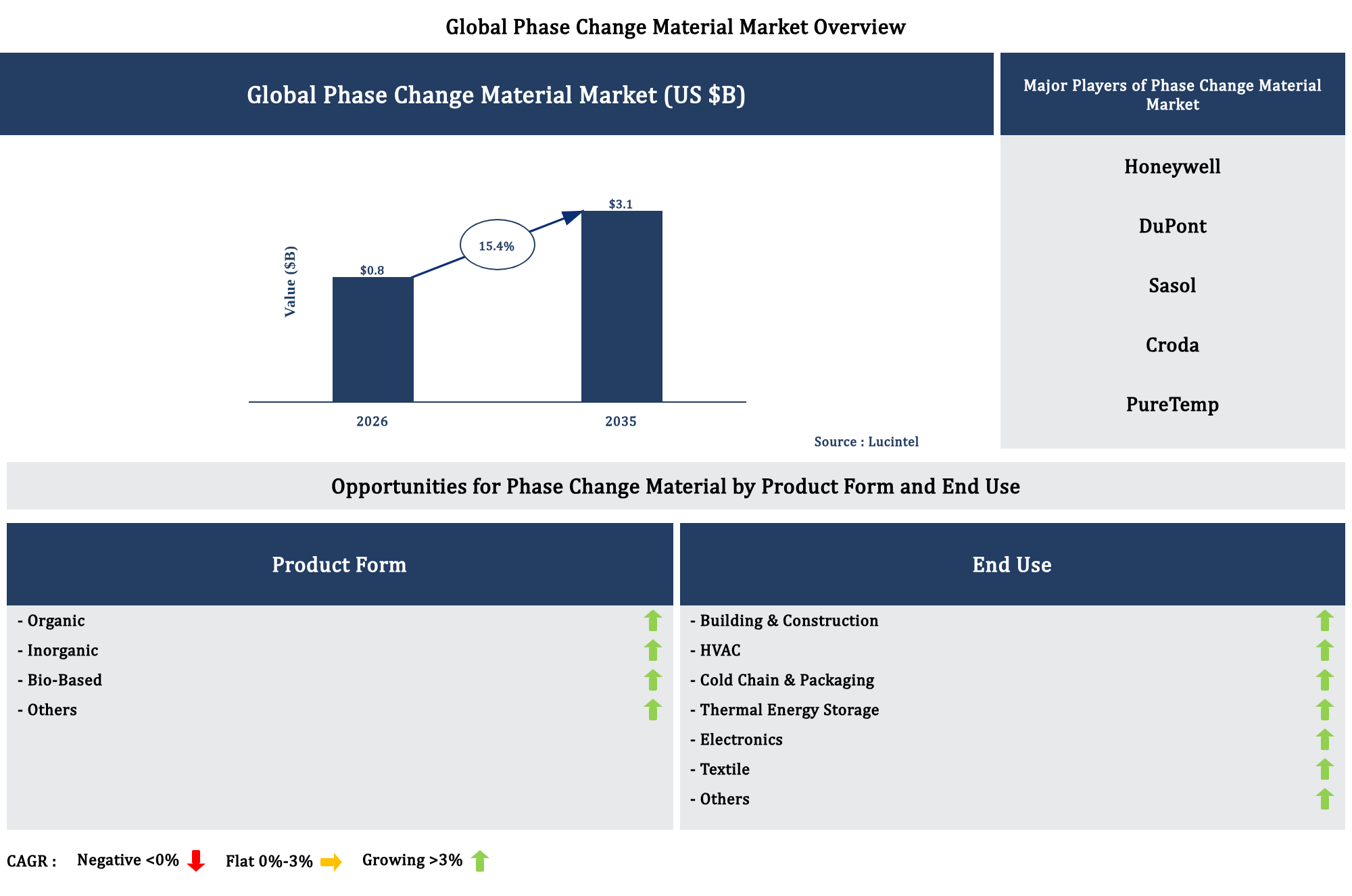
The future of the global phase change material market looks promising with opportunities in the building & construction, hvac, cold chain & packaging, thermal energy storage, electronic, and textile markets. The global phase change material market is expected to reach an estimated $3,131 million by 2035 with a CAGR of 15.4% from 2026 to 2035. The major drivers for this market are the increasing demand for energy-efficient buildings, the rising adoption in renewable energy storage, and the growing demand for awareness about energy conservation.
• Lucintel forecasts that, within the product form category, organic is expected to witness the highest growth over the forecast period.
• Within the end use category, building & construction is expected to witness the highest growth.
• In terms of region, APAC is expected to witness the highest growth over the forecast period.
Gain valuable insights for your business decisions with our comprehensive 150+ page report. Sample figures with some insights are shown below.
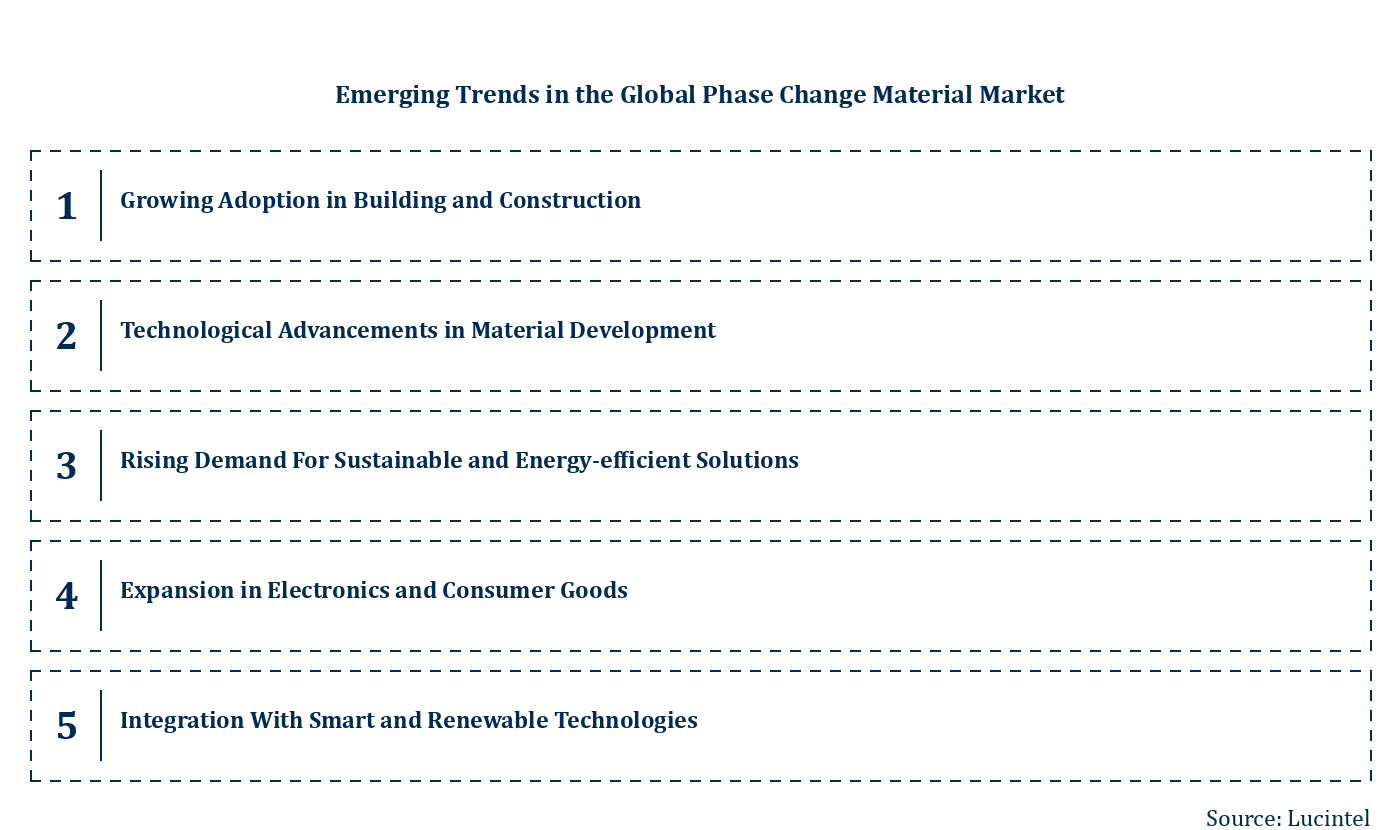
Emerging Trends in the Phase Change Material Market
The phase change material market is experiencing rapid growth driven by increasing demand for energy-efficient solutions across various industries. As global focus shifts toward sustainability and reducing carbon footprints, innovative materials that can store and release thermal energy are gaining prominence. Advances in technology, environmental regulations, and the need for smarter building solutions are fueling this expansion. Companies are investing heavily in research and development to improve PCM performance and cost-effectiveness. These developments are transforming traditional energy management practices, making PCM a vital component in sustainable infrastructure, electronics, and transportation sectors. The following key trends highlight the market‘s evolving landscape.
• Growing Adoption in Building and Construction: The construction industry is increasingly integrating PCM to enhance energy efficiency in buildings. PCM materials help regulate indoor temperatures by absorbing excess heat during the day and releasing it at night, reducing reliance on HVAC systems. This trend is driven by stringent energy codes and a push toward green buildings. The adoption of PCM in insulation, roofing, and wall panels is expected to significantly lower energy consumption and costs, making buildings more sustainable and comfortable. As awareness of environmental benefits grows, the construction sector is poised to become a major user of PCM solutions.
• Technological Advancements in Material Development: Innovations in PCM formulations are enhancing their thermal storage capacity, stability, and safety. Researchers are developing microencapsulated PCMs, which improve ease of integration into various products and prevent leakage. New composite materials are also being designed to operate efficiently over broader temperature ranges. These advancements are expanding PCM applications beyond traditional uses, enabling integration into textiles, electronics, and transportation. Improved performance and durability are making PCMs more attractive to manufacturers, fostering wider adoption across industries and driving market growth.
• Rising Demand for Sustainable and Energy-Efficient Solutions: Environmental concerns and regulatory pressures are pushing industries to adopt sustainable practices. PCM offers an eco-friendly way to reduce energy consumption and greenhouse gas emissions by optimizing thermal management. Governments and organizations are incentivizing the use of energy-efficient materials, which boosts demand for PCM-based products. This trend is particularly evident in the electronics sector, where thermal regulation is critical, and in renewable energy systems like solar power storage. The shift toward sustainability is positioning PCM as a key component in achieving energy efficiency goals globally.
• Expansion in Electronics and Consumer Goods: The electronics industry is increasingly utilizing PCM to manage heat in devices such as smartphones, laptops, and wearables. As devices become more powerful and compact, effective thermal management is essential to prevent overheating and ensure performance. PCM materials are incorporated into device casings and cooling systems to absorb excess heat. Additionally, consumer goods like smart textiles and packaging are integrating PCM for temperature regulation. This expansion enhances device reliability, prolongs lifespan, and improves user comfort, opening new revenue streams and market segments for PCM providers.
• Integration with Smart and Renewable Technologies: The convergence of PCM with smart systems and renewable energy solutions is creating innovative applications. PCM is being integrated into building management systems for real-time thermal regulation, contributing to smart city initiatives. In renewable energy, PCM enhances the efficiency of thermal storage in solar power plants and heat pumps. The development of IoT-enabled PCM systems allows for better control and optimization of energy use. This integration is fostering a more interconnected, efficient, and sustainable energy ecosystem, positioning PCM as a critical component in future smart infrastructure and renewable energy projects.
These emerging trends are significantly reshaping the phase change material market by promoting sustainable practices, technological innovation, and broader application across industries. As these developments continue, PCM is set to become an integral part of energy management solutions worldwide, driving market expansion and supporting global sustainability goals.
Recent Development in the Phase Change Material Market
The phase change material market is experiencing rapid growth driven by increasing demand for energy-efficient solutions across various industries. Innovations in material technology and expanding applications in building insulation, electronics, and thermal management are fueling market expansion. Governments and organizations are prioritizing sustainable practices, further boosting PCM adoption. This dynamic environment presents significant opportunities for manufacturers and investors to capitalize on emerging trends and technological advancements, shaping the future landscape of thermal regulation solutions worldwide.
• Growing Demand for Energy-Efficient Building Materials: The construction industry is increasingly adopting PCM for insulation to reduce energy consumption, lower heating and cooling costs, and meet sustainability standards. This shift is driven by stricter regulations and consumer awareness of environmental impacts, leading to a surge in PCM integration in residential and commercial projects. The market benefits from this trend through increased sales and innovation in building materials, positioning PCM as a key component in green construction.
• Advancements in Material Technology Enhance Performance: Recent developments in microencapsulation and composite materials have improved PCM stability, thermal conductivity, and longevity. These technological innovations enable broader application scopes, including electronics cooling and thermal regulation in wearable devices. Enhanced performance characteristics attract diverse industries, expanding market reach and creating new revenue streams. The ongoing research and development efforts are expected to sustain market growth and foster competitive advantages.
• Expansion into Electronics and Thermal Management Sectors: The electronics industry increasingly relies on PCM for thermal regulation to prevent overheating and improve device lifespan. Consumer electronics, data centers, and electric vehicles are adopting PCM solutions for efficient heat dissipation. This expansion addresses the growing need for compact, reliable cooling systems, driving demand and opening new markets. The integration of PCM in these sectors is expected to significantly influence overall market growth and technological innovation.
• Rising Government Initiatives and Sustainability Policies: Governments worldwide are implementing policies promoting energy efficiency and renewable energy use, indirectly supporting PCM adoption. Incentives, subsidies, and stricter building codes encourage industries to incorporate PCM solutions. These regulatory frameworks create a favorable environment for market expansion, attracting investments and fostering innovation. The alignment of policy and market needs accelerates the adoption of PCM technologies across multiple sectors.
• Increasing Applications in Textiles and Packaging: PCM is increasingly used in textiles for temperature regulation and in packaging for temperature-sensitive products. These applications improve comfort, safety, and product integrity, expanding market opportunities. The development of lightweight, flexible PCM materials enhances usability in various consumer and industrial products. This diversification of applications is expected to drive market growth, especially in emerging markets seeking sustainable and innovative solutions.
The overall impact of these developments is a robust expansion of the PCM market, driven by technological innovation, regulatory support, and diverse application opportunities. This growth is fostering a competitive landscape, encouraging investment, and accelerating the adoption of sustainable thermal management solutions worldwide.
Strategic Growth Opportunities in the Phase Change Material Market
The phase change material market is experiencing rapid expansion driven by increasing demand for energy-efficient solutions across various industries. Innovations in material technology, growing emphasis on sustainable building practices, and the need for thermal regulation in electronics are key factors fueling growth. Market players are focusing on product development, strategic partnerships, and expanding applications to capitalize on emerging opportunities. This dynamic landscape offers significant potential for companies to enhance their market share and contribute to global energy conservation efforts.
• Growing Demand for Energy-Efficient Building Insulation: The construction industry’s shift toward sustainable practices is boosting PCM adoption for thermal regulation, reducing energy consumption for heating and cooling. PCM-enhanced insulation materials help maintain indoor temperatures, lowering utility costs and carbon footprints. Increasing government regulations and green building certifications further accelerate this trend, creating substantial opportunities for manufacturers to develop innovative PCM-based insulation solutions tailored for residential, commercial, and industrial sectors.
• Expansion of PCM Applications in Electronics Cooling: As electronic devices become more powerful and compact, effective thermal management is critical. PCMs offer a promising solution by absorbing excess heat and maintaining optimal operating temperatures. The rising adoption of PCMs in consumer electronics, data centers, and electric vehicle batteries presents a significant growth avenue. Advances in microencapsulation and integration techniques are enabling more efficient, durable, and scalable PCM solutions, driving market expansion in electronics cooling applications.
• Increasing use of PCMs in Cold Chain Logistics: The global cold chain logistics sector relies heavily on temperature-sensitive transportation of pharmaceuticals, food, and chemicals. PCMs provide reliable, energy-efficient thermal regulation during transit, reducing spoilage and ensuring product integrity. Growing global trade and stringent regulatory standards are fueling demand for advanced PCM solutions in refrigerated containers and packaging. Innovations in biodegradable and environmentally friendly PCMs are also opening new markets, supporting sustainable logistics practices worldwide.
• Rising Adoption of PCMs in Renewable Energy Systems: PCMs are increasingly integrated into solar thermal systems and energy storage solutions to enhance efficiency and stability. They store excess thermal energy during peak sunlight hours and release it when needed, improving overall system performance. The push toward renewable energy adoption and grid stabilization creates opportunities for PCM-based thermal energy storage. Ongoing research into high-capacity, cost-effective PCMs is expected to further expand their role in sustainable energy infrastructure.
• Development of Advanced, High-Performance PCMs for Industrial Use: Industries such as manufacturing, textiles, and chemical processing require thermal management solutions capable of withstanding extreme conditions. The development of high-temperature and durable PCMs offers significant benefits in process control and energy savings. Customizable formulations and improved encapsulation techniques are enabling broader industrial applications. As industries seek to optimize energy consumption and reduce operational costs, the demand for specialized, high-performance PCMs is poised to grow substantially.
These growth opportunities are poised to significantly influence the Phase Change Material market by fostering innovation, expanding application scopes, and promoting sustainable practices. Companies that strategically invest in research, development, and market expansion will be well-positioned to capitalize on these emerging trends, driving overall market growth and contributing to global energy efficiency and environmental goals.
Phase Change Material Market Driver and Challenges
The phase change material market is influenced by a variety of technological, economic, and regulatory factors that shape its growth trajectory. Advances in material science and energy efficiency technologies drive innovation and adoption. Economic incentives, such as cost savings and government subsidies, encourage market expansion. Regulatory frameworks aimed at reducing carbon emissions and promoting sustainable practices further propel demand. However, the market also faces challenges including high material costs, limited long-term stability, and regulatory uncertainties. Understanding these drivers and challenges is essential for stakeholders to navigate the evolving landscape and capitalize on emerging opportunities.
The factors responsible for driving the phase change material market include:-
• Technological Advancements: The continuous development of new PCM formulations with improved thermal stability, higher energy storage capacity, and better compatibility with various applications significantly boosts market growth. Innovations in microencapsulation and composite materials enhance performance and safety, making PCMs more viable for diverse sectors such as construction, electronics, and textiles. These technological improvements reduce costs and expand application possibilities, fostering wider adoption and market expansion.
• Growing Energy Efficiency and Sustainability Initiatives: Increasing global emphasis on energy conservation and sustainable development drives demand for PCMs in building insulation, HVAC systems, and renewable energy storage. Governments and organizations are adopting stricter energy efficiency standards, incentivizing the integration of PCMs to reduce energy consumption and carbon footprint. This trend supports the market by creating a favorable environment for the adoption of energy-saving materials.
• Rising Construction and Infrastructure Development: Rapid urbanization and infrastructure projects worldwide necessitate innovative building materials that improve energy efficiency. PCMs are increasingly incorporated into building materials for temperature regulation, reducing reliance on traditional HVAC systems. This growth in construction activities, especially in emerging economies, significantly contributes to market expansion, as developers seek sustainable and cost-effective solutions.
• Increasing Adoption in Electronics and Wearable Devices: The proliferation of electronic gadgets and wearable technology demands efficient thermal management solutions. PCMs offer effective heat regulation, preventing overheating and enhancing device performance. As consumer electronics become more sophisticated, the integration of PCMs becomes essential, opening new revenue streams and expanding the market into high-tech sectors.
The challenges facing the phase change material market include:-
• High Material Costs and Manufacturing Expenses: The production of advanced PCMs, especially microencapsulated and composite variants, involves complex processes and expensive raw materials. These high costs hinder widespread adoption, particularly in price-sensitive markets. Overcoming cost barriers through technological innovations and economies of scale is crucial for market growth.
• Limited Long-term Stability and Repeated Cycling Performance: Many PCMs face issues related to phase separation, degradation, and reduced efficiency over multiple thermal cycles. This limits their durability and reliability in long-term applications, posing a challenge for industries requiring consistent performance. Improving stability and cycling endurance remains a key research focus.
• Regulatory Uncertainties and Lack of Standardization: The absence of comprehensive standards and clear regulatory guidelines for PCM safety, environmental impact, and performance creates market hesitations. Uncertainty regarding future regulations can delay adoption and investment. Establishing global standards and regulatory clarity is essential to foster confidence and facilitate market growth.
The phase change material market is driven by technological innovations, sustainability initiatives, infrastructure development, and expanding applications in electronics. However, high costs, stability issues, and regulatory uncertainties pose significant challenges. These factors collectively influence the market’s growth potential, requiring strategic efforts to overcome barriers and leverage opportunities. The market’s future will depend on continued innovation, supportive policies, and cost reduction strategies to ensure sustainable expansion and broader adoption across industries.
List of Phase Change Material Companies
Companies in the market compete on the basis of product quality offered. Major players in this market focus on expanding their manufacturing facilities, R&D investments, infrastructural development, and leverage integration opportunities across the value chain. With these strategies phase change material companies cater increasing demand, ensure competitive effectiveness, develop innovative products & technologies, reduce production costs, and expand their customer base. Some of the phase change material companies profiled in this report include-
• Honeywell
• DuPont
• Sasol
• Croda
• PureTemp
• Pluss Advanced Technologies
• Phase Change Energy Solutions
• Rubitherm Technologies
• Phase Change Materials Products
• Outlast Technologies
Phase Change Material Market by Segment
The study includes a forecast for the global phase change material market by product form, end use, and region.
Phase Change Material Market by Product Form [Value from 2019 to 2035]:
• Organic
• Inorganic
• Bio-Based
• Others
Phase Change Material Market by End Use [Value from 2019 to 2035]:
• Building & Construction
• HVAC
• Cold Chain & Packaging
• Thermal Energy Storage
• Electronics
• Textile
• Others
Phase Change Material Market by Region [Value from 2019 to 2035]:
• North America
• Europe
• Asia Pacific
• The Rest of the World
Country Wise Outlook for the Phase Change Material Market
The phase change material market has experienced significant growth driven by increasing demand for energy-efficient solutions and sustainable building materials worldwide. Innovations in material formulations, expanding applications in construction, electronics, and thermal management, and supportive government policies have accelerated market expansion. As countries seek to reduce energy consumption and carbon emissions, the adoption of PCM technologies is gaining momentum. The market‘s evolution reflects a shift toward greener, more efficient thermal regulation solutions across various sectors. This global trend is particularly prominent in major economies, each contributing uniquely to the market‘s development through technological advancements, policy initiatives, and industrial adoption.
• United States: The U.S. market for PCM has seen rapid growth, driven by increasing adoption in building insulation, HVAC systems, and electronics cooling. Innovations in microencapsulation and bio-based PCMs have enhanced performance and sustainability. The government’s focus on energy efficiency standards and green building certifications has further propelled market expansion. Major players are investing in R&D to develop advanced, cost-effective PCM solutions, while startups are exploring new applications in transportation and renewable energy storage. The U.S. market is also witnessing increased collaborations between academia and industry to accelerate technological advancements.
• China: China remains the largest market for PCM, fueled by rapid urbanization and government initiatives promoting energy-efficient buildings. The country has seen significant investments in PCM-based construction materials and thermal management systems. Domestic manufacturers are expanding their product portfolios, focusing on cost-effective, high-performance PCMs. The Chinese government’s policies aimed at reducing energy consumption and carbon emissions have created a favorable environment for market growth. Additionally, China is investing in research to develop bio-based and environmentally friendly PCM options, aligning with its sustainability goals.
• Germany: Germany’s PCM market is characterized by a strong emphasis on sustainable building practices and energy conservation. The country’s strict regulations on energy efficiency and green building standards have driven demand for PCM-enhanced insulation and construction materials. German companies are focusing on developing innovative, durable, and eco-friendly PCM products. The integration of PCM in smart building systems and passive cooling solutions is gaining traction. Germany’s leadership in renewable energy and technological innovation continues to support the development and adoption of advanced PCM solutions, positioning the country as a key player in Europe’s PCM market.
• India: The Indian PCM market is emerging, with increasing interest in energy-efficient cooling and heating solutions amid rising energy costs and climate concerns. The government’s initiatives to promote sustainable construction and smart cities are creating new opportunities for PCM applications. Local manufacturers are exploring affordable, bio-based PCMs suitable for Indian climatic conditions. The market is also benefiting from international collaborations and investments in R&D. As India aims to reduce its reliance on fossil fuels and improve energy security, PCM technology is expected to play a vital role in future thermal management and building efficiency projects.
• Japan: Japan’s PCM market is driven by its focus on disaster resilience, energy conservation, and technological innovation. The country has integrated PCM into building materials, electronics, and transportation to enhance thermal regulation. Japan’s aging population and energy efficiency goals have spurred the development of advanced, compact PCM solutions. The government’s support for green technology and smart city initiatives has further boosted market growth. Japanese companies are investing in research to develop environmentally friendly, high-performance PCMs, and are actively exploring applications in renewable energy storage and disaster preparedness, positioning Japan as a leader in innovative PCM solutions.
Features of the Global Phase Change Material Market
Market Size Estimates: Phase change material market size estimation in terms of value ($M).
Trend and Forecast Analysis: Market trends (2019 to 2025) and forecast (2026 to 2035) by various segments and regions.
Segmentation Analysis: Phase change material market size by product form, end use, and region in terms of value ($M).
Regional Analysis: Phase change material market breakdown by North America, Europe, Asia Pacific, and Rest of the World.
Growth Opportunities: Analysis of growth opportunities in different product form, end use, and regions for the phase change material market.
Strategic Analysis: This includes M&A, new product development, and competitive landscape of the phase change material market.
Analysis of competitive intensity of the industry based on Porter’s Five Forces model.
FAQ
Q1. What is the phase change material market size?
Answer: The global phase change material market is expected to reach an estimated $3,131 million by 2035.
Q2. What is the growth forecast for phase change material market?
Answer: The global phase change material market is expected to grow with a CAGR of 15.4% from 2026 to 2035.
Q3. What are the major drivers influencing the growth of the phase change material market?
Answer: The major drivers for this market are the increasing demand for energy-efficient buildings, the rising adoption in renewable energy storage, and the growing demand for awareness about energy conservation.
Q4. What are the major segments for phase change material market?
Answer: The future of the phase change material market looks promising with opportunities in the building & construction, hvac, cold chain & packaging, thermal energy storage, electronic, and textile markets.
Q5. Who are the key phase change material market companies?
Answer: Some of the key phase change material companies are as follows:
• Honeywell
• DuPont
• Sasol
• Croda
• PureTemp
• Pluss Advanced Technologies
• Phase Change Energy Solutions
• Rubitherm Technologies
• Phase Change Materials Products
• Outlast Technologies
Q6. Which phase change material market segment will be the largest in future?
Answer: Lucintel forecasts that, within the product form category, organic is expected to witness the highest growth over the forecast period.
Q7. In phase change material market, which region is expected to be the largest in next 8 years?
Answer: In terms of region, APAC is expected to witness the highest growth over the forecast period.
Q8. Do we receive customization in this report?
Answer: Yes, Lucintel provides 10% customization without any additional cost.
This report answers following 11 key questions:
Q.1. What are some of the most promising, high-growth opportunities for the phase change material market by product form (organic, inorganic, bio-based, and others), end use (building & construction, HVAC, cold chain & packaging, thermal energy storage, electronics, textile, and others), and region (North America, Europe, Asia Pacific, and the Rest of the World)?
Q.2. Which segments will grow at a faster pace and why?
Q.3. Which region will grow at a faster pace and why?
Q.4. What are the key factors affecting market dynamics? What are the key challenges and business risks in this market?
Q.5. What are the business risks and competitive threats in this market?
Q.6. What are the emerging trends in this market and the reasons behind them?
Q.7. What are some of the changing demands of customers in the market?
Q.8. What are the new developments in the market? Which companies are leading these developments?
Q.9. Who are the major players in this market? What strategic initiatives are key players pursuing for business growth?
Q.10. What are some of the competing products in this market and how big of a threat do they pose for loss of market share by material or product substitution?
Q.11. What M&A activity has occurred in the last 7 years and what has its impact been on the industry?
For any questions related to Phase Change Material Market, Phase Change Material Market Size, Phase Change Material Market Growth, Phase Change Material Market Analysis, Phase Change Material Market Report, Phase Change Material Market Share, Phase Change Material Market Trends, Phase Change Material Market Forecast, Phase Change Material Companies, write Lucintel analyst at email: helpdesk@lucintel.com. We will be glad to get back to you soon.