
Market Report · July 31, 2026

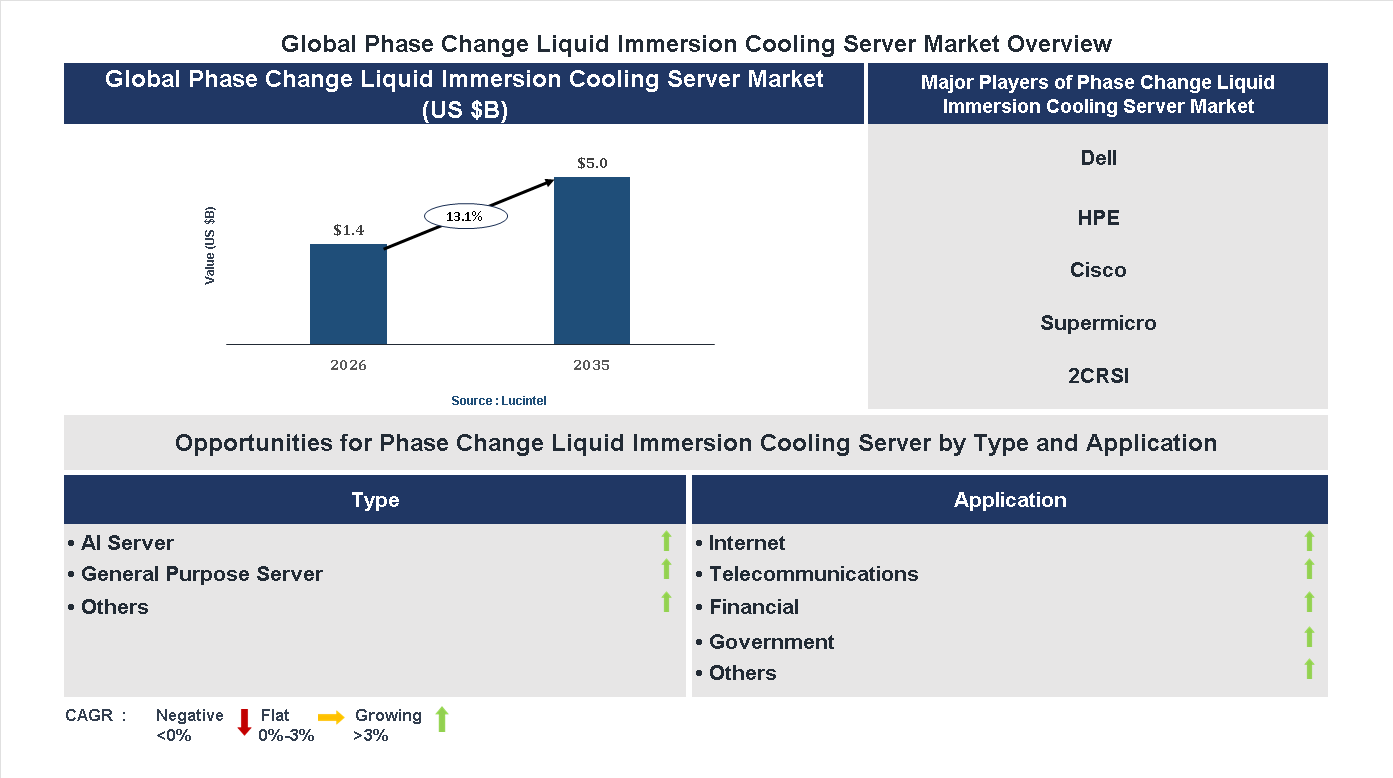
Key data points: The market size in 2035 = $5 billion, growth forecast = 13.1% annually for the next 8 years. Scroll below to get more insights. This market report covers trends, opportunities and forecasts in phase change liquid immersion cooling server market to 2035 by type (AI server, general purpose server, and others), application (internet, telecommunications, financial, government, and others), and region (North America, Europe, Asia Pacific, and the Rest of the World)
We'll send your sample report shortly.
• Lucintel forecasts that, within the type category, AI server is expected to witness higher growth over the forecast period.
• Within the application category, internet is expected to witness the highest growth.
• In terms of region, APAC is expected to witness the highest growth over the forecast period. Gain valuable insights for your business decisions with our comprehensive 150+ page report. Sample figures with some insights are shown below.
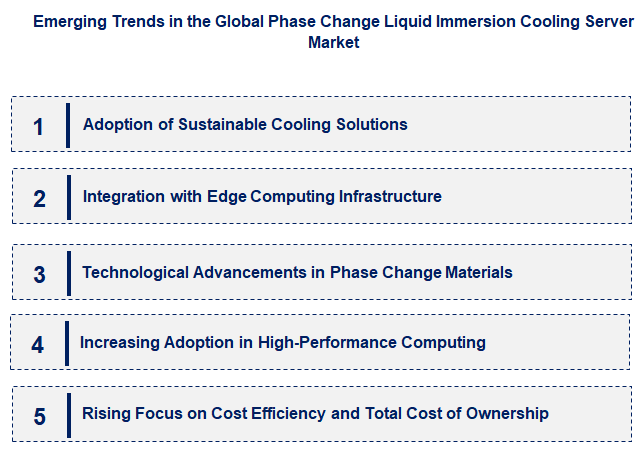
• Adoption of Sustainable Cooling Solutions: The market is witnessing a shift towards environmentally friendly cooling technologies. Phase change liquid immersion cooling reduces energy consumption significantly compared to traditional air cooling, lowering carbon footprints. Data centers are increasingly adopting these solutions to meet sustainability goals and comply with environmental regulations. This trend is driven by the need for cost-effective, eco-friendly operations and the desire to minimize environmental impact while maintaining high-performance computing capabilities.
• Integration with Edge Computing Infrastructure: As edge computing gains momentum, there is a rising demand for compact, efficient cooling solutions suitable for decentralized data centers. Phase change liquid immersion cooling offers a scalable and space-efficient option, enabling effective thermal management in small or remote facilities. This trend enhances the feasibility of deploying high-density servers at the edge, reducing latency and improving overall network performance. It also supports the expansion of IoT and 5G applications by providing reliable cooling in diverse environments.
• Technological Advancements in Phase Change Materials: Innovations in phase change materials (PCMs) are driving the market forward. New formulations with higher thermal conductivity and stability enable more efficient heat transfer and longer operational lifespans. These advancements improve the reliability and performance of immersion cooling systems, making them more attractive for large-scale deployment. Continuous research is expanding the capabilities of PCMs, leading to more versatile and cost-effective cooling solutions tailored to various server configurations.
• Increasing Adoption in High-Performance Computing: The demand for HPC applications in scientific research, AI, and big data analytics is fueling the adoption of phase change liquid immersion cooling. These systems generate substantial heat, requiring advanced cooling solutions to maintain optimal performance. Immersion cooling provides superior thermal management, enabling higher server densities and faster processing speeds. This trend is transforming HPC infrastructure by offering more efficient, reliable, and scalable cooling options, thus supporting the growth of computationally intensive fields.
• Rising Focus on Cost Efficiency and Total Cost of Ownership: Organizations are prioritizing solutions that reduce operational costs over the long term. Phase change liquid immersion cooling minimizes energy consumption, reduces cooling infrastructure costs, and extends hardware lifespan, leading to lower TCO. This trend is compelling data center operators to adopt immersion cooling as a cost-effective alternative to traditional methods. The economic benefits, combined with environmental advantages, are accelerating market adoption and encouraging investments in advanced cooling technologies. In summary, these emerging trends are fundamentally reshaping the phase change liquid immersion cooling server market by promoting sustainability, enabling edge and high-performance computing, advancing material technology, and emphasizing cost efficiency. These developments are driving innovation, expanding application scope, and positioning immersion cooling as a critical component of future data center infrastructure.
• Enhanced Efficiency: Phase change liquid immersion cooling offers superior heat dissipation, reducing energy consumption and operational costs. This technology allows servers to operate at higher densities without overheating, leading to increased data center capacity. The improved thermal management also extends hardware lifespan, minimizing maintenance costs. As a result, data centers become more sustainable and cost-effective, attracting investments and encouraging adoption across various sectors.
• Expansion of Market Applications: The technologys versatility is enabling its adoption beyond traditional data centers to edge computing, high-performance computing (HPC), and cryptocurrency mining. These applications require efficient cooling solutions to handle high thermal loads, making phase change immersion cooling ideal. The expansion broadens market opportunities, encouraging innovation and partnerships. This diversification accelerates market growth and promotes the development of customized solutions for different industry needs.
• Development of Advanced Materials: Innovations in phase change materials (PCMs) are enhancing cooling performance and safety. New formulations with higher thermal conductivity and stability improve heat transfer efficiency, enabling more compact and effective cooling systems. These materials also reduce environmental impact by being non-toxic and recyclable. The advancement in PCM technology fosters the creation of more reliable, efficient, and eco-friendly cooling solutions, driving industry adoption and supporting sustainability goals.
• Integration with Smart Technologies: Incorporating IoT and AI into immersion cooling systems enables real-time monitoring and predictive maintenance. These smart integrations optimize cooling performance, reduce downtime, and lower operational costs. Data analytics provide insights into system efficiency and potential issues, facilitating proactive interventions. This technological synergy enhances system reliability and user control, making immersion cooling more accessible and manageable for data center operators, thus expanding market reach and adoption.
• Focus on Sustainability and Regulations: Increasing environmental concerns and stricter regulations are pushing the industry toward greener cooling solutions. Phase change liquid immersion cooling reduces energy consumption and carbon footprint compared to traditional methods. Companies are investing in eco-friendly materials and energy-efficient designs to meet regulatory standards. This focus on sustainability not only aligns with global climate goals but also offers competitive advantages, encouraging market players to innovate and adopt environmentally responsible practices. Overall, these developments are significantly impacting the market by making cooling solutions more efficient, versatile, sustainable, and technologically advanced. They are driving widespread adoption, fostering innovation, and supporting the growth of data infrastructure globally, ultimately transforming the landscape of server cooling technologies.
• Enhanced Energy Efficiency and Cost Savings: Phase change liquid immersion cooling offers superior thermal management, reducing energy consumption and operational costs for data centers. By efficiently removing heat directly from server components, it minimizes the need for traditional air conditioning systems, leading to lower electricity bills and carbon footprint. This technology is especially attractive for large-scale data centers seeking sustainable and cost-effective cooling solutions, driving widespread adoption and market expansion.
• Growing Demand for High-Performance Computing (HPC): The increasing reliance on HPC applications in AI, machine learning, and scientific research necessitates advanced cooling methods to handle high thermal loads. Phase change liquid immersion cooling provides exceptional heat dissipation, enabling servers to operate at higher speeds without overheating. This capability supports the expansion of HPC infrastructure, creating new opportunities for market players to develop tailored cooling solutions for demanding computational workloads.
• Rising Adoption in Edge Data Centers: The proliferation of edge computing requires compact, efficient, and reliable cooling solutions to manage localized data processing units. Phase change liquid immersion cooling is ideal for these environments due to its high efficiency and minimal space requirements. As edge data centers grow in number and importance, the demand for scalable and effective cooling technologies like immersion cooling is expected to surge, opening avenues for market growth and innovation.
• Technological Advancements and Material Innovations: Continuous research into new phase change materials and cooling system designs enhances the performance and safety of immersion cooling solutions. Innovations such as environmentally friendly refrigerants and improved heat transfer fluids increase system reliability and reduce environmental impact. These advancements attract more industries to adopt immersion cooling, fostering market expansion and encouraging further technological development.
• Increasing Focus on Sustainability and Regulatory Compliance: Governments and organizations are emphasizing eco-friendly practices and energy-efficient infrastructure. Phase change liquid immersion cooling aligns with sustainability goals by significantly reducing energy consumption and greenhouse gas emissions. Compliance with environmental regulations and corporate sustainability initiatives incentivizes data center operators to adopt this technology, thereby accelerating market growth and encouraging the development of greener, more efficient cooling solutions. These growth opportunities are poised to transform the phase change liquid immersion cooling server market by enhancing efficiency, supporting high-performance applications, and promoting sustainable practices. As technological innovations and environmental considerations converge, the market is expected to experience substantial expansion, driving the evolution of next-generation data center cooling solutions worldwide.
• Technological Innovation: The continuous development of advanced cooling technologies enhances server efficiency and performance. Phase change liquid immersion cooling offers superior thermal management, reducing energy consumption and hardware failure rates. As data centers grow in size and complexity, the need for innovative cooling solutions becomes critical. This technological evolution attracts investments and encourages adoption across various sectors, including cloud computing and enterprise data centers. The ability to support high-density servers with minimal environmental impact makes this technology highly attractive, fostering market expansion.
• Rising Data Center Deployment: The exponential increase in data generation due to digital transformation, IoT, and AI applications drives the need for efficient cooling solutions. Data centers are expanding rapidly worldwide, demanding scalable and sustainable cooling methods. Phase change liquid immersion cooling provides an effective way to manage heat in densely packed servers, enabling data centers to operate more reliably and with lower energy costs. This growth in data infrastructure directly correlates with increased adoption of immersion cooling technologies, fueling market growth.
• Energy Efficiency and Sustainability Goals: Governments and organizations are setting ambitious targets to reduce energy consumption and carbon emissions. Liquid immersion cooling significantly lowers power usage effectiveness (PUE) and reduces cooling-related energy costs. Its environmentally friendly nature aligns with corporate sustainability initiatives, making it a preferred choice for eco-conscious companies. As regulatory pressures intensify, the adoption of energy-efficient cooling solutions like phase change immersion becomes a strategic imperative, further propelling market development.
• Cost Savings and Operational Efficiency: Although initial setup costs are high, phase change liquid immersion cooling offers substantial long-term savings through reduced energy bills, lower cooling infrastructure costs, and decreased hardware maintenance. Enhanced thermal management extends equipment lifespan and minimizes downtime. These economic benefits attract data center operators seeking to optimize operational efficiency and reduce the total cost of ownership, thereby accelerating market adoption and growth.
• Growing Adoption in High-Performance Computing: The demand for high-performance computing (HPC) in scientific research, financial modeling, and AI workloads necessitates advanced cooling solutions. Phase change liquid immersion cooling provides the thermal management required for high-density, high-performance servers. Its ability to maintain optimal operating temperatures ensures reliability and performance, making it the preferred choice for HPC applications. This trend is expected to continue, further expanding the market as industries seek robust cooling solutions for demanding computational tasks. The challenges facing this phase change liquid immersion cooling server market include:
• High Initial Investment Costs: Implementing phase change liquid immersion cooling requires significant capital expenditure on specialized equipment and infrastructure modifications. Many organizations are hesitant to adopt due to the upfront costs, especially when traditional cooling methods are still prevalent. This financial barrier limits widespread adoption, particularly among small and medium-sized enterprises. Overcoming this challenge necessitates demonstrating clear long-term cost benefits and potential return on investment to encourage broader acceptance.
• Technological Complexities and Maintenance: The technology involves complex systems that require specialized knowledge for installation, operation, and maintenance. Handling phase change materials and ensuring system reliability can be challenging, especially in existing data centers not designed for immersion cooling. Maintenance procedures are more intricate, and potential issues such as leaks or material degradation need to be managed carefully. These complexities can hinder adoption and increase operational risks, necessitating ongoing research and skilled workforce development.
• Regulatory and Safety Concerns: The use of certain phase change materials raises safety and environmental concerns, including toxicity and disposal issues. Regulatory frameworks governing the handling and disposal of these materials are still evolving, creating uncertainty for market participants. Additionally, safety protocols must be stringent to prevent accidents, which can add to operational costs and complexity. Navigating these regulatory landscapes and ensuring compliance is essential but challenging, potentially slowing market growth. In summary, the phase change liquid immersion cooling server market is driven by technological advancements, increasing data center deployment, sustainability initiatives, cost efficiencies, and high-performance computing needs. However, high initial costs, technological complexities, and regulatory uncertainties pose significant challenges. The overall impact of these factors suggests a promising yet cautious growth trajectory, with opportunities for innovation and strategic investments to overcome barriers and realize the full potential of immersion cooling solutions in the data center industry.
• Dell
• HPE
• Cisco
• Supermicro
• 2CRSI
• H3C
• GIGABYTE
• AI Server
• General Purpose Server
• Others
• Internet
• Telecommunications
• Financial
• Government
• Others
• North America
• Europe
• Asia Pacific
• The Rest of the World
• United States: The US market has seen rapid adoption of phase change liquid immersion cooling, driven by major tech giants and data center operators seeking energy-efficient solutions. Innovations include advanced heat transfer materials and scalable modular systems, with increased government funding for sustainable data infrastructure projects. Companies are also collaborating with startups to develop eco-friendly coolants and optimize system performance, positioning the US as a leader in this technology.
• China: China is rapidly expanding its data center capacity, integrating phase change immersion cooling to address high energy consumption and heat management challenges. The government’s focus on green technology and digital infrastructure has accelerated adoption. Local manufacturers are developing cost-effective cooling solutions, and partnerships with international firms are fostering technological exchange. The market is also supported by policies promoting sustainable development and energy conservation.
• Germany: Germany emphasizes sustainable and energy-efficient data center solutions, with a focus on integrating phase change immersion cooling into existing infrastructure. Leading technology firms are investing in research to improve coolant materials and system reliability. The country’s strong environmental policies and commitment to Industry 4.0 are driving innovations, making Germany a key player in developing eco-friendly server cooling technologies.
• India: India’s growing digital economy and increasing data center investments are fueling the adoption of phase change liquid immersion cooling. The market benefits from government initiatives promoting green technology and energy efficiency. Local startups and global companies are collaborating to develop affordable, scalable cooling solutions suitable for India’s climate and infrastructure. This trend aims to reduce operational costs and improve data center sustainability.
• Japan: Japan is focusing on integrating phase change immersion cooling within its highly advanced and energy-conscious data centers. The country’s emphasis on disaster resilience and energy efficiency has led to innovations in coolant materials and system design. Japanese firms are also exploring hybrid cooling solutions that combine phase change technology with traditional methods, aiming to optimize performance and environmental sustainability in their data infrastructure.


• Dell
• HPE
• Cisco
• Supermicro
• 2CRSI
• H3C
• GIGABYTE Q6. Which phase change liquid immersion cooling server market segment will be the largest in future? Answer: Lucintel forecasts that, within the type category, AI server is expected to witness higher growth over the forecast period. Q7. In phase change liquid immersion cooling server market, which region is expected to be the largest in next 5 years? Answer: In terms of region, APAC is expected to witness the highest growth over the forecast period. Q8. Do we receive customization in this report? Answer: Yes, Lucintel provides 10% customization without any additional cost.


Choose a license that fits your team. Instant PDF delivery.
Prices exclude taxes. Instant delivery. Custom licensing available on request.
Market Report · July 31, 2026
Market Report · July 31, 2026
Market Report · July 31, 2026
Trusted partner for strategic intelligence and business growth


Receive a complimentary market analysis tailored to your industry. Our analysts will identify key growth opportunities and competitive dynamics specific to your business.

Market size, growth rate, and key trend analysis for your specific sector.

Top competitor positioning and market share analysis.

Strategic recommendations backed by data-driven insights.
Get curated market intelligence and competitive moves straight to your inbox.
By subscribing, you agree to receive our monthly insights. Unsubscribe anytime.
Receive a complimentary market analysis tailored to your industry. Our analysts will identify key growth opportunities and competitive dynamics specific to your business.
Market size, growth rate, and key trend analysis for your specific sector.
Top competitor positioning and market share analysis.
Strategic recommendations backed by data-driven insights.
Get curated market intelligence, emerging trends, and competitive moves straight to your inbox each month.
By subscribing, you agree to receive our monthly insights. Unsubscribe anytime.
We'll send your sample report shortly.