
Market Report · July 16, 2026

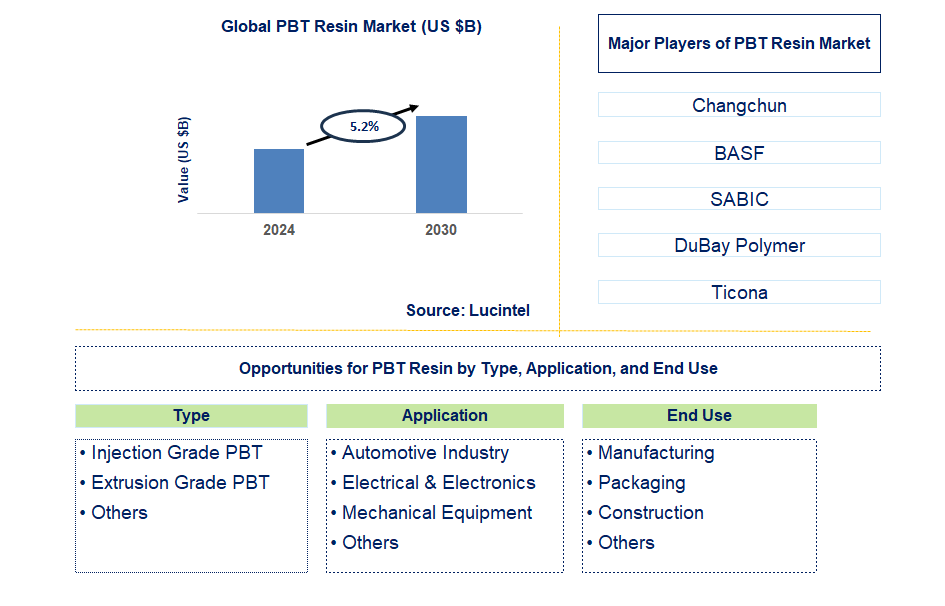
Key data points: The growth forecast = 5.2% annually for the next 6 years. Scroll below to get more insights. This market report covers trends, opportunities, and forecasts in the global PBT resin market to 2030 by type (injection grade PBT, extrusion grade PBT, and others), application (automotive industry, electrical & electronics, mechanical equipment, and others), end use (manufacturing, packaging, construction, and others), and region (North America, Europe, Asia Pacific, and the Rest of the World)
We'll send your sample report shortly.
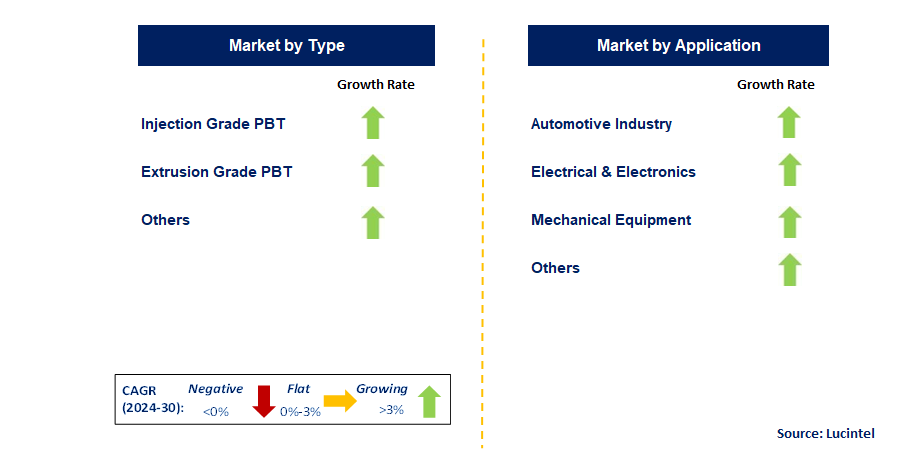
• Lucintel forecasts that, within the type category, the injection grade PBT segment is expected to witness the highest growth over the forecast period due to its significant application in manufacturing automotive and electrical components owing to its high thermal stability, excellent mechanical strength and toughness, low moisture absorption rate, and good dimensional stability.
• In terms of regions, APAC is expected to witness the highest growth over the forecast period due to rising demand for PBT resin from various end use industries, such as automotive, electrical and electronics, and consumer appliances industries of the region. Gain valuable insights for your business decisions with our comprehensive 150+ page report.
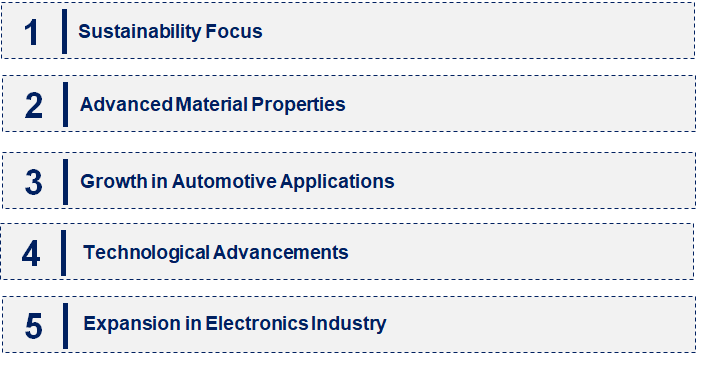
• Sustainability Focus: More organizations are investing in eco-friendly formulations of PBT resins that can easily degrade or be recycled once no longer useful. Examples include polymerizations resulting in bio-based polyesters or the development of alternative recycling techniques that minimize environmental impact. As companies adapt their practices to meet stricter regulations and respond to growing consumer demand for environmentally friendly products, they strive toward more sustainable solutions.
• Advanced Material Properties: PBT resins with enhanced properties, such as improved heat resistance, flame retardancy, and mechanical strength, are being developed to meet this trend. These advanced grades are increasingly important in high-performance applications, including automotive and electronics.
• Growth in Automotive Applications: The automotive industry is one of the key drivers of PBT resin demand due to the need for durable, lightweight materials. Due to its properties, PBT can be used for various automotive components like interior and exterior parts. As automotive manufacturers look to improve vehicle performance and fuel efficiency, PBT resin plays an important role in reducing weight while improving durability.
• Technological Advancements: Improved production techniques have led to a more efficient manufacturing process for PBT resins. Higher consistency and performance are achieved through precision molding and automated processing techniques. These developments not only reduce production costs but also expand PBT resin applications across various industries.
• Expansion in Electronics Industry: Modern electronic devices are becoming smaller and more complex, requiring high-precision PBT resins that can meet demanding performance conditions for dimensional stability and electrical insulation. This has led to specialized PBT formulations tailored to the needs of the electronics market. The evolving trends in PBT resin are reshaping the industry by pushing for greater sustainability, advancing material performance, and expanding into new applications, helping to enhance application flexibility without compromising quality standards and catering to consumer demand for innovative products. These changes foster innovation and growth, positioning PBT resin as a vital material across several high-tech, environmentally conscious sectors.
• Technological Innovations: Recent technological advancements have led to the development of high-performance PBT resins. These improvements include enhanced flame retardancy, chemical resistance, and thermal stability. Such advancements have increased the use of PBT in the automotive and electronics industries, where durability and reliability are essential.
• Sustainability Initiatives: The PBT resin industry is increasingly focused on sustainability, with companies adopting environmentally friendly production techniques. This includes using recycled materials, manufacturing biobased PBT resins, and implementing energy-efficient processes. Consequently, there has been an increase in consumer demand for eco-friendly products that reduce the environmental impact associated with PBT resin manufacturing.
• Application Expansion: PBT resin is now used across various sectors, such as automobiles, electronics, and consumer goods, where it was not previously applied. With its versatility and enhanced attributes, this material is now useful in demanding applications, such as lightweight automotive parts and high-precision electronic components. This expansion has led to increased sales volumes and relevance across diverse industries.
• Emerging Markets Driving Demand: Particularly in Asia-Pacific regions, emerging markets are experiencing a surge in demand for PBT resin. China and India, for example, are expanding their manufacturing capabilities to meet growing domestic and international demand. This regional growth is contributing to the global PBT resin market's expansion.
• Stricter Compliance Requirements: Regulatory changes have impacted the PBT resin industry, with stricter safety and environmental standards. To comply, companies are investing in compliance measures, such as enhanced testing and certification procedures. These adjustments drive innovation, ensuring PBT resin products meet higher quality, performance, and safety standards. Technological advancements, expanding applications, and enhanced sustainability in PBT resin are reshaping the industry. These changes position PBT resin as a key material for future market growth and innovation.
• Automotive Industry: The automotive industry presents substantial growth opportunities for PBT resins due to the demand for lightweight materials that can withstand harsh conditions. For example, bumpers, trims, and interior parts can be made from this material, which offers high strength at a low weight, helping automakers achieve fuel efficiency targets.
• Electronics Sector: The high-precision nature of electronics has led to increased use of insulating materials like polypropylene, which is increasingly replaced by PBT resin. For example, electronic housings, connectors, and circuit boards require dimensional stability and electrical insulating capabilities found in PBT. The demand for high-performance PBT resins is increasing as electronic devices become more complex and miniaturized.
• Consumer Goods: In the consumer goods sector, PBT resin is used in various applications, including kitchen appliances, personal care products, and durable items such as power tools. It is a versatile material that can be molded into various shapes at a low cost, making it attractive to manufacturers seeking durable, affordable products. The growing need for long-lasting consumer goods has increased PBT resin usage in this industry.
• Healthcare Applications: The healthcare industry is exploring PBT resin for medical devices due to its biocompatibility and high-performance characteristics. Applications include surgical instruments, which require resistance to sterilization processes, and diagnostic devices made from PBT. Demand for high-quality PBT resins is rising as focus intensifies on cutting-edge medical technologies.
• Green Technology: Opportunities are emerging for PBT resin producers to develop sustainable products through green technologies. This includes producing bio-based PBT resins and improving recycling methods. Companies are increasingly focused on innovations that contribute to sustainability, as environmental conservation becomes more important across various sectors. Strategic growth opportunities in PBT resin drive innovation and market expansion. By focusing on key applications and sustainability, companies can enhance their competitive advantage and meet changing market demands.
This industry is influenced by various drivers and challenges that affect its growth and development. Some of these include advancements in technology, economic conditions, and regulatory changes. It is important to understand these drivers and challenges to navigate the market effectively and take advantage of available opportunities. The factors responsible for driving the PBT resin market include:• Technological Advancements: One major factor driving the growth of PBT resin is advances in resin production technology. Enhancements such as better polymerization and precision molding technologies are making it possible to improve the performance quality of PBT resins. This has resulted in high-performance resins with advanced properties needed across different industries and applications.
• Growing Automotive Demand: Increasing demand for lightweight materials in the automotive industry has contributed to the increased use of PBT resin. Its properties make it an ideal choice for reducing car weight, thus improving fuel efficiency. Consequently, this has led to an increase in demand for PBT resin by automakers seeking regulatory compliance standards and consumers' expectations for fuel economy.
• Rising Electronics Market: The expanding electronics market has fueled demand for precise PBT resins. Its dimensional stability, coupled with electrical insulating properties, makes it an ideal material for many electronic devices. With advancements in microelectronics, there is a rising need for trusted, accurate materials like PBT, prompting further growth in this segment. Challenges in the PBT resin market include:
• Regulatory Changes: Stricter environmental regulations and safety standards have significantly impacted the PBT resin industry. Compliance with material safety laws and environmental impact standards has become essential, meaning companies must invest more in their operations. Consequently, market uptake and competitiveness depend on the degree of conformity with these regulations.
• Economic Factors: PBT resin production relies on certain raw materials, the prices of which can be highly volatile. The instability in petrochemical feedstock costs may affect manufacturing expenses and profits. Therefore, businesses aiming to remain relevant must manage such economic uncertainties while maintaining high-quality products at reasonable costs.
• Supply Chain Disruptions: Supply chain disruptions, such as delays in raw material availability or transportation issues, impact PBT resin production and distribution. These disruptions typically lead to increased lead times and higher costs, thereby affecting overall supply chain efficiency and eventually influencing market supply and prices. These drivers and challenges are determining the direction of PBT resin's development and influencing the market dynamics. Addressing these factors and adapting to changes will enable companies to gain an advantage in the fast-evolving PBT resin industry.
• Changchun
• BASF
• SABIC
• DuBay Polymer
• Ticona
• DuPont
• Kanghui
• Injection Grade PBT
• Extrusion Grade PBT
• Others
• Automotive Industry
• Electrical & Electronics
• Mechanical Equipment
• Others
• Manufacturing
• Packaging
• Construction
• Others
• North America
• Europe
• Asia Pacific
• The Rest of the World
• United States: In the US, advances in PBT resin involve improving its properties and broadening its application range. This includes the development of more effective flame retardants, resulting in wider use by the automobile and electronics industries. Companies are investing in sustainable production processes, including recycling, reuse, and reduced carbon emissions. There is also a growing trend toward high-performance grades of PBT for demanding applications.
• China: China has become a key player in the PBT resin market, with substantial investments aimed at increasing production capacity and advancing technology. The country leads in cost-effective manufacturing processes and high-quality resin production. Enhanced automotive and electrical demands, along with advances in resin properties and performance, have boosted local consumption and global competitiveness.
• Germany: Germany is leading in innovation in sustainable and high-performance PBT resins. German firms are developing eco-friendly versions of Polybutylene Terephthalate (PBT) resins that reduce environmental impact and improve recyclability, such as biodegradable polymers. High-end applications within the automotive and industrial sectors have pushed the boundaries of PBT capabilities, with a strong emphasis on stringent European performance and safety standards.
• Indian: India is experiencing rapid expansion in its PBT resin sector due to rising demand in automotive, electrical, and consumer goods industries. The country is modernizing production facilities and adopting advanced technologies to improve PBT resin quality and performance. Efforts to optimize the supply chain and reduce expenses are positioning India as an important player in the global PBT market.
• Japan: Japan leads in high-tech applications and precision manufacturing of PBT resins. Specialized resins with superior properties are being developed by Japanese companies for use in electronics, automotive, and medical equipment. Japan's ability to create new polymers and maintain strict quality standards gives it a competitive edge worldwide.


• Changchun
• BASF
• SABIC
• DuBay Polymer
• Ticona
• DuPont
• Kanghui Q5. Which PBT resin market segment will be the largest in future? Answer: Lucintel forecasts that injection grade PBT segment is expected to witness the highest growth over the forecast period due to its significant application manufacturing automotive and electrical components owing to its high thermal stability, excellent mechanical strength and toughness, low moisture absorption rate, and good dimensional stability. Q6. In PBT resin market, which region is expected to be the largest in next 5 years? Answer: APAC is expected to witness highest growth over the forecast period due to rising demand for PBT resin from various end use industries, such as automotive, electrical and electronics, and consumer appliances industries of the region. Q.7 Do we receive customization in this report? Answer: Yes, Lucintel provides 10% customization without any additional cost.


Choose a license that fits your team. Instant PDF delivery.
Prices exclude taxes. Instant delivery. Custom licensing available on request.
Market Report · July 16, 2026
Market Report · July 15, 2026
Market Report · July 15, 2026
Trusted partner for strategic intelligence and business growth


Receive a complimentary market analysis tailored to your industry. Our analysts will identify key growth opportunities and competitive dynamics specific to your business.

Market size, growth rate, and key trend analysis for your specific sector.

Top competitor positioning and market share analysis.

Strategic recommendations backed by data-driven insights.
Get curated market intelligence and competitive moves straight to your inbox.
By subscribing, you agree to receive our monthly insights. Unsubscribe anytime.
Receive a complimentary market analysis tailored to your industry. Our analysts will identify key growth opportunities and competitive dynamics specific to your business.
Market size, growth rate, and key trend analysis for your specific sector.
Top competitor positioning and market share analysis.
Strategic recommendations backed by data-driven insights.
Get curated market intelligence, emerging trends, and competitive moves straight to your inbox each month.
By subscribing, you agree to receive our monthly insights. Unsubscribe anytime.
We'll send your sample report shortly.