
Market Report · July 22, 2026

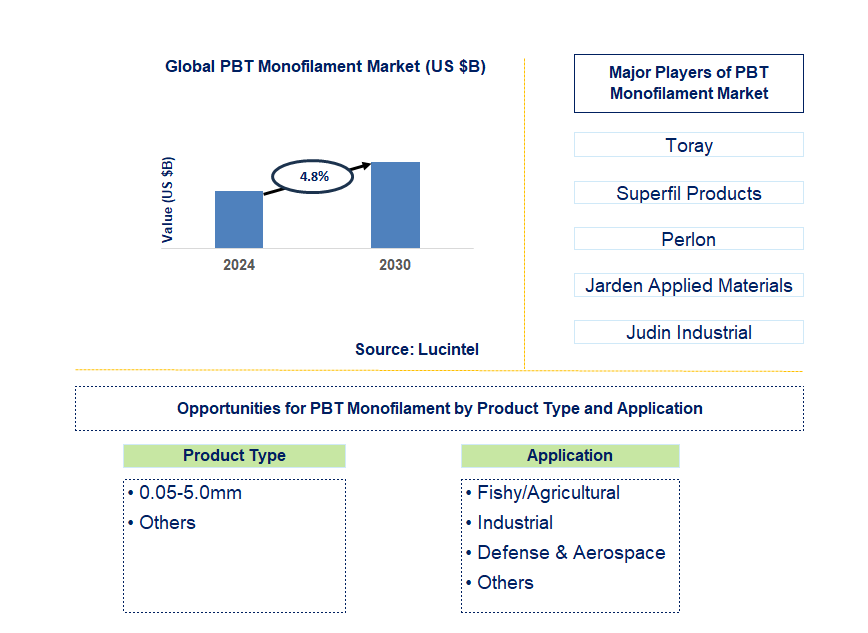
Key data points: The market size in 2030 = $0.2 billion, growth forecast = 4.8% annually for the next 6 years. Scroll below to get more insights. This market report covers trends, opportunities, and forecasts in the global pbt monofilament market to 2030 by product type (0.05-5.0mm and others), application (fishy/agricultural, industrial, defense & aerospace, and others), and region (North America, Europe, Asia Pacific, and the Rest of the World)
We'll send your sample report shortly.
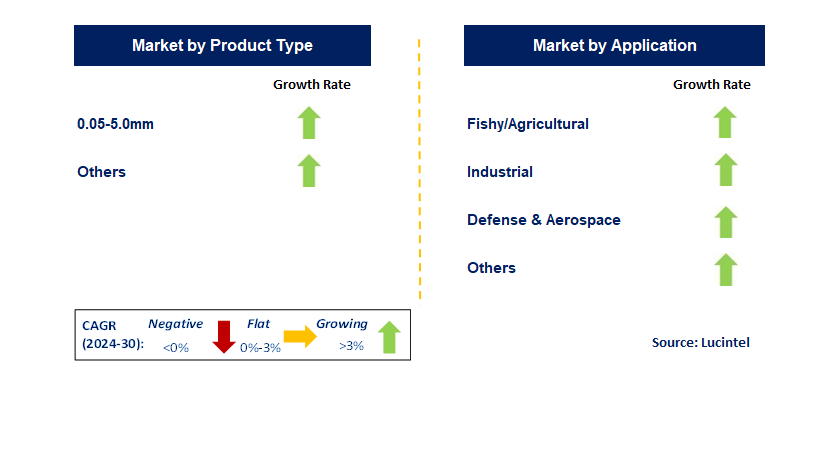
• Lucintel forecasts that, within the product type category, 0.05-5.0mm is expected to witness the highest growth over the forecast period due to its benefits, such as high strength, durability, abrasion resistance, lightweight, and easy to cast.
• In terms of regions, North America is expected to witness the highest growth over the forecast period. Gain valuable insights for your business decisions with our 150+ page report.
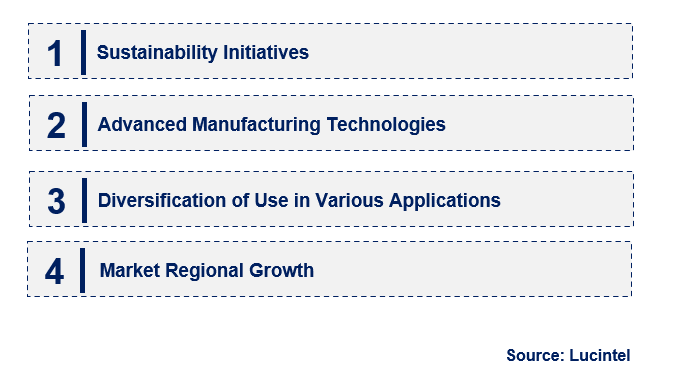
• Sustainability Initiatives: A few trends driving PBT monofilament development are aimed at sustainability. Companies are developing eco-friendly methods for producing PBT monofilaments and are continuously exploring recycling options for monofilament material. This shift responds to increased environmental regulations and consumer demand for greener products.
• Advanced Manufacturing Technologies: The adoption of advanced technologies in the manufacture of monofilaments, including automation and the use of AI, leads to efficient production with high precision in PBT monofilaments. These advantages result in better-quality products and reduced production costs, enhancing market competitiveness.
• Diversification of Use in Various Applications: New uses for PBT monofilaments, once considered unthinkable, are emerging. As medical devices, electronics, and textiles progress, many applications requiring special monofilaments with unique properties are arising, thereby expanding market horizons.
• Market Regional Growth: The production and consumption of PBT monofilaments are expanding significantly in growth markets, particularly in the Asia-Pacific region. The continued growth of the market is driven by increasing industrial activities, boosting demand for high-performance materials, and creating more opportunities in these regions. All these emerging trends are transforming the PBT monofilament market for the better, driving product performance, sustainability, and manufacturing efficiency. As these trends evolve, they will shape the market dynamics and unlock new opportunities for growth and innovation.
• Advanced Material Properties: Recent developments include enhancements in the properties of PBT monofilaments, such as increased tensile strength, chemical resistance, and thermal stability. These improvements aim to meet the demand for parts in automotive, industrial, and medical applications, thus creating more market opportunities.
• Sustainable Production: Firms are adopting production methods that prioritize reusability and eco-friendly materials. Environmental legislation, along with consumer demand for "greener" products, propels the shift toward a sustainable PBT monofilament market.
• Technological Upgrade: Advanced manufacturing technologies, including automation and precision control systems, are integrated into the PBT monofilament production process. These upgrades improve efficiency and quality, reducing production costs and enhancing product performance, which in turn boosts market competitiveness.
• Diversification in Application Segments: PBT monofilaments are being introduced into new application fields, such as medical devices, electrical applications, and special textiles. This shift is driven by the demand for high-performance materials with tailored properties, which extends the scope of PBT monofilament applications.
• Regional Market Growth: Regions such as the Asia-Pacific, particularly China and India, have experienced significant growth. This is supported by increased industrial activities and a rising demand for high-quality materials, which contribute to the global market dynamics. These developments are adding value and sustainability to the PBT monofilament market and facilitating the discovery of new applications. Further developments in the market will create growth and innovation opportunities for industry players.
• Automotive Applications: PBT monofilaments offer great potential in the automotive industry, driven by the demand for strength, durability, and resistance to harsh conditions. Applications include reinforcement materials and components requiring high performance, particularly as demand for lightweight and strong automotive parts grows.
• Medical Applications: PBT monofilaments present growth opportunities in the medical field due to their biocompatibility and precision. Potential applications include surgical sutures, diagnostic tools, and other medical equipment that require high performance and reliability.
• Textiles: The textile industry is exploring the use of PBT monofilaments in filter fabrics, industrial textiles, and sportswear. The demand for high-strength, durable, and lightweight materials is driving growth in this segment.
• Electronics: PBT monofilaments are used in applications such as cable insulation and connectors in the electronics industry. Their excellent thermal stability and electrical properties open up new opportunities in this sector.
• Agriculture: New uses for PBT monofilaments in agriculture include reinforcement materials for nets and ropes. Growth in agricultural technology is driving the demand for durable, weather-resistant materials. These strategic growth opportunities highlight the rapidly expanding applications and demand for PBT monofilaments. A targeted approach to these sectors will enable companies to better capture market trends and create future growth opportunities.
• Technological Advancements: Innovative material science and advanced manufacturing technologies are driving the development of high-performance PBT monofilaments. With improvements in strength, durability, and production efficiency, more opportunities are emerging in the market, resulting in better product performance.
• Growing Demand from End-Use Applications: Rising usage of PBT monofilaments in automotive, medical, textiles, and electrical sectors is driving market growth. Increasing demand for superior-quality, specialty materials is fueling expansion and innovation across key applications.
• Sustainability Initiatives: Shifting towards sustainable production practices, such as recycling and using eco-friendly materials, is propelling market growth. Environmental regulations and consumer preferences for sustainable products are pushing companies to adopt greener practices.
• Regional Market Expansion: Growth in emerging markets, particularly in the Asia-Pacific region (e.g., China and India), is a key driver. Increased industrial activity and demand for high-performance materials are expanding the global market for PBT monofilaments. Challenges in the pbt monofilament market are:
• Regulatory Compliance: Complying with environmental regulations and standards is a major challenge for most manufacturers. High investment is needed to align with regulatory requirements, which may increase production costs and affect market dynamics.
• High Cost of Production: The raw materials and advanced technologies required for manufacturing are costly, which can reduce the competitiveness of PBT monofilaments, especially in price-sensitive markets. These drivers and challenges continue to shape the PBT monofilament market. Growth is driven by technological advancements, sectoral demand, and sustainability trends, while compliance with regulations, high production costs, and competition pose ongoing challenges.
• Toray
• Superfil Products
• Perlon
• Jarden Applied Materials
• Judin Industrial
• Ruichang Special Monofilament
• Ri-Thai
• 0.05-5.0mm
• Others
• Fishy/Agricultural
• Industrial
• Defense & Aerospace
• Others
• North America
• Europe
• Asia Pacific
• The Rest of the World
• USA: The PBT monofilament market in the USA is on a fast development track. The demand for high-performance materials in the automotive and industrial sectors is driving growth. Recent developments include the production of high-tensile strength, abrasion-resistant monofilaments for filtration and reinforcement purposes. Innovations in production processes have further improved the efficiency and quality of these monofilaments.
• China: With rapid industrial development, China is experiencing booming demand for diversified materials. Consequently, the production capacity for PBT monofilaments is expanding rapidly. Recent developments include chemically resistant and dimensionally stable monofilaments for various applications, from textiles to automotive parts. Upgrading production technologies is also contributing to market growth.
• Germany: Germany offers an innovative and high-quality production environment for PBT monofilaments. Recent developments include enhanced thermal and mechanical properties, with monofilaments being used in precision applications such as medical devices and automotive parts. Germany’s commitment to sustainability has led to innovations in eco-friendly production techniques and recycling materials derived from monofilaments.
• India: Demand from the automotive, textiles, and agriculture sectors is driving the growth of the PBT monofilament market in India. Recent developments include expanding local production capacity and upgrading manufacturing technologies. Indian manufacturers are focusing on producing cost-effective, high-performance monofilaments for both domestic and international markets.
• Japan: Japan is known for high-tech, engineering-intensive applications of PBT monofilaments. The development of high-performance monofilaments for use in electronics and medical devices is part of the ongoing evolution. Companies in Japan continue to invest in improved manufacturing methods to enhance product performance and meet customer demands for superior quality, further facilitating growth in high-end applications.


• Toray
• Superfil Products
• Perlon
• Jarden Applied Materials
• Judin Industrial
• Ruichang Special Monofilament
• Ri-Thai Q6. Which PBT monofilament market segment will be the largest in future? Answer: Lucintel forecasts that 0.05-5.0mm is expected to witness highest growth over the forecast period due to its benefits, such as high strength, durability, abrasion resistance, lightweight, and easy to cast. Q7. In PBT monofilament market, which region is expected to be the largest in next 5 years? Answer: North America is expected to witness highest growth over the forecast period. Q.8 Do we receive customization in this report? Answer: Yes, Lucintel provides 10% customization without any additional cost.


Choose a license that fits your team. Instant PDF delivery.
Prices exclude taxes. Instant delivery. Custom licensing available on request.
Market Report · July 22, 2026
Market Report · July 22, 2026
Market Report · July 22, 2026
Trusted partner for strategic intelligence and business growth


Receive a complimentary market analysis tailored to your industry. Our analysts will identify key growth opportunities and competitive dynamics specific to your business.

Market size, growth rate, and key trend analysis for your specific sector.

Top competitor positioning and market share analysis.

Strategic recommendations backed by data-driven insights.
Get curated market intelligence and competitive moves straight to your inbox.
By subscribing, you agree to receive our monthly insights. Unsubscribe anytime.
Receive a complimentary market analysis tailored to your industry. Our analysts will identify key growth opportunities and competitive dynamics specific to your business.
Market size, growth rate, and key trend analysis for your specific sector.
Top competitor positioning and market share analysis.
Strategic recommendations backed by data-driven insights.
Get curated market intelligence, emerging trends, and competitive moves straight to your inbox each month.
By subscribing, you agree to receive our monthly insights. Unsubscribe anytime.
We'll send your sample report shortly.