
Market Report · May 18, 2026

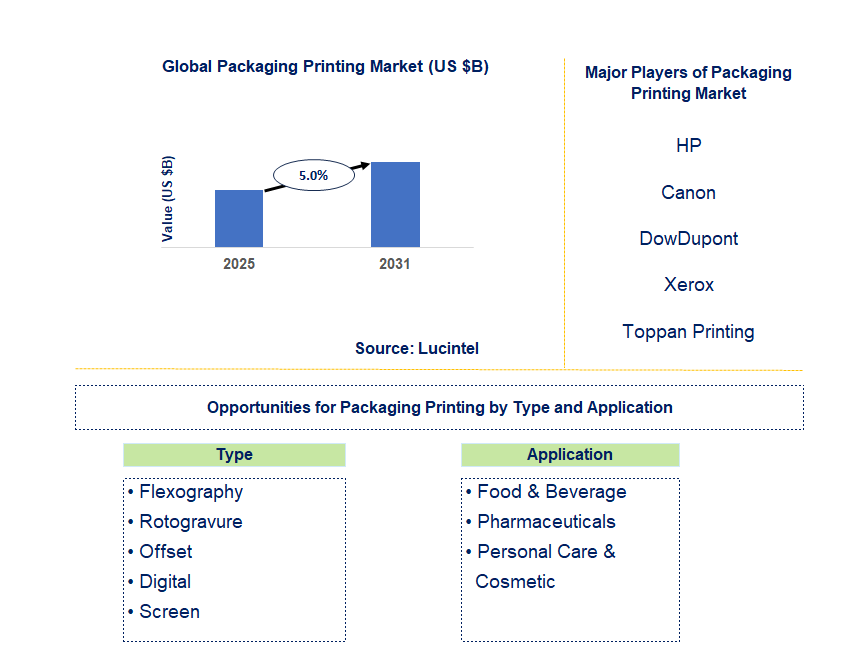
Key data points: The growth forecast = 5% annually for the next 7 years. Scroll below to get more insights. This market report covers Trends, opportunities and forecasts in packaging printing market to 2031 by type (flexography, rotogravure, offset, digital, and screen), application (food & beverage, pharmaceuticals, and personal care & cosmetic), and region (North America, Europe, Asia Pacific, and the Rest of the World)
We'll send your sample report shortly.
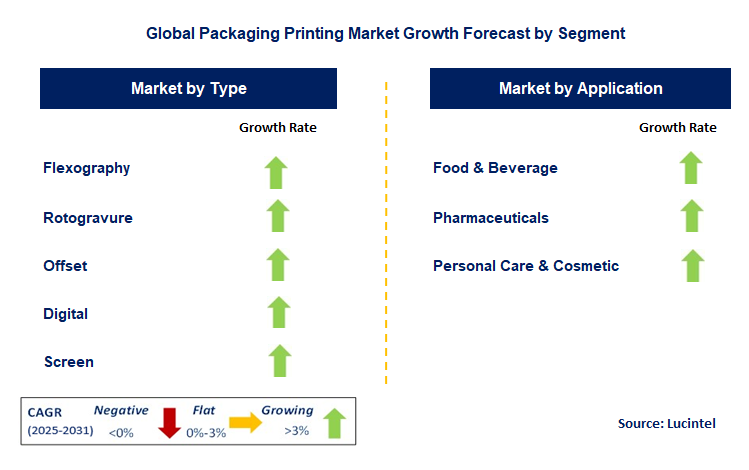
• Lucintel forecasts that, within the type category, digital is expected to witness the highest growth over the forecast period.
• Within the application category, food & beverage is expected to witness the highest growth.
• In terms of region, APAC is expected to witness the highest growth over the forecast period.
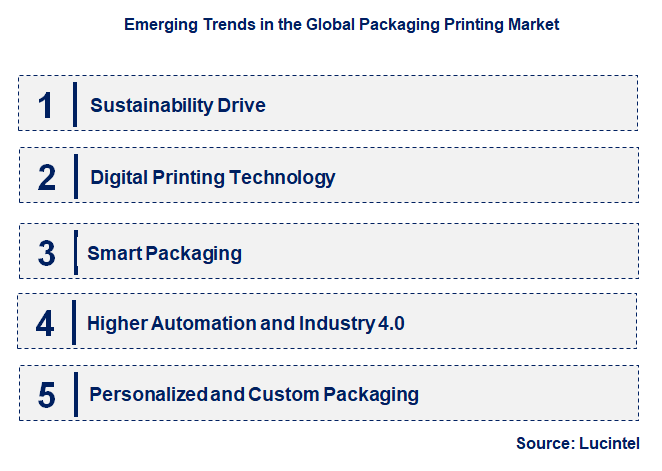
• Sustainability Drive: Sustainability is the topmost trend that has been revolutionizing packaging printing. Brands now place more value on using environmental-friendly materials and production processes that decrease the firm's carbon footprint. Customers are calling for more sustainable packaging, and companies are responding by developing biodegradable plastics, recycled content, and energy-efficient manufacturing. The trend is causing companies to move toward sustainable packaging solutions that comply with environmental standards and corporate social responsibility initiatives. The need for recyclable, reusable, and compostable packaging will continue to increase, shaping printing methods and materials employed in packaging manufacturing.
• Digital Printing Technology: Digital printing technology is transforming the packaging printing industry by providing quicker turnaround times and reduced production costs for short runs. Digital printing, unlike conventional printing techniques, provides more customization, and hence it is best suited for packaging that needs special designs or customized messages. It helps brands create packaging on-demand, eliminating waste and inventory expenses. Furthermore, digital printing allows for the use of more flexible and sustainable materials, leading to economic and environmental advantages. This technology is increasingly popular in most industries, such as food and beverages, cosmetics, and pharmaceuticals.
• Smart Packaging: Smart packaging is a dominant trend in the packaging printing market. Smart packaging integrates functionalities such as QR codes, RFID tags, and NFC technology to increase consumer interaction and offer useful product information. These technologies allow for real-time tracking, authentication, and inventory management, enhancing the supply chain as a whole. In addition, smart packaging improves the consumer experience by offering interactive and personalized content, including promotions or product information. With the rise in demand for interactive and functional packages, manufacturers are incorporating these smart functionalities into packaging printing.
• Higher Automation and Industry 4.0: Automation is redefining the packaging printing sector as companies spend heavily on future-proof robots, artificial intelligence, and Internet of Things tech to make the manufacturing process smarter. Industry 4.0 technologies are supporting businesses in optimizing supply chain, enhancing efficiency in production, and minimizing human errors. Automated printing systems permit more accurate, quality prints and quicker production rates. With the implementation of these technologies, businesses are able to react swiftly to market needs, minimize downtime, and lower costs of production. Automation further helps in sustainable operations by reducing waste and energy use in the process.
• Personalized and Custom Packaging: Custom and personalized packaging is becoming increasingly popular as brands strive to engage with consumers at a deeper level. Personalized packaging enables companies to design distinctive products for individual customer groups, which enhances brand loyalty and interaction. Custom packaging also enables one-of-a-kind designs, which improve the product's visibility on the shelf and give a company a competitive advantage. Improvements in printing technologies, including digital printing, have made it less expensive for companies to print customized packaging in smaller volumes. This is especially true in sectors such as beauty, food, and beverages, where personalization is becoming a highly valued marketing asset. These new trends are transforming the packaging printing business by enhancing efficiency, sustainability, and consumer participation. While companies continue to embrace new technologies such as digital printing, intelligent packaging, and automation, they are able to keep pace with changing consumer needs and regulations more effectively. These trends are not only revolutionizing how packages are made but also how they connect with consumers, leading to a more personalized, sustainable, and innovative marketplace.
• Development of Digital Printing: Digital printing has greatly revolutionized the packaging printing industry by providing short-run and on-demand capabilities. This technology provides fast turnaround times, reduced costs for small runs, and the capacity to print highly personalized designs. With brands looking to minimize inventory and waste, digital printing is emerging as a necessary tool for packaging firms. Digital technologies also make it possible to place greater emphasis on sustainability because it minimizes material waste and enables the use of sustainable materials in the production process.
• Development of Sustainable Packaging Solutions: The drive for sustainability has motivated the creation of innovative packaging materials and printing technologies. Biodegradable, recyclable, and reusable packaging materials are becoming popular choices for companies, especially as consumers increasingly seek greener products. Advances in inks and coatings are reducing the environmental impact of packaging print, while advances in material science have developed new sustainable packaging. These measures are catching momentum as regulations concerning waste management and sustainability tighten worldwide.
• Application of Augmented Reality in Packaging: Augmented reality (AR) is increasingly becoming an important tool in packaging printing, enabling brands to design interactive and engaging experiences for consumers. Through the use of AR features such as QR codes or special symbols, brands can offer additional information, entertainment, and promotions. This innovation increases consumer engagement by enabling them to interact with the packaging in a meaningful manner. AR is especially useful in industries such as food, beverage, and cosmetics, where product information and personalization are of great importance.
• Smart Packaging Technologies Integration: The use of smart technologies in packaging is expanding at a rapid pace. Packaging is becoming more and more integrated with features such as RFID tags, NFC chips, and QR codes, which enable consumers and companies to trace products and engage with the packaging digitally. Such innovations enhance traceability of products, prevent counterfeiting, and offer more customer value. Smart packaging also enables personalized offers, inventory tracking, and enhanced supply chain management, making overall efficiency and consumer experience better.
• Flexographic and Gravure Printing Developments: Flexographic and gravure printing have benefited from technology advancements to become more cost-effective and efficient for high-volume packaging production. Both types of printing are now efficient at delivering high-quality prints at higher speeds and with increased accuracy, making them well-suited for mass production. Furthermore, technological advancements in ink formulation and press design are helping make printing more environmentally friendly, minimizing the green footprint of bulk packaging printing operations. These innovations are revolutionizing the packaging printing sector by enhancing efficiency, sustainability, and consumer interaction. From the emergence of digital and intelligent packaging to the call for sustainable measures, companies are responding to the changing needs of the market. These innovations are opening up new avenues for expansion while recasting the future of packaging printing.
• E-commerce Packaging: E-commerce packaging is one of the most rapidly expanding markets, fueled by internet shopping. As online orders rise, so does the need for packaging that provides product protection, convenience, and a captivating unboxing experience. Customized packaging, branding, and sustainability are essential to e-commerce businesses that want to differentiate in a competitive marketplace. Packaging printing firms are taking advantage of digital print technologies to deliver affordable, personalized solutions to e-commerce companies.
• Packaging of Food and Beverages: The food and drinks sector remains the largest user of packaging printing services, as packaging is essential in ensuring product protection, branding, and consumer convenience. There has been an increase in the focus on sustainable packaging in this market, with packaging solutions that offer functionality and also sustainability being favored by companies. Developments in printing technologies like flexible packaging and direct-to-container printing are bringing new opportunities to packaging suppliers.
• Pharmaceutical Packaging: The pharmaceutical market demands packaging that is compliant with stringent regulatory requirements while maintaining product safety and integrity. Packaging printing technology advancements are allowing businesses to produce packaging with enhanced security, traceability, and tamper-evident capabilities. Demand for customized packaging for pharmaceuticals is increasing with the rise in personalized medicine and smaller production lots. The packaging printing market is taking advantage of these trends by providing more secure, sustainable, and regulatory-compliant solutions.
• Cosmetics and Personal Care Packaging: The personal care and cosmetics industry is fueled by demand for appealing, high-end packaging. Companies are employing packaging as a means to differentiate and communicate product messages to consumers more and more. Advances in printing technologies make it possible to incorporate more complex designs, embossing, and bespoke features that add to the product beauty. The move towards sustainable packaging is also prevalent in this industry as firms look for environmentally friendly packaging options that appeal to their customers.
• Flexible Packaging: Flexible packaging is increasingly expanding because it is versatile and can be utilized across a number of industries. Printing on flexible substrates such as films and pouches is gaining popularity owing to its economic nature, lightweight, and transportability. Progress in printing technology, including flexography, makes it simpler for businesses to mass-produce top-quality flexible packaging solutions. The growth of sustainable flexible packaging, especially with recyclable or compostable films, is likely to further fuel market growth. These opportunities emphasize the wide-ranging and increasing use of packaging printing in a multitude of industries. From food and e-commerce packaging to pharmaceuticals and cosmetics, businesses are seizing the growth opportunity presented by growing demand for tailored, sustainable, and high-quality packaging. Increasing emphasis on sustainability and digital technology is transforming the environment and presenting new opportunities for innovation and market expansion.
• HP
• Canon
• DowDupont
• Xerox
• Toppan Printing
• Mondi
• Quad/Graphics
• Eastman Kodak
• Xeikon
• Quantum Print and Packaging
• Flexography
• Rotogravure
• Offset
• Digital
• Screen
• Food & Beverage
• Pharmaceuticals
• Personal Care & Cosmetic
• North America
• Europe
• Asia Pacific
• The Rest of the World
• United States: The U.S. packaging printing industry has been emphasizing sustainability and digital printing technology. Growing demand for sustainable packaging and the increased trend of customization have fueled investment in new print technologies. There has been a surge in digital printing, allowing for shorter runs and faster turnaround times for personalized packaging. Brands are also seeking to add more sustainable material, such as biodegradable plastics and recycled paper, in order to cut down on the environmental footprint. Regulatory forces and consumer pressure for more environmentally friendly solutions are also driving market change.
• China: China is pushing its packaging print industry forward with the implementation of cutting-edge print technologies, including flexographic and gravure printing. The nation is putting emphasis on expanding its capacity to produce high-quality printed packaging to respond to the rising demand both locally and globally. China's massive investment in smart manufacturing technologies is also accelerating automation in packaging manufacturing. Sustainability is also gaining prominence, with an increasing number of companies seeking to minimize their carbon imprint. Environmental policies are also forcing companies to use environmentally friendly materials in packaging printing.
• Germany: Germany remains at the forefront of the packaging printing industry by incorporating innovative printing technologies like 3D printing and UV printing. The focus is on minimizing waste through accurate printing, and the transition to digital printing is contributing to enhanced efficiency and quality. Germany's sustainability focus is reflected in its efforts towards recyclable packaging solutions and the utilization of renewable materials. Furthermore, the nation is leading the way in pharmaceutical and food packaging innovation, where product safety and regulatory compliance take center stage.
• India: The Indian packaging printing market is growing rapidly, led by the booming e-commerce market and growing demand for packaged products from consumers. Digital printing is becoming increasingly popular as it facilitates more affordable, tailor-made packaging solutions. Further, there is also a movement toward sustainable packaging material, and several companies are going for biodegradable and environment-friendly options. India is also experiencing increased uptake of innovative printing technologies like flexographic and screen printing to enhance print quality as well as package design.
• Japan: The Japanese packaging printing industry is defined by the high-technology uptake as well as quality emphasis. The nation has been rapid in embracing digital and 3D printing technologies, which enable the production of highly customized and complex designs. Japan is also emphasizing sustainable packaging solutions, with firms investing in biodegradable and recyclable materials. In addition, the Japanese market is experiencing a demand for high-quality, functional packaging, especially in the electronics and food sectors, where product safety and aesthetic appeal are paramount.


• HP
• Canon
• DowDupont
• Xerox
• Toppan Printing
• Mondi
• Quad/Graphics
• Eastman Kodak
• Xeikon
• Quantum Print and Packaging Q5. Which packaging printing market segment will be the largest in future? Answer: Lucintel forecasts that, within the type category, digital is expected to witness the highest growth over the forecast period. Q6. In packaging printing market, which region is expected to be the largest in next 5 years? Answer: In terms of region, APAC is expected to witness the highest growth over the forecast period. Q7. Do we receive customization in this report? Answer: Yes, Lucintel provides 10% customization without any additional cost.


Choose a license that fits your team. Instant PDF delivery.
Prices exclude taxes. Instant delivery. Custom licensing available on request.
Market Report · May 18, 2026
Market Report · May 18, 2026
Market Report · May 18, 2026
Trusted partner for strategic intelligence and business growth


Receive a complimentary market analysis tailored to your industry. Our analysts will identify key growth opportunities and competitive dynamics specific to your business.

Market size, growth rate, and key trend analysis for your specific sector.

Top competitor positioning and market share analysis.

Strategic recommendations backed by data-driven insights.
Get curated market intelligence and competitive moves straight to your inbox.
By subscribing, you agree to receive our monthly insights. Unsubscribe anytime.
Receive a complimentary market analysis tailored to your industry. Our analysts will identify key growth opportunities and competitive dynamics specific to your business.
Market size, growth rate, and key trend analysis for your specific sector.
Top competitor positioning and market share analysis.
Strategic recommendations backed by data-driven insights.
Get curated market intelligence, emerging trends, and competitive moves straight to your inbox each month.
By subscribing, you agree to receive our monthly insights. Unsubscribe anytime.
We'll send your sample report shortly.