
Market Report · July 15, 2026

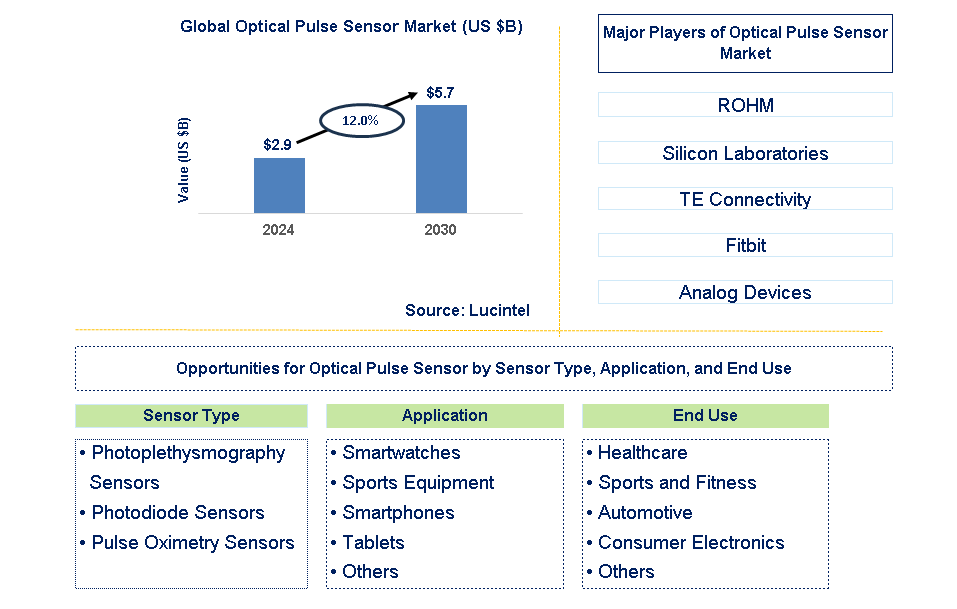
Key data points: The market size in 2030 = $5.7 billion, growth forecast = 12.0% annually next 6 years. Scroll below to get more insights. This market report covers trends, opportunities, and forecast in the global optical pulse sensor market to 2030 by sensor type (photoplethysmography sensors, photodiode sensors, and pulse oximetry sensors), application (smartwatches, sports equipment, smartphones, tablets, and others), end use (healthcare, sports and fitness, automotive, consumer electronics, and others), and region (North America, Europe, Asia Pacific, and the Rest of the World)
We'll send your sample report shortly.
• United States: The future of the Optical Pulse Sensor market is paved with innovation in wearables that can track heart rate and blood oxygen levels instantly in the U.S. Companies are embedding sensors within fitness trackers and smartwatches to service a healthy-conscious consumer base. FDA support with regards to regulation allows for quicker approvals to newer devices and competition enhances offerings in the market.
• China: China's Optical Pulse Sensor market is growing rapidly and is placing emphasis on affordable healthcare solutions. Significant investments by the government in health technology along with the promotion of smart wearables, relating to vast monitoring of vital signs, have also promoted this growth. Companies are now also exploring the use of AI-based analytics to make meanings and decipher data coming from sensors so as to increase remote monitoring capabilities. This, in turn, actually follows China's trend toward smart healthcare initiatives.
• Germany: In Germany, emphasis is placed on high-quality optical sensors to ensure that medical devices are accurate and reliable. More recently, the firms have partnered with technology firms as well as healthcare providers to improve sensor integration in the clinical environment. Development in a regulated market continues to enhance safety and efficacy, providing consumer and healthcare professional confidence.
• India: The low-cost optical pulse sensors are also witnessing tremendous growth in the region of India for adoption by the urban and rural healthcare systems. Start-ups innovate with lightweight devices, which are possible to use in monitoring vital signs. The demand for these technologies increases as the government initiatives enhance the telemedicine services to make healthcare more accessible to a larger population.
• Japan: From Japan, highly developed optical pulse sensor technology still leads the miniaturization and precision accuracy in innovation. Sensors are being incorporated into increasingly sophisticated consumer goods, like smartphones and home health devices. Additionally, Japan's rapidly aging population demands constant monitoring solutions, hence significantly investing in R&D.
• Wearables Integration: For instance, optical pulse sensors are being integrated into wearables. That kind of gadget will provide the promise of continuous health monitoring for each user and prompt one to really be on top of their health.
• AI and Data Analytics: This integration of AI algorithms in optical pulse sensors improves data analytics. This technology could give one predictive health insights, and trend analysis, which brings about the creation of tailored health strategies, meaning advice based on health data for users.
• Compatibility with Telehealth: Next, optical pulse sensors are compatible with telehealth platforms; thus, remote monitoring of patients is allowed. This is with regards to the growing demand for telemedicine; this simply means that a healthcare provider can monitor the health status of the patient in real-time and go back to adjust treatments so as to enhance patient care.
• Focus on Miniaturization: Advances in miniaturization technology keep making these optical pulse sensors smaller, less obtrusive, and hence more comfortable for the users to be used. This style increases user comfort and promotes the use of health monitoring technologies, which helps to open broader market acceptance and usage of these types of technologies in everyday life.
• Better Battery Life and Connectivity: Some innovative implementations are changing optical pulse sensors with increasing battery life and connectivity options. Long-lasting devices and devices which can seamlessly integrate with smartphones and health applications enhance user experience as it lets the users rely on the device for continued monitoring of health status.
This changed the Optical Pulse Sensor market in more ways because health monitoring is made more accessible and efficient and leads to the better management of health and patient outputs.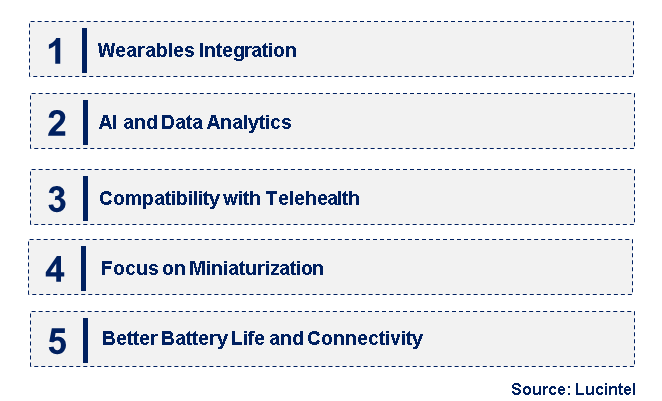
• Advanced wearable devices: Companies are now introducing the advanced wearable devices that also have an optical pulse sensor, which provides rich health metrics to its wearer. It tracks heart rate and blood oxygen levels aside from tracking and evaluating the activity of users while urging people to take even more proactive roles in health management.
• AI-Driven Insights: It results in sophisticated analytics over the data and provides real-time insights and trend analysis, which enables users to make informed health decisions based on their data patterns.
• Streamlining Regulatory Issues: The regulatory bodies of the U.S. such as the FDA streamline new optical pulse sensor technologies in the development to speed up the approval of new products into the market. Such a move hails the innovation and competition that brings forth a wide variety of products more rapidly.
• Connectivity Features Improved: New optical pulse sensors are designed with highly enhanced connectivity feature without any wire requirement. It can easily be integrated into smartphones and connected with health management apps. This access to health data can be easily shared with healthcare providers by a user.
• Affordability Focus: Manufacturers will pay much more attention to making optical pulse sensor products affordable, particularly when introducing the markets. This is through reducing cost while maintaining quality. This enables companies to make these technologies much more available to a large population, particularly in areas with limited health delivery.
All these developments have an impact on the market concerning Optical Pulse Sensor as it improves technology performance, access, and user involvement in health management.• Telemedicine Applications: The telemedicine industry, which is still unfolding, would have another huge area where optical pulse sensors would play a very important role. And it would facilitate remote monitoring of patients' vital signs, enhance care continuity, improve health outcomes, and become indispensable for the telehealth providers.
• Fitness and Wellness Monitoring: The market for consumer fitness and wellness tracking is growing rapidly. Optical pulse sensors on wearable fitness devices are designed for the health conscious who want real-time data regarding their heart rate and activity levels, which would positively increase engagement and adherence to desired fitness goals.
• Chronic Disease Management: Optical pulse sensors are one vital component in the care of chronic diseases, especially heart diseases and diabetes. Real-time monitoring of vital signs allows health care providers to appropriately take decisions and change strategies in care management.
• Home Healthcare Solution: With the move towards home health care, the optical pulse sensors have a particularly interesting opportunity in continuous surveillance of a growing number of patients being cared for in a home-based setting-a prospect that gives immense peace of mind both to the patients and the family and also makes the care more efficient.
• Integration with Smart Devices: Great prospects for optical pulse sensors are brought by the trend towards smart home technology. The less conspicuous the health monitoring of such sensors inside smart devices is, the higher their incorporation level, and thus the more seamless it will be in everyday life with improving users' engagement and adherence to health recommendations.
The best growth opportunities determine the Optical Pulse Sensor market with all its encouraging innovation and improvement in health monitoring between consumers and healthcare providers.• ROHM
• Silicon Laboratories
• TE Connectivity
• Fitbit
• Analog Devices
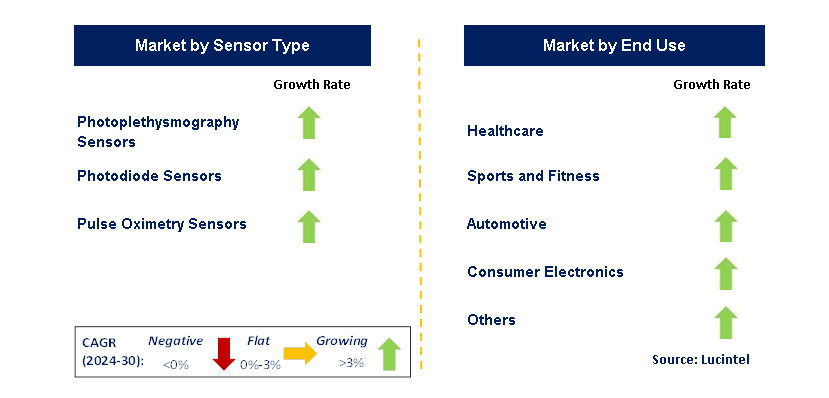
• Photoplethysmography Sensors
• Photodiode Sensors
• Pulse Oximetry Sensors
• Smartwatches
• Sports Equipment
• Smartphones
• Tablets
• Others
• Healthcare
• Sports and Fitness
• Automotive
• Consumer Electronics
• Others
• North America
• Europe
• Asia Pacific
• The Rest of the World


• ROHM
• Silicon Laboratories
• TE Connectivity
• Fitbit
• Analog Devices
Q6. Which optical pulse sensor market segment will be the largest in future?

Choose a license that fits your team. Instant PDF delivery.
Prices exclude taxes. Instant delivery. Custom licensing available on request.
Market Report · July 15, 2026
Market Report · July 13, 2026
Market Report · July 13, 2026
Trusted partner for strategic intelligence and business growth


Receive a complimentary market analysis tailored to your industry. Our analysts will identify key growth opportunities and competitive dynamics specific to your business.

Market size, growth rate, and key trend analysis for your specific sector.

Top competitor positioning and market share analysis.

Strategic recommendations backed by data-driven insights.
Get curated market intelligence and competitive moves straight to your inbox.
By subscribing, you agree to receive our monthly insights. Unsubscribe anytime.
Receive a complimentary market analysis tailored to your industry. Our analysts will identify key growth opportunities and competitive dynamics specific to your business.
Market size, growth rate, and key trend analysis for your specific sector.
Top competitor positioning and market share analysis.
Strategic recommendations backed by data-driven insights.
Get curated market intelligence, emerging trends, and competitive moves straight to your inbox each month.
By subscribing, you agree to receive our monthly insights. Unsubscribe anytime.
We'll send your sample report shortly.