
Optical Metasurface Market Report: Trends, Forecast and Competitive Analysis to 2035

Key data points: The market size in 2035 = $900 million, growth forecast = 17.9% annually for the next 9 years. Scroll below to get more insights. This market report covers trends, opportunities and forecasts in optical metasurface market to 2035 by component (metalenses, beam deflectors, polarization converters, meta-holograms, and others), material (dielectric metasurfaces, metallic metasurfaces, and hybrid metasurfaces), application (AR & VR, optical communication, imaging & sensing sys, holography, sensing & detection, and others), end use (commercial, industrial, research & academia, and others), and region (North America, Europe, Asia Pacific, and the Rest of the World)

Publisher: Lucintel Last Updated: July 2026
See Pricing

Download Sample Report

| ✨ New Download Sample report — Get instant insights! | ✨ New Download Sample report — Get instant insights!

Optical Metasurface Market Report: Trends, Forecast and Competitive Analysis to 2035

Optical Metasurface Market

The future of the global optical metasurface market looks promising with opportunities in the commercial, industrial, and research & academia markets. The global optical metasurface market is expected to reach an estimated $900 million by 2035 with a CAGR of 17.9% from 2026 to 2035. The major drivers for this market are the increasing adoption of compact optical devices, the rising demand for advanced imaging technologies, and the growing use of augmented reality applications.

  • Lucintel forecasts that, within the component category, metalens will remain the largest segment over the forecast period due to the increasing demand for compact optical components.
  • Within the end use category, commercial will remain the largest segment due to the rising adoption across commercial applications.
  • In terms of regions, North America will remain the largest region over the forecast period due to the growing investments in advanced photonic technologies.

Gain valuable insights for your business decisions with our comprehensive 150+ page report. Sample figures with some insights are shown below.
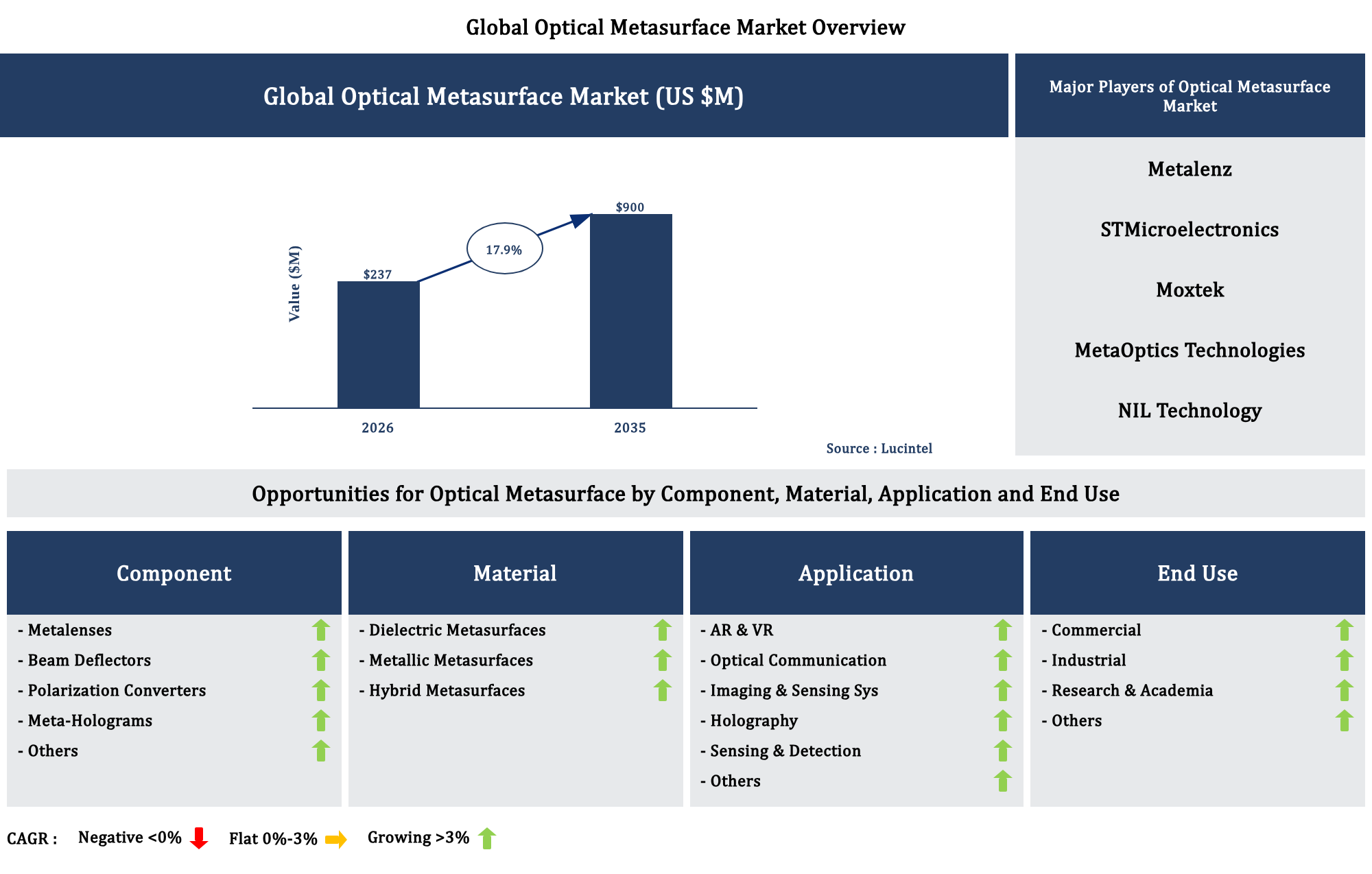
Optical Metasurface Market

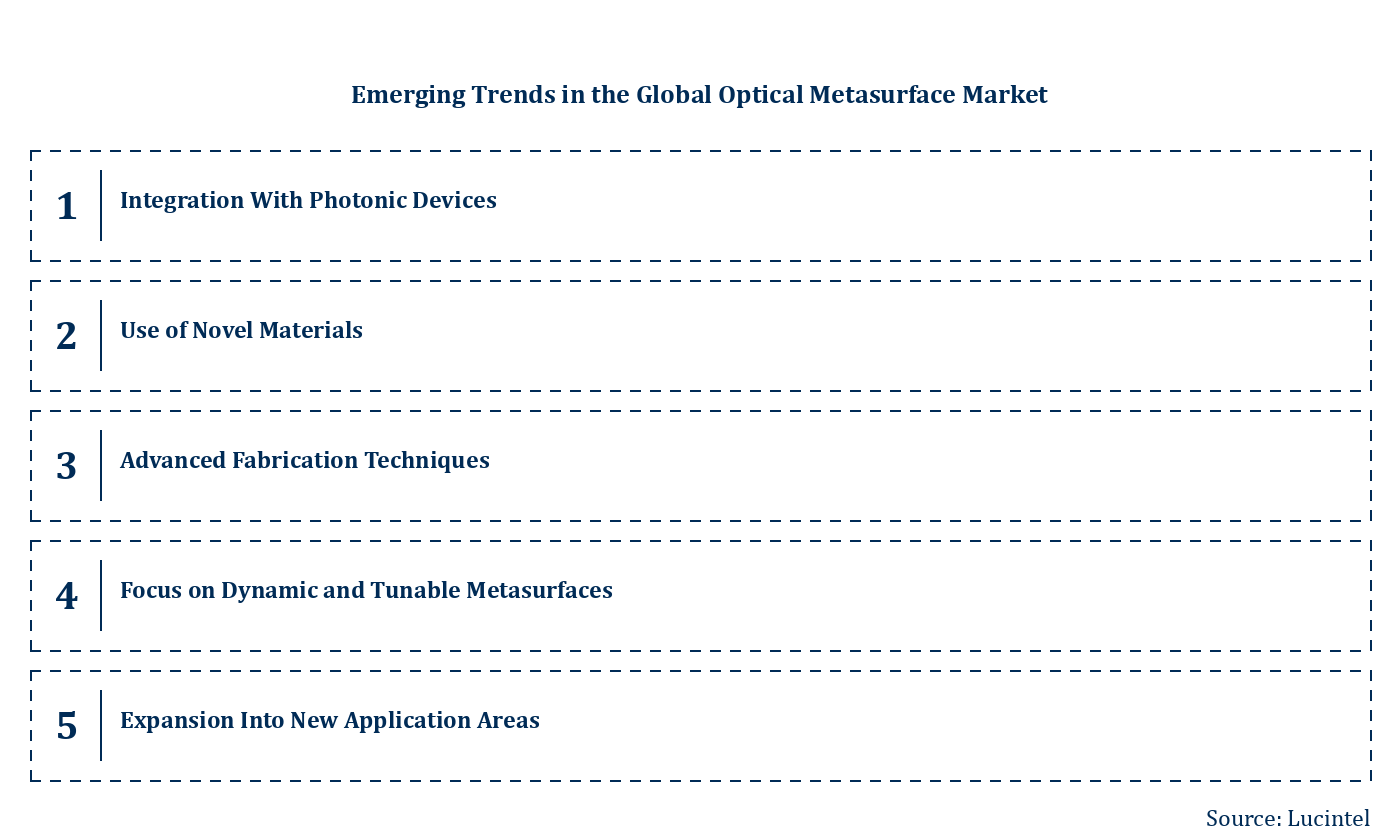
Emerging Trends in the Optical Metasurface Market

The optical metasurface market is experiencing rapid growth driven by technological advancements and increasing demand across various industries such as telecommunications, consumer electronics, healthcare, and defense. These ultra-thin, highly customizable surfaces manipulate light in innovative ways, enabling new functionalities and improving device performance. As research progresses, new materials and fabrication techniques are emerging, expanding the potential applications of metasurfaces. The market's evolution is also influenced by the rising adoption of miniaturized optical components and the need for energy-efficient solutions. These developments are transforming the landscape, fostering innovation, and opening new avenues for commercial and industrial applications.

  • Integration with Photonic Devices: The trend toward integrating metasurfaces with existing photonic components is accelerating. This integration enhances device capabilities such as beam steering, focusing, and polarization control, leading to more compact and efficient optical systems. It enables the development of advanced sensors, augmented reality devices, and high-resolution imaging systems. The seamless integration reduces system complexity and manufacturing costs, making metasurface-based solutions more accessible and scalable across various sectors.
  • Use of Novel Materials: Researchers are exploring new materials like dielectric, plasmonic, and two-dimensional materials such as graphene and transition metal dichalcogenides. These materials offer unique optical properties, including low loss, tunability, and high efficiency. The adoption of such materials improves the performance of metasurfaces, enabling applications in dynamic beam shaping, holography, and adaptive optics. This trend is crucial for overcoming limitations of traditional materials and expanding the functional scope of metasurfaces.
  • Advanced Fabrication Techniques: Innovations in fabrication methods, including electron-beam lithography, nanoimprint lithography, and self-assembly, are making it possible to produce metasurfaces with higher precision and at lower costs. These techniques facilitate mass production and enable complex, multi-layered structures. Improved fabrication processes are vital for commercial viability, allowing for the creation of highly customized metasurfaces tailored to specific applications such as laser systems, optical filters, and sensors.
  • Focus on Dynamic and Tunable Metasurfaces: The development of active metasurfaces capable of dynamic tuning is a significant trend. Incorporating materials like liquid crystals, phase-change materials, or microelectromechanical systems (MEMS) allows real-time control over optical properties. This capability is essential for applications requiring adaptable functionalities, such as variable focus lenses, reconfigurable holography, and optical switching. Dynamic metasurfaces are poised to revolutionize optical systems by providing versatile, on-demand control over light.
  • Expansion Into New Application Areas: The market is witnessing diversification into sectors like healthcare, augmented reality, and quantum computing. In healthcare, metasurfaces enable high-resolution imaging and biosensing. In augmented reality, they facilitate lightweight, compact optical components for immersive experiences. Quantum computing benefits from metasurfaces in manipulating quantum states of light. This expansion broadens the market scope, driving innovation and creating new revenue streams, while also addressing specific industry challenges with tailored optical solutions.

These trends are reshaping the optical metasurface market by fostering innovation, improving performance, and enabling new applications. The integration of advanced materials, fabrication techniques, and dynamic functionalities is making metasurfaces more versatile and commercially viable. As these developments continue, the market is expected to grow rapidly, transforming optical technologies across multiple industries and paving the way for next-generation optical systems.
Optical Metasurface Market by country

Recent Developments in the Optical Metasurface Market

The optical metasurface market is experiencing rapid growth driven by technological advancements and increasing demand across various industries. Innovations in material science and fabrication techniques are enabling more efficient, compact, and versatile optical devices. These developments are opening new avenues for applications in telecommunications, imaging, and sensing. As the market evolves, key opportunities are emerging that promise to reshape the landscape of optical technologies and expand the reach of metasurface applications globally.

  • Growing Demand for Compact Optical Devices: The miniaturization of optical components is a significant driver, with metasurfaces enabling ultra-thin, lightweight, and high-performance lenses and filters. This trend benefits consumer electronics, medical devices, and augmented reality systems by reducing size and weight while maintaining or enhancing functionality. The ability to replace bulky traditional optics with flat metasurfaces is transforming product design and user experience, fostering innovation and expanding market reach.
  • Advancements in Material Technologies: New materials such as dielectric and plasmonic metasurfaces are improving efficiency and durability. These materials allow for better control of light at nanoscale, leading to enhanced performance in applications like holography, beam shaping, and polarization control. The development of low-loss, tunable, and environmentally stable materials is expanding the scope of metasurface applications, attracting investments and fostering competitive advantages in the market.
  • Integration with Photonic and Electronic Systems: Combining metasurfaces with existing photonic and electronic platforms is creating multifunctional devices. This integration enables on-chip optical components for data processing, sensing, and communication, reducing system complexity and cost. Such developments are crucial for advancing integrated photonics, IoT devices, and 5G infrastructure, thereby accelerating market growth and opening new commercial opportunities.
  • Rising Adoption in Healthcare and Biomedical Fields: Metasurfaces are increasingly used in medical imaging, diagnostics, and therapeutic devices due to their ability to manipulate light precisely. Innovations in endoscopic imaging, optical coherence tomography, and biosensing are improving diagnostic accuracy and treatment outcomes. The biocompatibility and customizable nature of metasurfaces are making them attractive for personalized medicine, expanding their market footprint in healthcare sectors.
  • Expansion of Manufacturing and Fabrication Techniques: New fabrication methods like nanoimprint lithography and laser-assisted processes are reducing costs and increasing production scalability. These advancements enable mass production of high-quality metasurfaces, making them more accessible for commercial applications. Improved manufacturing techniques are crucial for meeting market demand, fostering innovation, and enabling the development of diverse metasurface-based products across industries.

These recent developments are significantly impacting the optical metasurface market by enhancing device performance, reducing costs, and broadening application scopes. The integration of advanced materials, miniaturization, and manufacturing innovations are driving market expansion and competitiveness. As these opportunities mature, they are poised to revolutionize optical technologies, foster new applications, and accelerate growth across sectors, establishing metasurfaces as a cornerstone of future optical innovation.

Strategic Growth Opportunities in the Optical Metasurface Market

The optical metasurface market is experiencing rapid growth driven by advancements in nanofabrication, increasing demand for miniaturized optical devices, and expanding applications across industries such as telecommunications, consumer electronics, and healthcare. Innovations in material science and design are enabling more efficient, tunable, and multifunctional metasurfaces. As industries seek lightweight, compact, and high-performance optical components, the market presents significant opportunities for manufacturers and developers to innovate and capture new revenue streams.

  • Integration of Optical Metasurfaces in Consumer Electronics: The incorporation of metasurfaces into smartphones, AR/VR devices, and wearable technology offers enhanced display quality, compact optical systems, and improved user experiences. Miniaturization of optical components reduces device size and weight, meeting consumer demand for portable, high-performance gadgets. This integration also opens avenues for innovative features like holographic displays and advanced imaging, driving growth in the consumer electronics segment.
  • Expansion of Metasurfaces in Telecommunications Infrastructure: The deployment of metasurfaces in fiber-optic communication systems enhances signal modulation, beam steering, and wavelength multiplexing. These capabilities improve data transmission speeds, reduce signal loss, and enable more efficient network architectures. As 5G and future 6G networks expand, metasurfaces will play a crucial role in developing compact, high-capacity optical components, fueling growth in the telecommunications sector.
  • Development of Tunable and Reconfigurable Metasurfaces for Adaptive Optics: Advances in active materials such as phase-change materials and liquid crystals enable the creation of tunable metasurfaces that can dynamically modify their optical properties. These adaptive surfaces are vital for applications like LIDAR, holography, and beam shaping, providing real-time control over light manipulation. The ability to customize optical responses on demand offers significant growth potential across scientific, industrial, and defense applications.
  • Application of Metasurfaces in Healthcare Imaging and Diagnostics: Metasurfaces enhance imaging resolution, enable compact optical sensors, and improve light focusing in biomedical devices. They facilitate non-invasive diagnostics, high-resolution microscopes, and portable imaging systems, contributing to early disease detection and personalized medicine. The lightweight and efficient nature of metasurfaces makes them ideal for integration into wearable health monitors and point-of-care devices, expanding their role in healthcare technology.
  • Adoption of Metasurfaces in Augmented Reality and Virtual Reality Devices: Metasurfaces enable ultra-thin, lightweight lenses and holographic displays, significantly improving AR/VR device performance. They provide high efficiency, wide field-of-view, and reduced optical aberrations, enhancing user immersion and comfort. As demand for immersive experiences grows, metasurfaces will be central to developing next-generation AR/VR headsets, creating new opportunities for consumer entertainment, training, and industrial applications.

The overall market outlook is positively influenced by these growth opportunities, fostering innovation and expanding application horizons. As technological capabilities advance, the optical metasurface market is poised for substantial expansion, driven by increasing demand for compact, efficient, and multifunctional optical solutions across diverse industries. This evolution will likely lead to new product developments, increased competition, and broader adoption of metasurface-based technologies worldwide.

Optical Metasurface Market Drivers and Challenges

The optical metasurface market is influenced by a variety of technological, economic, and regulatory factors that shape its growth trajectory. Advances in nanofabrication and material science are enabling the development of highly efficient and customizable metasurfaces, driving innovation in optical applications. Economic factors such as increasing demand for miniaturized optical devices and the proliferation of consumer electronics are fueling market expansion. Regulatory standards related to environmental safety and manufacturing practices also impact product development and commercialization. Additionally, the need for sustainable and energy-efficient solutions is prompting investments in research and development. These combined drivers and challenges create a dynamic environment that determines the market's future growth and innovation potential.

The factors responsible for driving the optical metasurface market include:

  • Technological Advancements: Rapid progress in nanofabrication techniques and material science has enabled the creation of highly precise and functional metasurfaces. These innovations allow for better control over light manipulation, leading to applications in imaging, sensing, and holography. As technology continues to evolve, the development of multifunctional and tunable metasurfaces is expected to accelerate, opening new avenues for commercial and industrial use. The ability to produce scalable and cost-effective manufacturing processes further supports market growth, making advanced optical components more accessible across various sectors.
  • Increasing Demand for Miniaturized Optical Devices: The proliferation of portable electronics, smartphones, and wearable devices has heightened the need for compact and efficient optical components. Metasurfaces offer a promising solution by replacing bulky traditional optics with ultra-thin, lightweight alternatives. This trend is particularly significant in consumer electronics, medical devices, and augmented reality systems, where space and weight are critical factors. The demand for miniaturized optics is expected to continue rising, driving innovation and adoption of metasurface technology to meet the evolving needs of these industries.
  • Growing Applications in Healthcare and Medical Imaging: The healthcare sector is increasingly adopting metasurface-based optical components for advanced imaging and diagnostic tools. These surfaces enable high-resolution imaging, precise light focusing, and spectral filtering, which are essential for medical diagnostics and minimally invasive procedures. The ability to customize metasurfaces for specific medical applications enhances their utility, leading to improved patient outcomes. As medical technology advances, the integration of metasurfaces is anticipated to expand, further boosting market growth and fostering innovation in healthcare solutions.
  • Rising Investment in R&D and Commercialization: Governments, private enterprises, and research institutions are investing heavily in the development of optical metasurfaces. Funding initiatives aim to improve fabrication techniques, develop new materials, and explore novel applications. This investment accelerates the commercialization process, reduces costs, and enhances product performance. The increasing focus on sustainable and energy-efficient optical solutions also encourages research into environmentally friendly metasurface materials. These investments are crucial for overcoming technical challenges and establishing metasurfaces as mainstream optical components.
  • Expansion in Consumer Electronics and Communication Technologies: The rapid growth of 5G networks, high-speed data transmission, and advanced display technologies is fueling demand for innovative optical components. Metasurfaces enable the development of compact lenses, beam steering devices, and holographic displays, which are vital for next-generation communication and entertainment systems. The integration of metasurfaces into consumer devices enhances user experience through improved performance and new functionalities. As these technologies become more widespread, the market for optical metasurfaces is expected to expand significantly, driven by the need for high-performance, miniaturized optical solutions.

The challenges facing the optical metasurface market include:

  • Technical Complexity and Manufacturing Challenges: Producing high-quality, large-area metasurfaces with precise nanostructures remains a significant hurdle. The fabrication process involves complex, costly, and time-consuming techniques such as electron-beam lithography and nanoimprinting, which are difficult to scale for mass production. Achieving uniformity and reproducibility across large surfaces is challenging, impacting product reliability and performance. Overcoming these manufacturing barriers is essential for commercial viability, but it requires substantial technological innovation and investment, which can slow market growth and limit widespread adoption.
  • Material Limitations and Durability Concerns: The performance of optical metasurfaces heavily depends on the choice of materials, which must possess specific optical properties, stability, and compatibility with fabrication processes. Many promising materials are prone to degradation under environmental conditions such as humidity, temperature fluctuations, and UV exposure. This affects the durability and long-term reliability of metasurface-based devices, especially in demanding applications like outdoor or medical environments. Developing robust, environmentally stable materials remains a critical challenge that could hinder market expansion and product lifespan.
  • Regulatory and Standardization Barriers: As the technology advances, the lack of standardized testing protocols, safety regulations, and certification processes poses obstacles to commercialization. Regulatory frameworks for nanomaterials and nanofabrication processes are still evolving, creating uncertainty for manufacturers and consumers. Compliance with environmental and safety standards can increase costs and delay product launches. Additionally, intellectual property issues and patent disputes may restrict innovation and market entry. Addressing these regulatory and standardization challenges is vital for fostering a stable and predictable market environment.

The optical metasurface market is driven by technological innovations, increasing miniaturization demands, expanding applications in healthcare, substantial R&D investments, and growth in consumer electronics. However, technical complexities, material durability issues, and regulatory hurdles present significant challenges. These factors collectively influence the pace and scope of market development. While opportunities for growth are substantial, overcoming these challenges requires concerted efforts in research, standardization, and manufacturing innovation. The market's future will depend on how effectively these drivers and challenges are managed to unlock the full potential of optical metasurfaces.

List of Optical Metasurface Market Companies

Companies in the market compete on the basis of product quality offered. Major players in this market focus on expanding their manufacturing facilities, R&D investments, infrastructural development, and leverage integration opportunities across the value chain. Through these strategies optical metasurface market companies cater increasing demand, ensure competitive effectiveness, develop innovative products & technologies, reduce production costs, and expand their customer base. Some of the optical metasurface market companies profiled in this report include-

  • Metalenz
  • STMicroelectronics
  • Moxtek
  • MetaOptics Technologies
  • NIL Technology
  • Lumotive
  • 2Pi Optics
  • Tunoptix
  • Kymeta Corporation
  • Viavi Solutions

Optical Metasurface Market by Segment

The study includes a forecast for the global optical metasurface market by component, material, application, end use, and region.

  • Optical Metasurface Market by Component [Value from 2019 to 2035]:
    • Metalenses
    • Beam Deflectors
    • Polarization Converters
    • Meta-Holograms
    • Others
  • Optical Metasurface Market by Material [Value from 2019 to 2035]:
    • Dielectric Metasurfaces
    • Metallic Metasurfaces
    • Hybrid Metasurfaces
  • Optical Metasurface Market by Application [Value from 2019 to 2035]:
    • AR & VR
    • Optical Communication
    • Imaging & Sensing Sys
    • Holography
    • Sensing & Detection
    • Others
  • Optical Metasurface Market by End Use [Value from 2019 to 2035]:
    • Commercial
    • Industrial
    • Research & Academia
    • Others
  • Optical Metasurface Market by Region [Value from 2019 to 2035]:
    • North America
    • Europe
    • Asia Pacific
    • The Rest of the World

Country Wise Outlook for the Optical Metasurface Market

The optical metasurface market has experienced rapid growth driven by technological advancements and increasing demand across various industries such as telecommunications, consumer electronics, and healthcare. Innovations in material science and fabrication techniques have enabled the development of more efficient, customizable, and scalable metasurfaces. Governments and private sectors are investing heavily in research to harness the potential of metasurfaces for applications like imaging, sensing, and beam steering. As the market evolves, regional players are adopting new strategies to enhance their competitive edge, leading to significant shifts in market dynamics globally. The following summarizes recent developments in the United States, China, Germany, India, and Japan.

  • United States: The US market has seen significant investments in research and development, with leading tech companies integrating metasurfaces into consumer devices and defense systems. Universities and startups are pioneering innovative applications in holography and flat optics, while government agencies support commercialization efforts. The focus is on scalable manufacturing processes and enhancing device performance, positioning the US as a leader in metasurface technology.
  • China: China has rapidly advanced in metasurface research, backed by substantial government funding and industrial collaborations. Chinese firms are focusing on mass production techniques to reduce costs and expand applications in telecommunications and consumer electronics. Recent breakthroughs include high-efficiency metasurfaces for 5G and augmented reality devices, with a growing emphasis on integrating metasurfaces into existing manufacturing ecosystems.
  • Germany: Germany's market is characterized by strong industrial integration, especially in automotive and optical instrument sectors. Research institutions are collaborating with industry to develop durable, high-performance metasurfaces for sensors and imaging systems. The emphasis is on precision engineering and sustainable manufacturing practices, positioning Germany as a key player in high-end optical applications.
  • India: India is witnessing increasing interest in metasurface technology, primarily driven by startups and academic institutions. Focus areas include developing cost-effective metasurfaces for telecommunications and medical imaging. Government initiatives aim to promote innovation and build a domestic supply chain, with a growing ecosystem of research centers and industry partnerships.
  • Japan: Japan continues to lead in advanced optical research, with a focus on integrating metasurfaces into consumer electronics and space applications. Major corporations are investing in next-generation metasurface designs for miniaturized optical components and sensors. The country emphasizes high-quality manufacturing and innovative material use, maintaining its position as a key innovator in the field.

Features of the Optical Metasurface Market

  • Market Size Estimates: Optical metasurface market size estimation in terms of value ($M).
  • Trend and Forecast Analysis: Market trends (2019 to 2025) and forecast (2026 to 2035) by various segments and regions.
  • Segmentation Analysis: Optical metasurface market size by various segments, such as by component, material, application, end use, and region in terms of value ($M).
  • Regional Analysis: Optical metasurface market breakdown by North America, Europe, Asia Pacific, and Rest of the World.
  • Growth Opportunities: Analysis of growth opportunities in different components, materials, applications, end uses, and regions for the optical metasurface market.
  • Strategic Analysis: This includes M&A, new product development, and competitive landscape of the optical metasurface market.
  • Analysis of competitive intensity of the industry based on Porter’s Five Forces model.

Top 5 Companies

  • Metalenz
  • STMicroelectronics
  • Moxtek
  • MetaOptics Technologies
  • NIL Technology

Table of Contents

1. Executive Summary
15.1 Competitive Analysis Overview

List of Figures

List of Tables

Methodology

Lucintel has been in the business of market research and management consulting since 2000 and has published over 1000 market intelligence reports in various markets / applications and served over 1,000 clients worldwide. This study is a culmination of four months of full-time effort performed by Lucintel's analyst team. The analysts used the following sources for the creation and completion of this valuable report:

  • In-depth interviews of the major players in this market
  • Detailed secondary research from competitors' financial statements and published data
  • Extensive searches of published works, market, and database information pertaining to industry news, company press releases, and customer intentions
  • A compilation of the experiences, judgments, and insights of Lucintel's professionals, who have analyzed and tracked this market over the years.

Extensive research and interviews are conducted across the supply chain of this market to estimate market share, market size, trends, drivers, challenges, and forecasts. Below is a brief summary of the primary interviews that were conducted by job function for this report.

Lucintel's methodology for market research

Thus, Lucintel compiles vast amounts of data from numerous sources, validates the integrity of that data, and performs a comprehensive analysis. Lucintel then organizes the data, its findings, and insights into a concise report designed to support the strategic decision-making process. The figure below is a graphical representation of Lucintel's research process.

Primary interviews by job function

Buy Now

Choose a license that fits your team. Instant PDF delivery.

Market Report

1 User PDF

$4,850
Buy Now

Market Report

2-5 Users PDF

$6,700
Buy Now

Market Report

Corporate PDF

$8,850
Buy Now

Market Report

Global PDF

$10,000
Buy Now

Prices exclude taxes. Instant delivery. Custom licensing available on request.

Frequently Asked Questions

What is the optical metasurface market size?
The global optical metasurface market is expected to reach an estimated $900 million by 2035.
What is the growth forecast for optical metasurface market?
The global optical metasurface market is expected to grow with a CAGR of 17.9% from 2026 to 2035.
What are the major drivers influencing the growth of the optical metasurface market?
The major drivers for this market are the increasing adoption of compact optical devices, the rising demand for advanced imaging technologies, and the growing use of augmented reality applications.
What are the major segments for optical metasurface market?
The future of the optical metasurface market looks promising with opportunities in the commercial, industrial, and research & academia markets.
Who are the key optical metasurface market companies?

Some of the key optical metasurface companies are as follows:

  • Metalenz
  • STMicroelectronics
  • Moxtek
  • MetaOptics Technologies
  • NIL Technology
  • Lumotive
  • 2Pi Optics
  • Tunoptix
  • Kymeta Corporation
  • Viavi Solutions
Which optical metasurface market segment will be the largest in future?
Lucintel forecasts that, within the component category, metalens will remain the largest segment over the forecast period.
In optical metasurface market, which region is expected to be the largest in next 9 years?
In terms of region, North America will remain the largest region over the forecast period.
Do we receive customization in this report?
Yes, Lucintel provides 10% customization without any additional cost.

Key Questions

  • What are some of the most promising, high-growth opportunities for the optical metasurface market by component (metalenses, beam deflectors, polarization converters, meta-holograms, and others), material (dielectric metasurfaces, metallic metasurfaces, and hybrid metasurfaces), application (AR & VR, optical communication, imaging & sensing sys, holography, sensing & detection, and others), end use (commercial, industrial, research & academia, and others), and region (North America, Europe, Asia Pacific, and the Rest of the World)?
  • Which segments will grow at a faster pace and why?
  • Which region will grow at a faster pace and why?
  • What are the key factors affecting market dynamics? What are the key challenges and business risks in this market?
  • What are the business risks and competitive threats in this market?
  • What are the emerging trends in this market and the reasons behind them?
  • What are some of the changing demands of customers in the market?
  • What are the new developments in the market? Which companies are leading these developments?
  • Who are the major players in this market? What strategic initiatives are key players pursuing for business growth?
  • What are some of the competing products in this market and how big of a threat do they pose for loss of market share by material or product substitution?
  • What M&A activity has occurred in the last 6 years and what has its impact been on the industry?
Why Choose Us

The Lucintel Advantage

Trusted partner for strategic intelligence and business growth

25+ Years Excellence

25+ Years Excellence

Quarter century of proven expertise in management consulting and market research across global markets.
Game-Changer Ideas

Game-Changer Ideas

Innovative strategies and actionable insights that help clients become the smartest in their industry.
Global Reach

Global Reach

Extensive coverage across 50+ industries and markets worldwide with localized expertise.
Start Your Growth Journey

Get Your Free
Market Intelligence
Briefing

Receive a complimentary market analysis tailored to your industry. Our analysts will identify key growth opportunities and competitive dynamics specific to your business.

Custom Market Snapshot

Market size, growth rate, and key trend analysis for your specific sector.

Competitive Landscape Overview

Top competitor positioning and market share analysis.

Growth Opportunity Identification

Strategic recommendations backed by data-driven insights.

Subscribe

Subscribe to our Newsletter

Get curated market intelligence and competitive moves straight to your inbox.

By subscribing, you agree to receive our monthly insights. Unsubscribe anytime.

Industry Trends Market Signals Opportunities Competitor Moves