
Report Feature
Onshore Oil and Gas Pipeline Market Trends and Forecast
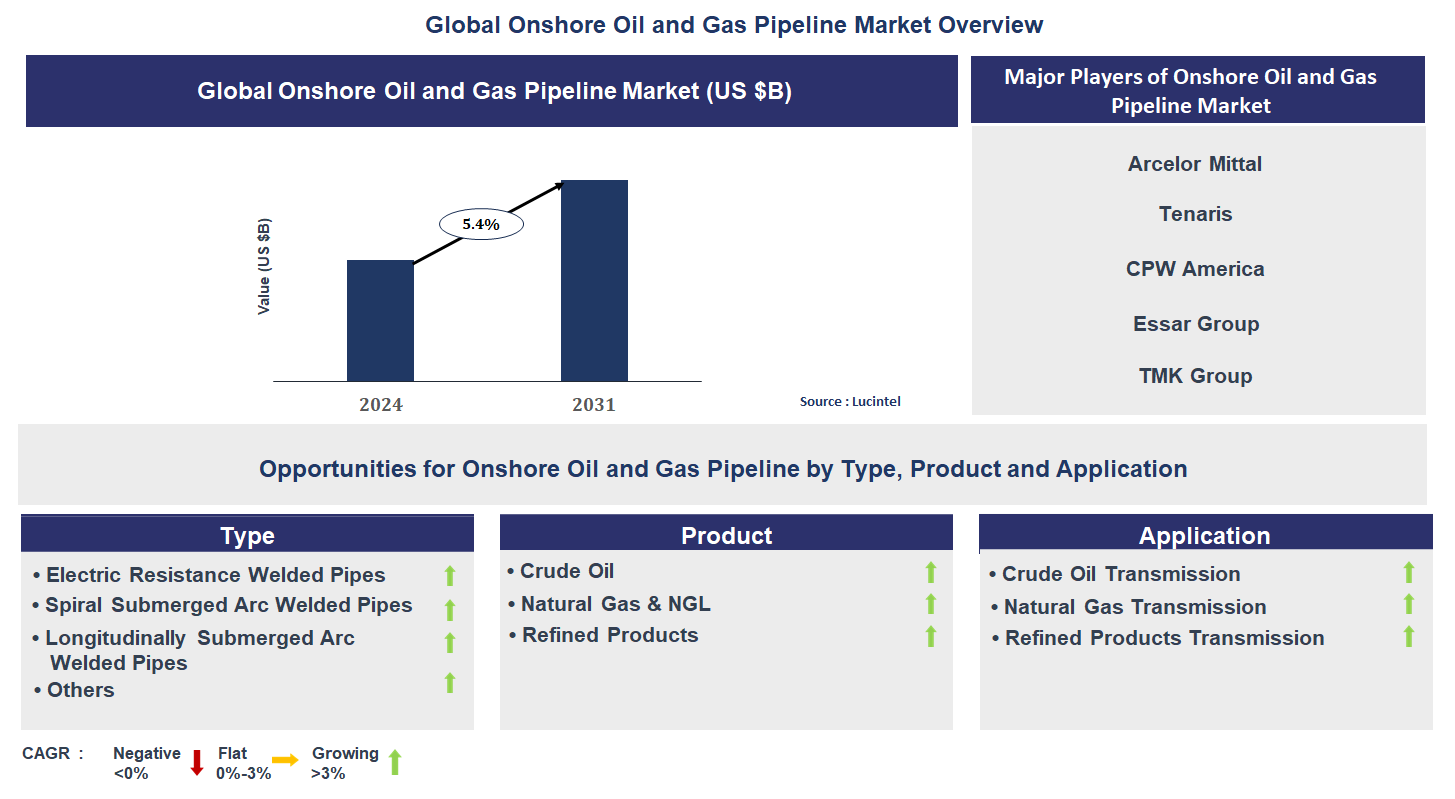
The future of the global onshore oil and gas pipeline market looks promising with opportunities in the crude oil transmission, natural gas transmission, and refined products transmission markets. The global onshore oil and gas pipeline market is expected to grow with a CAGR of 5.4% from 2025 to 2031. The major drivers for this market are the increasing demand for energy from developing countries, the rising investments in exploration activities, and the growing development of cross-country pipeline infrastructure.• Lucintel forecasts that, within the type category, longitudinally submerged arc welded pipe is expected to witness higher growth over the forecast period.
• Within the application category, natural gas transmission is expected to witness the highest growth.
• In terms of region, APAC is expected to witness the highest growth over the forecast period. Gain valuable insights for your business decisions with our comprehensive 150+ page report. Sample figures with some insights are shown below.
Emerging Trends in the Onshore Oil and Gas Pipeline Market
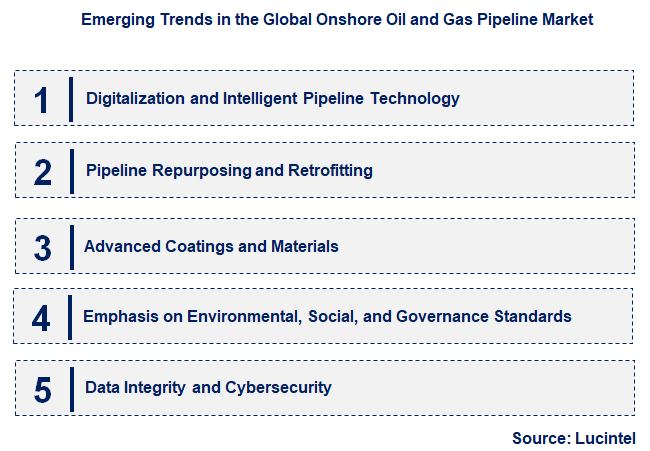
The onshore oil and gas pipeline industry is being influenced by a number of strong emerging trends that are fundamentally changing the way material is moved. These trends are a reaction to growing demands for efficiency, security, and sustainability. They are pushing innovation beyond the conventional application of pipelines, making them a central part of contemporary, robust energy infrastructure.• Digitalization and Intelligent Pipeline Technology: Sensor and digital monitoring system integration is a key trend. Intelligent pipelines give real-time data about pressure, temperature, and flow, and also leak and structural condition detection. This trend is affecting the market by allowing predictive maintenance, minimizing expensive unplanned downtime. It converts a pipeline from an inert piece of equipment into a dynamic, information-generating asset that improves system dependability and safety, and generates enormous value for operators.
• Pipeline Repurposing and Retrofitting: As the world shifts away from fossil fuels, repurposing existing oil and gas pipelines for alternative energy forms like hydrogen, biogas, and carbon dioxide is becoming increasingly popular. This movement is transforming the market as it offers an economically efficient means of developing new infrastructure as opposed to constructing new infrastructure altogether. It lengthens the economic life of assets in place and is consistent with global decarbonization ambitions, which is a rising priority for governments and investors.
• Advanced Coatings and Materials: There is an emerging trend towards the development of advanced materials and coatings for pipelines. This involves the application of nanotechnology and expert composites to improve strength, durability, corrosion resistance, and abrasion resistance. This trend is transforming the market by widening the scope of application for pipelines into more hostile and corrosive environments, thus making them more competitive with conventional materials and enhancing their overall life expectancy.
• Emphasis on Environmental, Social, and Governance Standards: The market is witnessing more emphasis on ESG standards due to investor pressure and regulatory reforms. Organizations are being forced to reduce their carbon footprint, enhance safety levels, and interact with the local community. The trend is influencing the market to embrace innovative technologies to detect leaks and cut emissions, which are emerging as a competitive edge.
• Data Integrity and Cybersecurity: With pipelines becoming increasingly digital, they are also at an increased risk from cyberattacks. Increasing investments in strong cybersecurity mechanisms to secure pipeline control systems and confidential data is the growing trend. The trend is transforming the market by making cybersecurity an essential part of pipeline infrastructure and a key area of investment for operators necessary for ensuring safe and reliable energy flow. These trends are deeply transforming the onshore oil and gas pipeline industry by making the technology smarter, sustainable, and secure. The transition from a reactive to proactive service model fueled by digitalization and high-performance materials is giving rise to a more resilient and dynamic industry that is better able to meet the complexities of contemporary energy and infrastructure requirements.
Recent Development in the Onshore Oil and Gas Pipeline Market
The onshore oil and gas pipeline sector has witnessed several recent developments, prompted by the ongoing demand for efficiency and cost minimization in several industrial settings. These developments manifest as an evolution from rudimentary working tools to complex, integrated systems that deliver enhanced capabilities and better performance. These are the major developments, a reflection of the sectors dedication to innovation and its reaction to challenges of modern infrastructure.• Natural Gas and LNG Infrastructure Expansion: One major development has been the extensive development of new natural gas and LNG pipelines throughout North America and Asia. This is motivated by worldwide demand for natural gas as a lower-carbon fuel and the requirement to move it from production sources to coastal liquefaction terminals. The effect of this evolution is a boost in the markets capacity to deliver a diversified energy mix, important for lowering a nations reliance on a single fuel source and achieving its carbon reduction objectives.
• Implementation of Advanced Welding and Coating Technologies: Widening evolution has centered on enhancing welding and coating technologies to advance pipeline integrity and lifespan. This involves the application of welding machines and special anti-corrosion coating. This is a very important development as it minimizes the risk of leaks and failure, which can be expensive and hazardous.
• Integration of Real-Time Monitoring and SCADA Systems: Integration of sophisticated Supervisory Control and Data Acquisition (SCADA) systems and real-time monitoring is one of the biggest advancements. These systems enable operators to view pipeline conditions remotely from a central control and to act promptly on any problems that may arise. The effect of this innovation is a move toward predictive maintenance mode, whereby organizations can foretell and avoid failure before it happens, which maximizes safety, minimizes breakdown downtime, and maximizes operational efficiency.
• Smart Pigging and Internal Inspection: An important innovation is the application of smart "pigs" (pipeline inspection gauges) that move through pipelines to gather information on their internal health. These tools are fitted with sophisticated sensors capable of sensing tiny imperfections, cracks, and rust. This innovation is making a significant difference by enabling operators to perform extensive inspections without interrupting the flow of energy, which assures the integrity of the pipeline system and is one of the essential factors in enhancing safety.
• Greater Application of Large-Diameter Pipelines: The latest developments are focused on the greater application of large-diameter pipelines to transport long distances. These pipes have the capability to carry a significantly greater volume of oil or gas, which is necessary for satisfying the energy requirements of large populations and industries. This innovation is affecting the market in that it enhances the cost saving and efficiency of energy transport and lessens the number of compressor stations needed, an important aspect of minimizing operational costs and environmental influence. These advances are significantly affecting the onshore oil and gas pipeline market by making the technology more intelligent, reliable, and capable. They are making pipelines a primary solution for more applications, cementing them as a vital tool in contemporary infrastructure.
Strategic Growth Opportunities in the Onshore Oil and Gas Pipeline Market
The onshore oil and gas pipeline market provides multiple strategic growth prospects in a variety of applications, fueled by the demand for more efficient and long-lasting solutions within a tough industry environment. By concentrating on targeted areas of application, firms can create specialized products and services that address specific customer requirements and leverage new demands. These are not merely opportunities for selling products but for delivering complete solutions that meet the particular needs of each industry.• Midstream Infrastructure for Unconventional Resources: One of the key strategic growth opportunities is to construct the midstream infrastructure for unconventional oil and gas resources, including shale gas and tight oil. The sudden expansion of these resources in areas such as the Permian Basin in the US and the Sichuan Basin in China has generated a huge need for new pipelines to tie wellheads to processing plants and markets.
• Modernization and Replacement of Aging Networks: A significant growth opportunity is the modernization and replacement of aging pipeline networks in mature markets like the United States and Europe. Many of these pipelines are decades old and are in need of replacement to meet modern safety and environmental standards. The opportunity lies in providing new materials and technologies that offer a longer life span and enhanced safety features, which is a stable and long-term market.
• LNG Export and Import Infrastructure Development: The transition toward natural gas globally is presenting a strategic opportunity for growth in the establishment of pipelines between onshore production facilities and LNG export terminals and import terminals and end-market destinations. Natural gas demand as a cleaner fuel is fueling the opportunity, especially in Asia, as nations aim to diversify their energy portfolio.
• Low-Carbon Fuel Transport: With the globe transitioning to a low-carbon economy, there is a significant opportunity for growth in transporting new energy carriers such as hydrogen and carbon dioxide (for carbon capture and storage). Either developing new pipelines or converting existing ones would be necessary. The opportunity is to offer the engineering and construction capabilities for developing new infrastructure, a long-term growth market that is aligned with world sustainability objectives.
• Urban and Industrial Gas Distribution: Urban and industrial gas distribution network expansion, especially in emerging economies such as India and China, is a significant growth opportunity. The government is encouraging natural gas consumption by households and industries as a cleaner and efficient option compared to conventional fuels. The opportunity is to supply the pipes, fittings, and services for these city gas distribution (CGD) networks, a high-volume and stable market. These opportunities are affecting the onshore oil and gas pipeline market by pushing its development toward a more application-specific and specialized industry. By concentrating on high-value, high-growth niches, firms are able to differentiate themselves and establish a more sustainable business model, transitioning from commodity products to becoming essential partners in resolving the sophisticated problems of contemporary industry.
Onshore Oil and Gas Pipeline Market Driver and Challenges
The onshore oil and gas pipeline market is a fast-paced business driven by the intricate interplay of several drivers that propel its development and limitations that restrict its potential. The key drivers and limitations are diverse technological, economic, and regulatory elements. It is important to understand these dynamics to enable players to navigate the market effectively. The factors responsible for driving the onshore oil and gas pipeline market include: 1. Rising Energy Demand: One of the main drivers is increased world demand for energy, especially in developing economies with increasing populations and high industrialization rates. This results in a sustained need for effective and reliable transportation networks to transport oil and gas from production facilities to final markets. 2. Technological innovations: Ongoing innovation in new technologies, including next-generation welding methods, corrosion-resistant coatings, and digital monitoring systems, is a principal driver of growth. These innovations are making pipelines higher quality, longer-lasting, and safer to produce, which makes them an increasingly appealing investment proposition for operators. 3. Call of the Oil and Gas Industry: The oil and gas industry is a significant driver, with a continued need to move hydrocarbons from conventional and unconventional reservoirs. Focus of the industry on minimizing cost and long-term integrity of assets has made new pipeline development and upgrading existing pipelines an appealing investment. 4. Industrialization and Urbanization: Industrialization and urbanization, especially in Asia, are putting a huge demand for new pipeline infrastructure. As industries and cities develop, there is a requirement of new pipelines to offer a constant supply of energy for household and commercial purposes. 5. Emphasis on Natural Gas as a Transition Fuel: A major catalyst is the worlds emphasis on natural gas as a transition fuel towards a shift away from fossil fuels towards renewables. As nations aim to lower their carbon footprints, they are now looking more towards natural gas, which is a cleaner option compared to coal and oil. Challenges in the onshore oil and gas pipeline market are: 1. Strict Environmental Laws and Public Backlash: One of the major challenges is the growing public backlash and strict environmental laws that hinder issuing permits and right-of-way for new pipeline ventures. This results in substantial delays and cost escalation. The industry is coming under pressure to embrace stricter environmental regulations and interaction with local communities in order to overcome the same. 2. High Capital Expenditures and Project Financing: Onshore pipeline development involves high capital expenditure, and the availability of sufficient financing can be a major issue. The high initial investment and the long-term project nature can prove to be an obstacle, especially in a market with fluctuating oil and gas prices. 3. Geopolitical and Security Risks: The onshore pipeline industry is exposed to geopolitical tensions and security threats, which can pose a high impact on the planning, construction, and operation of pipelines. Pipelines typically pass through several nations, and political instability or conflicts can hamper the free flow of these vital energy veins. In summary, the onshore oil and gas pipeline industry is at crossroads, with strong drivers nudging towards technological innovation and growth, while the major challenges such as environmental resistance and capital intensity present barriers. The net result of all these is a market increasingly characterized by a dual emphasis: on offering both high-technology, high-value solutions for advanced industrial applications and on offering simple, low-cost products for broad application.List of Onshore Oil and Gas Pipeline Companies
Companies in the market compete on the basis of product quality offered. Major players in this market focus on expanding their manufacturing facilities, R&D investments, infrastructural development, and leverage integration opportunities across the value chain. With these strategies onshore oil and gas pipeline companies cater increasing demand, ensure competitive effectiveness, develop innovative products & technologies, reduce production costs, and expand their customer base. Some of the onshore oil and gas pipeline companies profiled in this report include-• Arcelor Mittal
• Tenaris
• CPW America
• Essar Group
• TMK Group
Onshore Oil and Gas Pipeline Market by Segment
The study includes a forecast for the global onshore oil and gas pipeline market by type, product, application, and region.Onshore Oil and Gas Pipeline Market by Type [Value from 2019 to 2031]:
• Electric Resistance Welded Pipes
• Spiral Submerged Arc Welded Pipes
• Longitudinally Submerged Arc Welded Pipes
• Others
Onshore Oil and Gas Pipeline Market by Product [Value from 2019 to 2031]:
• Crude Oil
• Natural Gas & NGL
• Refined Products
Onshore Oil and Gas Pipeline Market by Application [Value from 2019 to 2031]:
• Crude Oil Transmission
• Natural Gas Transmission
• Refined Products Transmission
Onshore Oil and Gas Pipeline Market by Region [Value from 2019 to 2031]:
• North America
• Europe
• Asia Pacific
• The Rest of the World
Country Wise Outlook for the Onshore Oil and Gas Pipeline Market
The onshore oil and gas pipeline industry is at a time of profound change, fueled by converging global energy needs, technological advancements, and shifting geopolitical environments. With the transition to cleaner-burning natural gas and the imperative of greater security and efficiency, the emphasis is on upgrading aged networks and constructing new, extremely sophisticated pipelines. These advancements focus on enhancing operating safety, lowering environmental footprints, and embracing intelligent technologies for real-time monitoring. Each of the top world economies—the United States, China, Germany, India, and Japan—is targeting these advancements with a distinct set of strategic imperatives that mirror its unique energy requirements and economic situation.• United States: The U.S. market is defined by strong growth fueled by the shale gas revolution. Current developments are centered on the expansion of pipeline takeaway capacity from major production basins such as the Permian and Appalachia. One significant trend is the construction of giant-diameter, high-pressure natural gas pipelines to move gas to seashore LNG export terminals.
• China: Chinas market is a pacesetter in mega infrastructure projects, driven by its huge energy requirements and emphasis on national energy security. Recent trends are focused on establishing an integrated national pipeline network to enhance internal connectivity and diminish dependence on imported energy. The nation is developing rapidly on giant cross-country initiatives, including the Sichuan-to-East Gas Transmission Pipeline that connects gas fields out west to energy-thirsty eastern provinces.
• Germany: Germanys market is transitioning, with recent initiatives prioritizing both securing natural gas supply and planning for a hydrogen future. New projects also include the building of new gas pipes to replace Russian supply, a strategic development to reinforce energy security. A distinctive development is converting established gas pipes for carrying hydrogen, a long-term endeavor aligned with the ambitious decarbonization aspirations of the country.
• India: The Indian market is witnessing fast growth, driven by government plans to build its natural gas network. The recent action focuses on the ambitious National Gas Grid project, intended to link the whole nation and raise the proportion of natural gas in the energy mix to 15%. This involves the growth of urban gas distribution (CGD) networks rapidly to supply piped natural gas (PNG) to domestic and industrial consumers.
• Japan: Japans market is highly specialized and technologically sophisticated, with emphasis on long-term energy security and a transition to cleaner fuels. Its recent developments are focused on diversifying its energy supply and constructing a robust domestic pipeline network. One important development is the governments proposal for the establishment of a domestic hydrogen pipeline network, which demonstrates its intention to be a hydrogen economy.

Features of the Global Onshore Oil and Gas Pipeline Market
Market Size Estimates: Onshore oil and gas pipeline market size estimation in terms of value ($B). Trend and Forecast Analysis: Market trends (2019 to 2024) and forecast (2025 to 2031) by various segments and regions. Segmentation Analysis: Onshore oil and gas pipeline market size by type, product, application, and region in terms of value ($B). Regional Analysis: Onshore oil and gas pipeline market breakdown by North America, Europe, Asia Pacific, and Rest of the World. Growth Opportunities: Analysis of growth opportunities in different types, products, applications, and regions for the onshore oil and gas pipeline market. Strategic Analysis: This includes M&A, new product development, and competitive landscape of the onshore oil and gas pipeline market. Analysis of competitive intensity of the industry based on Porter’s Five Forces model.
FAQ
Q1. What is the growth forecast for onshore oil and gas pipeline market? Answer: The global onshore oil and gas pipeline market is expected to grow with a CAGR of 5.4% from 2025 to 2031. Q2. What are the major drivers influencing the growth of the onshore oil and gas pipeline market? Answer: The major drivers for this market are the increasing demand for energy from developing countries, the rising investments in exploration activities, and the growing development of cross-country pipeline infrastructure. Q3. What are the major segments for onshore oil and gas pipeline market? Answer: The future of the onshore oil and gas pipeline market looks promising with opportunities in the crude oil transmission, natural gas transmission, and refined products transmission markets. Q4. Who are the key onshore oil and gas pipeline market companies? Answer: Some of the key onshore oil and gas pipeline companies are as follows:• Arcelor Mittal
• Tenaris
• CPW America
• Essar Group
• TMK Group Q5. Which onshore oil and gas pipeline market segment will be the largest in future? Answer: Lucintel forecasts that, within the type category, longitudinally submerged arc welded pipe is expected to witness higher growth over the forecast period. Q6. In onshore oil and gas pipeline market, which region is expected to be the largest in next 5 years? Answer: In terms of region, APAC is expected to witness the highest growth over the forecast period. Q7. Do we receive customization in this report? Answer: Yes, Lucintel provides 10% customization without any additional cost.
Table of Contents
List of Figures
List of Tables
Methodology
- In-depth interviews of the major players in this market
- Detailed secondary research from competitors’ financial statements and published data
- Extensive searches of published works, market, and database information pertaining to industry news, company press releases, and customer intentions
- A compilation of the experiences, judgments, and insights of Lucintel’s professionals, who have analyzed and tracked this market over the years.


Buy Now
Choose a license that fits your team. Instant PDF delivery.
Prices exclude taxes. Instant delivery. Custom licensing available on request.
Key Questions
- • What are some of the most promising, high-growth opportunities for the onshore oil and gas pipeline market by type (electric resistance welded pipes, spiral submerged arc welded pipes, longitudinally submerged arc welded pipes, and others), product (crude oil, natural gas & NGL, and refined products), application (crude oil transmission, natural gas transmission, and refined products transmission), and region (North America, Europe, Asia Pacific, and the Rest of the World)?
- • Which segments will grow at a faster pace and why?
- • Which region will grow at a faster pace and why?
- • What are the key factors affecting market dynamics? What are the key challenges and business risks in this market?
- • What are the business risks and competitive threats in this market?
- • What are the emerging trends in this market and the reasons behind them?
- • What are some of the changing demands of customers in the market?
- • What are the new developments in the market? Which companies are leading these developments?
- • Who are the major players in this market? What strategic initiatives are key players pursuing for business growth?
- • What are some of the competing products in this market and how big of a threat do they pose for loss of market share by material or product substitution?
- • What M&A activity has occurred in the last 5 years and what has its impact been on the industry? For any questions related to Onshore Oil and Gas Pipeline Market, Onshore Oil and Gas Pipeline Market Size, Onshore Oil and Gas Pipeline Market Growth, Onshore Oil and Gas Pipeline Market Analysis, Onshore Oil and Gas Pipeline Market Report, Onshore Oil and Gas Pipeline Market Share, Onshore Oil and Gas Pipeline Market Trends, Onshore Oil and Gas Pipeline Market Forecast, Onshore Oil and Gas Pipeline Companies, write Lucintel analyst at email: helpdesk@lucintel.com. We will be glad to get back to you soon.


