
Market Report · July 29, 2026

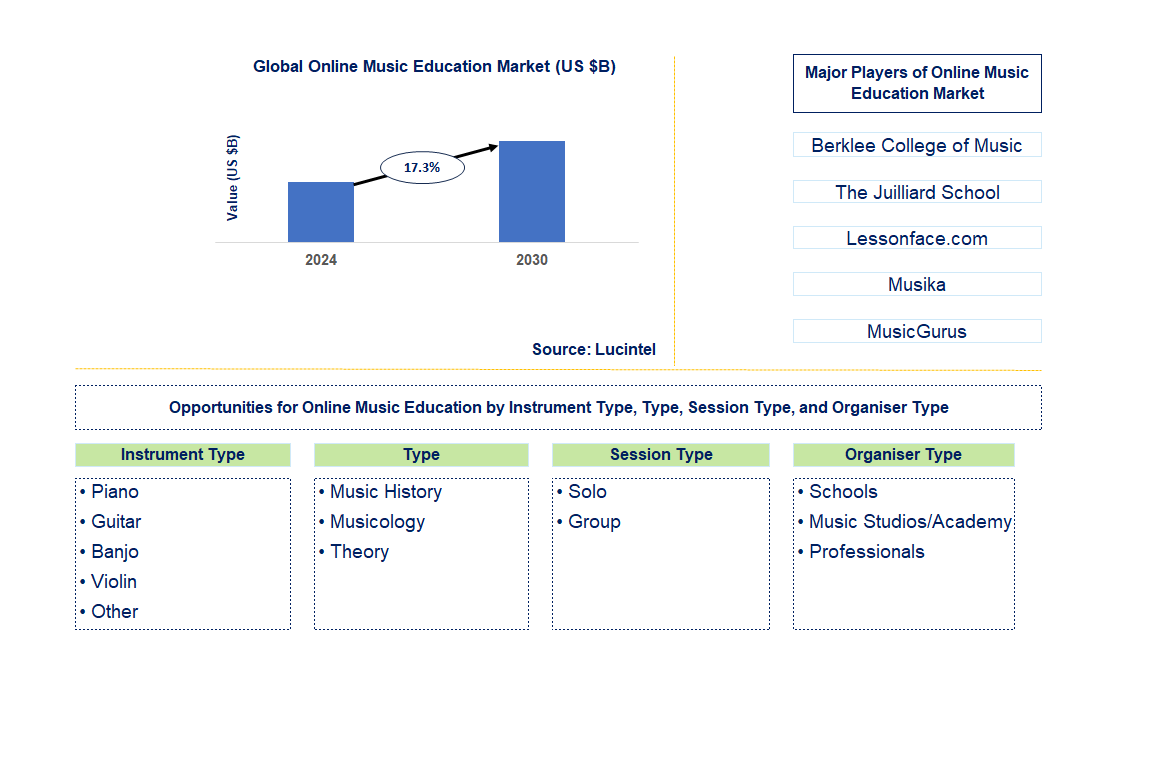
Key data points: The growth forecast = 17.3% annually next 6 years. Scroll below to get more insights. This market report covers trends, opportunities, and forecast in the global online music education market to 2030 by instrument type (piano, guitar, banjo, violin, and other), type (music history, musicology, and theory), session type (solo and group), organiser type (schools, music studios/academy, and professionals), and region (North America, Europe, Asia Pacific, and the Rest of the World)
We'll send your sample report shortly.
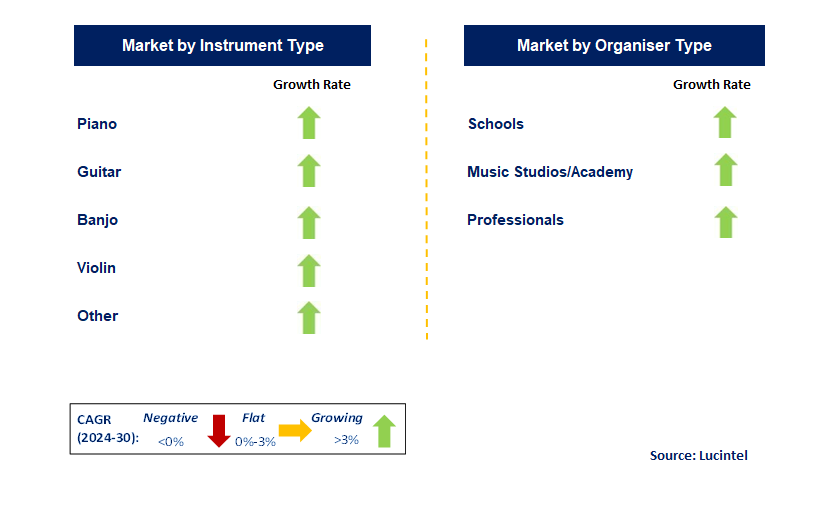
• Lucintel forecasts that piano will remain the largest segment over the forecast period.
• Within this market, schools is expected to witness highest growth.
• North America will remain the largest region over the forecast period. A more than 150-page report is developed to help in your business decisions.
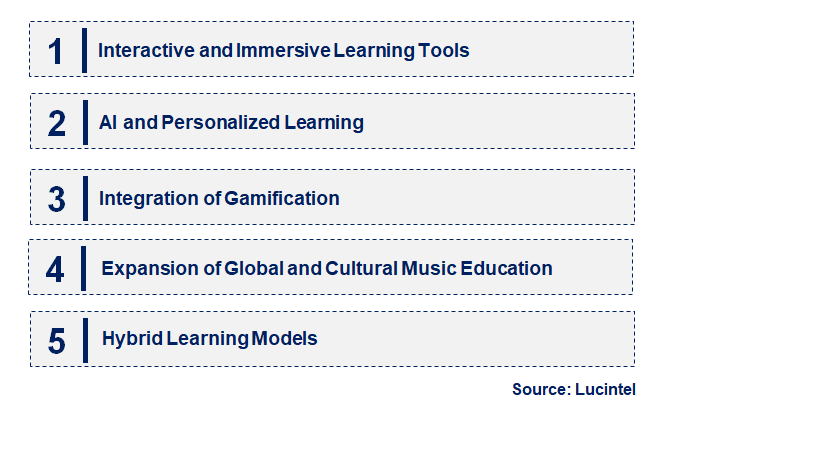
• Interactive and Immersive Learning Tools: Platforms are increasingly using AR and VR to create immersive music education experiences. These tools enable students to visualize and interact with music concepts in a virtual environment, enhancing engagement and retention. By simulating real-life scenarios, students can practice their skills in a more dynamic and interactive way.
• AI and Personalized Learning: Artificial Intelligence is being leveraged to provide personalized feedback and adaptive learning paths. AI-driven tools analyze students’ performance, offering customized practice exercises and recommendations. This trend allows for tailored learning experiences that address individual strengths and weaknesses, improving overall learning outcomes.
• Integration of Gamification: Gamification is becoming a popular method to make music learning more engaging. Incorporating game-like elements such as rewards, levels, and challenges helps motivate students and makes learning enjoyable. This trend is particularly effective in attracting younger audiences and maintaining their interest in music education.
• Expansion of Global and Cultural Music Education: Online platforms are increasingly offering courses in diverse musical genres and traditions from around the world. This trend reflects a growing interest in global music styles and cultural exchange. By providing access to a wide range of musical traditions, online education fosters a more inclusive and comprehensive learning experience.
• Hybrid Learning Models: The combination of online and offline learning, known as hybrid models, is gaining traction. This approach allows students to benefit from the flexibility of online classes while also participating in in-person workshops or lessons. Hybrid models cater to diverse learning preferences and offer a more balanced educational experience. These trends are reshaping the online music education market by enhancing learning experiences through technology, increasing accessibility, and broadening the scope of musical education. They reflect a shift towards more interactive, personalized, and globally inclusive approaches, ultimately making music education more engaging and effective
• Advanced Learning Platforms: New platforms are emerging with sophisticated features, such as interactive lessons and real-time feedback. For example, platforms like Yousician and Flowkey offer comprehensive music instruction with built-in practice tools and instant feedback. These innovations are making high-quality music education more accessible and engaging.
• AI Integration for Personalized Learning: Artificial Intelligence is being integrated into music education platforms to provide personalized learning experiences. Tools like SmartMusic use AI to assess student performance and offer tailored practice suggestions. This technology helps students improve their skills more effectively by targeting individual needs.
• Growth of Mobile Learning: Mobile apps are becoming a significant part of online music education, offering flexible and accessible learning options. Apps like Simply Piano and GarageBand allow users to learn and practice music on-the-go. The convenience of mobile learning is expanding the reach of music education to a wider audience.
• Expansion of Collaborative Learning Features: Online music education platforms are incorporating features that facilitate collaboration among students and instructors. Tools such as live video sessions and group projects enable interactive learning and peer feedback. This collaborative approach enhances the learning experience by allowing students to engage with others.
• Emphasis on Music Production and Technology: There is a growing focus on music production and technology within online music education. Courses are increasingly covering topics such as digital audio workstations (DAWs) and music production techniques. This development reflects the increasing importance of technology in modern music careers and education. These developments are significantly impacting the online music education market by enhancing accessibility, personalization, and interactivity. As technology continues to advance, the landscape of online music education will likely see further innovations that improve learning outcomes and broaden educational opportunities.
• Personalized Learning Platforms: The demand for tailored educational experiences presents a significant growth opportunity. Platforms that use AI and machine learning to offer customized lesson plans, practice exercises, and real-time feedback can attract a broad audience. Personalized learning enhances student engagement and improves outcomes, making it a compelling proposition for learners seeking individualized instruction.
• Integration of Virtual and Augmented Reality: The incorporation of VR and AR technologies into music education can create immersive learning environments. These technologies allow students to visualize music concepts and interact with virtual instruments, providing a hands-on learning experience. The growth of VR and AR can transform traditional music lessons into engaging and interactive sessions, attracting tech-savvy learners.
• Expansion of Mobile and App-Based Learning: Mobile apps offer a flexible and accessible way to learn music, catering to users who prefer learning on-the-go. Growth in this area includes developing apps that provide interactive lessons, practice tools, and progress tracking. The increasing penetration of smartphones and tablets means that mobile learning solutions can reach a global audience, making music education more accessible.
• Development of Collaborative Learning Tools: Platforms that facilitate collaboration between students and teachers or among peers represent a significant opportunity. Features such as live video lessons, virtual jam sessions, and group projects enhance the learning experience by allowing real-time interaction and feedback. This collaborative approach can foster a sense of community and support among learners, making online education more dynamic.
• Emphasis on Music Production and Technology Education: As interest in music production grows, there is a rising demand for courses focused on digital audio workstations (DAWs) and music technology. Offering specialized content on these subjects can attract aspiring music producers and sound engineers. This trend reflects the increasing importance of technology in the music industry, providing opportunities for platforms to offer relevant and in-demand education. These growth opportunities are reshaping the online music education market by enhancing personalization, interactivity, and accessibility. Leveraging advanced technologies and expanding into new areas can help providers meet the evolving needs of learners and stay competitive in a rapidly changing landscape.
• Berklee College of Music
• The Juilliard School
• Lessonface.com
• Musika
• MusicGurus
• AAFT School
• VIP Peilian
• Skoove
• TakeLessons
• Point Blank
• Piano
• Guitar
• Banjo
• Violin
• Other
• Music History
• Musicology
• Theory
• Solo
• Group
• Schools
• Music studios/academy
• Professionals
• North America
• Europe
• Asia Pacific
• The Rest of the World
• United States: In the US, online music education has seen significant growth with platforms like MasterClass and Coursera expanding their offerings. High-quality video tutorials and live classes are becoming more common, leveraging interactive features and virtual reality to enhance learning. Institutions like Berklee College of Music are also offering accredited online programs, broadening access to formal music education.
• China: China online music education market is booming, with platforms like Xueersi and Yinxiang Music gaining popularity. The government’s push towards integrating technology in education has supported this growth. Additionally, there is an increasing trend of gamifying music lessons to engage younger students, making learning both fun and effective.
• Germany: In Germany, online music education is focusing on integrating classical music with modern teaching tools. Platforms such as Udemy and Music Tutor have adapted to include more structured courses, combining video lessons with interactive content. The emphasis is on maintaining the quality of traditional music instruction while utilizing digital tools.
• India: India is experiencing a surge in online music education, driven by platforms like MusiX and Taal Inc. These services are expanding access to music training in remote areas. Mobile-first approaches and regional language support are key to reaching a diverse audience, while affordable pricing models are making music education more inclusive.
• Japan: Japan online music education market is growing, with platforms like TACT and MUSE offering specialized courses in both traditional and contemporary music. Innovations include AI-driven feedback systems that provide personalized learning experiences. The integration of these technologies reflects Japan's focus on combining traditional musical heritage with modern educational tools.


• Berklee College of Music
• The Juilliard School
• Lessonface.com
• Musika
• MusicGurus
• AAFT School
• VIP Peilian
• Skoove
• TakeLessons
• Point Blank Q5. Which online music education market segment will be the largest in future? Answer: Lucintel forecasts that piano will remain the largest segment over the forecast period. Q6. In online music education market, which region is expected to be the largest in next 5 years? Answer: North America will remain the largest region over the forecast period. Q.7 Do we receive customization in this report? Answer: Yes, Lucintel provides 10% customization without any additional cost.


Choose a license that fits your team. Instant PDF delivery.
Prices exclude taxes. Instant delivery. Custom licensing available on request.
Market Report · July 29, 2026
Market Report · July 20, 2026
Market Report · July 20, 2026
Trusted partner for strategic intelligence and business growth


Receive a complimentary market analysis tailored to your industry. Our analysts will identify key growth opportunities and competitive dynamics specific to your business.

Market size, growth rate, and key trend analysis for your specific sector.

Top competitor positioning and market share analysis.

Strategic recommendations backed by data-driven insights.
Get curated market intelligence and competitive moves straight to your inbox.
By subscribing, you agree to receive our monthly insights. Unsubscribe anytime.
Receive a complimentary market analysis tailored to your industry. Our analysts will identify key growth opportunities and competitive dynamics specific to your business.
Market size, growth rate, and key trend analysis for your specific sector.
Top competitor positioning and market share analysis.
Strategic recommendations backed by data-driven insights.
Get curated market intelligence, emerging trends, and competitive moves straight to your inbox each month.
By subscribing, you agree to receive our monthly insights. Unsubscribe anytime.
We'll send your sample report shortly.