
Market Report · May 18, 2026

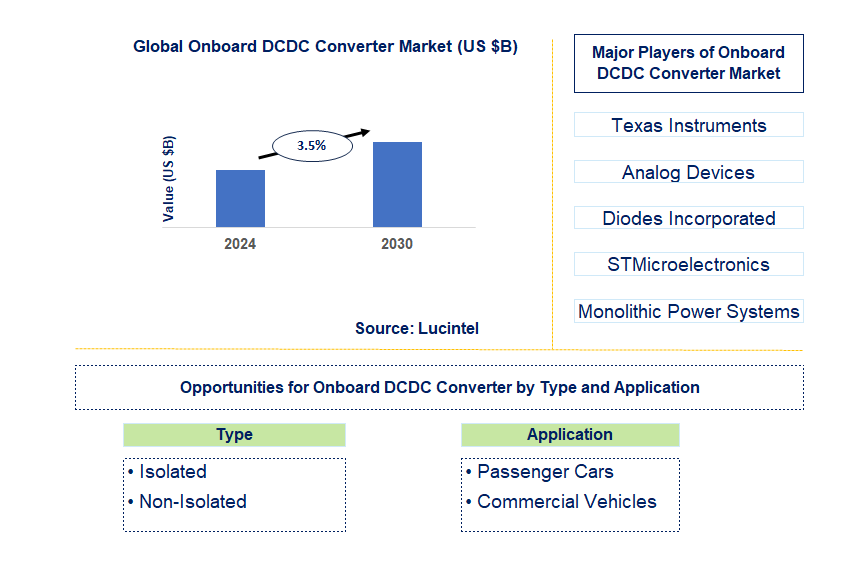
Key data points: The growth forecast = 3.5% annually for the next 6 years. Scroll below to get more insights. This market report covers trends, opportunities, and forecasts in the global onboard dcdc converter market to 2030 by type (isolated and non-isolated), application (passenger cars and commercial vehicles), and region (North America, Europe, Asia Pacific, and the Rest of the World)
We'll send your sample report shortly.
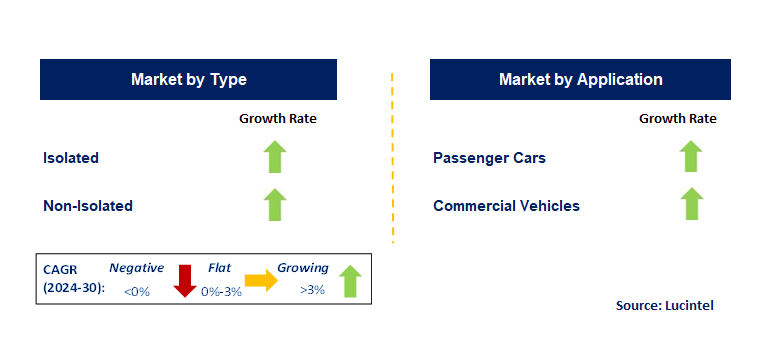
• Lucintel forecasts that, within the type category, isolated is expected to witness higher growth over the forecast period.
• Within the application category, passenger car is expected to witness higher growth.
• In terms of regions, APAC is expected to witness the highest growth over the forecast period. A more than 150-page report is developed to help in your business decisions.
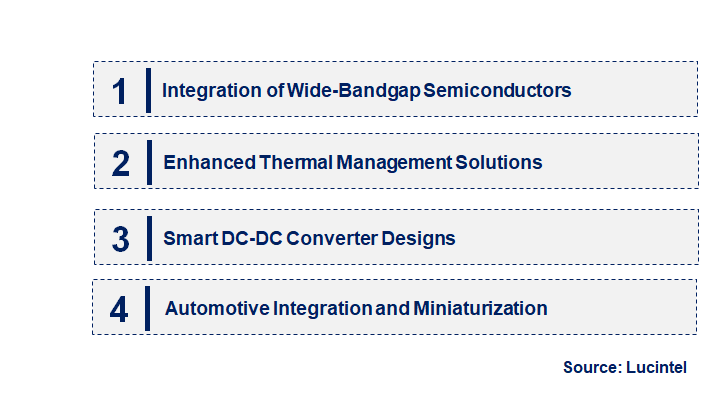
• Integration of Wide-Bandgap Semiconductors: There is an increase in the use of wide-bandgap materials like silicon carbide (SiC) and gallium nitride (GaN). These materials offer higher efficiency compared to others, making them ideal for automotive applications that demand high-temperature operation. They reduce size and weight, also improving the converter's overall performance and energy efficiency.
• Enhanced Thermal Management Solutions: As converters become smaller yet more powerful, efficient heat dissipation becomes more important. An example includes new cooling technologies such as phase-change materials or liquid cooling that enhance reliability by maintaining appropriate ambient temperatures, even in harsh environments, ensuring the successful operation of the device.
• Smart DC-DC Converter Designs: DC-DC converters are emerging with technologies like real-time monitoring and adaptive control systems. These attributes help converters automatically adjust their performance based on operating conditions, thus enhancing efficiency and extending the life of their components.
• Automotive Integration and Miniaturization: A current trend is the integration of DC-DC converters into automotive systems for space-saving and reducing complexity in cars. The miniaturization drive focuses on designing smaller converters that can fit into tighter spaces created by electric and hybrid vehicles. These trends point towards more efficient, smaller, and smarter onboard DC-DC converters. Each trend addresses specific industry needs, leading to improved automotive technology and power management systems.
• Advancements in Wide-Bandgap Semiconductors: More wide-bandgap semiconductors, such as silicon carbide (SiC) and gallium nitride (GaN), are being used now more than ever before. SiC and GaN improve upon previous aspects of DC-DC converters. They possess high thermal conductivity and low efficiency, coupled with reducing sizes of DC-DC converters. This leads to higher power density and efficiency, making them suitable for high-performance automotive applications.
• Improved Thermal Management Techniques: New approaches to thermal management are needed to maintain converter performance and reliability. Advanced heat sinks, thermal interface materials, integrated cooling solutions, etc., address this changing environment without affecting other operations. Therefore, it is important that more power goes through DC-DC converters, knowing that their increased power densities will have consequences if not properly addressed in high-temperature environments.
• Integration with Advanced Automotive Systems: Battery management systems (BMS), energy recovery systems (ERS), and intelligent transport systems (ITS) are some of the systems that DC-DC converters can integrate with in vehicles. As a result, these converters help optimize power distribution and improve overall vehicle efficiency. Manufacturers are designing converters that can easily interface with many automotive electronics to enable features such as regenerative braking and dynamic power management.
• Focus on Compact and Lightweight Designs: The trend toward miniaturization is driving the development of smaller and lighter DC-DC converters. Packaging innovations, along with component designs, have made it possible to create compact devices that can fit into small spaces in automobiles. This is particularly significant for electric and hybrid vehicles, where miniaturization is crucial due to limited space and reduced load-carrying capacity. In summary, these developments reflect the efforts being made by industry insiders to improve the performance, efficiency, and integration of onboard DC-DC converters for modern automotive applications.
• Expansion in Electric Vehicle (EV) Sector: This offers onboard DC-DC converter manufacturers a great opportunity due to the increasing use of electric cars. Competing in this growing market involves developing high-efficiency transformers whose characteristics conform to the strict requirements and standards applied by EVs. Advanced technology aims at improving performance and reliability levels for plug-in hybrid electric vehicles (PHEVs).
• Emerging Markets: Expansion into emerging markets with large vehicle production units and increased electrification initiatives offers an opportunity for growth. Designing products based on local requirements or regulations provides another way of entering new business segments through additional product offerings. In addition, partnerships and investment should be prioritized by companies willing to capitalize on local manufacturing partners, enabling them to enter new foreign markets quickly.
• Technological Innovations: Competitive advantage is achieved through investment in research aimed at advanced features like smart controls and increased productivity for next-generation converters characterized by better efficiencies compared to their current counterparts. Innovations in material science and design are required to improve performance and reduce costs for devices targeting consumers who want cutting-edge technologies.
• Integration with Renewable Energy Systems: There are growth opportunities in integrating onboard DC-DC converters with renewable energy sources like solar and wind. Converters designed to efficiently manage and convert power from renewable sources can foster sustainable development through hybrid energy systems. These strategic growth prospects emphasize areas where companies could harness developments in market trends and technical breakthroughs to increase returns and enhance their presence in the onboard DC-DC converter market.
• Growth of Electric Vehicles (EVs): The adoption of electric vehicles increases the demand for high-performance DC-DC converters, which are vital for efficient power distribution and improve energy use in EVs, making it a growing market to explore.
• Technological Innovations: Advancements in materials used in semiconductor technologies such as silicon carbide (SiC) and gallium nitride (GaN) contribute to improved efficiency in DC-DC converters. Improvements in miniaturization techniques and thermal management also facilitate market expansion through enhanced product quality.
• Legislative Compliance: Stricter regulatory standards, especially for car emissions, necessitate more efficient and reliable DC-DC converters. This makes compliance with regulations a continuous necessity, driving improvement and better technology applications.
• Increasing Demand for Advanced Automotive Features: DC-DC converters are now integrated with advanced automotive features such as ADAS and infotainment systems, creating new possibilities. In this case, converters need to support the increasing power requirements of these systems, driving innovation. Challenges in the onboard DC-DC converter market are:
• High Production Costs: These higher costs stem from expensive advanced materials or technologies, which result in an overall price increase for the DC-DC converter. In addition, striking a balance between cost performance and efficiency is a major hurdle for manufacturers.
• Complexity of Integration: Integrating DC-DC converters into various vehicle systems and technologies is complicated. High expertise and development are required to ensure compatibility and seamless operation.
• Competitive Market: The market for DC-DC converters is crowded with many players offering similar products. Therefore, manufacturers need a competitive advantage in terms of features, performance, and cost.
• Regulatory Hurdles: Navigating diverse regulatory requirements across different regions can be challenging. Developing products that meet these standards lengthens development periods and increases costs. To sum up, driving forces and challenges impact the growth and development of the onboard DC-DC converter market. Addressing these factors effectively is crucial for success in the evolving market landscape.
• Texas Instruments
• Analog Devices
• Diodes Incorporated
• STMicroelectronics
• Monolithic Power Systems
• Infineon
• On Semiconductor
• XP Power
• Vicor
• Artesyn Technologies
• Isolated
• Non-Isolated
• Passenger Cars
• Commercial Vehicles
• North America
• Europe
• Asia Pacific
• The Rest of the World
• United States: In the US, there have been a lot of developments in the onboard DC-DC converter market due to EV adoption and renewable energy systems. There have been various improvements including adoption of advanced semiconductor technologies like Silicon carbide (SiC) and gallium Nitride (GaN), which has improved efficiency as well as reducing size. Others are putting much efforts on thermal management improvement and reliability that corresponds with strict automaker standards.
• China: China is growing its onboard DC-DC converter market rapidly mainly because of robust EV growth rate. These include manufacturers within China investing heavily on local R&D to produce highly-efficient converters at competitive prices. Additionally, domestic companies are partnering with international suppliers to develop converter technology through joint ventures so that they can meet green energy objectives.
• Germany: German manufacturers focus on high-performance onboard DC-DC converters that comply with EU regulations. Some examples are using new materials or cooling methods that help increase efficiency and lifespan; some others integrate these devices along with energy management units inside electric vehicles to optimize power distribution in order to achieve best vehicle’s performance.
• India: The Indian onboard DC-DC converter market is growing with the increasing automotive production and EV movement. Recent changes have seen the introduction of affordable, compact converters meeting local automotive makers’ needs. Additionally, these days attention has been paid to converters able to operate under different power and environmental situations in India.
• Japan: The Japanese onboard DC-DC converter market is characterized by compactness and high efficiency improvements. For instance, the country’s companies are among those whose ideas led to integration between DC-DC converters and advanced driver assistance systems (ADAS) including other motor vehicle electronics. This is because they have worked on reducing sizes of components while making them perform better with improved thermal management required for next-generation vehicles.


• Texas Instruments
• Analog Devices
• Diodes Incorporated
• STMicroelectronics
• Monolithic Power Systems
• Infineon
• On Semiconductor
• XP Power
• Vicor
• Artesyn Technologies Q5. Which onboard DCDC converter market segment will be the largest in future? Answer: Lucintel forecasts that isolated is expected to witness higher growth over the forecast period. Q6. In onboard DCDC converter market, which region is expected to be the largest in next 5 years? APAC is expected to witness the highest growth over the forecast period. Q.7 Do we receive customization in this report? Answer: Yes, Lucintel provides 10% customization without any additional cost.


Choose a license that fits your team. Instant PDF delivery.
Prices exclude taxes. Instant delivery. Custom licensing available on request.
Market Report · May 18, 2026
Market Report · May 18, 2026
Market Report · May 18, 2026
Trusted partner for strategic intelligence and business growth


Receive a complimentary market analysis tailored to your industry. Our analysts will identify key growth opportunities and competitive dynamics specific to your business.

Market size, growth rate, and key trend analysis for your specific sector.

Top competitor positioning and market share analysis.

Strategic recommendations backed by data-driven insights.
Get curated market intelligence and competitive moves straight to your inbox.
By subscribing, you agree to receive our monthly insights. Unsubscribe anytime.
Receive a complimentary market analysis tailored to your industry. Our analysts will identify key growth opportunities and competitive dynamics specific to your business.
Market size, growth rate, and key trend analysis for your specific sector.
Top competitor positioning and market share analysis.
Strategic recommendations backed by data-driven insights.
Get curated market intelligence, emerging trends, and competitive moves straight to your inbox each month.
By subscribing, you agree to receive our monthly insights. Unsubscribe anytime.
We'll send your sample report shortly.