
Report Feature
Omni Directional Antenna Market Trends and Forecast
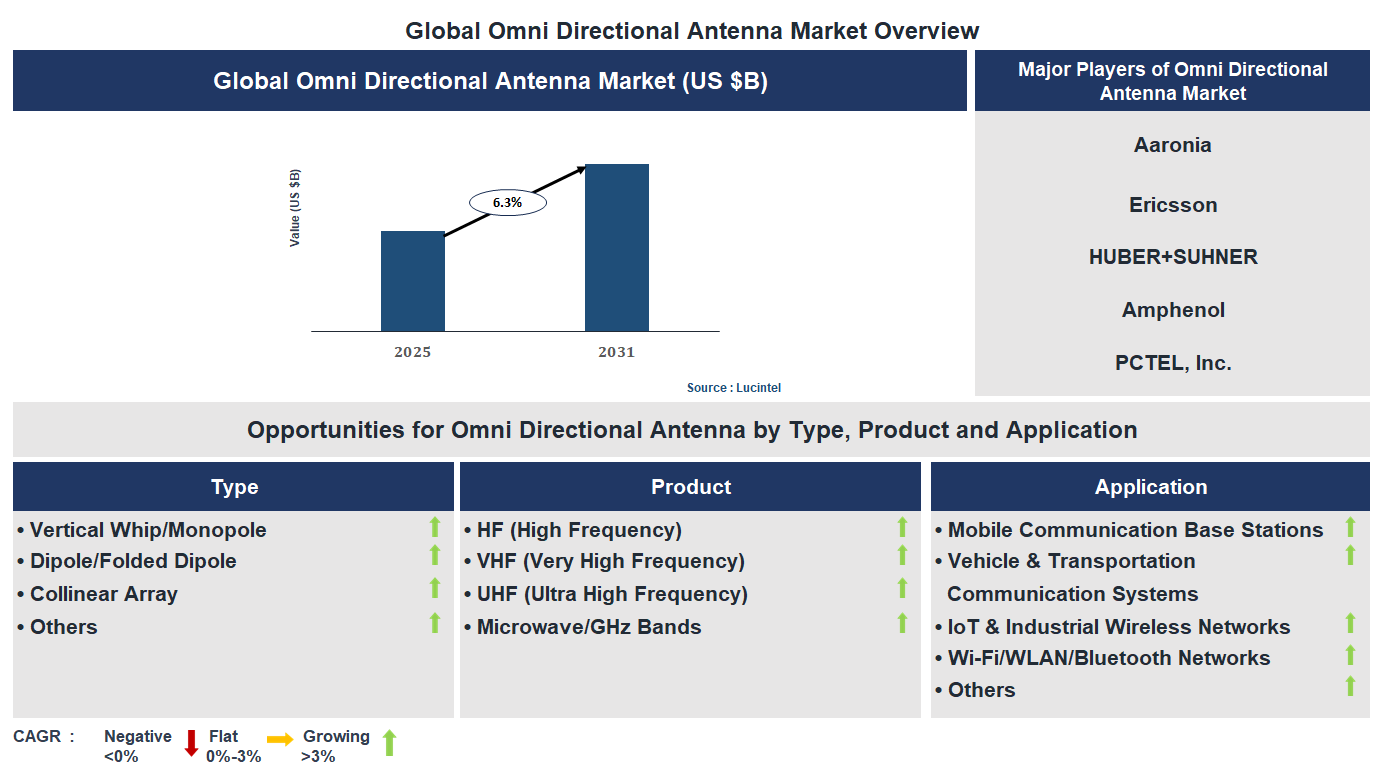
The future of the global omni directional antenna market looks promising with opportunities in the mobile communication base station, vehicle & transportation communication system, IoT & industrial wireless network, and Wi-Fi/WLAN/bluetooth network markets. The global omni directional antenna market is expected to grow with a CAGR of 6.3% from 2025 to 2031. The major drivers for this market are the increasing demand for wireless communication, the rising adoption of IoT devices, and the growing need for 5G infrastructure.• Lucintel forecasts that, within the type category, collinear array is expected to witness the highest growth over the forecast period.
• Within the application category, mobile communication base station is expected to witness the highest growth.
• In terms of region, APAC is expected to witness the highest growth over the forecast period. Gain valuable insights for your business decisions with our comprehensive 150+ page report. Sample figures with some insights are shown below.
Emerging Trends in the Omni Directional Antenna Market
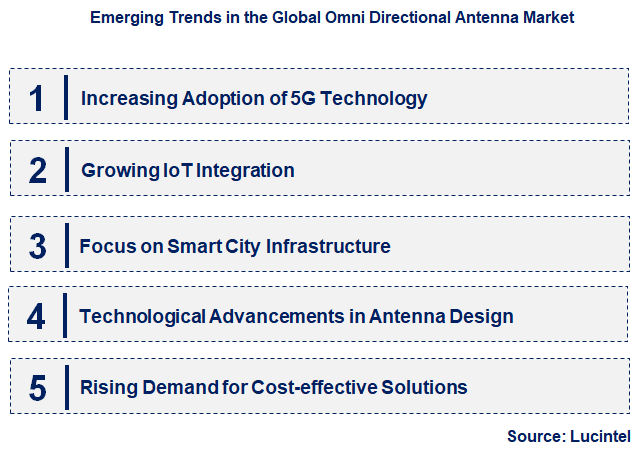
The omni directional antenna market is experiencing rapid evolution driven by technological advancements, increasing demand for wireless connectivity, and the proliferation of IoT devices. As industries seek more reliable and extensive coverage, manufacturers are innovating to meet these needs. The market is also influenced by the growing adoption of 5G technology, smart city initiatives, and the need for cost-effective communication solutions. These developments are not only expanding the market size but also transforming how wireless communication infrastructure is deployed and utilized across various sectors. Understanding these emerging trends is crucial for stakeholders aiming to capitalize on future opportunities and stay competitive.• Increasing Adoption of 5G Technology: The rollout of 5G networks is significantly boosting the demand for omni directional antennas, which are essential for providing wide coverage and high-speed connectivity. These antennas support the dense network infrastructure required for 5G, enabling faster data transfer and lower latency. As telecom providers expand 5G services, the market for omni directional antennas is expected to grow substantially, driven by the need for reliable, high-capacity wireless communication solutions across urban and rural areas.
• Growing IoT Integration: The proliferation of Internet of Things (IoT) devices across industries such as healthcare, manufacturing, and smart homes is fueling demand for omni directional antennas. These antennas facilitate seamless connectivity among numerous devices, ensuring consistent data transmission and real-time monitoring. The integration of IoT with wireless infrastructure necessitates antennas that can cover wide areas efficiently, making omni directional antennas a critical component in supporting the expanding IoT ecosystem and enabling smarter, more connected environments.
• Focus on Smart City Infrastructure: Governments and urban planners are investing heavily in smart city initiatives that require extensive wireless networks for traffic management, public safety, and utilities. Omni directional antennas are vital in these projects because they provide broad coverage with minimal infrastructure, reducing deployment costs. This trend is driving innovation in antenna design to enhance coverage, durability, and energy efficiency, ultimately supporting the development of interconnected urban environments that rely on robust wireless communication.
• Technological Advancements in Antenna Design: Innovations such as beamforming, MIMO (Multiple Input Multiple Output), and advanced materials are improving the performance of omni directional antennas. These advancements enable better signal strength, increased data capacity, and reduced interference, which are crucial for supporting high-demand applications like 5G and IoT. Enhanced antenna designs are also more compact and energy-efficient, making them suitable for a wider range of deployment scenarios, from urban centers to remote areas.
• Rising Demand for Cost-effective Solutions: As the market expands, there is a growing emphasis on affordable and scalable wireless infrastructure. Manufacturers are developing cost-effective omni directional antennas that do not compromise on performance, making them accessible for small and medium-sized enterprises, rural deployments, and developing regions. This trend is democratizing access to reliable wireless connectivity, fostering market growth, and enabling broader adoption of wireless technologies across diverse sectors. In summary, these emerging trends are reshaping the omni directional antenna market by enhancing connectivity capabilities, reducing deployment costs, and supporting the rapid expansion of wireless networks. The integration of advanced technologies and the focus on scalable, cost-effective solutions are driving innovation and opening new opportunities for stakeholders. As these trends continue to evolve, they will play a pivotal role in shaping the future landscape of wireless communication infrastructure worldwide.
Recent Development in the Omni Directional Antenna Market
The omni directional antenna market is experiencing rapid growth driven by increasing demand for wireless communication, IoT expansion, and advancements in 5G technology. As industries adopt more connected devices, the need for reliable, wide-coverage antennas becomes critical. Innovations in antenna design and materials are enhancing performance and cost-efficiency. Market players are investing heavily in R&D to meet evolving consumer and enterprise needs. These developments are shaping a competitive landscape, opening new opportunities for manufacturers and service providers alike.• Growth in Wireless Communication: The rising adoption of wireless devices and networks is fueling demand for omni directional antennas, which provide broad coverage and reliable connectivity. This trend is driven by the proliferation of smartphones, IoT devices, and smart home systems. As 5G networks expand, the need for high-performance antennas that support seamless data transmission becomes essential. The market benefits from increased investments in infrastructure, leading to higher sales and technological innovation. This growth enhances network reliability and user experience across various sectors.
• Expansion of IoT and Smart Devices: The rapid deployment of IoT devices across industries such as healthcare, manufacturing, and agriculture is boosting the need for omni directional antennas. These antennas enable efficient data collection and transmission over wide areas, supporting real-time monitoring and automation. As IoT ecosystems grow, the demand for antennas that can handle multiple connections and provide stable signals increases. This trend encourages manufacturers to develop specialized antennas, fostering market expansion and technological advancements that improve device connectivity and operational efficiency.
• Advancements in 5G Technology: The rollout of 5G networks is a significant driver for the omni directional antenna market. These antennas are crucial for providing extensive coverage and high-speed data transfer required by 5G infrastructure. Innovations in antenna design, such as beamforming and MIMO technology, are enhancing network capacity and performance. The demand for 5G-compatible antennas is creating new opportunities for manufacturers to develop products tailored for urban and rural deployments. This development is pivotal in enabling next-generation wireless services and applications.
• Innovation in Antenna Materials and Design: Recent developments focus on using lightweight, durable, and cost-effective materials to improve antenna performance. Advanced design techniques, including phased arrays and compact form factors, are enabling better signal strength and coverage. These innovations reduce manufacturing costs and facilitate integration into various devices and infrastructure. Enhanced materials and designs are also improving environmental resilience, making antennas suitable for diverse conditions. This progress supports market growth by expanding application possibilities and improving overall product quality.
• Increasing Investment in R&D and Market Competition: Companies are investing heavily in research and development to create more efficient, versatile, and cost-effective omni directional antennas. Competitive pressures are driving innovation, leading to the introduction of smarter, more adaptable products. This investment accelerates technological breakthroughs and broadens application scopes, from consumer electronics to industrial uses. As a result, the market is witnessing rapid evolution, with new entrants and established players vying for market share, ultimately benefiting consumers through better products and services. The overall impact of these developments is a dynamic, expanding market characterized by technological innovation, increased connectivity, and broader application scope. Enhanced antenna performance and new deployment strategies are driving growth across industries, fostering a competitive environment that benefits consumers and businesses alike. This evolution is set to support the continued expansion of wireless networks, IoT, and 5G infrastructure, shaping the future of communication technology.
Strategic Growth Opportunities in the Omni Directional Antenna Market
The omni directional antenna market is poised for significant expansion driven by increasing demand for reliable wireless communication, IoT connectivity, and smart infrastructure. Advancements in antenna technology and the proliferation of wireless devices are creating new opportunities for market players. Strategic investments and innovations are expected to enhance coverage, improve signal quality, and support emerging applications across various industries, fostering a competitive landscape with substantial growth potential.• Expansion in Wireless Communication Networks: The growing need for seamless connectivity in urban and rural areas is fueling demand for omni directional antennas. These antennas provide broad coverage, making them ideal for cellular networks, Wi-Fi, and public safety communications. As 5G deployment accelerates, the market will benefit from increased adoption of omni directional antennas to support high-speed, reliable wireless services, especially in densely populated regions.
• Growth of Internet of Things (IoT) Devices: The proliferation of IoT devices across industries such as healthcare, manufacturing, and smart homes is driving the need for versatile antennas. Omni directional antennas facilitate effective communication between devices by providing omnidirectional signal coverage, reducing dead zones. This growth enhances connectivity reliability, enabling real-time data transfer, remote monitoring, and automation, thereby expanding the market for omni directional antennas in IoT applications.
• Increasing Adoption in Public Infrastructure and Smart Cities: Governments and municipalities are investing in smart city initiatives that require extensive wireless infrastructure. Omni directional antennas are crucial for deploying surveillance, traffic management, and public Wi-Fi networks due to their wide coverage. Their ability to support multiple devices simultaneously makes them essential for urban development projects, boosting market growth as cities aim for enhanced connectivity and efficient resource management.
• Rising Demand for Wireless Security and Surveillance Systems: Security systems increasingly rely on wireless communication for real-time monitoring and remote access. Omni directional antennas enable comprehensive coverage for surveillance cameras, sensors, and alarm systems, especially in large or complex environments. The need for reliable, wide-area wireless security solutions is expected to propel market growth, as organizations seek to enhance safety and operational efficiency through advanced wireless infrastructure.
• Technological Innovations Improving Antenna Performance: Ongoing research and development efforts are leading to more efficient, compact, and high-performance omni directional antennas. Innovations such as beamforming, MIMO technology, and materials advancements improve signal strength, range, and interference resistance. These technological improvements expand application possibilities, attract new customers, and enable market players to offer more competitive products, thereby accelerating overall market growth. The overall market outlook remains positive as these opportunities collectively drive innovation, expand application scope, and meet the increasing demand for reliable wireless connectivity, ensuring sustained growth and competitive advantage in the omni directional antenna market.
Omni Directional Antenna Market Driver and Challenges
The omni directional antenna market is influenced by a variety of technological, economic, and regulatory factors that shape its growth and development. Advances in wireless communication technology, increasing demand for reliable connectivity, and evolving regulatory standards are key drivers. Simultaneously, challenges such as technological limitations, regulatory hurdles, and market saturation pose significant obstacles. Understanding these drivers and challenges is essential for stakeholders to navigate the market effectively and capitalize on emerging opportunities while mitigating risks. The factors responsible for driving the omni directional antenna market include:-• Technological Innovation: The rapid evolution of wireless communication technologies, including 5G and IoT, necessitates advanced antenna solutions. Omni directional antennas are crucial for providing broad coverage and reliable connectivity in diverse environments. Continuous innovation in antenna design, materials, and manufacturing processes enhances performance, efficiency, and cost-effectiveness, fueling market growth. As industries adopt smarter and more connected devices, the demand for versatile antenna solutions increases, making technological advancement a primary driver.
• Growing Wireless Infrastructure Deployment: The expansion of wireless networks worldwide, especially in urban and rural areas, drives the need for omni directional antennas. These antennas are essential for base stations, Wi-Fi hotspots, and IoT devices, offering omnidirectional coverage that simplifies installation and maintenance. Governments and private enterprises investing heavily in infrastructure to support smart cities, autonomous vehicles, and broadband expansion further accelerate demand, making infrastructure development a significant growth catalyst.
• Increasing Adoption of IoT Devices: The proliferation of IoT devices across sectors such as healthcare, manufacturing, and agriculture relies heavily on reliable wireless communication. Omni directional antennas facilitate seamless connectivity for multiple devices within a network, ensuring consistent data transmission. This widespread adoption boosts demand for antennas capable of supporting high data rates and extensive coverage, directly impacting market expansion as IoT continues to grow exponentially.
• Regulatory and Standardization Developments: Evolving regulatory frameworks and standards aimed at ensuring spectrum efficiency and reducing interference influence the market. Governments and industry bodies are establishing guidelines that promote the use of omni directional antennas for better network coverage and performance. Compliance with these standards encourages manufacturers to innovate and produce compliant products, thereby driving market growth and ensuring interoperability across different regions and applications. The challenges facing this omni directional antenna market include:-
• Technological Limitations: Despite advancements, omni directional antennas face limitations such as signal interference, limited range in certain environments, and susceptibility to physical obstructions. These issues can compromise network reliability and performance, especially in dense urban areas or challenging terrains. Overcoming these technical constraints requires ongoing research and development, which can be costly and time-consuming, potentially hindering market growth.
• Regulatory and Spectrum Constraints: Regulatory restrictions on spectrum allocation and licensing can impede the deployment of omni directional antennas. Variations in regulations across regions create complexities for manufacturers and service providers, limiting market expansion. Additionally, spectrum scarcity in certain frequency bands can restrict antenna performance and deployment options, posing significant challenges to scaling solutions globally.
• Market Saturation and Competition: As the market matures, saturation in key regions and intense competition among manufacturers threaten profit margins and innovation. Companies face pressure to differentiate their products through technological enhancements and cost reductions. Market saturation can also slow growth rates, especially in developed markets, requiring players to explore new applications and emerging markets to sustain expansion. In summary, the omni directional antenna market is driven by technological innovation, infrastructure expansion, IoT adoption, and regulatory support. However, technological limitations, regulatory constraints, and market saturation pose notable challenges. These factors collectively influence the market’s trajectory, requiring stakeholders to innovate continuously and adapt strategies to capitalize on opportunities while addressing obstacles. Overall, the market’s growth prospects remain promising, provided that technological and regulatory challenges are effectively managed.
List of Omni Directional Antenna Companies
Companies in the market compete on the basis of product quality offered. Major players in this market focus on expanding their manufacturing facilities, R&D investments, infrastructural development, and leverage integration opportunities across the value chain. With these strategies omni directional antenna companies cater increasing demand, ensure competitive effectiveness, develop innovative products & technologies, reduce production costs, and expand their customer base. Some of the omni directional antenna companies profiled in this report include-• Aaronia
• Ericsson
• HUBER+SUHNER
• Amphenol
• PCTEL, Inc.
• Taoglas
• CellMax Technologies
• Smiths Interconnect
• L‑Com
• Luxun Antenna
Omni Directional Antenna Market by Segment
The study includes a forecast for the global omni directional antenna market by type, product, application, and region.Omni Directional Antenna Market by Type [Value from 2019 to 2031]:
• Vertical Whip/Monopole
• Dipole/Folded Dipole
• Collinear Array
• Others
Omni Directional Antenna Market by Product [Value from 2019 to 2031]:
• HF (High Frequency)
• VHF (Very High Frequency)
• UHF (Ultra High Frequency)
• Microwave/GHz Bands
Omni Directional Antenna Market by Application [Value from 2019 to 2031]:
• Mobile Communication Base Stations
• Vehicle & Transportation Communication Systems
• IoT & Industrial Wireless Networks
• Wi-Fi/WLAN/Bluetooth Networks
• Others
Omni Directional Antenna Market by Region [Value from 2019 to 2031]:
• North America
• Europe
• Asia Pacific
• The Rest of the World
Country Wise Outlook for the Omni Directional Antenna Market
The omni directional antenna market has experienced significant growth driven by advancements in wireless communication, increasing demand for IoT devices, and expanding 5G infrastructure worldwide. As technology evolves, countries are investing heavily in research and development to enhance antenna performance, coverage, and integration with emerging networks. The markets development varies across regions, influenced by technological adoption rates, government policies, and industry investments. These recent developments reflect a global push toward more reliable, high-speed connectivity, supporting various applications from consumer electronics to industrial automation. Here is a country-specific overview of recent market trends and advancements.• United States: The US market has seen substantial innovation with the integration of smart antenna technologies to improve 5G network coverage and capacity. Major players are investing in R&D to develop high-gain, compact antennas suitable for urban and rural deployments. The government’s focus on expanding broadband access and 5G infrastructure has accelerated market growth. Additionally, increased adoption of IoT devices has driven demand for omni directional antennas in smart homes, healthcare, and transportation sectors. The US also witnesses collaborations between tech giants and startups to develop next-generation antenna solutions, fostering competitive advancements.
• China: China continues to lead in the deployment of 5G networks, significantly boosting the omni directional antenna market. The country’s rapid urbanization and government initiatives like "Made in China 2025" have prioritized advanced wireless infrastructure. Chinese companies are innovating in high-performance, cost-effective antennas tailored for dense urban environments and large-scale IoT applications. The expansion of 5G base stations and smart city projects has further increased demand. Additionally, China’s focus on domestic manufacturing and technological self-reliance has resulted in a robust supply chain for antenna components, supporting both local and export markets.
• Germany: Germany’s market development is driven by its strong industrial base and emphasis on Industry 4.0 initiatives. The adoption of omni directional antennas in manufacturing plants, smart factories, and transportation systems has increased. Germany is also investing in 5G infrastructure to support smart city projects and digital transformation. The country emphasizes sustainable and energy-efficient antenna solutions, aligning with its environmental policies. Collaborations between research institutions and industry players are fostering innovation in antenna design, especially for applications requiring high reliability and precision. The market is also benefiting from EU funding programs aimed at digital infrastructure enhancement.
• India: India’s omni directional antenna market is expanding rapidly due to government initiatives like Digital India and the push for widespread 4G and 5G connectivity. The increasing penetration of smartphones and IoT devices in rural and urban areas has driven demand. Local manufacturers are focusing on affordable, durable antennas suitable for diverse terrains and applications. The government’s focus on expanding broadband access and smart city projects has created a favorable environment for market growth. Additionally, collaborations with global technology firms are facilitating the adoption of advanced antenna technologies, supporting India’s goal of becoming a major digital hub.
• Japan: Japan’s market is characterized by high technological innovation and a focus on advanced wireless communication systems. The country is investing heavily in 5G infrastructure, with a particular emphasis on high-frequency, high-capacity antennas for urban environments. Japanese companies are developing compact, multi-functional omni directional antennas for use in smart cities, autonomous vehicles, and industrial automation. The government’s strategic initiatives to enhance digital infrastructure and promote IoT adoption are fueling market growth. Japan also emphasizes sustainability, leading to the development of energy-efficient antenna solutions that align with environmental goals. The market remains competitive with ongoing R&D efforts to improve antenna performance and integration.

Features of the Global Omni Directional Antenna Market
Market Size Estimates: Omni directional antenna market size estimation in terms of value ($B). Trend and Forecast Analysis: Market trends (2019 to 2024) and forecast (2025 to 2031) by various segments and regions. Segmentation Analysis: Omni directional antenna market size by type, product, application, and region in terms of value ($B). Regional Analysis: Omni directional antenna market breakdown by North America, Europe, Asia Pacific, and Rest of the World. Growth Opportunities: Analysis of growth opportunities in different types, products, applications, and regions for the omni directional antenna market. Strategic Analysis: This includes M&A, new product development, and competitive landscape of the omni directional antenna market. Analysis of competitive intensity of the industry based on Porter’s Five Forces model.
FAQ
Q1. What is the growth forecast for omni directional antenna market? Answer: The global omni directional antenna market is expected to grow with a CAGR of 6.3% from 2025 to 2031. Q2. What are the major drivers influencing the growth of the omni directional antenna market? Answer: The major drivers for this market are the increasing demand for wireless communication, the rising adoption of IoT devices, and the growing need for 5G infrastructure. Q3. What are the major segments for omni directional antenna market? Answer: The future of the omni directional antenna market looks promising with opportunities in the mobile communication base station, vehicle & transportation communication system, IoT & industrial wireless network, and Wi-Fi/WLAN/bluetooth network markets. Q4. Who are the key omni directional antenna market companies? Answer: Some of the key omni directional antenna companies are as follows:• Aaronia
• Ericsson
• HUBER+SUHNER
• Amphenol
• PCTEL, Inc.
• Taoglas
• CellMax Technologies
• Smiths Interconnect
• L‑Com
• Luxun Antenna Q5. Which omni directional antenna market segment will be the largest in future? Answer: Lucintel forecasts that, within the type category, collinear array is expected to witness the highest growth over the forecast period. Q6. In omni directional antenna market, which region is expected to be the largest in next 5 years? Answer: In terms of region, APAC is expected to witness the highest growth over the forecast period. Q7. Do we receive customization in this report? Answer: Yes, Lucintel provides 10% customization without any additional cost.
Table of Contents
List of Figures
List of Tables
Methodology
- In-depth interviews of the major players in this market
- Detailed secondary research from competitors’ financial statements and published data
- Extensive searches of published works, market, and database information pertaining to industry news, company press releases, and customer intentions
- A compilation of the experiences, judgments, and insights of Lucintel’s professionals, who have analyzed and tracked this market over the years.


Buy Now
Choose a license that fits your team. Instant PDF delivery.
Prices exclude taxes. Instant delivery. Custom licensing available on request.
Key Questions
- • What are some of the most promising, high-growth opportunities for the omni directional antenna market by type (vertical whip/monopole, dipole/folded dipole, collinear array, and others), product (HF (high frequency), VHF (very high frequency), UHF (ultra high frequency), and microwave/GHZ bands), application (mobile communication base stations, vehicle & transportation communication systems, IoT & industrial wireless networks, Wi-Fi/WLAN/bluetooth networks, and others), and region (North America, Europe, Asia Pacific, and the Rest of the World)?
- • Which segments will grow at a faster pace and why?
- • Which region will grow at a faster pace and why?
- • What are the key factors affecting market dynamics? What are the key challenges and business risks in this market?
- • What are the business risks and competitive threats in this market?
- • What are the emerging trends in this market and the reasons behind them?
- • What are some of the changing demands of customers in the market?
- • What are the new developments in the market? Which companies are leading these developments?
- • Who are the major players in this market? What strategic initiatives are key players pursuing for business growth?
- • What are some of the competing products in this market and how big of a threat do they pose for loss of market share by material or product substitution?
- • What M&A activity has occurred in the last 6 years and what has its impact been on the industry? For any questions related to Omni Directional Antenna Market, Omni Directional Antenna Market Size, Omni Directional Antenna Market Growth, Omni Directional Antenna Market Analysis, Omni Directional Antenna Market Report, Omni Directional Antenna Market Share, Omni Directional Antenna Market Trends, Omni Directional Antenna Market Forecast, Omni Directional Antenna Companies, write Lucintel analyst at email: helpdesk@lucintel.com. We will be glad to get back to you soon.


