
Report Feature
OLED Material Trends and Forecast
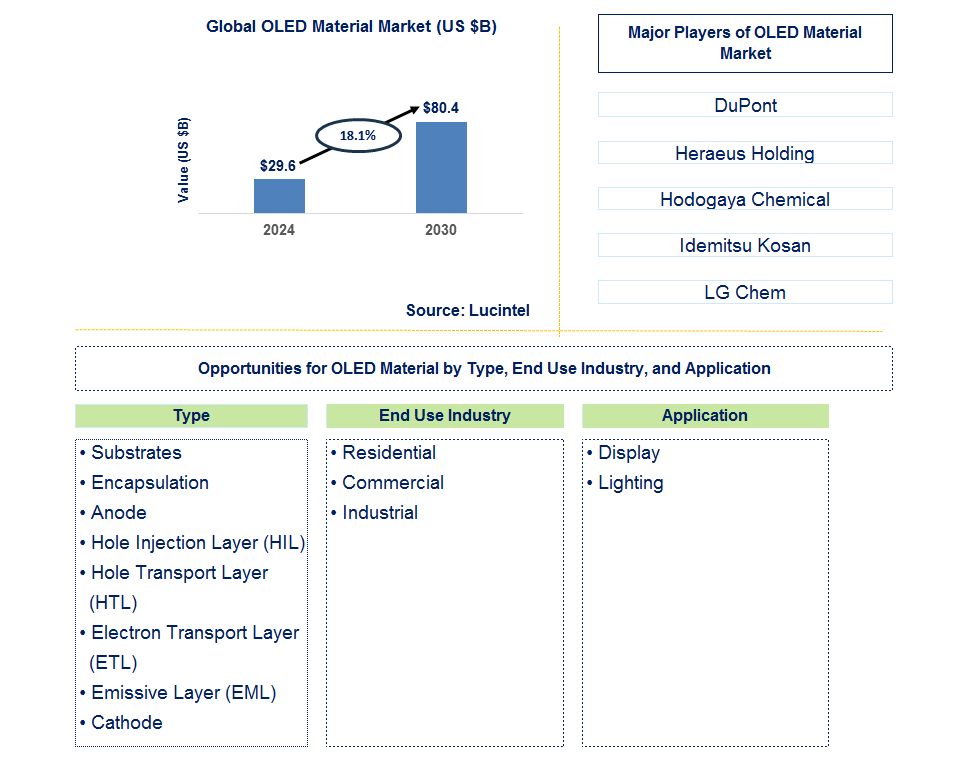
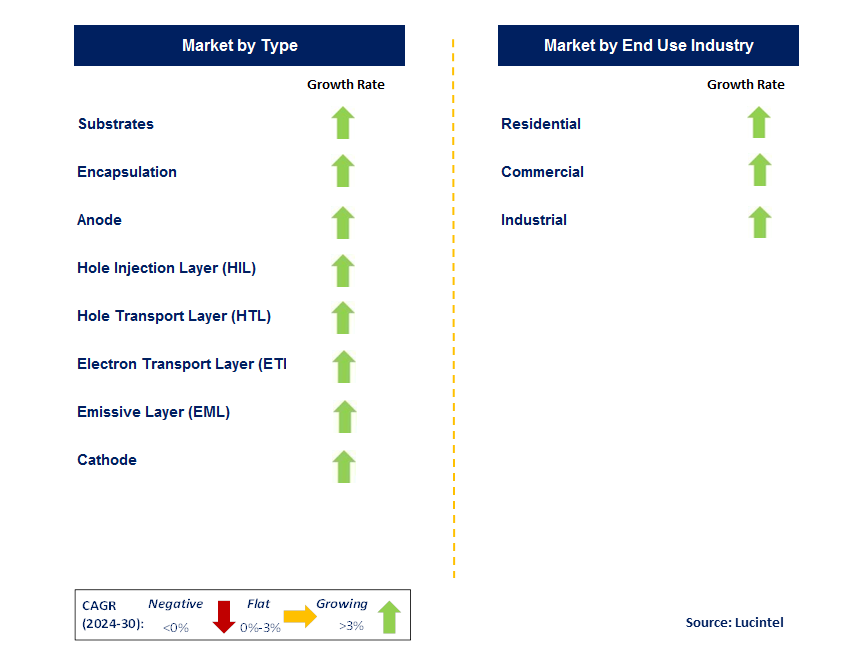
The future of the global OLED material market looks promising with opportunities in the residential, commercial, and industrial markets. The global OLED material market is expected to reach an estimated $80.4 billion by 2030 with a CAGR of 18.1% from 2024 to 2030. The major drivers for this market are growing need for lighting options that use less energy, technical developments in the OLED materials field, and rising demand for consumer devices like PCs, printers, laptops, and smartphones.• Lucintel forecasts that, within the type category, substrates is expected to witness the highest growth over the forecast period due to affordability and the growing popularity of technological gadgets like televisions and cellphones, as well as, OLEDs are built on substrates.
• In terms of regions, APAC will remain the largest region over the forecast period due to population growth, a rise in the use of new technology, and steady economic expansion, as well as, shifts in living standards and the comforts offered by cellphones in this region. A more than 150-page report is developed to help in your business decisions.
Emerging Trends in the OLED Material Market
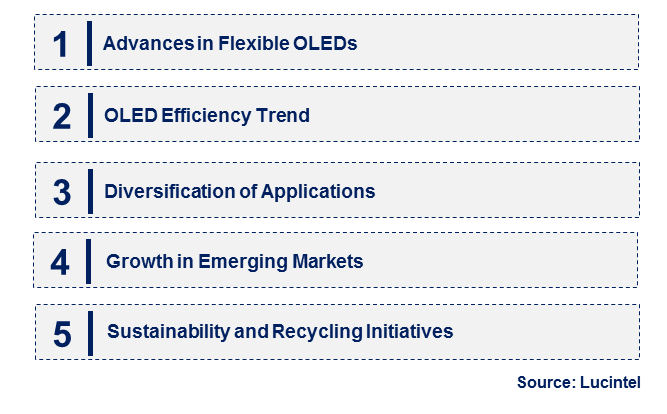
The trends so far coming up in the OLED material market show how the future of displays and their application areas is shaped. Moving into the future, these are indicative of innovative changes taking place in materials, techniques of production, and application areas. Understanding such trends provides insight into how the market is adapting to new demands and technological advancement.• Advances in Flexible OLEDs: The technology of flexible OLEDs is getting widely adopted since it may lead to various innovations like foldable smartphones and rollable displays. Advancement in materials and manufacturing processes is making flexible OLEDs more durable and cost-effective. This has attracted the interest of heavy investors and researchers, hence opening up new avenues for adding value to user experience and designs of novel devices.
• OLED Efficiency Trend: Among the dominant trends is the efficiency of the material OLED itself, which was motivated by a pressing need to realize the stability and efficiency of displays. Research has been focused on devising new organic compounds and improving the already existing materials to achieve increased brightness and longer life spans. This trend has prime importance for the reduction of energy consumption and extending the usability of devices based on OLEDs, especially in consumer electronics.
• Diversification of Applications: OLED technology has attracted a number of non-traditional display segments in addition to the conventional ones. Innovations in material research have opened up new prospects in automotive lighting, wearables, and even medical displays. This diversification into multiple applications has opened up additional market opportunities and has triggered growth in many diversified sectors-a reflection of the flexibility and promise of OLED technology.
• Growth in Emerging Markets: Demand for OLEDs from emerging markets-for instance, India and Southeast Asia-is accelerating, supported by increased consumer demand for advanced display technologies and investments that develop local manufacturing and supply chains to make OLEDs increasingly accessible in these markets. This is extending the global market and developing new opportunities for the industry.
• Sustainability and Recycling Initiatives: More emphasis is being placed on sustainability in the OLED industry, including using recyclable materials and further steps toward minimal environmental impact. Each company tries to come up with ways of making OLED production more environmentally friendly, as there has been increased awareness over waste management and resource utilization. This corresponds to a general trend towards responsible manufacturing, which also aligns with global sustainability goals. These newly emerging trends are driving the way forward for innovation, applications, and sustainability-related issues in the OLED material market. As the industry is at its evolving stage, these trends are continuously going to affect the market dynamics and would create more opportunities and challenges for all the stakeholders involved.
Recent Developments in the OLED Material Market
Changes within the recent times in the OLED material market can tell much about what will happen in the future in the display technologies. These changes signal continuous development in materials, manufacturing processes, and market strategies. Understanding such key events helps one get insight into how the industry develops and reacts to new challenges and opportunities.• Introduction of New Organic Compounds: New organic compounds are being developed to improve OLED performance in terms of brightness, color accuracy, and longevity. Innovation in materials science is making advanced OLED materials possible for superior display quality with energy efficiency. Development has become crucial in keeping up competitiveness and meeting growing demand for high-performance displays.
• Improvement in Manufacturing Process: Manufacturing processes in the case of OLED materials are continuously getting upgraded, and new methods are being thought of to achieve better production efficiency with improved cost control. Various techniques, such as inkjet printing and roll-to-roll processing, are being optimized for better scalability with low production cost. These improvements are hence making the OLED technology accessible and economically viable to adapt in many fields.
• Expansion of Production Capability: Major OLED manufacturers are putting huge efforts into the development and expansion of their production capabilities. New facilities and technologies have been introduced, further enhancing the production capacity, especially for larger and more complex displays. This expansion paves the way for industry growth by ensuring a steady supply of OLED materials to various applications.
• Flexible and Transparent OLEDs: The advancement in the field of materials and processes has made flexible and transparent OLEDs more practical. This kind of development enables the opening up of new design and application possibilities for displays, such as curved surface displays or see-through displays. New markets will be opened, and more versatility for the OLED display platform will be achieved with the under-development technologies.
• Increasing Collaboration and Partnerships: Increasingly, collaboration and partnerships between the suppliers of OLED materials and device manufacturers are being developed. These are in targeted ways to accelerate innovation, improve material performance, and develop new applications. Fundamentally, industry players interact with each other in a number of ways to enhance their capabilities so as to spur the development of the OLED market. All these key developments are pushing the OLED material market with respect to technology advancement, production expansion, and partnerships. These will act as key factors for the future development of OLED technology in this ongoing evolving industry.
Strategic Growth Opportunities for OLED Material Market
In the OLED material market, strategic growth opportunities are created by the expansion of key applications and evolution of others. These opportunities, therefore, reflect a capacity for innovation and market expansion driven by the developments in OLED technology. The identification of opportunities reveals where stakeholders must focus to ensure maximum impact and growth.• Consumer Electronics: The consumer electronics industry, especially the demand for smartphones and televisions, signifies an important area of growth for materials in OLEDs. This is basically because high-quality and energy-efficient displays spur innovation in OLED technology. Companies continue to invest in advanced materials that will improve the performance of displays to meet customer expectations, thus creating huge opportunities for marketers.
• Automotive Displays: OLED technology is a new and emerging field of application that can be used both within and outside a car. Owing to advantages of brightness, flexibility, and design freedom, OLEDs are also suitable for interior displays, capable of customization for the implementation of advanced driver-assistance systems. This is an emerging high-growth area as more automotive manufacturers need to add beauty and functionality.
• Wearables: Smartwatches and fitness trackers are wearables that increasingly use OLED technology due to their flexibility and low power consumption. This enables high-resolution displays with different OLED materials for improved user experiences and more functionalities on the device. It is in such a growing market segment that opportunities can be found for innovation in display technology, suited for wearables.
• Digital Signage: Another sector that holds immense possibilities for OLED material growth is digital signage. These displays are in demand because of the demand for efficient, colorful displays offering high contrast and the possibility of flexibility. Regarding the need for dynamic, high-quality digital signage, there is increasing scope for this technology to take center stage in the reformation of point-of-sale advertising and information display.
• Medical Appliances: Starting from diagnostic to medical imaging systems, OLED finds its use in medical appliances. High resolution and color accuracy allow for improved generation of precise and detailed medical visuals. As health appliances continue their integration with advanced technologies, so will OLED materials provide new opportunities in the development of newer medical appliances and diagnostic systems. It illustrates the new emerging uses of the OLED material market and opens the possibility for innovation in various industries. The stakeholders will now utilize this for the market growth and cashing the opportunities arising in the new trends emerging in the technology of OLED.
OLED Material Market Driver and Challenges
The growth of the OLED material market is based on a few driving and challenging factors. Deep technology, economic, and regulatory forces significantly affect the behavioral pattern of the market. Also, an understanding of these drivers and challenges is essential to gauge the opportunities and obstacles faced by the industry. The factors responsible for driving the oled material market include:• Technological Development: Improvement in material performance, efficiency, and application versatility of OLED technology is the driving force for market growth. New organic compounds, flexible displays, and improved techniques for manufacturing will result in better display quality and greater market potential. This is a highly necessary technological development in order to remain competitive and keep pace with the changes in consumer demand.
• Higher Consumers' Demand: Increasing demand from consumers for value-added and power-saving displays is one of the key end-market drivers for the OLED material market. As consumers increasingly require an enhanced viewing experience in a variety of smartphones, TVs, and other devices, the demand for value-added OLED materials continues to rise. This leads to driving innovation and investments further in the OLED industry.
• Increasing number of applications: The rise in OLED usage-from automotive displays to wearables and digital signage-all helps to drive market growth. Flexibility and advantages, such as flexibility and high resolution offered by OLED technology, make it fit for a variety of applications. All these factors create more opportunities and encourage the development of this market.
• Research and Development Investments: Serious investments in R&D by leading companies and research institutions drive the developments related to OLED materials. As a consequence of this, such investments have to do with the improvement of material performance, the development of new technologies, and enhancement of manufacturing processes. Further R&D is necessary to keep the pace of innovation and secure further competitiveness of the OLED industry.
• Favorable Government Policies: Government policies and programs that encourage technology innovation and manufacturing are likely to favor the OLED material market. Subsidies, tax incentives, and research funding further help boost industries and, hence, investment. Supportive policies mean advancement in developing newer technologies of OLEDs and promote market expansion. Challenges in the oled material market are:
• High Production Costs: The very high production cost of the materials and OLED devices is a serious challenge. The complexity of the process, together with the high cost of advanced materials, contributes to overall costs. These prohibitively high costs make markets inaccessible and affect profit margins, especially for newer and smaller companies.
• Technical Challenges: There are technical challenges, which, when addressed, would significantly affect material performance and durability, further enhancing manufacturing efficiency. Issues related to limited material lifespan, defects, or production scaling might eventually make OLED displays of low quality and costly, hence of low market viability. It is, therefore, important that such technical challenges be put into light as a way of improving the viability of markets.
• Competition from Alternative Technologies: The OLED market faces competition from other display technologies like LCD and microLED. Each of these technologies has different advantages and may be competitive in market share for specific applications. This would eventually affect the growth in the OLED market and the ongoing need for innovation to maintain relevance. The drivers and challenges that affect the OLED material market are multifaceted. The driving factors are technological advances and increasing consumer demand, while the most significant hurdles are high production costs and technical challenges. Overcoming these challenges while capitalizing on the drivers will be paramount for continued growth and development in the OLED materials market.
List of OLED Material Companies
Companies in the market compete on the basis of product quality offered. Major players in this market focus on expanding their manufacturing facilities, R&D investments, infrastructural development, and leverage integration opportunities across the value chain. Through these strategies OLED material companies cater increasing demand, ensure competitive effectiveness, develop innovative products & technologies, reduce production costs, and expand their customer base. Some of the OLED material companies profiled in this report include-• DuPont
• Heraeus Holding
• Hodogaya Chemical
• Idemitsu Kosan
• LG Chem
• Merck KGaA
• Samsung SDI
• Sumitomo Chemical
• Tokyo Chemical Industry
• BASF
OLED Material by Segment
The study includes a forecast for the global OLED material by type, end use industry, application, and region.OLED Material Market by Type [Analysis by Value from 2018 to 2030]:
• Substrates
• Encapsulation
• Anode
• Hole Injection Layer (HIL)
• Hole Transport Layer (HTL)
• Electron Transport Layer (ETL)
• Emissive Layer (EML)
• Cathode
OLED Material Market by End Use Industry [Analysis by Value from 2018 to 2030]:
• Residential
• Commercial
• Industrial
OLED Material Market by Application [Analysis by Value from 2018 to 2030]:
• Display
• Lighting
OLED Material Market by Region [Analysis by Value from 2018 to 2030]:
• North America
• Europe
• Asia Pacific
• The Rest of the World
Country Wise Outlook for the OLED Material Market
The OLED material market is a recent past of rapid transformation catalyzed by continuous technological development, regional investments, and changing consumer needs. Major markets such as the United States, China, Germany, India, and Japan are exhibiting different developments driven by innovations in display technology, improvements in energy efficiency, and increased applications in consumer electronics, among others. The regional update reflects broader trends in the OLED industry, underlining the shifts occurring in the realms of production capabilities, market strategies, and technological focus.• United States: The OLED material market in the U.S. has been characterized by huge research and development investments. Major players, such as Universal Display Corporation, have invested time and effort in order to enhance the efficiency and durability of the material in question. Development of phosphorescent materials and innovative ways of production defines the patterns for displays in the premium categories. Moreover, the increasing applications into flagship smartphones and TVs now do much to promote further growth, encouraged by governmental support and finance to keep the edge in technologies.
• China: China was one of the fastest-growing OLED markets, with substantial investment driven by electronic giants such as BOE Technology Group and TCL. The focus had been on increasing production capacities and trimming manufacturing costs as a way of making the technology more affordable. Secondly, there has been a number of policies initiated by the Chinese government to promote OLED research and local production, thus increasing competition and encouraging the advancement in flexible and transparent OLED materials.
• Germany: Germany is turning to be one of the leading countries in the OLED material market, as it has a leading edge in materials science and production technologies. Companies such as Merck KGaA take the lead in developing high-efficiency OLED materials. German research institutions are taking the leading role in finding new organic compounds and innovative manufacturing processes that will enable improved performance and sustainability for OLED applications in automotive displays and industrial use.
• India: The OLED market is developing on the back of increased demand for advanced display technologies in smartphones and TVs. In addition, companies like LG Display are expanding their presence to create more local production capability for OLEDs. Initiatives by the Indian government to promote electronics manufacturing and technology adoption act as a catalyst for this growth; however, the path to establishing a robust supply chain and infrastructure remains challenging.
• Japan: Japan still remains one of the most crucial participants in the OLED material market, as major companies like Sony and Panasonic continue to drive innovation in OLED technology. Japanese companies are targeting high-resolution and flexible OLED displays for consumer electronics and automotive applications. The next-generation investments in OLED materials and technologies are foreseen to keep Japan competitive in the worldwide market, with substantial emphasis on high performance and energy efficiency.

Features of the Global OLED Material Market
Market Size Estimates: OLED material market size estimation in terms of value ($B). Trend and Forecast Analysis: Market trends (2018 to 2023) and forecast (2024 to 2030) by various segments and regions. Segmentation Analysis: OLED material market size by type, end use industry, application, and region in terms of value ($B). Regional Analysis: OLED material market breakdown by North America, Europe, Asia Pacific, and Rest of the World. Growth Opportunities: Analysis of growth opportunities in different type, end use industry, application, and regions for the OLED material market. Strategic Analysis: This includes M&A, new product development, and competitive landscape of the OLED material market. Analysis of competitive intensity of the industry based on Porter’s Five Forces model.If you are looking to expand your business in this or adjacent markets, then contact us. We have done hundreds of strategic consulting projects in market entry, opportunity screening, due diligence, supply chain analysis, M & A, and more.

FAQ
Q1. What is the OLED material market size? Answer: The global OLED material market is expected to reach an estimated $80.4 billion by 2030. Q2. What is the growth forecast for OLED material market? Answer: The global OLED material market is expected to grow with a CAGR of 18.1% from 2024 to 2030. Q3. What are the major drivers influencing the growth of the OLED material market? Answer: The major drivers for this market are growing need for lighting options that use less energy, technical developments in the OLED materials field and rising demand for consumer devices like PCs, printers, laptops, and smartphones. Q4. What are the major segments for OLED material market? Answer: The future of the OLED material market looks promising with opportunities in the residential, commercial, and industrial markets. Q5. Who are the key OLED material market companies? Answer: Some of the key OLED material companies are as follows:• DuPont
• Heraeus Holding
• Hodogaya Chemical
• Idemitsu Kosan
• LG Chem
• Merck KGaA
• Samsung SDI
• Sumitomo Chemical
• Tokyo Chemical Industry
• BASF Q6. Which OLED material market segment will be the largest in future? Answer: Lucintel forecasts that substrates is expected to witness the highest growth over the forecast period due to affordability and the growing popularity of technological gadgets like televisions and cellphones, as well as, OLEDs are built on substrates. Q7. In OLED material market, which region is expected to be the largest in next 5 years? Answer: APAC will remain the largest region over the forecast period due to population growth, a rise in the use of new technology, and steady economic expansion, as well as, shifts in living standards and the comforts offered by cellphones in this region. Q.8 Do we receive customization in this report? Answer: Yes, Lucintel provides 10% customization without any additional cost.
Table of Contents
Methodology
- In-depth interviews of the major players in this market
- Detailed secondary research from competitors’ financial statements and published data
- Extensive searches of published works, market, and database information pertaining to industry news, company press releases, and customer intentions
- A compilation of the experiences, judgments, and insights of Lucintel’s professionals, who have analyzed and tracked this market over the years.


Buy Now
Choose a license that fits your team. Instant PDF delivery.
Prices exclude taxes. Instant delivery. Custom licensing available on request.
Key Questions
- • What are some of the most promising, high-growth opportunities for the OLED material market by type (substrates, encapsulation, anode, hole injection layer (HIL), hole transport layer (HTL), electron transport layer (ETL), emissive layer (EML), and cathode), end use industry (residential, commercial, and industrial), application (display and lighting), and region (North America, Europe, Asia Pacific, and the Rest of the World)?
- • Which segments will grow at a faster pace and why?
- • Which region will grow at a faster pace and why?
- • What are the key factors affecting market dynamics? What are the key challenges and business risks in this market?
- • What are the business risks and competitive threats in this market?
- • What are the emerging trends in this market and the reasons behind them?
- • What are some of the changing demands of customers in the market?
- • What are the new developments in the market? Which companies are leading these developments?
- • Who are the major players in this market? What strategic initiatives are key players pursuing for business growth?
- • What are some of the competing products in this market and how big of a threat do they pose for loss of market share by material or product substitution?
- • What M&A activity has occurred in the last 5 years and what has its impact been on the industry? For any questions related to Oled Material Market, Oled Material Market Size, Oled Material Market Growth, Oled Material Market Analysis, Oled Material Market Report, Oled Material Market Share, Oled Material Market Trends, Oled Material Market Forecast, Oled Material Companies, write Lucintel analyst at email: helpdesk@lucintel.com. We will be glad to get back to you soon.


