
Market Report · July 20, 2026

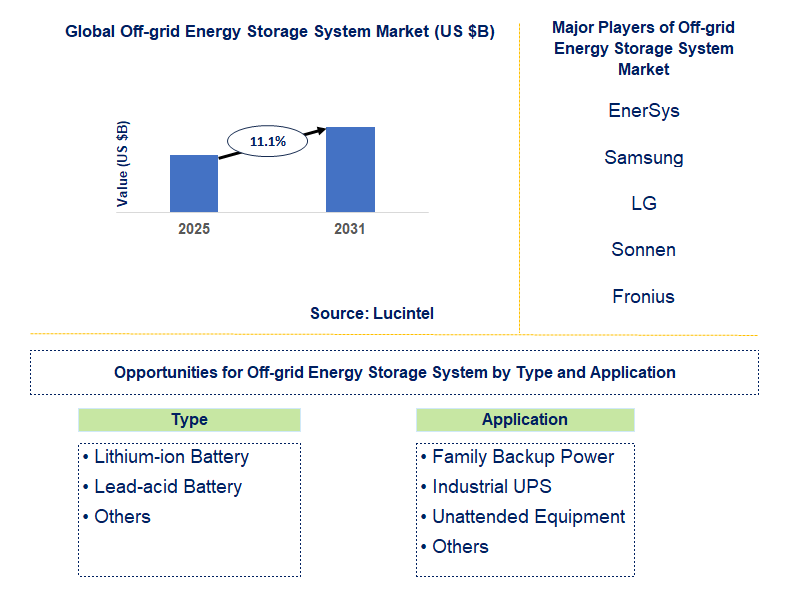
Key data points: The growth forecast = 11.1% annually for the next 7 years. Scroll below to get more insights. This market report covers Trends, opportunities and forecasts in off-grid energy storage system market to 2031 by type (lithium-ion battery, lead-acid battery, and others), application (family backup power, industrial UPS, unattended equipment, and others), and region (North America, Europe, Asia Pacific, and the Rest of the World)
We'll send your sample report shortly.
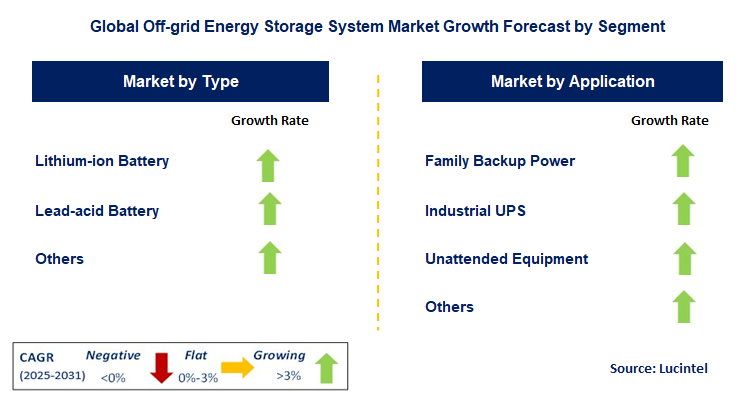
• Lucintel forecasts that, within the type category, lithium-ion battery is expected to witness higher growth over the forecast period.
• Within the application category, family backup power is expected to witness the highest growth.
• In terms of region, APAC is expected to witness the highest growth over the forecast period.
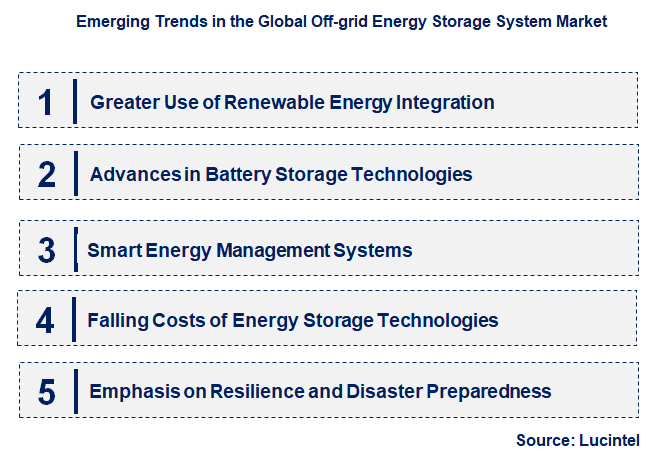
• Greater Use of Renewable Energy Integration: Off-grid energy storage systems are being increasingly implemented together with renewable energy technologies like solar, wind, and hydroelectric power. By integrating these technologies, off-grid systems are able to store the surplus energy produced during times of high production and utilize it in times of need. It is a trend that is necessitated by the increased call for cleaner energy alternatives and declining costs of renewable technology. The inclusion of renewable energy in off-grid systems is enhancing energy access and minimizing fossil fuel reliance in off-grid areas.
• Advances in Battery Storage Technologies: Battery storage technologies, such as lithium-ion and flow batteries, are improving by leaps and bounds, enhancing the efficiency and cost-effectiveness of off-grid systems. The advancements enable enhanced energy storage capacity, improved charging speed, and longer lifespan, which are vital for off-grid applications. Also, new energy storage technologies like solid-state batteries are under investigation to provide even greater efficiency and safety. All these are opening up more possibilities for the use of off-grid energy storage, enabling it to be used by more users.
• Smart Energy Management Systems: The incorporation of smart energy management systems (EMS) is another major trend in off-grid energy storage. EMS employ sophisticated software to track, manage, and optimize energy production, storage, and use. Such systems are able to forecast energy requirements based on weather forecasts, user behavior, and other parameters, thus ensuring maximum efficiency and minimizing waste. The use of smart EMS is enhancing the efficiency of off-grid storage systems and making them more responsive to the fluctuating energy needs of remote locations.
• Falling Costs of Energy Storage Technologies: With decreasing prices of technology and economies of scale, the price of off-grid energy storage systems is decreasing, making it more affordable for consumers and companies. The lowered cost of energy storage, together with declining prices of renewable energy technologies, is promoting the large-scale adoption of off-grid systems. This movement is especially critical for low-income and off-grid communities that may not have enjoyed access to trustworthy energy storage solutions previously.
• Emphasis on Resilience and Disaster Preparedness: Off-grid energy storage systems are becoming more widely employed to improve energy resilience, especially in areas exposed to natural disasters. These systems offer backup power during grid outages due to hurricanes, earthquakes, and other catastrophic events. With climate change causing an increase in the frequency and severity of natural disasters, the need for resilient off-grid energy storage systems is on the rise. Off-grid systems are being invested in by governments and other organizations to enhance disaster preparedness and provide reliable power to key services, including hospitals and emergency shelters, in the event of an emergency. The new trends in off-grid energy storage are shaping innovation, affordability, and sustainability in the industry. Through the integration of renewable energy sources, the development of battery technologies, and the use of smart EMS, the market is becoming efficient, resilient, and accessible. These trends are revolutionizing the off-grid energy storage market, making it an essential solution for energy access, particularly in remote and underserved communities.
• Growth of Solar-Powered Off-grid Storage Solutions: Solar-powered off-grid storage solutions are increasingly gaining traction in areas where there is a lot of sunlight but limited availability of the main grid power. These systems take power from solar panels and store electricity in batteries to use at a later time. This combination of solar and energy storage is turning out to be the best option for rural electrification, minimizing the use of diesel generators and enhancing access to energy in off-grid locations. This trend is poised to increase as the cost of solar technology keeps falling.
• Technology Advances in Batteries: Battery technologies, especially lithium-ion batteries, are changing very fast, with higher energy densities, quicker charging times, and longer lifetimes. These developments are making off-grid energy storage systems more efficient and economical. New types of batteries, like solid-state batteries, are also being created to provide even higher efficiency and safety. These developments are broadening the uses of off-grid systems, making them applicable to more users and enhancing their performance in remote locations.
• Government Support and Incentives: Governments around the world are offering financial incentives, subsidies, and grants to promote the use of off-grid energy storage systems. These initiatives are designed to enhance the uptake of renewable energy and enhance energy access in remote locations. For instance, the Indian government has launched various initiatives to support solar and off-grid storage solutions in rural areas. Likewise, other nations, such as China and the United States, are facilitating the deployment of off-grid storage by positive policies and regulatory environments.
• Hybrid Off-grid Storage Solution Development: Hybrid off-grid storage solutions, which integrate two or more energy sources like solar, wind, and diesel generators, are becoming increasingly popular. These systems provide higher reliability by enabling users to switch between energy sources based on availability and demand. Hybrid systems are especially beneficial in areas with variable renewable energy production or where grid access is intermittent. This innovation is enhancing the reliability and flexibility of off-grid energy storage systems, making them a more viable option for remote communities.
• Growing Private Sector Investment: Investment by the private sector in off-grid energy storage systems is increasingly growing, fueled by the expanding demand for cleaner energy solutions. Firms are enhancing storage innovation and establishing novel business models for off-grid use. Investment is speeding up the rollout of off-grid energy storage systems, especially in remote areas with poor infrastructure. Private investment is also helping in the advancement of more cost-effective and efficient storage technology, thereby fueling market growth. These developments are influencing the off-grid energy storage system market by enhancing efficiency, affordability, and accessibility. The convergence of solar power, battery technology improvements, and government incentives are pushing the global uptake of off-grid storage systems. As the developments progress, the market will continue to grow, providing clean and sustainable energy solutions for off-grid and remote communities.
• Rural Electrification: Off-grid storage systems are crucial for rural electrification, ensuring power to communities that do not have access to the main grid. Solar-powered systems are highly effective in these areas, providing a cheap and renewable source of power for households and businesses. Off-grid storage systems in rural areas are increasing in demand as governments and agencies strive to enhance energy access and decrease dependence on fossil fuels.
• Emergency Backup Power: Off-grid energy storage systems are becoming more common as backup power sources in times of emergencies or power failures. These types of systems offer an uninterrupted power source when the grid collapses, thus continuing to operate critical infrastructure like hospitals, emergency services, and communications networks. Increased emphasis on disaster preparedness and resilience is leading to the implementation of off-grid storage systems in locations with a history of natural disasters or grid unreliability.
• Commercial and Industrial Uses: Companies and industries are implementing off-grid energy storage systems to minimize energy expenses and improve energy security. These systems enable companies to produce and store their own energy, less dependent on the grid and less exposed to electricity price volatility. Industrial applications of off-grid storage are increasing as companies look for cleaner and cheaper energy options to facilitate their operations.
• Remote Telecommunications and Infrastructure: Off-grid energy storage systems are essential to power remote telecommunications towers and infrastructure in locations with no dependable grid connection. These systems provide an uninterrupted supply of communication and data transmission in remote areas. With growing demand for connectivity, especially in rural and underserved areas, the use of off-grid energy storage systems for telecommunications is likely to be on the upswing.
• Electric Vehicle Charging Stations: Off-grid energy storage systems are utilized to facilitate electric vehicle (EV) charging stations, especially where the grid is not reliable or adequate. With the combination of solar power and storage systems, these charging stations can offer a stable energy supply independent of the main grid. This use is expanding as the use of electric vehicles grows and the need for green charging increases. These strategic development opportunities are changing the off-grid energy storage sector by broadening its applications into different industries. Rural electrification, backup power during emergencies, industrial uses, and charging of electric vehicles are some of the major growth prospects that are catapulting the industry ahead. When these opportunities turn into reality, the off-grid energy storage system market is forecasted to accelerate at a considerable rate, providing clean and sustainable energy solutions for underserved people and industries.
• EnerSys
• Samsung
• LG
• Sonnen
• Fronius
• Toshiba
• Mitsubishi Heavy Industries
• Sumitomo Electric Industries
• Enphase
• SAFT
• Lithium-ion Battery
• Lead-acid Battery
• Others
• Family Backup Power
• Industrial UPS
• Unattended Equipment
• Others
• North America
• Europe
• Asia Pacific
• The Rest of the World
• United States: Off-grid energy storage systems are being more commonly used in rural and remote locations as well as for emergency backup power in the United States. The increase in household solar power usage has had a major increase in the uptake of off-grid storage solutions. States such as California and Hawaii are at the forefront, thanks to policies in favor of storage and renewable energy. Furthermore, innovative developments in lithium-ion battery and energy management technologies are making off-grid storage solutions more cost-efficient and effective, thus increasingly suitable for private households and firms.
• China: Off-grid energy storage is a key focus area for China as part of its initiatives towards improving energy security, lowering carbon emissions, and rural electrification. China is investing in the large-scale off-grid storage in remote areas and islands through cutting-edge battery technologies. The Chinese government is also promoting the adoption of renewable sources like solar and wind into off-grid systems. This is backed by policies that promote the innovation of energy storage technologies, with financial incentives and research grants for industry players.
• Germany: Germany, a global leader in renewable energy, has been leading the way in the innovation of off-grid energy storage systems. Germany is rolling out off-grid storage systems in rural regions to back its energy transition. Thanks to significant government subsidies and supportive regulation, Germany is leading the development of its storage technologies to smoothly incorporate solar and wind power. Off-grid storage is also increasingly popular in outlying areas to deliver reliable power where the central grid is either non-existent or unstable, aiding Germany in meeting its renewable energy objectives while maximizing energy independence.
• India: India is experiencing an upsurge in off-grid energy storage systems as the nation attempts to overcome its electricity access problems, particularly in rural and distant areas. India's government has launched different schemes to encourage solar-powered off-grid storage systems, especially in areas with unreliable or no grid connections. Such systems assist in offering stable power while lowering the carbon footprint. With the ongoing innovation of energy storage technologies and private sector investment, off-grid storage is viewed as one of the main solutions for rural electrification and energy autonomy.
• Japan: Japan is utilizing off-grid energy storage systems to increase energy resilience, particularly after the Fukushima nuclear accident. The nation is using off-grid storage systems in remote and disaster-hit areas to provide power reliability during crisis situations. Japan is also combining these systems with renewable energy sources such as solar and wind, with the government offering incentives for the use of energy storage technology. Energy resilience, coupled with advancements in technology, has enabled Japan to become a global leader in the development and deployment of off-grid storage systems to enhance energy security.


• EnerSys
• Samsung
• LG
• Sonnen
• Fronius
• Toshiba
• Mitsubishi Heavy Industries
• Sumitomo Electric Industries
• Enphase
• SAFT Q5. Which off-grid energy storage system market segment will be the largest in future? Answer: Lucintel forecasts that, within the type category, lithium-ion battery is expected to witness higher growth over the forecast period. Q6. In off-grid energy storage system market, which region is expected to be the largest in next 5 years? Answer: In terms of region, APAC is expected to witness the highest growth over the forecast period. Q7. Do we receive customization in this report? Answer: Yes, Lucintel provides 10% customization without any additional cost.


Choose a license that fits your team. Instant PDF delivery.
Prices exclude taxes. Instant delivery. Custom licensing available on request.
Market Report · July 20, 2026
Market Report · July 20, 2026
Market Report · July 20, 2026
Trusted partner for strategic intelligence and business growth


Receive a complimentary market analysis tailored to your industry. Our analysts will identify key growth opportunities and competitive dynamics specific to your business.

Market size, growth rate, and key trend analysis for your specific sector.

Top competitor positioning and market share analysis.

Strategic recommendations backed by data-driven insights.
Get curated market intelligence and competitive moves straight to your inbox.
By subscribing, you agree to receive our monthly insights. Unsubscribe anytime.
Receive a complimentary market analysis tailored to your industry. Our analysts will identify key growth opportunities and competitive dynamics specific to your business.
Market size, growth rate, and key trend analysis for your specific sector.
Top competitor positioning and market share analysis.
Strategic recommendations backed by data-driven insights.
Get curated market intelligence, emerging trends, and competitive moves straight to your inbox each month.
By subscribing, you agree to receive our monthly insights. Unsubscribe anytime.
We'll send your sample report shortly.