
Market Report · July 22, 2026

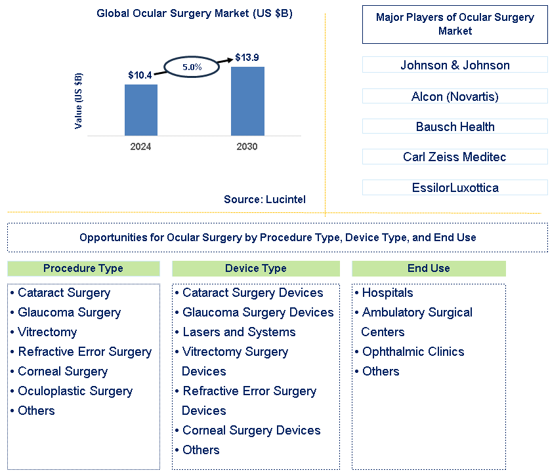
Key data points: The market size in 2031 = $14.6 billion, growth forecast = 5.0% annually for the next 7 years. Scroll below to get more insights. This market report covers trends, opportunities, and forecasts in the global ocular surgery market to 2031 by procedure type (cataract surgery, glaucoma surgery, vitrectomy, refractive error surgery, corneal surgery, oculoplastic surgery, and others), device type (cataract surgery devices, glaucoma surgery devices, lasers and systems, vitrectomy surgery devices, refractive error surgery devices, corneal surgery devices, and others), end use (hospitals, ambulatory surgical centers, ophthalmic clinics, and others), and region (North America, Europe, Asia Pacific, and the Rest of the World)
We'll send your sample report shortly.
• Lucintel forecasts that, within the device type category cataract surgery is expected to witness the highest growth over the forecast period.
• Within the end use category, hospital is expected to witness the highest growth over the forecast period.
• In terms of regions, North America is expected to witness highest growth over the forecast period.
• Customized Eye Surgeries: Personalized eye surgeries have gained popularity, with individualized intraocular lenses (IOLs) or precise laser treatments being offered based on individual needs. This has been made possible by improved diagnostics and surgical planning, leading to more precise procedures performed on specific vision defects, resulting in improved visual outcomes as well as higher patient satisfaction rates since treatments are matched with particular visual impairments and lifestyle requirements.
• MIGS: Minimally invasive glaucoma surgery (MIGS) is becoming mainstream and has seen a transition toward less invasive procedures with improved postoperative comfort and reduced complications. MIGS devices have become the go-to option for treating mild to moderate glaucoma as they provide a safer approach compared to conventional surgery. This trend improves patients’ quality of life while decreasing the overall burden on healthcare systems.
• AI in Eye Surgery: AI techniques are being increasingly used in eye surgery for diagnosis, surgical planning, and postoperative management. AI-driven platforms help surgeons make accurate incisions as well as predict surgical outcomes, hence enhancing precision and efficiency. The use of AI in eye surgery will continue to rise, thereby giving access to improved decision-making tools and personalized treatment protocols.
• Robotic-Assisted Surgery: Robotic-assisted surgeries are gaining popularity in the ocular surgery market because they provide superior accuracy and control over complex procedures. These systems facilitate minimally invasive surgeries that have better precision, reducing the risk of complications as well as improving patient recovery periods. With more ophthalmology specialists adopting robotic surgical equipment, especially in complicated cases, this will revolutionize how eye operations are conducted.
• Teleophthalmology and Remote Surgery: Teleophthalmology and remote surgery are taking shape today, changing eye healthcare, particularly in rural or underserved regions. These technologies enable live consultations with clients who may be very far from the surgeon physically but can still be operated on remotely, ensuring that high-quality eye care is not only for those who can afford it. The accelerated uptake of teleophthalmology brought about by COVID-19 is expected to remain a major trend, driving greater accessibility for patients and better results after surgical interventions.
These trends emerging within the ocular surgery market are driving significant improvements in terms of increased surgical precision, patient outcomes, and care availability globally. Personalized therapies and minimally invasive approaches integrating cutting-edge technologies such as AI and robotics have revolutionized the sector, setting new benchmarks for global eye care. These trends will be essential in shaping the future of ocular surgery as they continue.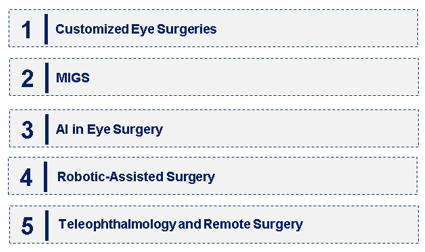
• FDA Approvals of Advanced Intraocular Lenses (IOLs): The recent FDA approval of advanced intraocular lenses is a major milestone for the ocular surgery market. They provide improved vision for patients with cataracts, such as better near and distance vision after undergoing this type of operation. Hence, this IOL approval will drive growth by attracting more patients who choose premium lenses that guarantee a higher quality of life post-surgery.
• Adoption of Femtosecond Laser-Assisted Cataract Surgery: The increasing femtosecond laser-assisted cataract surgeries has transformed cataract treatment procedures. This technology allows better incisions and lens fragmentation, leading to improved surgical results and quicker recovery processes. More surgical centers are expected to adopt this technology, making it a standard for cataract surgeries, thus accelerating the market growth further.
• Rise of Minimally Invasive Glaucoma Surgery (MIGS): A safer and more effective alternative to traditional glaucoma surgery, minimally invasive glaucoma surgery (MIGS) is increasingly becoming popular as a safer and effective alternative to traditional glaucoma surgery. These MIGS procedures have become more accessible with the recent developments in MIGS devices, allowing shorter recovery time frames and lower associated complications. The increasing uptake of MIGS, especially for minimal or moderate glaucoma, has had a positive impact on the ocular surgery sector.
• Integration of Augmented Reality (AR) in Surgery: This move is a game changer in ocular surgery with augmented reality that enhances surgical precision and visualization. It helps surgeons see digital images over their surgical fields, which are used as guides during operations. It can be particularly helpful when carrying out complex surgeries where precision is paramount. Therefore, it could be expected that the use of AR technology in ophthalmology will continue to develop, bringing new possibilities for improved outcomes after treatment.
• Expansion of Teleophthalmology Services: Ocular surgery access has been revolutionized by teleophthalmology services, with expansion through reaching areas that are remote and underserved. There have been recent developments in teleophthalmology platforms that allow real-time consultations or even guidance on how to carry out an operation remotely, hence making quality eye care more accessible. Over the years, the growth rate of this sub-segment is projected to remain high due to demand for efficient and accessible solutions.
• Cataract Surgery: Demand for cataract surgery continues to grow rapidly due to the aging global population and developments in surgical techniques. This is one of the fastest growing segments of ophthalmic surgery, driven by increasing adoption of premium intraocular lenses (IOLs) and femto-second laser technology that are improving surgical outcomes; hence, making this a major area to watch for investors eyeing investments in ophthalmic surgeries. Therefore, the cataract surgery market is expected to witness significant growth as more patients seek high-quality personalized solutions.
• Glaucoma Treatment: Introduction of MIGS (Minimally Invasive Glaucoma Surgeries) has brought about additional treatment options for glaucoma sufferers, thus stimulating its development even further. MIGS offers a safer and less invasive alternative to traditional glaucoma surgery with shorter healing times and fewer complications. Additionally, there will be a greater use of MIGS devices alongside improved diagnostic tools, which would drive this segment within the ocular surgery industry.
• Refractive Surgery: LASIK and PRK refractive surgeries are still considerable areas where ophthalmologists can make a profit from practice. Growth prospects are represented by advances in laser technology and increasing patient preference towards vision correction procedures. It is predicted that a greater number of people will want freedom from glasses or contact lenses, leading to an expansion in the refractive surgery sector, thus providing ground for video innovations into untapped markets.
• Retinal Surgery: Technological advancements, including the introduction of microincision vitrectomy surgery (MIVS) and AI-based surgical planning systems, have propelled retinal surgery further than ever before. In turn, this is improving surgical outcomes and broadening the range of treatable retinal conditions. The growth in the number of patients with retinal disorders, especially among aging populations, will spur growth in the global retinal surgery market.
• Corneal Transplantation: It is important to note that corneal transplantation has a lot of room for growth, given advances in tissue engineering and new techniques such as Descemet’s membrane endothelial keratoplasty (DMEK). These innovations are improving patient outcomes and reducing the risk of complications. Furthermore, there is an increase in the availability of donor tissue and synthetic corneas being developed, leading to expansion within the corneal transplantation marketplace.
• Johnson & Johnson
• Alcon (Novartis)
• Bausch Health
• Carl Zeiss Meditec
• EssilorLuxottica
• Hoya
• Nidek
• Topcon
• Lumenis
• Ellex Medical Lasers
• Cataract Surgery
• Glaucoma Surgery
• Vitrectomy
• Refractive Error Surgery
• Corneal Surgery
• Oculoplastic Surgery
• Others
• Cataract Surgery Devices
• Glaucoma Surgery Devices
• Lasers and Systems
• Vitrectomy Surgery Devices
• Refractive Error Surgery Devices
• Corneal Surgery Devices
• Others
• Hospitals
• Ambulatory Surgical Centers
• Ophthalmic Clinics
• Others
• North America
• Europe
• Asia Pacific
• The Rest of the World
• United States: In the United States of America (USA), there is FDA approval for recently invented advanced intraocular lenses (IOLs) as well as minimally invasive glaucoma surgeries (MIGS). The focus on personalized eye care solutions and teleophthalmology is also growing, driven by increasing patient demand for precision medicine and remote consultations. The outpatient surgical center market is also expanding, making procedures more accessible to patients at a lower cost.
• China: The Chinese market for ocular surgery has been witnessing tremendous growth due to an ageing population and high rates of myopia. Some notable achievements include the adoption of femtosecond laser-assisted cataract surgery and increased government support for public health initiatives targeting eye care. Chinese firms are also investing in AI-based diagnostic tools and robotic systems used during surgery in order to improve the surgical success rate as well as reduce healing times.
• Germany: Ocular surgery advancements in Germany revolve around integrating digital technologies into surgical procedures such as augmented reality (AR) and artificial intelligence (AI). These innovations are improving the precision with which surgical services are provided. Furthermore, there has been an increase in the number of minimally invasive techniques that treat glaucoma or retinal diseases, supported by strong healthcare infrastructure and research projects ongoing in various universities across the country.
• India: The ocular surgery market is growing significantly due to accessibility rise when it comes to healthcare services provided by various organizations, besides increased awareness about issues surrounding eyesight among citizens. Recent developments include the expansion of cataract programs within India, plus the adoption of advanced surgical techniques like microincision cataract surgery (MICS). Additionally, the Indian government is investing in a number of initiatives that are aimed at reducing blindness and improving access to eye care services within rural areas.
• Japan: The Japanese ocular surgery market is known for its heavy focus on innovation and technology. Notable achievements include the use of high-frequency ultrasound for cataract surgery as well as AI-based pre-operative planning and post-operative care. More so, the market uptake of premium IOLs is rising to offer better visual outcomes for patients’ vision. These advancements are mainly driven by Japan’s aging population.


• Johnson & Johnson
• Alcon (Novartis)
• Bausch Health
• Carl Zeiss Meditec
• EssilorLuxottica
• Hoya
• Nidek
• Topcon
• Lumenis
• Ellex Medical Lasers
Q6. Which ocular surgery market segment will be the largest in future?

Choose a license that fits your team. Instant PDF delivery.
Prices exclude taxes. Instant delivery. Custom licensing available on request.
Market Report · July 22, 2026
Market Report · July 22, 2026
Market Report · July 22, 2026
Trusted partner for strategic intelligence and business growth


Receive a complimentary market analysis tailored to your industry. Our analysts will identify key growth opportunities and competitive dynamics specific to your business.

Market size, growth rate, and key trend analysis for your specific sector.

Top competitor positioning and market share analysis.

Strategic recommendations backed by data-driven insights.
Get curated market intelligence and competitive moves straight to your inbox.
By subscribing, you agree to receive our monthly insights. Unsubscribe anytime.
Receive a complimentary market analysis tailored to your industry. Our analysts will identify key growth opportunities and competitive dynamics specific to your business.
Market size, growth rate, and key trend analysis for your specific sector.
Top competitor positioning and market share analysis.
Strategic recommendations backed by data-driven insights.
Get curated market intelligence, emerging trends, and competitive moves straight to your inbox each month.
By subscribing, you agree to receive our monthly insights. Unsubscribe anytime.
We'll send your sample report shortly.