
Market Report · May 18, 2026

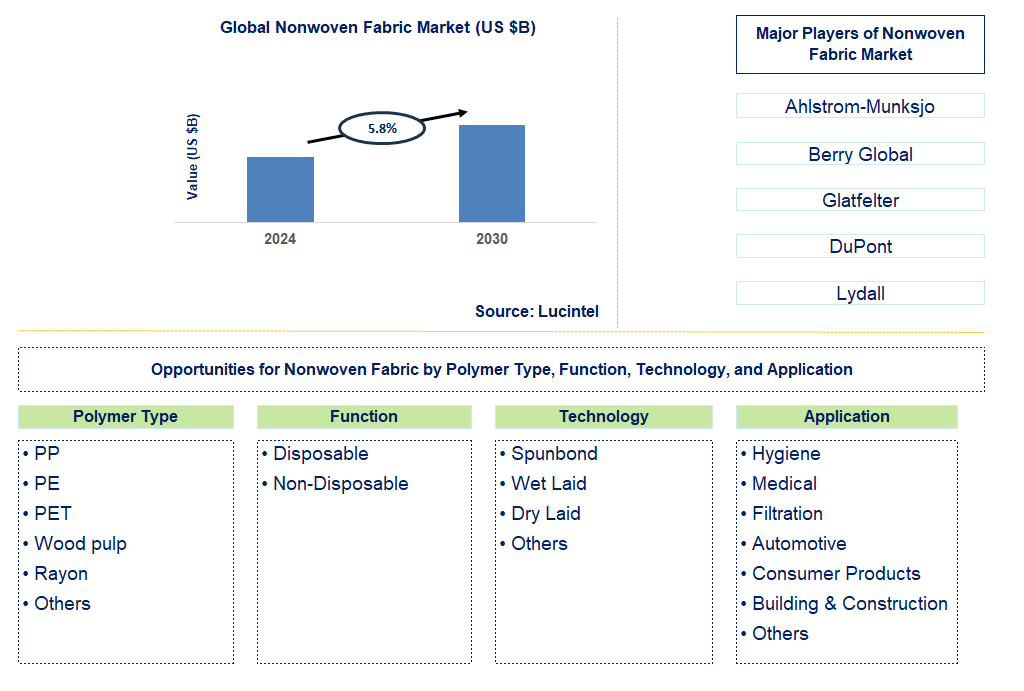
Key data points: The growth forecast = 5.8% annually for the next 6 years. Scroll below to get more insights. This market report covers trends, opportunities, and forecasts in the global nonwoven fabric market to 2030 by polymer type (PP, PE, PET, wood pulp, rayon, and others), function (disposable and non-disposable), technology (spunbond, wet laid, dry laid, and others), application (hygiene, medical, filtration, automotive, consumer products, building & construction, and others), and region (North America, Europe, Asia Pacific, and the Rest of the World)
We'll send your sample report shortly.
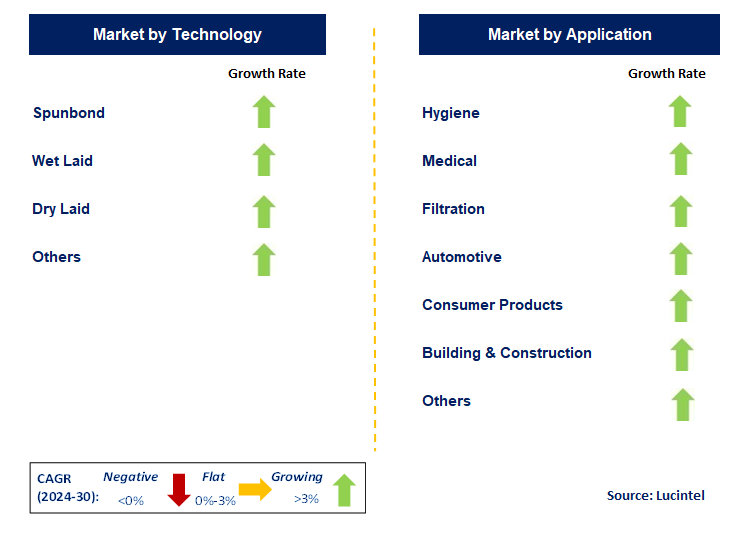
• Lucintel forecasts that, within the technology category, spunbond is expected to witness the highest growth over the forecast period due to growing in the demand for these spunbond nonwovens across various applications.
• Within the application category, hygiene will remain the largest segment due to quality like excellent absorption properties, softness, smoothness, strength, comfort & fit, stretchability, and cost-effectiveness.
• In terms of regions, APAC is expected to witness highest growth over the forecast period due to improving global economy, expanding working population, increasing domestic demand for hygiene products. A more than 150-page report is developed to help in your business decisions.
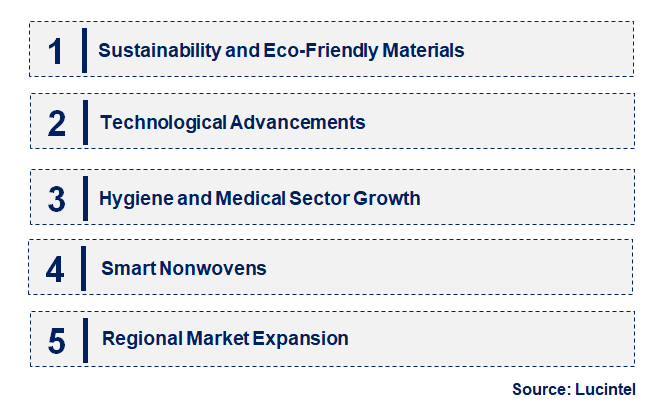
• Sustainability and Eco-Friendly Materials: Consumers increasingly require more sustainable products. Manufacturers are working on biodegradable and recycled materials. With the rising sustainability focus in the market, companies are increasing their use of sustainable materials to improve brand reputation and attract eco-conscious consumers.
• Technological Advancements: Technologies related to production, such as spun bond, melt blown, and carded processes, improve the quality and performance of nonwoven fabrics. This leads to an increase in the use of nonwovens in various applications across different sectors such as healthcare, automotive, and construction, which drives market growth.
• Hygiene and Medical Sector Growth: Especially after the pandemic, the demand for hygiene and medical applications of nonwovens has increased significantly. Surgical masks, gowns, and hygiene pads made from nonwoven fabrics are gaining a lot of popularity. This trend continues in the era of chronic health threats.
• Smart Nonwovens: Interest in smart nonwovens, sometimes called functional nonwovens, which add functionality like antimicrobial or moisture management properties, is growing. These may have applications in specialized segments, such as healthcare or personal care, and therefore hold value for manufacturers willing to differentiate their offerings.
• Regional Market Expansion: Nonwoven fabrics are in growing demand, particularly in Asia and Africa, where industrialization is increasing. The growth opportunity is significant for manufacturers willing to invest in local production and supply chains to fulfill regional requirements. This is going to alter the dynamics and shape the nonwoven fabric industry. More attention is being paid to sustainability, innovation, and flexibility. Companies that strategically balance these trends can gain competitive advantages and open up new access to market shares.
• Increased Production Capacity: Manufacturers are expanding their manufacturing sites as the demand for nonwoven material increases globally, especially in the hygiene and medical fields. Productivity and quality are upgraded through the implementation of advanced machines and technology.
• Eco-Friendly Product Lines: Companies are launching increasing numbers of eco-friendly product lines made from recycled or biodegradable materials. With consumer demand on the rise for eco-friendly products, this is a key development in alignment with global sustainability goals.
• Smart Nonwoven Fabric Innovation: The market is seeing innovations in smart nonwoven fabrics, such as feature-based products containing antimicrobial agents and moisture-wicking properties. These advanced products have specialized applications mainly in healthcare and personal care.
• Strategic Partnerships: Companies are teaming up with research institutions to enhance innovation in nonwoven technologies. The collaboration aims at developing new applications and enhancing the performance of existing products to ensure that the products resulting from these partnerships remain competitive in the market.
• Regulatory Compliance and Standards: As health and safety regulations rise, manufacturers are emphasizing higher criteria to conform to rigid quality standards. These strict standards ensure that nonwoven products meet the right certifications for critical applications, especially in the healthcare or hygiene sectors. These developments are significantly influencing the nonwoven fabric market due to advancements in innovation, improvements in production capabilities, and scope for sustainability. Companies that embrace these changes have a great opportunity to succeed in this market.
• Hygiene Products: The hygienic products industry, which includes diapers and female personal care products, has growth prospects. Due to increased awareness of health and hygiene, manufacturers can innovate new nonwoven solutions that are comfortable and high-performing to gain a greater share of the market.
• Medical Applications: The growing demand for PPE and medical textiles presents significant growth potential for nonwovens in the healthcare sector. Companies could focus on producing nonwovens for surgical masks, gowns, and other medical applications, ensuring regulatory compliance while also fulfilling urgent consumer requirements.
• Automotive Sector: The automotive industry increasingly uses nonwovens for interior applications, particularly for soundproofing and insulation. Manufacturers can enter this emerging market by creating lightweight yet strong and aesthetically appealing nonwovens.
• Geotextiles: Applications of nonwoven geotextiles in construction and landscaping, especially for soil stabilization and erosion control, are gaining momentum. Companies can enter this niche by developing specialized nonwoven products that meet industry requirements and set higher standards.
• Filtration Applications: There is growing demand for clean air and water purification systems through high-efficiency filtration products. The application of nonwoven fabrics is ideal here. Companies can aggressively innovate and develop advanced filtration solutions with a constant focus on both industrial and consumer markets. These strategic growth opportunities demonstrate the potential of nonwoven fabrics across a range of applications. Companies that aggressively pursue these opportunities will improve their market position and ensure sustainable growth.
• Increasing Demand from Various Industries: Rising demand is reported across various end applications, such as hygiene, medical, and automotive sectors, supporting market growth. The versatility and cost-effectiveness of nonwoven fabrics make them increasingly sought after by industries.
• Technology: Innovative advances in manufacturing technologies, such as spun bond and melt blown processes, make nonwoven fabrics more efficient and quality-oriented. This propels the demand for performance-oriented materials with defined applications.
• Sustainability Focus: As consumer demand and regulations grow, the market is likely to shift toward greener products. Manufacturers of products that embrace sustainable practices or have sustainable material usage gain a competitive advantage. In fact, there are few eco-friendly consumers who do not support green products.
• Health and Safety Issues: Awareness of health and hygiene, resulting from the COVID-19 pandemic, has led to a rise in demand for nonwovens in medical and hygiene applications. This trend will continue as consumers remain conscious of these issues.
• Accelerated Industrialization in Emerging Markets: Rapid industrial growth in developing economies will provide the largest opportunities for nonwoven fabric manufacturers. Companies should target these markets to capitalize on the increasing demand for sustainable, innovative nonwoven solutions. Challenges in the nonwoven fabric market are:
• Raw Material Price Fluctuations: Raw material price variations may lead to changes in production costs and profit margins. Manufacturers must develop strategies to manage these fluctuations so that they do not negatively affect the market.
• Competition from Substitute Materials: Alternatives like woven and knitted fibers pose a threat to the nonwoven fabric market. There is a need for clear differentiation and uniqueness in their applications.
• Compliance with Regulations: Mandatory compliance with revised regulatory requirements is a major cost for manufacturers. Research and development, as well as quality assurance processes, are needed to meet health and safety regulations, which also strain resources. The various drivers and challenges have a significant impact on the nonwoven fabric market. Stakeholders who effectively utilize opportunities while addressing challenges are better positioned to thrive in this dynamic environment.
• Ahlstrom-Munksjo
• Berry Global
• Glatfelter
• DuPont
• Lydall
• Fitesa
• TWE
• PP
• PE
• PET
• Wood pulp
• Rayon
• Others
• Disposable
• Non-Disposable
• Spunbond
• Wet Laid
• Dry Laid
• Others
• Hygiene
• Medical
• Filtration
• Automotive
• Consumer Products
• Building & Construction
• Others
• North America
• Europe
• Asia Pacific
• The Rest of the World
• United States: The nonwoven fabric market is booming in the United States, especially in healthcare and hygiene products due to the COVID-19 pandemic. Manufacturers are investing in advanced production technologies like spun bond and melt blown processes to improve fabric quality. In line with the growing sustainability focus, the use of biodegradable materials is also increasing as consumers demand environmentally friendly products. Governmental initiatives promoting the adoption of medical-grade nonwovens are enhancing innovation and business opportunities.
• China: China is the largest supplier of nonwoven fabric in the global market, primarily due to rapid industrial development and increased manufacturing capacity. China has been producing nonwovens in high volumes for PPE and hygiene applications. The government supports innovation by providing subsidies and fostering technological development, resulting in higher-quality and more efficient products. Additionally, sustainable material adoption is being observed, with local manufacturers focusing on bio-based fibers and recycling initiatives to meet both domestic and global market demands.
• Germany: As a European leader in nonwoven technology and sustainability, recent developments include high-quality fiber production and finishing processes that enhance the strength and functionality of nonwoven fabrics. Products oriented toward environmental responsiveness are leading in the market, particularly those following circular economy principles. Collaboration between industry players and research institutions is also driving innovation, especially in automotive and construction applications. Strict health and safety regulations are reflected in the demand for high-quality nonwovens.
• India: India's nonwoven fabric market is growing rapidly due to rising demand from the hygiene, medical, and automotive sectors. The government's "Make in India" policy encourages local production and attracts foreign investments, providing opportunities for higher-quality and cost-effective nonwoven products. In the region, innovations related to biodegradable fabrics are gaining significant interest, with consumers becoming more eco-conscious. Furthermore, India is witnessing a shift in demand towards sustainable solutions, presenting an opportunity for manufacturers that produce recyclable nonwoven materials.
• Japan: Japan is making strides in developing advanced nonwoven materials, particularly for medical and automotive applications. High standards for quality and durability continue to drive market growth. The country's focus on innovations such as moisture management properties, anti-bacterial technologies, and specialized industrial nonwovens makes it a competitive hub for high-end nonwoven fabrics.


• Ahlstrom-Munksjo
• Berry Global
• Glatfelter
• DuPont
• Lydall
• Fitesa
• TWE Q5. Which nonwoven fabric market segment will be the largest in future? Answer: Lucintel forecasts that spunbond is expected to witness the highest growth over the forecast period due to growing in the demand for these spunbond nonwovens across various applications. Q6. In nonwoven fabric market, which region is expected to be the largest in next 6 years? Answer: APAC is expected to witness highest growth over the forecast period due to improving global economy, expanding working population, increasing domestic demand for hygiene products. Q.7 Do we receive customization in this report? Answer: Yes, Lucintel provides 10% customization without any additional cost.


Choose a license that fits your team. Instant PDF delivery.
Prices exclude taxes. Instant delivery. Custom licensing available on request.
Market Report · May 18, 2026
Market Report · May 18, 2026
Market Report · May 18, 2026
Trusted partner for strategic intelligence and business growth


Receive a complimentary market analysis tailored to your industry. Our analysts will identify key growth opportunities and competitive dynamics specific to your business.

Market size, growth rate, and key trend analysis for your specific sector.

Top competitor positioning and market share analysis.

Strategic recommendations backed by data-driven insights.
Get curated market intelligence and competitive moves straight to your inbox.
By subscribing, you agree to receive our monthly insights. Unsubscribe anytime.
Receive a complimentary market analysis tailored to your industry. Our analysts will identify key growth opportunities and competitive dynamics specific to your business.
Market size, growth rate, and key trend analysis for your specific sector.
Top competitor positioning and market share analysis.
Strategic recommendations backed by data-driven insights.
Get curated market intelligence, emerging trends, and competitive moves straight to your inbox each month.
By subscribing, you agree to receive our monthly insights. Unsubscribe anytime.
We'll send your sample report shortly.