
Market Report · May 16, 2026

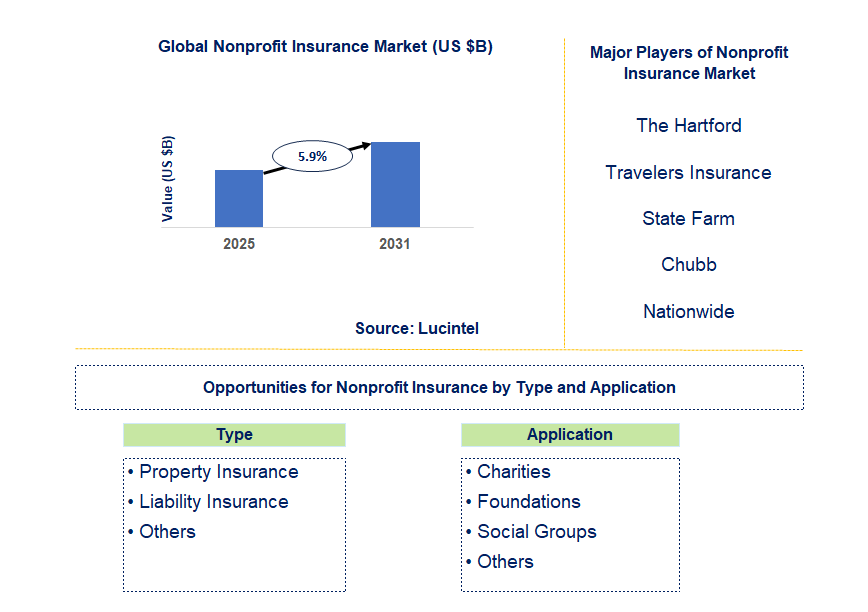
Key data points: The growth forecast = 5.9% annually for the next 7 years. Scroll below to get more insights. This market report covers Trends, opportunities and forecasts in nonprofit insurance market to 2031 by type (property insurance, liability insurance, and others), application (charities, foundations, social groups, and others), and region (North America, Europe, Asia Pacific, and the Rest of the World)
We'll send your sample report shortly.
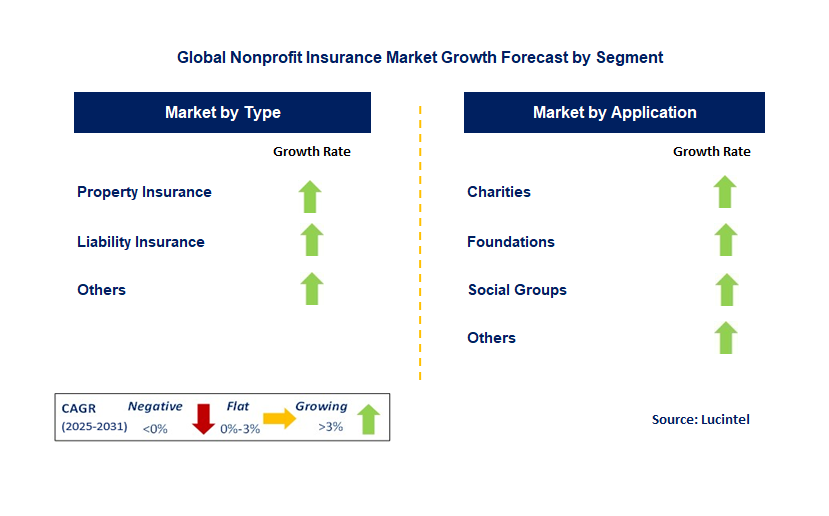
• Lucintel forecasts that, within the type category, liability insurance is expected to witness higher growth over the forecast period.
• Within the application category, charity is expected to witness the highest growth.
• In terms of region, North America is expected to witness the highest growth over the forecast period.
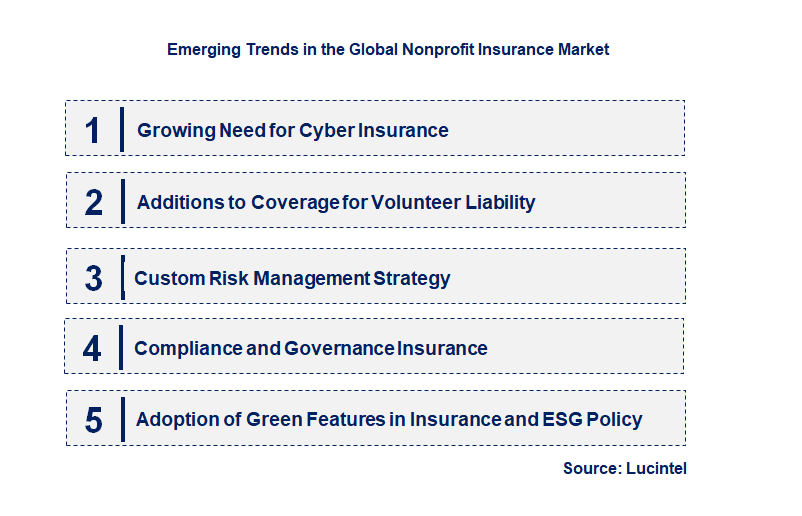
• Growing Need for Cyber Insurance: Nonprofits are moving toward digital operations and managing data files, increasing the need for cyber insurance. Donor information, financial details, and personal records dominate every nonprofit, making it a jewel for cyberattacks. Cyber insurance policies are now being crafted to avert the repercussions of data breach hacking and ransomware attacks. This offer aids nonprofits to avert spending issues and save their reputation. Nonprofits are becoming more reliant on technology and cyber-attacks pose great risks to their uninterrupted operations. This shift is prompting insurers to provide unique, tailored coverage suited for nonprofit organizations.
• Additions to Coverage for Volunteer Liability: Volunteer work has always been an integral part of the nonprofit sector, rigidifying their hands with boundless liability risks. The cover is increasingly being introduced to protect an organization from legal action due to accident injury or illness suffered by a volunteer. This trend helps nonprofits encourages volunteers whilst mitigating the risk of employing individuals who work in high-risk areas. As the sector intensifies reliance on volunteers for critical work, this trend is helping sustain organizational operations while protecting their employees.
• Custom Risk Management Strategy: Nonprofits are now focusing on purchasing insurance policies that include customized risk management strategies specifically suited to their challenges. Fraud coverage, disaster recovery, reputation protection, and a myriad of other areas are now receiving more specialized attention from insurers as they offer innovative products that extend beyond conventional coverage. Tailored risk management services are assisting nonprofits in assessing, managing, and claim mitigation through effective vulnerability identification processes. Such tailored services are enabling nonprofit organizations to manage their operational complexities more effectively while ensuring appropriate insurance coverage.
• Compliance and Governance Insurance: Nonprofits have to deal with ever-increasing regulations from different authorities worldwide. There is an emerging need for insurance policies that enable an organization to comply with local and international laws. Nonprofits have to look for coverage that protects them against possible violations of tax, employment, or even environmental laws. Such gaps in coverage are pushing insurers to come up with products that enable nonprofits to meet their legal and asset protection obligations. Compliance coverage is quickly becoming a standard part of the region’s nonprofit insurance packages in areas that have intricate regulatory frameworks.
• Adoption of Green Features in Insurance and ESG Policy: With growing concern for issues involving the environment, social welfare, or governance (ESG) policies, nonprofits are adopting insurance policies that consider their social and environmental impact. Insurers are now offering green policies which cover environment-related risks including natural disasters, climate catastrophes, and pollution. These policies aid the non-profit organizations in losing assets while countering their ESG values. There is a growing demand for ESG insurance because non-profit organizations are assuming greater responsibility for social concerns, and insurers are advancing to provide services to nonprofits focused on social and environmental change. Such developments are driving changes in the nonprofit insurance market with innovations aimed at creating tailored products for enhanced risk management encountered by nonprofits. Fulfilling their mission with these services becomes operationally sustainable and helps reduce the cost of maintaining their assets and protecting them from possible threats.
• New Cybersecurity Insurance Policy Tailored for Nonprofit: Nonprofits cyber risks also rank among the top issues for consideration because they deal with a significant volume of sensitive personal and financial data. As a result, nonprofits have begun to receive specialized marketing cyber insurance coverages. Such policies protect firms against data breaches, cyberattacks, and hacking, which is critical for organizations that lack the financial resources to enact stringent cybersecurity protocols. These policies are enabling nonprofits to protect themselves from the risks arising from digital business processes including compliance risks, and protecting them from the legal ramifications of non compliance with data protection laws.
• Natural Disaster Coverage Expansion: Nonprofit organizations, particularly those in disaster relief and recovery, are progressively becoming affected by floods, hurricanes, and wildlife fires. In response, many insurance companies are expanding coverage options that address these risks by providing policies that ensure the protection of nonprofit assets and operations in the event of a disaster. This allows nonprofits to continue their refrain operations and assist communities suffering from the impact of financial collapse due to natural disasters. With climate change enhancing the frequency and intensity of natural disasters, this trend is gaining attention.
• Sponsorship Liability Policies Designed for Other : With a limited budget, most small nonprofits, make it harder for these organizations to obtain complete insurance coverage. Insurers are developing lower-priced liability insurance products focused on young nonprofits to fill this gap. Small nonprofits can function without the fear of financial devastation from unforeseen circumstances like volunteer liability claims, accidents, and general liability with the protection offered by these policies. This change enables smaller nonprofits to defend their endeavors while remaining cost-effective, showing a positive change in the insurance access landscape.
• Rise of Tailored Health and Workers : Nonprofits, particularly in social services and healthcare, are implementing tailored health and workers’ compensation insurance policies to safeguard their employees and even volunteers. These policies tackle the specific issues that impact nonprofit workers, such as mental health challenges, injuries at work, and burnout. Health insurers are working alongside nonprofit organizations to develop comprehensive health insurance policies that support workforce wellness while enabling organizations to meet contractual obligations regarding labor compliance.
• Greater Attention to Nonprofit D&O Liability Insurance: Nonprofit organizations are proactively addressing the need for Directors and Officers (D&O) liability insurance by focusing on protecting their leadership teams from possible lawsuits. D&O coverage is becoming increasingly necessary to protect board members and organizational executives from incurring personal financial liabilities due to heightened scrutiny relating to the governance and management of nonprofit entities. This growing need is often associated with increased litigation and regulatory scrutiny that seek to address gaps in these policies, enabling nonprofit leaders to continue their efforts with minimal legal concerns. These changes illustrate the deepening intricacy and specialization of the nonprofit insurance market. Nonprofit associations are undergoing transformative changes, and their insurance providers are crafting more sophisticated solutions to help them effectively manage risks and sustain their operations.
• Volunteer Based Organizations Need Specialized Insurance Policy: Due to the increasing popularity of volunteer-driven organizations, the need for specialized volunteer liability insurance is growing. Insurers can take advantage of this opportunity by providing volunteer policies that defend participants from sustaining injuries or accidents while rendering service. This is especially true for nonprofits in disaster relief, healthcare, and educational sectors where volunteers are crucial to organizational success. Volunteer based nonprofits would greatly benefit from having their insurance broadened and in turn help unsponsored volunteers receive crucial protection.
• Designing Cyber Risk Solutions for Small and Medium Nonprofit Organization: Due to a cyber attack’s low cost and high chance for success, small and mid-sized nonprofits become easy prey due to their cyber deficiency. These organizations do not have the financial muscle to combat aggressive cyber issues. If insurers offer lower-cost and easier-to-access cyber risk tools specific to small nonprofits, they would be able to mitigate their risk of data breaches, ransomware attacks, and other cyber incidents that can cripple entities dealing with sensitive information. Insurers would be able to serve an underserved market that has grave financial needs as there is a growing focus on cybersecurity challenges facing the nonprofit sector.
• Designing Green Insurance Policies for Environmental Nonprofit: Green insurance policies and products are in high demand from environmental nonprofits that greatly value sustainability. Insurers have an opportunity to create policies that cover organizations involved in conservation, renewable energy, and climate action with protection against pollution, damage to the environment, and other climate calamities. Tailoring green insurance products can not only help insurers greatly expand their markets but helps environmental nonprofits achieve their advanced risk mitigation towards solving sustainable development goals.
• Healthcare Nonprofit Workers Compensation Expansion: Healthcare Nonprofits face unique risks, such as dealing with infectious diseases and various workplace injuries. Insurers have a gap in the market which can be catered to by giving these organizations specialized workers’ compensation policies that directly address their potential threats. Such a policy should include coverage for healthcare workers, volunteers, and medical contractors, so that non-profit organizations can render critical services without endangering their employees. Addressing the needs of healthcare non-profits by broadening workers' compensation policies is beneficial because such organizations have an increasing demand for services.
• Increase Strain Nonprofit Board Governance With D&O Insurance: Tighter regulation on nonprofit governance opens up opportunities in the market for better D&O liability insurance policies which serve to protect members of the board from facing legal repercussions. Nonprofits that want to protect their leadership from falling into reputation-shattering situations can have targeted solutions. With the increasing complexity of the nonprofit sector, a robust insurance policy will serve as the primary path to growth, especially in highly regulated areas, for insurers focusing on charities that need basic and extensive governance. These specific opportunities reveal how insurers have the potential to deepen their service scope, customize their products, and more proactively meet the requirements of nonprofit organizations. If insurers leverage these opportunities, they will be seen as strategic allies in the nonprofit market who assist nonprofits in safeguarding the mission and managing risks effectively.
• The Hartford
• Travelers Insurance
• State Farm
• Chubb
• Nationwide
• Sentry Insurance
• Liberty Mutual
• Zurich Insurance
• Allianz
• EMC Insurance
• Property Insurance
• Liability Insurance
• Others
• Charities
• Foundations
• Social Groups
• Others
• North America
• Europe
• Asia Pacific
• The Rest of the World
• United States: In the United States, there is more focus on specific coverage insurance as integrated policies now dominate the nonprofit sector. Insurance companies are formulating specialized policies pertaining to nonprofit exposures such as D&O liability, cyber liability, and workers’ compensation. Available digital tools and platforms have further enhanced self-service claims and policy adjustment submission. Moreover, nonprofits are shifting their focus towards active risk management, and insurers are beginning to aid these nonprofits in developing strategies to reduce risk exposure. Finally, there is a growing need for post-pandemic unemployed insurance schemes that take incorporate the strategic intricacies of operating a nonprofit.
• China: The nonprofit segment is growing at a relatively swift pace in China, notably in education, health, and environmental service. With growth in the nonprofit sector, there is an emerging demand for comprehensive insurance packages such as employee benefits and liability insurance. There is also a shift in China towards greater regulation of nonprofit organizations, with greater focus on enforcement of compliance and transparency. This has led to information and communication technology non-governmental organizations (NGOs) and social service NGOs that take on public welfare adopting advanced practices being offered by the insurance market such as governance, financial operation, harm, and sensitive data breach protection, all requiring sophisticated coverage solutions.
• Germany: Germany's nonprofit domain is expanding in relation to social services, healthcare, and environmental protection. Additionally, there is increasing demand for insurance catering to nonprofit-specific liability, workers' compensation, and property damage risks. German insurers are now providing volunteer coverage and climate-related asset protection along with specialty policies. Moreover, the regulatory compliance burden for nonprofits in Germany is increasing, compelling insurers to develop more governance, risk, and compliance policies. This shift in policy is helping to encourage more nonprofits to acquire insurance to better guard their operations and financial resources.
• India: The growth of India's nonprofit insurance sector correlates with the expanding healthcare, education, and rural development sectors. The country’s legislative framework is evolving which has fueled demand for dedicated insurance products. Some Indian insurers are providing adequate non-profit solutions such as comprehensive risk management, fraud, and cyber insurance. The increased use of digital technology and the migration to online insurance management platforms is also influencing the market. Alongside this shift, there is growing need for operational and natural disaster insurance to cover associated risks.
• Japan: Japan is witnessing changes in the environmental governance components within the nonprofit sector. Nonprofit organizations in Japan are undergoing intense regulatory scrutiny regarding compliance verification associated with domestic and international frameworks, particularly in relation to risks. Insurers are responding by developing financing for environmental liabilities, volunteer cyberattacks, and even volunteer cyberattacks or saboteurs. There is also a growing attention towards insurance for nonprofits engaged in disaster relief and recovery in Japan, and the policies are beginning to be adapted to the peculiarities of these operations. The Japanese nonprofit sector is increasingly aware of the need for integrated risk management frameworks.


• The Hartford
• Travelers Insurance
• State Farm
• Chubb
• Nationwide
• Sentry Insurance
• Liberty Mutual
• Zurich Insurance
• Allianz
• EMC Insurance Q5. Which nonprofit insurance market segment will be the largest in future? Answer: Lucintel forecasts that, within the type category, liability insurance is expected to witness higher growth over the forecast period. Q6. In nonprofit insurance market, which region is expected to be the largest in next 5 years? Answer: In terms of region, North America is expected to witness the highest growth over the forecast period. Q7. Do we receive customization in this report? Answer: Yes, Lucintel provides 10% customization without any additional cost.


Choose a license that fits your team. Instant PDF delivery.
Prices exclude taxes. Instant delivery. Custom licensing available on request.
Market Report · May 16, 2026
Market Report · May 16, 2026
Market Report · May 16, 2026
Trusted partner for strategic intelligence and business growth


Receive a complimentary market analysis tailored to your industry. Our analysts will identify key growth opportunities and competitive dynamics specific to your business.

Market size, growth rate, and key trend analysis for your specific sector.

Top competitor positioning and market share analysis.

Strategic recommendations backed by data-driven insights.
Get curated market intelligence and competitive moves straight to your inbox.
By subscribing, you agree to receive our monthly insights. Unsubscribe anytime.
Receive a complimentary market analysis tailored to your industry. Our analysts will identify key growth opportunities and competitive dynamics specific to your business.
Market size, growth rate, and key trend analysis for your specific sector.
Top competitor positioning and market share analysis.
Strategic recommendations backed by data-driven insights.
Get curated market intelligence, emerging trends, and competitive moves straight to your inbox each month.
By subscribing, you agree to receive our monthly insights. Unsubscribe anytime.
We'll send your sample report shortly.